 Skip to content

Dying in Toronto
Daša Drndić
(Istros Books, 2026)
There is an anecdote halfway through Dying in Toronto, Daša Drndić’s (1946-2018) account of her life as a refugee in Canada in the mid-1990s, which illustrates the absurd dilemma many found themselves in after the break-up of the former Yugoslavia. In the University of Toronto, at the time, Croatian and Serbian students were physically separated at the behest of their parents. This was the solution to growing tensions: the classroom was divided, a border was drawn. Though the languages share more similarities than they do differences, the professor wrote in Latin script with his left hand for the Croatian students and in Cyrillic script with his right hand for the Serbian students. Serbo-Croat, the official language of Yugoslavia until 1992 and understood by all, had now become something else. It had become a problem.
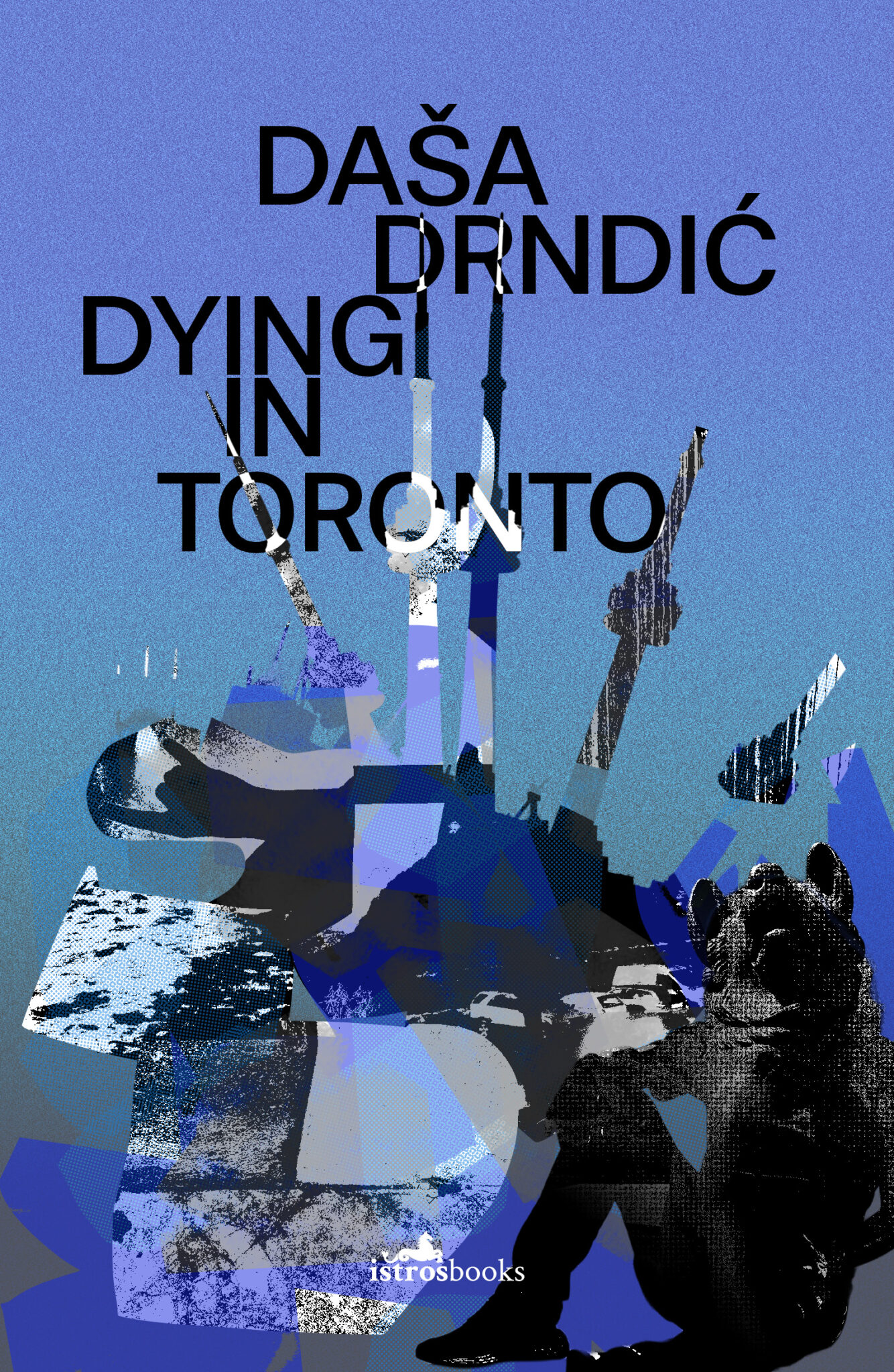
Daša Drndić did not die in Toronto: the book was originally published as Umiranje u Torontu in 1997, the year of Drndić’s return to Croatia. It has now been newly translated into English by Celia Hawkesworth. Dying in Toronto is an exploration of the problem of this sudden split from the inside out. Drndić writes as someone who encountered the chasm in her day-to-day life, but who refused to accept it. Presented as a collection of essays that touch on topics as varied as chestnuts, pet hamsters, translation, war and poverty, and interspersed with Canadian news items that often sound dire or unflattering (the first one reports the murder of a Macedonian man by a masked figure who somehow escaped arrest), they never stray far from their object: countries, nations, both familiar and strange. It is a lively account, briskly told, and entirely untainted by praise.
Canada, she writes, is « a land of infinite order », « a land of computers » and « computerised people ». Canadians themselves are « good-natured, inquisitive people » who « like researching ». They go to different restaurants and get to know « faraway lands » so that « nothing is strange to them ». The wind in Canada blows from behind, pushes her hair into her face and drives her crazy. Toronto, a city of « enclaves » and « parks », encroaches on her with a rapacious appetite. Her fears of assimilation are projected onto the city, transforming it into an impersonal, aggressively capitalist nightmare. She describes the underground railway system as both a symbol of Toronto and a « terrifying phenomenon » because it reveals, in its snaking, sprawling complexity, how vast and apparently unknowable the city is. « In the underground carriages an unnatural silence reigns, » she writes. « It’s the silence of those who have no choice. » Writing, then, is a way to break that silence. These essays, from someone with « no choice », are perhaps a way of reclaiming some agency lost in transit, a way of offering her own perspective of a city that seems eager to sweep her into statistical anonymity.
This article is behind the paywall. Want to keep reading this article?
Subscribe to the European Review of Books, from as low as €5,00 per month.
Already a subscriber? Sign in