 Skip to content

The ERB is reading the 2026 World Cup and offering daily dispatches, in collaboration with Hazar Deniz Eker and Sander Pleij (one is losing his belief in football, and the other is mesmerized by it; it’s up to you, dear reader, to guess which is which), and others.
Subscribe here for 39 days of daily dispatches
UPDATES:
Day 39 | 19 Jul 21:07 CEST
Hazar Deniz Eker
Fait Divers
Exactly 39 days ago, we hailed the arrival of yet another World Cup induced « collective suspension of disbelief. » Since then, we’ve read the world’s largest cultural commodity as it unfolded across 103 matches, number 104 is yet to be played…
International football has always been a proxy for nationalist ambitions. It’s an anxiety-inducing expectation, one that caused acclaimed Korean director Park Chan-wook panic (day 2), as he sinned and betrayed his nation (he didn’t care for football).
But how much hope should one put in a footballer? Why is it that this highly elitist, commercialised sport and its distant players have become such strong representations of the masses?
I don’t know, let’s ask telecommunications giant Orange! « We became a nation that has traded its dreams for manufactured illusions, » wrote artist Bahia Shebab, whose analysis of Orange advertisements for this World Cup in Egypt we featured back on day 12. Egypt’s modern identity hasn’t just been reflected in commercialisation, but actively shaped by it. « As apothecaries became pharmacies, healers became doctors, blond became more beautiful than brown, some notions of who we are were lost. »
Who does get to define the image of a nation? Orange and Egypt offer one answer, France another. 99 players in this competition were born in France, playing for their country of birth, as well as Tunisia, Haiti, Senegal, Morocco, Algeria, and Cote d’Ivoire. No World Cup featured more diasporic players. This diversity is no accident, but an admission that what constitutes national belonging is more complicated than what some might have you believe, as we cover on day 34 with Mbappe in France, day 29 with the Moroccan team, or day 18, with an Algerian football team that predates its own state.
Yet glaringly present in opposition to this unavoidable diversity was of course, none other than the competitions host.
Set mostly in Trump’s America, the President’s presence was palpable on and off the pitch. On day 3 we explored how the United States’ missed out on soccer in its early days of nation-building, on day 14 we witnessed how profit and transhuman dreams change the role of athletes, on day 17 we reminded ourselves why a tie, even in the country of winners and losers, is important, and on day 30 we revelled in the satisfying self-implosion of the American soccer dream after the President pulled himself up by his own bootstraps to intervene. It didn’t work.
Blocking the American Dream was none other than a nation known best for carbs and the statue of a peeing boy. On day 6 we questioned, justifiably, whether Belgium exists at all, drifting into the depths of a local grotesque in which a goalie puts his head on the line, only to become the ball himself. What does it mean, we wondered, only to fall deeper into the rabbit hole of football(s) as literary devices (day 10). Eventually, we received a glaringly clear answer by a procession of Dadaists in 1919: times of intense cultural and political chaos can leave you confused, just “don’t let yourself get kicked around by others, kick your own football, don’t get kicked.”
Good advice, but some couldn’t afford to follow it. Starting on day 7, we’ve written on England’s battle against fate throughout the competition. Facing seismic and comically unfortunate circumstances in their training facilities, the players entered the competition looking strong, only to be reminded of not one, but two curses levied against them (day 7, 15, 22, and 31). Both have proven frustratingly successful.
Hmmm, what else? Players have become (sexy) deities, should we be concerned (day 8 and 16)? Norway left it in cruise control, a reminder that we should all take it easy (day 31)? A German broadcast left me sleepy – I want more drama (day 9)! Penalties could be so much easier if we tried (day 25), and football’s morality, borrowing terms from Islam, is still a bit confused as to what constitutes good and evil (day 21).
All of which brings us to today.
Flash floods and tropical thunderstorms have brought chaos over New York City. An orange tint, caused by an influx of smoke from wildfires in Canada, adds to an apocalyptic atmosphere. It makes it difficult to ignore, to suspend our disbelief one more time, but perhaps we never did.
Reading football challenges what we set out all the way back in day 1: suspending our disbelief, seeing the game as nothing but a game, won’t work if you peek behind its shallow curtain. As we said in citing Simon Kuper on day 34, « Football is not football. »
Recommending reading
Identity and nationalism
Cultural commentary on the sport/sports history
Day 35: Hand of god
Day 34: French identity, and Mbappé
Day 31: Norwegian ease vs English chaos
Day 30: Ceci n’est pas un match
Day 29: Moroccans of the world
Day 27: Barbiiii Markovic
Day 26: Just asking questions
Day 25: Cortex interruptus
Day 24: French philosophy (Maignan)
Day 23: The last Yugoslav footballers
Day 22: Es Posible
Day 21: Moral relativism of haramball
Day 20: Jedermann sein eigner fusball
Day 19: The migrant cup
Day 18: Revenge for Gijon
Day 17: All tied
Day 16: Virility van Dijk
Day 15: The man who cursed Harry Kane
Day 14: Everybody hates hydration breaks
Day 13: Resurrected for ninety minutes
Day 12: Egypt never lasts that long
Day 11: They took our staches
Day 10: You base football players
Day 9: We need more drama (broacast)
Day 8: In the beginning was the island (Madeira)
Day 7: It ain’t coming home
Day 6: Absurd absurdism (Belgium, ball for a head)
Day 5: Return either a veteran or a martyr
Day 4: Happiness of Vinicius
Dat 3: Soccer in a footbal world
Day 2: The sin of not liking soccer
Day 1: The ultimate commodity

Day 38 | 18 Jul 18:20 CEST
Hazar Deniz Eker
Who cares about finishing third?
« That match for third place should never be played. It has nothing to do with top-level sport, » Dutch coach Louis van Gaal felt almost insulted by the notion that he should care about the third-place game at the 2014 World Cup. The Netherlands was stopped short of achieving their run to the final by Argentina and were now supposed to face a decimated Brazil side who had conceded seven goals to Germany.
Neither the Netherlands, nor Brazil, wanted to be there.
Twelve years later and the mood for tonight’s game for third place, or the « Bronze final » as FIFA dubbed it, is arguably even lower. For the first time in the competition’s history, the four teams who qualified for the semifinals happened to be the four best-ranked teams in the world – meaning that whoever lost would have felt that a Bronze final is little more than an exhausting insult. « None of our players and none of the French players want to play this match, » England’s coach Thomas Tuchel explained after losing to Argentina in the semifinal.
The lack of enthusiasm isn’t entirely universal: to Sweden in 1994 and Turkey in 2002, finishing third meant, by far, the most successful result in the country’s respective footballing histories.
But there is no glory for teams of the calibre of England and France in finishing third.
Take the perennial slogan of the English: « It’s coming home, » a cruel, self-inflicted, and often almost self-deprecating statement, coming from a team that hasn’t really come close to a repeat of their only ever championship in 1966.
Yet what endears so many people to events like the World Cup, is this type of hope: the belief that things might just work out for the team you identify with, no matter the odds. Even if, as is evident in the case of England, what stops their hopes from materializing is so often the team itself. English football has become synonymous with choking – the act of crumbling at the finish line, of harboring better players, tactics, a good coach, only to throw it all away on the final stretch.
In other words, English fans engage in repeated acts of cruel optimism: what you desire becoming the biggest obstacle to your own fulfillment, as cultural theorist Lauren Berlant writes in the book of the same title.
The book explores what happens when the realities of our social and political life in 21st century US and Europe don’t live up to the liberal-democratic ideals we’ve been promised, and believed in. When inspiring candidates disappoint voters after elections, when revolutionary moments turn into stagnant aesthetics, when we work hard and hit the inevitable ceiling of meritocracy, when we search for a “good life” and find disappointment in friends or lovers, or when we make our own success contingent on the performance of a representative, like a footballer, and they fall short.
But what if, there is no promise to begin with? What if you engage in a relation that has no glorified outcome? With the possibility of optimism for once essentially eliminated, perhaps this is the first time in a while we can observe a cultural moment like a World Cup game with no possibility for hope, belief, and cruel disappointment.
Perhaps for the first time in 38 days, we can just watch football.
Day 37 | No matches.
Day 36 | No matches
Day 35 | 15 Jul 19:33 CEST
Hazar Deniz Eker
Hand of God, part 2?
What year, and tournament, is the following sentence describing, 1986, or 2026?
In tonight’s World Cup knock-out game, Argentina face England, in the midst of on-pitch controversy over Argentinians receiving favourable treatment by referees, and off-pitch tensions over a territorial dispute in the Falkland Islands.
The answer is of course, both.
On the pitch, Argentina has been the single most controversial team at this World Cup. An avalanche of conspiracy theories, often hateful ones at that, have flooded social media, questioning at times suspicious refereeing decisions in favour of the 3-time World Cup winners.
Nothing new for Argentina, as their game against England in 1986 saw the most infamous refereeing mishap of all time unfold in real time. With the fresh memory of defeat in the Falkland War reportedly on his mind, Diego Maradona took « symbolic revenge » on the English: Maradona jumped and scored, using his left hand to push the ball in – or as he said, « un poco con la cabeza y un poco con la mano de Dios>> (« a little with Maradona’s head and a little with the hand of God » ).
When asked as to why he did it, Maradona quickly turned to the off-pitch controversy driving the long footballing rivalry.
« We, as Argentinians, didn’t know what the military was up to. » Argentina was fighting England over the Falklands, a dispute that continues to divide the countries to this day. Posters spelling « Las malvinas son argentinas » (« The Falklands are Argentine ») still pop up in crowds at countless games. And more importantly, politicians re-stirred the tensions recently. Argentina’s foreign minister wrote an opinion story last week, calling the pro-UK inhabitants of the Falklands « implanted » people.
But back in the day, Maradona and his team had less access to information, less coherent narratives, and only discovered the truth once they left the country for the World Cup. « They told us that we were winning the war. But in reality, England was winning 20–0. It was tough. The hype [for the soccer game] made it seem like we were going to play out another war. »
Yet, the revenge was improvised.
« I knew it was my hand. It wasn’t my plan but the action happened so fast that the linesman didn’t see me putting my hand in. The referee looked at me and he said: ‘Goal.’ It was a nice feeling like some sort of symbolic revenge against the English. »
Day 34 | 14 Jul 23:20 CEST
Sander Pleij
Adieu, Mbappé
There were plenty of reasons to write about Kylian Mbappé, captain of the French side that faced Spain in the semifinal.
There’s the footballing talent, for starters: what an unpredictable attacker. One moment he accelerates out of nowhere, the next he suddenly slows down, or sidesteps twice and comes free with nobody near him. This tournament he became a true captain: he made his teammates shine, launching them ahead of him, out of his shadow.
But there’s so much more to this man. Take his composed response to the Paraguayan senator who, after France’s win over Paraguay, had this to say:
« Bruto no aprendió ni a escribir, en vez de leche materna chupaba cocos y lo más instruido que escucho eran chimpancés. »
Which translates as: « Brute didn’t even learn to write, instead of mother’s milk he sucked on coconuts, and the most educated thing he heard were chimpanzees. »
Now, she said this on social media to seek attention, but Mbappé gets this thrown at him constantly anyway. Still, his reply had weight:
« Vous êtes une femme méprisable et indigne de sa fonction. Vous ne représentez pas le Paraguay, ce pays qui a transpiré la passion et l’honneur tout au long de la compétition. »
Loosely translated: « You are a contemptible woman, unworthy of her position. You do not represent Paraguay, this country that has exuded passion and honor throughout the competition. » After which he went on, unbothered, to compliment the Paraguayan players.
I’d like to tell you what else makes this man so remarkable. With a champion, it’s always more than what is called instinct. Mbappé grew up among other poor descendants of immigrants in a banlieue and, according to his mother, was different his whole life: by five he already knew the entire Charles Aznavour songbook by heart. Assisted by his mother and a team of women, he invests his money in a number of things: a football club, but also a charity.
But good grief, what a world. Types like the old Spanish prime minister Mariano Rajoy keep coming back to fart on the beautiful wonder of life, that we all share together. In a conservative-Catholic paper he wrote this week about the French players:
« Tiene, además, una plantilla de altísimo nivel. Eso sí, sin franceses. »
« It also has an extremely high-level squad. Except, without any Frenchmen. »
You’d think there’s nothing more motivating than remarks like that. And according to many, there was even more at stake this tournament: next year France holds its elections, and out in front sit the convicted Marine Le Pen and her second-in-command, Jordan Bardella. At the last election, Mbappé called on young people to vote and spoke out against their National Assembly. Plenty of French people believed a World Cup win for this Mbappé-led team could have a genuine effect on multicultural society and on the election itself.
So let’s talk about it, then. « Football is not football, » as the writer Simon Kuper put it in an earlier piece for the ERB. Here’s his piece on his discovery of what football writing could be: https://europeanreviewofbooks.com/football-is-not-football/
In his book World Cup Fever (2025), Kuper reports on the tournaments he’s lived through, this one being his tenth. In 2018, France beat Croatia in Moscow, and a 19-year-old Mbappé scored in the final. After the win, the players wrapped themselves in the French tricolor, and coach Didier Deschamps (yes, same one as now) said: “We love the French, we’re proud to be French, to be Les Bleus. Vive La République!“
But for that chapter of World Cup history, I’d rather point you to Simon Kuper’s indispensable anthropological reading of these tournaments (great book!). Because honestly, I’m getting a little tired of the fact that they’ve managed, once again, to grab my attention. I even found myself hoping France would face Argentina in the final again. They lost that one in 2022, despite a Mbappé hat-trick, after which the Argentinian team bus rang out with a song claiming the French players come from Angola: “they’re just like travestites, like that whore Mbappé.”
They will not play the final. 2 – 0. No Mbappé goal. Sure, Spain won with better tactics, but why were so many individual errors made as well, by the French. What happened?
Let’s not end there. Let’s end instead on the image we know best: Mbappé, that brave man, spotting a cluster of two, three, four defenders standing between him and the goal, then diving straight into the group, disappearing for a moment and, somehow, popping out the other side, ball at his feet, or already in the net.
Day 33 | No matches
Day 32 | No matches
Day 31 | 11 Jul 18:20 CEST
Hazar Deniz Eker
« It’s not supposed to be easy »
Norwegian star striker Erling Haaland walked down the pitch, relaxed, as if on a Sunday stroll through Oslo as everything around him was in motion: on the left flank, teammate Andreas Schjelderup ran past a few Brazilian defenders. All eyes were on him. Haaland watched. Suddenly the ball came in high, Haaland leaped forward, and headed in a goal. Ten minutes later, he received the ball around the edge of the box, and just shot with a few defenders on him. He scored again. Instead of celebrating a brace against Brazil, he just walked it off, smiling. On the other end, Brazil, the footballing nation, the record-breaking five-time winner of the competition, with a population of 213.6 million people, was distraught. The 5.5 million Norwegians celebrated as if it was a friendly.
Norway is taking it easy, and it’s working: in their first World Cup since 1998, the team looked comfortable. No late drama, no major weaknesses. It felt like so far in the competition, Norway remained in cruising altitude.
This is by design. The world of Norwegian sports recruitment stands out: rather than spotting young prodigies, isolating them in elite football academies to shape new diamonds in the rough like in most countries, the world of Norwegian football is strictly anti-competitive: until a child is 13, it can practice multiple sports, and even if it chooses football, there are no competitions, no leagues, points, tables, relegation and promotion. Just fun. Multiple Norwegian players, including Haaland, practiced skiing, handball, or other sports next to football until committing to it.
Perhaps as far removed as ideologically possible stands their quarter final opponent tonight. England breeds super stars as early as humanly possible, in a league system that is the flagship for competitive football and absurd foreign investment, with a national team that has gone through the single most dramatic journey so far: facing their own age-old failures and comically rare extreme weather events (as we wrote about on day 7), a successful curse against them by a Ghanaian priest (day 15), only to then play at the most overwhelming arena on the planet (day 22), where they barely survived a high-altitude clash, down a man, against all odds.
Yet what makes England’s next opponent daunting is no cosmic intervention, curse, or on-pitch drama, but the inverse attitude: Norway is a team so leisurely confident, so relaxed, that they feel inevitable.
And Norwegians know this too. In a tourism ad for the capital Oslo, a resident takes a camera crew through his life in the city. Picturesque, calm, available, clean, friendly, the ad paints the seemingly perfect Nordic destination against the resident, who feels fed-up with living in paradise. The ad, titled: Is it even a city?, ends with our protagonist describing his city like Haaland would describe the World Cup after leisurely breezing past Brazil: « I think a city [read: the World Cup] should feel a little hard to get. It’s like a good relationship, you know? It’s not supposed to be easy. »
Day 30 | 10 Jul 21:32 CEST
Hazar Deniz Eker
Ceci n’est pas un match
With the Belgian national team, only one thing counts: never count them out.
Over the past week, whatever small remnants of public trust FIFA harboured, gave way to an avalanche of anger and conspiracy — and the sport’s organizing body can only blame itself. After US President Donald Trump personally phoned the FIFA head Gianni Infantino, asking for US striker Balogun’s red card suspension to be reversed, Belgium, up to this point underperforming at the tournament, swept over a deflated American team to win 4-1. Despite playing at home, having good momentum, with their best striker cleared for play and the President’s backing, the Americans crumbled under the pressure. It was, by all means, not supposed to end this way.
One match prior, in the Round of 32, Belgium again defied all logic. Against Senegal, the team looked completely lost for 80 minutes. At a fan bar in Brussels where I followed the game, audiences cursed the players and the coach, not understanding where the team’s odd passivity came from. Minutes later, they had equalized. A few more nerve-racking minutes after that and the team had won their match.
Belgium has been in the conversation to be a contender for years, always falling short at the final hurdles. This year, the now tiring promises of a « dark horse » run weren’t even present in the capital. It felt as if the whole country entered a period of complicity.
Maybe it is this lack of expectation that made this team’s trajectory so surprising. Dribbling past challenges both on the field, off the field and in the White House, Belgium continues winning — all the while wearing their blue/red away jersey: an hommage to Belgian surrealist René Magritte. The secret to the team’s relative success so far is ingrained on the shirt itself: «Ceci n’est pas un maillot » (This is not a jersey), meaning that you shouldn’t let yourself be deceived by what you see, an image is just an image. Reality often pans out differently than expected.
Day 29 | 9 Jul 18:48 CEST
Hazar Deniz Eker
Moroccans of the world
« In 1976, a decree authorized family reunification. […] Since then, immigration has escaped all regulation, » reads a 2022 booklet of the French far-right National Rally party. Its leader, Marine Le Pen, would love to scrap the law, which has since accelerated France’s multicultural society: over 10% of the French population was born abroad.
Migration, of course shows the most in France’s flagship national project: its football team. Out of the 26-man squad competing in tonight’s quarterfinals game at the World Cup, 16 are either migrants or children of migrants.
This puts Le Pen in a pickle: Looking to favour « French French » citizens under her national preference policy, the 26-man squad would be reduced to 10, maybe coach Didier Deschamps can help out in the goal? Of course there’s also the option of supporting the opposition, which in this case is none other than Morocco.
The Atlas Tigers join Algeria, Tunisia, Senegal, Côte d’Ivoire and Haiti as nations that were once French colonies and have since composed their teams with players from the diaspora: 99 players at this World Cup were born in France, 55 of them in the greater Paris region alone, just 12 of those chose to play for the French team.
Why players chose to represent their country of birth or origin changes from case to case: some, like Morocco’s Ayyoub Bouaddi, played for France’s U21, then switched to Morocco. Brahim Diaz, born in Spain to a Moroccan parent, said he feels 100% Spanish and 100% Moroccan. Haiti’s team was outspoken about the country’s ongoing troubles, while most players never even lived there.
But maybe the simplest answer is a change of direction. In an essay on the Moroccan national team, Aomar Boum and Brahim El Guabli write:
« Both labor and brain drain followed the same pattern. Doctors, soldiers, players, and workers moved from former colonies to the Global North; from the periphery to the metropole. The unspoken truth has nonetheless been that the children of formerly colonized nations should feel blessed for being included in the benefits of European modernity. »
Now, they simply look to move in the other direction. The Moroccan national team is the product of a deliberate effort to attract the diaspora, not only to fill up the team sheet but also to redefine the country’s national identity. Magharibat al-alam, which literally means « Moroccans of the world, » has become a powerful concept that holds more than a descriptive label for the diaspora. It is a strategic category in which emigration serves nation-building and its prestige. While it is mainly visible in football, it operates across various facets of Moroccan life.
And now, the Moroccans of the world were visible to the world: at some point in their game against Brazil, all 11 field players for the team were foreign-born. On Day 29, Morocco plays against the French team. We’ll see players born in France in a Moroccan shirt, players born or with parents from Morocco and other former French colonies, in a French shirt. One thing is certain: Africa will win.
Day 28 | No matches
Day 27 | 6 Jul 23:30 CEST
Sander Pleij
Barbiiiiiiiiiiiiiiiiiiiiiiiii, Barbi Marković, it’s unbelievable
Football nostalgia: spare me. My little club. In the stands with my father. Back when you still had those fat, brown, hand-stitched balls, and the nets were crocheted by housewives. When loyalty was bigger than a tattoo, when big money hadn’t yet corrupted the game and… in football everything used to be even better than it already was everywhere else.
In Piksi-Buch (Voland & Quist, 2024) Barbi Marković runs football romanticism all the way into satire, and the way she uses football-talk to write her satirical memoir is highly entertaining. As a football commentator she comments and praises her writing:
« Beautiful. Beautiful background information. Immediately improves the story. Barbiiiiiiiiiiiiiiiiiiiiiiiii, Barbi Marković, it’s unbelievable, in the first chapter, in the sixth reading-minute, right in the top corner. Nobody will equal this. Well, well. Masterfully written. How beautiful is that?! Barbi Marković, ice-cold. The only one who writes about football differently. Sensational. Magnificent. »
This was printed on exactly the sixth page of text of the slightly-over-ninety-page Dutch translation (I read the Dutch translation, Het laatste team, Koppernik, 2026, and translated these passages from it.) But it soon turns out that Piksi-Buch is not only a wild play with words. It was commissioned as a book about the footballer Dragan Piksi Stojković, due to appear in the Ikonen series of the German publisher Voland & Quist. But we can forget about that Piksi, Marković writes, in the football-commentator register:
« Look how I repeat and enumerate. How I toss in jokes along the way. Look how skillfully I turn something trivial into an image that won’t let you go. That’s because I’ve used doping. That’s why I forget nothing. I know exactly how many layers made up the clotted little remnant of toenail; I remember the facial expressions and the things said, and I make nothing prettier than it is. That’s why I don’t disappear, that’s why I’m so present, even though this story isn’t supposed to be about me but about that one footballer, about Piksi. But you can forget that Piksi of yours. Did anyone really think I’d write a biography of a footballer? Someone who doesn’t know me, perhaps. »
Through these exaggerations the book turns into a satire of the memoir-writers. Very funny, yet slowly it grows clear that all the jokes and the bravado are unable to mask that we’re being served fragments of a hard childhood: a striking, headstrong father, Slobodan, for whom she is not a football son but a football daughter, a family falling apart, a country falling apart. The writer Barbi Marković — call her the anti-sentimentalist — refuses to file personal misery into the compartments of usual phrasings, and it’s only through the exaggeration of the football commentary that grief seeps through. When all falls apart, after the ninetieth minute, she again turns it into a game: the readers can re-enact the very last moment Yugoslavia was one (see also Day 23 of The Footnotes), by slipping into the skins of the Radio Belgrade commentators calling the penalties in the quarter-final between Yugoslavia and Argentina at the 1990 World Cup in Italy. Maradona will miss but Yugoslavia will lose the shoot-out, and the country will never heal.
Day 26 | 6 Jul 17:24 CEST
Hazar Deniz Eker
Just asking questions
In the 115th minute of the game, or 90+15 to be exact, a header off a corner kick for Croatia finds defender Josko Gvardiol. His last-ditch effort was successful: he equalised the game against Cristiano Ronaldo’s Portugal. A sensational last-minute twist, if it had counted. It was ruled offside, despite the fact that the ball touched a Portuguese player before arriving at Gvardiol, which technically lifts the offside.
FIFA must want Cristiano Ronaldo to remain in the competition longer, nobody beats his TV ratings!
In their game against the massive underdogs Cabo Verde, Argentina struggled. Underperforming for long stretches, they had a plethora of favourable refereeing decisions go their way: Argentine fouls went unnoticed, freekicks were taken before the Cabo Verdean players were ready, and everyone who wasn’t in a lightblue/white jersey felt just a bit cheated.
Messi is the sports poster child, FIFA cannot let him lose his last World Cup!
France faced a Paraguay that puts our text from day 21: The moral relativism of haramball into question. A performance so aggressive, at parts violent, that it included wild tackles, insults, and elbow kicks ended in a narrow French victory. Paraguay’s players miraculously received not one yellow card.
FIFA’s clearly trying to stop the biggest challenge to an Argentine World Cup victory!
And then of course, the events of the weekend: the US American striker Folarin Balogun received a red card, which entails being barred from playing one game. After President Donald Trump urged everyone to reconsider, FIFA, in an unprecedented and much criticised decision, lifted Balogun’s ban. Fans, players, coaches, pundits, and even other footballing associations like UEFA criticised it.
Unprecedented, incomprehensible, and unjustifiable. Trump just does what Trump wants!
These are just some of the countless conspiracy theories surrounding this edition of the World Cup. Of course, for each instance, there are clauses, images, and long-debated explanations by those involved. Football has always been a hotbed for the hidden narratives, a place where millions can collectively (re)construct entire myths to explain the outcomes of games.
But in the examples listed above, the frustrations were more than legitimate. Even if only an injustice in perception, people feel confused, and angry — but it certainly doesn’t stop us from watching. American sports leagues, from the NBA to the NFL, have recorded record-breaking viewership after major sporting conspiracies made the rounds online. A new addition to the footballing commentary this year, beyond haram- and halalball, has been « hatewatching »: the ecstasy of following a match, wishing nothing but the worst possible outcome for a set team, often because they are at the centre of the near-constant drama (in this World Cup, the usual targets of hatewatching are Argentinia, England, and France).
Hate, love, confusion, and awe: what to do with all this energy that the sport, and this competition in particular, conjures up in millions? « The easiest substitute for political debate, » is how the Italian Überintellectual Umberto Eco, described football in his essay The World Cup and Its Pomps,
« It allows you to take positions, express opinions, suggest solutions, without exposing yourself to arrest, to loyalty oaths, or, in any case, to suspicion. It doesn’t oblige you to intervene personally, because you are talking about something played beyond the area of the speaker’s power. In short, it allows you to play at the direction of the government without all the sufferings, the duties, the imponderables of political debate. For the male adult it’s like little girls playing ladies: a pedagogical game, which teaches you how to occupy your proper place. »
Day 25 | 5 Jul 22:33 CEST
Sander Pleij
Cortex Interruptus
Mention national trauma in the Netherlands these days, and nobody will think of World War Two anymore. Penalties! This tournament again, so many are missed. Footballers are scared shitless (as, of course, any sensible being would be). The biggest stars bow out, their colleagues blast the ball over the bar or feed it meekly into the keeper’s hands. So often! Not just the Dutch, countries like Spain, Italy, England know this particular failure too.
Why all the misses? That goal is really quite large, you know.
And so many men of the old school that repeat what the Dutch coach said after three of five missed penalties: you can’t train what happens in a player’s head during the fifty meters from the halfway line to the penalty spot. Wrong. You absolutely can. The lack of open-mindedness of a particular breed of man is peculiar. Wouldn’t the marines, to name a group, train for how to handle a life-or-death kind of pressure?
Take that ritual of standing shoulder to shoulder on the halfway line, arms slung over each other, meant to project togetherness, brotherly strength, and also completely wrong. Listen to the Dutch professor of neuropsychology Erik Scherder. You need a plan, and yes, you can train and visualize that plan every which way, so you have something to hold on to when you actually take the kick. But there’s more. Many parts of the brain that are located in the cortex are very good at filtering: keeping the focus on only what matters and stripping away the rest. A whole stadium can whistle and jeer; you can still filter it out.
The more active the cortex, the more you can filter. So you want that cortex switched on as fully as possible. In a genuinely stressful situation the filters already drop, because stress lets the cortex sag a little. The man about to take the penalty shouldn’t just stand around in that line with the others. He should keep moving, kick a quick ball around with a couple of teammates, concentrate on receiving it, passing through, and then, only when he’s called, walk over to the spot and make his kick over there. Far better than letting it all wash over you while you wait.
That’s just one example. Personally, I also wonder what would happen if you made a player walk one hundred times a day between a cage of barking dogs and popping fireworks, but then again, I’m no brain scientist.
Erik Scherder said this in the Dutch podcast Met Open Vizier (S08E19)
Day 24 | 4 Jul 16:27 CEST
Sander Pleij
French Philosophy
On Day 24, in their match against Paraguay, the French goal will be defended by Mike Maignan from AC Milan. If you look closely, you might catch a glimpse of the philosophy that this French Guiana-born keeper has written on his gloves and boots.
His outlook is not too dissimilar from another French goalkeeper, about seventy years ago.That one unfortunately could not use his gloves or boots for it, but had to resort to jotting down his philosophy in books, since at seventeen he contracted TB and had to give up playing. Yet the sport never left him, as this French Algeria-born keeper, Albert Camus, learned his philosophy in football. In a piece from 1957, written for an alumni magazine he wrote about his old football club, Racing Universitaire Algérois (RUA):
« Après beaucoup d’années où le monde m’a offert beaucoup de spectacles, ce que finalement je sais sur la morale et les obligations des hommes, c’est au sport que je le dois. »
(After many years in which the world offered me many spectacles, what I finally know most surely about morality and the obligations of men, I owe to sport.)
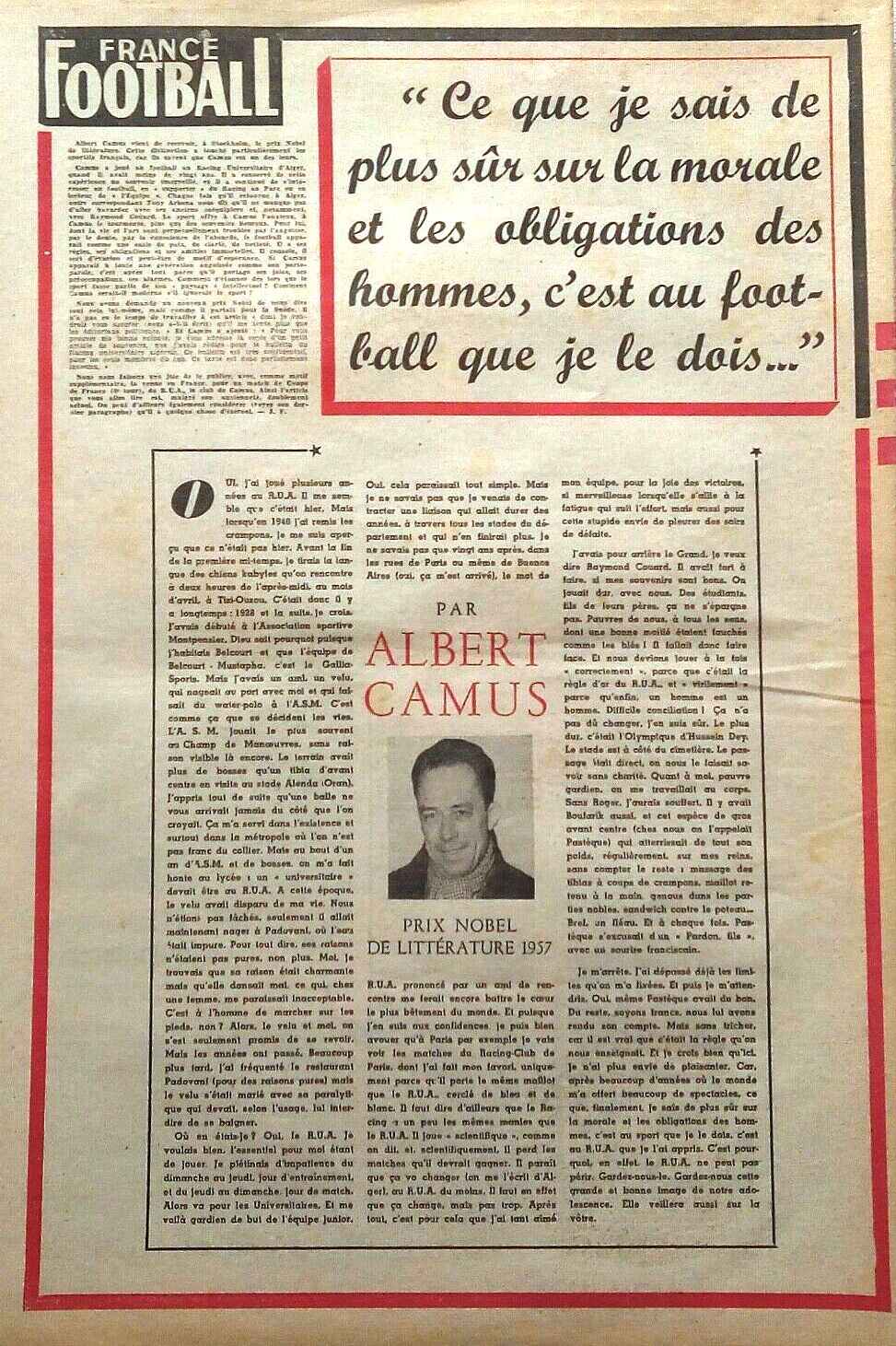
There is more to be said about the few things this commendable keeper from the junior team wrote after he had so sadly had to quit the game. Naturally, Camus remained, through and through, simply a footballer — once a keeper, always a keeper. In France, Racing Club de Paris would become his club: the same blue-and-white club colors and the same style of play as RUA, he notes ironically that they wanted to play « scientifically » and so they scientifically lost the matches they should have been winning.
According to the Albert Camus Society, the importance of football for Camus should be put into perspective, but they also write that, in their view, Camus was referring to « a kind of simple morality he wrote about in his early essays, an ethic of sticking up for your friends, of valuing courage and fair play. Camus believed that the people of politics and religion try to confuse us with convoluted moral systems to make things appear more complicated than they really are, possibly to suit their own agendas. People may do better to look to the simple morality of the football field than to politicians and philosophers. »
Ah, maybe they are right too. Just before Camus writes that he learned everything from football, he describes how a keeper gets roughed up: ‘shin massages with cleats, jersey held back by hand, knee in the family jewels, sandwiched against the post’. And a big striker they called Watermelon would land, with great regularity, with all his weight, on Camus’s kidneys: « Watermelon would apologize with a ‘Sorry, son,’ and a Franciscan smile. »
Perhaps his is isn’t so far from the philosophy that will be on display tonight. On his gloves, Maignan has written:
« Foi, Discipline, Travail, Patience et Humilité. »
(Faith, Discipline, Work, Patience, and Humility.)
Day 23 | 3 Jul 20:14 CEST
Hazar Deniz Eker
The last Yugoslav footballers
Jesus said ‘turn the other cheek’, but he didn’t tell what you should do when he hits you on the other cheek, that’s how Croatian centre-back Zvonimir Boban justified the longest-lasting legacy of his career in a documentary. He was not remembered for his impressive stints in European top leagues, but a moment in which he took initiative: in a game between Dinamo Zagreb and Red Star Belgrade in 1990, he flew towards a policeman beating up a football fan, kicking him with a force that renders Zinedine Zidane’s headbut sixteen years later a kindergarten skirmish at best.
The game at the Maksimir stadium in Zagreb has colloquially been dubbed the « game that ended Yugoslavia. »
Entering its final years, the union of what is today Slovenia, Croatia, Bosnia and Herzegovina, Serbia, North Macedonia, Kosovo and Montenegro began tensing up. From political drama to everyday life, displays of nationalism increasingly opposed the pan-Slavic state structure. No place made this as abundantly clear as the football pitch.
« Football games began mirroring the weakness of the Yugoslav state, the symbolic transformation of spectators into soldiers, the mobilisation of nationalist agendas and ultimately the country’s dissolution, » Dario Brentin writes, looking back at the role the game played in Yugoslavian unity and dissolution.
The game in Maksimir might have been an escalation, but it wasn’t the sole catalyst. Rather, the gradual disintegration of the state happened, accelerated yet dispersed, in acts of resistance and violence throughout the Yugoslav territory — but the games had to go on.
Yugoslavia, following a resounding success in a youth World Cup, travelled to Italy for the 1990 World Cup. A documentary titled The Last Yugoslavian Football Team follows the players, coaches, and fans throughout the process, interviewing them both before and after the eventual Yugoslav wars.
Both a beacon of unity and a spark for local nationalism, the Yugoslav national team’s history is inseparably bound to the legacy of the war. Nevena Kasic, in a review of the documentary, writes about this dynamic: « There is always something unnerving about revisiting a period you personally survived. It’s not that the war hasn’t carved itself into your marrow, though. It lives there, loiters listlessly, and hovers sporadically between your eyes like an invisible tattoo, and right below the surface of your epidermis, too, just waiting to emerge (pounce, even), and whizzes between synapses, finding ways to insinuate itself into conversations it should otherwise have no business interrupting. »
Decades later, Croatia and Bosnia and Herzegovina, are spearheaded by two aging captains who came of age in the war: Luka Modríc (Zadar, Croatia) and Edin Džeko (Sarajevo, Bosnia and Herzegovina). Both have played in the round of 32, trying to save their young nations, but to no avail.
The last ex-Yugoslav teams are out of the World Cup. The last two players to remember the war are now retired.
Day 22 | 2 Jul 18:23 CEST
Hazar Deniz Eker
¡Es Posible!
« For Mexican fans, disillusionment begins at home. » Author Juan Villoro had some doubts about this rendition of the World Cup before the tournament started. Justifiably so. In his essay ¡No es Posible! he runs through the sport’s myriad crises of legitimacy, but ultimately lands back onto the one closest to his heart:
« It could be said that the social contract between the team and its supporters is beginning to crack. While not yet time for divorce, the romance has entered a critical phase, in which the lovers can see it will be equally difficult whether they stay together or break up. »
No team has been to more World Cups than Mexico without winning the title. In fact, in seventeen appearances at the tournament, Mexico never even managed to survive past the first knock-out round.
A shocking statistic for a country so obsessed with the sport – but another record gives the country some hope. Mexico might struggle at tournaments, its domestic league might be riddled in controversy, its democracy might be tainted by long-lasting disputes Villoro outlines in his essay, but when « El Tri » play at home, particularly at the Estadio Azteca, they simply don’t lose.
« In recognition of the fact that football causes heart attacks, the Estadio Azteca was built near Mexico City’s Institute of Cardiology, » Villoro isn’t exaggerating. « The international press argued, with some justification, that playing at 7,200 feet [2,200 meters] under the midday sun would be an updated form of the human sacrifice practised by the Aztecs. »
What happens on the pitch of the Azteca is, undoubtedly, football, but it feels larger than that. It’s a location that, whenever the World Cup circus arrives, is guaranteed to cement another seminal moment in the sports history. Pelé won his last World Cup in the Azteca. Germany played Italy in the « game of the century » in the Azteca. And England faced none other than Maradona’s Argentina in the stadium, where tens of thousands of onlookers witnessed the infamous « Hand of God. »
Mexico only ever lost two games in the stadium, never a World Cup match. Yet the legacy of the Azteca isn’t about the results at all. Villoro argues that what cemented the Azteca’s great moments in history is its larger-than-life atmosphere. It’s an environment that this time around, empowered El Tri beyond belief: Mexico has won all of its group stage matches, as well as its first knock-out game yesterday, conceding no goals. The Azteca delivered.
They’re going to host England in the next round. About 40 years after the Hand of God, England looks for revenge not in the opponent, but in the venue that reduced its efforts to that of a bystander to greatness, that rendered England’s participation in a World Cup final into a mere footnote.
Mexico won’t play any more games at the Azteca this tournament, even if it progresses. Villoro’s account of the stadium is mournful, describing its increased commercialization and expenses, but if the past few games by Mexico are anything to go by, he does not have to worry. The Azteca looks likely to deliver its inevitable reminder:
« Aware that symbols can be more important than reality in Mexico, Ramírez Vázquez, the stadium’s architect, gave the Azteca a brutalist exterior, supported by immense concrete pillars with a geometry that evoked the Aztec pyramids.
It declared beyond all doubt that this extravagant structure was ours. »
Day 21 | 1 Jul 20:32 CEST
Hazar Deniz Eker
The moral relativism of haramball
Football has produced some memorable songs over the years: from Shakira’s Waka Waka to La Copa de la Vida by Ricky Martin or Wavin’ Flag by K’naan.
The submission of the United States, a country song called Lighter by Jelly Roll, has meanwhile landed on deaf ears – but don’t worry. Football fans have found alternatives: multiple nasheeds, Arabic vocal chants, have been going viral online, accompanying football clips with one of two captions: haram-ball, or halal-ball.
Prior to going viral online, Haramball was known by its older name, « Anti-football », a playstyle that is, in short, boring to watch: teams that pass a lot, defend intensely (also known as « parking the bus »), and score, if at all, with set pieces like corners or free kicks, or with the rare counter.
The popularity of the haramball meme coincided with the recent successes of teams like Atletico Madrid in Spain and Arsenal, the current English champion: two teams known for their overly defensive, slow playstyles, despite their vast resources and players with great technical ability. In short, they could be playing more attractive football, but chose not to.
The opposing brand of the game, faster and more attacking, has since been dubbed «halalball » by online audiences, turning games between two professional football clubs into sites of battles between good and evil.
Yet, sometimes sinfulness is good: among the greatest upsets of this World Cup are overly defensive performances of lower ranked teams against household favourites: Cabo Verde against Spain, DR Congo against Portugal, or Paraguay against Germany. Yet, after these matches, that were undoubtedly haram in their style, there wasn’t much criticism? What made acts of haram become halal?
Underdogs, teams with players in lower leagues, get a pass. And maybe we shouldn’t be too harsh with them. Their performance against a favorite, to an extent, must be defensive, simply as a matter of survival.
Let the underdog sin.
Day 20 | 30 Jun 20:15 EEST
Sander Pleij
Jedermann sein Eigener Fussball
Yesterday two major European football nations bowed out against countries from Africa and South America, with which they each share a special bond. Morocco beat the Netherlands, where Moroccans form one of the largest immigrant populations. Germany lost to Paraguay, where Germans form one of the largest immigrant populations.
Both lost on penalties, the players who missed their kicks looked like zombies mid-panic-attack.
Now what?
Regroup, recalibrate, reorient, reflect, reposition and what have you. You can already hear the language from that wondrous crossroads of management-speak and new-age fluff. Maybe they should instead reach back, a bit more lightheartedly, to a brochure distributed in Berlin more than a hundred years ago: Jedermann Sein Eigner Fussball (here’s a facsimile edition).
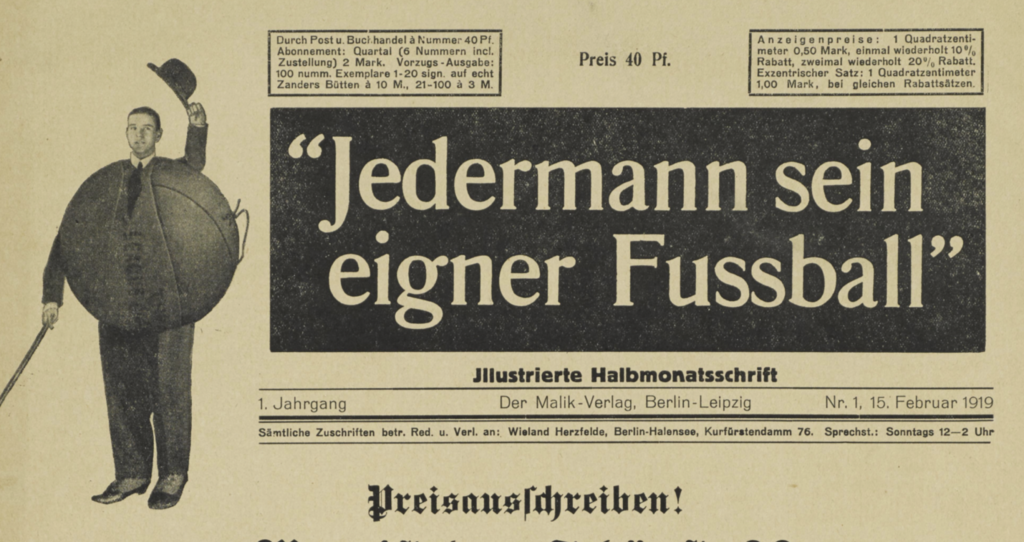
On 15 February 1919, a motley procession moved through the center of Berlin, down the long Wilhelmstrasse, with both Dadaists and the brass band of a bowling club, hired by the Dadaists themselves, yet striking up nationalist songs.
I’ve read several conflicting accounts of what happened, but it seems that, with great bravado, the Dadaists presented and sold the first edition of a four-page magazine from a flatbed cart. Avant-gardists and nationalist anthems together: as if they wanted to prove just how thoroughly confused everyone and everything had become. The young guard had been completely disillusioned with progress, which had revealed its true face in the form of bombs dropped from zeppelins, poison gas, and machine guns mowing down regiments of soldiers. The Kaiser had fled; communists, socialists, and nationalists alike all failed to seize power, and Berlin seemed to be sliding into civil war. The self-appointed Oberdada Johannes Baader shouted inside Berlin Cathedral: « Was ist Ihnen Jesus Christus? Er ist Ihnen Wurst. » (‘What is Jesus to you? To you he is a sausage,’ meaning: you couldn’t care less about him.) Church, state, capitalism, the bourgeoisie: nothing offered the avant-gardists solace. The Dadaists tried to show that everything was absurd, and that every order had to be torn down before a better society could emerge.
The procession ended in chaos, and the magazine Jedermann sein Eigener Fussball was confiscated by the police, its makers taken to the station. It seems that the very same afternoon, in a pub, the new magazine Die Pleite (bankruptcy) was founded.
So what did Jedermann sein Eigener Fussball actually write about football?
Nothing.
The cover showed a man whose belly was a football. The title expressed: Don’t let yourself be kicked around by others, take action yourself, kick your own football, don’t get kicked.
And so we’re back to the defensive posture of the Dutch team, which had shown its attacking skills in the group phase but now decided to sit back and let Morocco play their game. The predictable result: they were kicked around the pitch by opponents who chose to actually play football. For the German team, too, it seems an apt motto: Jedermann sein eigner Fussball. Don’t let yourself be kicked around any longer.
Day 19 | 29 Jun 20:35 CEST
Hazar Deniz Eker
The migrant cup
One of the earliest instances in which I consciously felt guilty was when I reflexively hoisted my fist into the air, sitting on the floor in the house I grew up in , screaming in joy after Turkey equalized in the 86th minute of the 2008 European Championship semifinal against Germany.
That house, as evidenced by its interior, was 100% Turkish. A round lampshade, adorned with a ring of fake diamonds illuminated the living room with a white fluorescent light. Our couches were beige, the armrests showing some hints of silver. The walls were bare, white, with the exception of a framed image of the 99 names of Allah. Our recently purchased TV receiver was still partially covered in its plastic wrapping, allegedly to avoid any damage although the wrapping would cause it to overheat. The couch table was filled with snacks and tea. I knew many Turkish living rooms that were almost indistinguishable from ours.
And yet I felt some guilt celebrating the goal, as I was supposed to root for both teams. This carefully constructed Turkish living room was surrounded, to all sides, by a foreign entity. Germany. A Turkish enclave in the heart of the German Black Forest.
Growing up as a second-generation immigrant, there are many instances in which the two (or more) nationalities one harbours, come to the forefront, or even clash. In my experience, these battles were weird. Take how one is supposed to celebrate a German or Turkish victory in football, from the POV of a Turkish migrant:
A German win was usually celebrated with a modest Swabian cheer to the neighbours. A timid but content conversation the next day about the tactical soundness of the team. The lack of passion was comforting to me, as it didn’t make me look too enthusiastic over Turkey’s demise. A Turkish win, on the other hand, was always an performance. A brief justification to step into a car, drive around and honk, playing Turkish music on loudspeakers.
These two realities are difficult to reconcile when Germany finally plays Turkey.
It used to be obligatory for players like Mesut Özil, a German of Turkish origin, to continuously having to « prove » their commitment to the national team, even after performing well. The selective and limited empathy of domestic fans for players of migratory backgrounds continues to define much of the criticism they face today (like when Saka, of Nigerian descent, faced racist comments after missing a penalty for England in the Euro 2020 final).
But eighteen years later, things also feel different, at least to me. There have never been more foreign-born players at a World Cup. One in four was born outside of the country they represent. Over nine teams feature squads with a majority of foreign-born players. Among the top three are Curacao, DR Congo, and Morocco, with over 70% of their players born outside of the country they represent. Being born and raised elsewhere, even at times struggling to speak the language, seems to no longer be an exclusionary criterium for national belonging. Just look at Pico Lopes, Cabo Verde’s centre-back, who was invited to play for the team via LinkedIn, but initially didn’t understand the message. The Dublin-born player of Cabo Verdean origin didn’t speak Portuguese.
The importance of migration has become inevitable to the sport. Not only are the likes of DR Congo or Senegal mostly composed of players born in Europe, but the European powerhouses for their part, consist of players whose parents and grandparents were born in Africa, Asia, or South America.
In a tournament hosted primarily by a country that has created the world’s most expensive and vast deportation bureaucracy, the squads are a blatant example of how much migration can positively shape national identities.Something that comes back into play on Day 19, as the Netherlands faces Morocco. The majority of the Dutch team has a migratory background. Over 70% of the Moroccan team was born outside of the country.
Whatever happens, migrants will win.
Day 18 | 28 Jun 16:10 CEST
Hazar Deniz Eker
Revenge for Gijón
What comes first: the nation, or the national team? For Algeria, it was the latter: in 1958, eleven Algerian footballers playing in the French league escaped to Tunisia. While France’s colonial occupation of Algeria continued, they formed the Onze de l’Indépendance, an Algerian national team in exile. Four years before the country gained its independence from the French, their national team already toured the world, representing not a country, but its promise.
To Algerians looking to establish their own national identity after decades of colonial subjugation, the team « advanced the cause by ten years, » as Algeria’s first President claimed. The national team lived off this hopeful origin story, until anger started to define its footballing legacy in 1982.
At the World Cup in Spain, Algeria’s young nation put itself on the map: facing racist ridicule by other teams and staff, they beat West Germany and Chile, and lost to Austria – meaning that they were practically through to the next round.
Then West Germany played its final game against Austria.
The math, in short, was this: if West Germany won its game against Austria (by no more than two2 goals), both would go through, while Algeria would leave the competition.
The game kicked off in Gijón. Germany scored, and for the next eighty minutes, nothing happened. Players leisurely kicked the ball around with an energy more akin to an evening stroll than a World Cup group decider. Fans, German, Austrian, and local Spanish attendees, all started booing. It was obvious: Algeria, a nation of twenty years with a national team of twenty-four years, was being pushed out of the tournament by what seemed to be a mutual understanding between the two teams. And worst of all: it was boring.
The «Shame of Gijón » haunted a generation of Algerian football fans. FIFA immediately changed its rules, playing the final round of group matches simultaneously to avoid match fixing – but fate would find a way to give Algeria a glimpse at revenge.
Today, Algeria played its final group match against who else but Austria. If Algeria had won, Austria would have been out – but then Algeria would face Spain in the next round, a world class team and tournament favorite. Third place would face Switzerland, a good team, but a much easier opponent.
Is this the revenge for Gijón? Algeria could deploy Austria’s tactics: refusing to win, drawing or even losing the game could throw Austria under the Spanish bus. If Algeria play as passively as Austria did in 1982, Austria would be forced to watch in agonizing passivity as even their best efforts, goals and a victory against Algeria, would only be rewarded with more hardship.
That would make for a nice story, but ahead of the game, Algeria’s team and staff, as well as its fans, didn’t seem keen on fighting shame with more shame. They wanted to beat Austria, at whatever cost. As a fan told the Guardian in an interview:
« My friends and I are all on the same page. We want to beat Austria. It isn’t about hatred or nursing a long grudge. »
Algeria took the lead in stoppage time, 90+2. For a few minutes, Austria was out. Then they equalized, and will now face Spain.
The Algerian fans from earlier continued. « Everything that happens in the world is connected to history and what came before. This would be a way of righting an old wrong. »
Day 17 | 27 Jun 17:26 CEST
Hazar Deniz Eker
All tied
Among the many reasons as to why football (soccer) never achieved the same popularity in the United States as it did elsewhere, must be the American reluctance to draws. The US-American sports story needs a winner, and a loser.
After all, who wins if it ends in a draw?
Cabo Verde, an archipelago nation off the coast of Senegal, might’ve changed some American minds. The nation had never been to a World Cup before. Many saw them as pushovers, only here due to the expansion of the tournament.
Then they played Spain in their opening match. The result was one of the most enthralling 0-0 draws in the history of the sport. Global audiences, including many, many American sportscasters and fans, collectively turned a tied, goalless game into one of the tournament’s greatest viral hits yet. The forty-year old Cabo Verdean goalkeeper Vozinha, keeping his team alive with his heroics, became a global sensation. His online following jumped from 50,000 to 17 million in a week.
Football, like other sports and much else in our daily lives, has become obsessed with metrics that try to dictate our behaviour. High among them, the “expected goals” (xG), a statistic that measures the quality of individual shots and chances to demonstrate how many goals a team should’ve scored.
Spain in its game against Cabo Verde had an xG of 2,2 – but didn’t score, such is the exciting nature of a draw: defying all logic, statistics, and likelihoods, two opponents become equals by the mere will of the underdog.
Then Cabo Verde played Uruguay. A second draw, but of a completely different nature. Cabo Verde again faced an opponent who should’ve scored two goals, and this time didn’t leave their chances hanging. But rather than standing back and defending for their lives, Cabo Verde played with attacking frenzy, somehow scoring more than they should’ve. The game, an exciting back and forth, ended 2-2. Cabo Verde’s xG stood at 0,8.
Enticing audiences with two vastly different but impressive draws, they, for the first time entered a game not as complete underdogs. Their final match was against Saudi Arabia.
Cabo Verde got a taste of its own medicine: by the metrics, they should’ve won this game, sitting in the driver seat for the vast majority of the game. A draw that wasn’t as much an upset as it was frustrating. Cabo Verde, for a moment, became like Spain.
And yet, it was enough: due to other results, the island nation qualified for the next round. They haven’t lost a match, and haven’t won one either – they just kept on striking a healthy balance.
Day 16 | 26 Jun 23:13 CEST
Sander Pleij
Virility van Dijk
He gazes into the lens, sultry, his head tilted slightly. One eye sits in shadow, the other is looking straight through you. His beautiful face is made a touch more striking by the small black goatee beneath his chin. Then the body, that long body. We don’t see his whole one meter and ninety-five centimeters. Only the torso is visible, but what a torso. The top buttons of his white shirt are open, and in the décolleté we see the smooth skin of his chest, not a single hair on it, his skin glinting as though forever lit by the sun of the golden hour. The shirtsleeves are rolled, flaring loosely halfway up his biceps and opening a view onto what appears to be a tribal tattoo. But the shirt is wet! Here and there it clings to the torso, and the golden skin comes through the white, sometimes with a small pocket of air still between. No jewellery, none needed, although in another photo, where he looks into the camera laughing, a tiny band is visible around the wrist.
Isn’t it time we talked about the erotic pull of footballers?
Virgil van Dijk stands like a god at the centre of the defence. For Liverpool the rest of the year, and during the World Cup for the Dutch national team, which beat Tunisia yesterday. He is the captain, the leader, the one who always stays calm and fronts up after the match, even when he has to answer for defeats or other faults. Virgil van Dijk is there. A picture of manliness. If footballers are gods, Virgil is enthroned high on Olympus. Interviewer Eliot Hayworth calls him, in the magazine Fantastic Man: « mature, hyper-manly. Also lithe, glowing, youthful, healthy. » There are fans who have his face tattooed onto their skin.
Would you like to know something about his skincare, too? You can: « Virgil’s skincare routine consists largely of Zwitsal baby oil, which he has used since childhood. » But Virgil doesn’t give everything away:
« His hair routine is a secret. ‘One day I’ll tell, but not today.’ When in public, he wears his long hair pulled back in a bun, but at home he wears it down.»
Fantastic Man is a fashion magazine for people who want to think for themselves. It features, alongside probably top-of-the-bill photo shoots, interviews on the brink of literary fiction. It has a pleasingly idiosyncratic eye for whom it portrays. A fantastic man is not per se world famous, yet a pioneer in his field, has a style of his own, and on every other front too: he is no follower. Van Dijk adorns the cover of the current issue, and he seems made for it. He looks entirely at home there. In the interview he talks at length about his skincare, his hair routine and his choice of clothes. As famous as he is, he can’t simply go shopping himself, but luckily he has a stylist for that, who together with his wife sees to it that Virgil is impeccably dressed. And beyond a story that shows how hard his road to success was, you learn that he has become a man of the world. Where the football hero was once a son of the people, who stayed ordinary, Virgil is a pioneer. He has a poor background, sure, but that’s not what defines him. He talks freely about his feelings and about how he tries to protect younger players, who are regularly torn to pieces on social media. He doesn’t hide his depth, after the death of his highly important teammate and star player Diogo Jota, he set up support groups for the rest, together with other senior players. Socially he is outspoken, but, like a politician, he also knows what he can and cannot talk about.
The Gods have died, their replacements are human. Once you could read these mortal’s virtues, vices and desires after their career, when the working-class hero snorted his nose to pieces or coasted on his fame at daytime TV. The desires of today’s men are represented by Virgil van Dijk, who already knows where he’ll be found after his last match:
« You know, Milan and Paris fashion weeks are coming up but there are so many games. It would be amazing to find a moment to go to one of the shows. If I’m over in Europe for a game I’d try to go to a show, or if I have a day off I’d definitely fly over. »
Day 15 | 25 Jun 18:09 EEST
Hazar Deniz Eker
The man who cursed Harry Kane
Last week, we wrote about England’s World Cup curse. Hours later, they convincingly won their first game against Croatia, their strongest group stage opponent. Next up was Ghana.
Once a football powerhouse, Ghana didn’t arrive in its best shape: key players have been injured, and the team’s performance in games and tournaments over the past few years (!) has been miserable. England currently stands at 4th in FIFA’s world rankings. Ghana is at 65th, among the worst teams of the tournament.
That’s before the traditional Ghanaian priest Nana Kwaku Bonsam got to work.
Bonsam claimed to have helped a sick man back in 1992 on his way home from work. The man thanked him with a « mysterious gift »” which gave Bonsam healing powers. That day, as Bonsam’s story goes, he became a traditional healer. Growing in popularity over the years, Bonsam had since expanded his reach, previously opening multiple shrines, schools, and a farm. He also has at least 14 children. Yesterday, he announced to name one of them after England’s star striker: « Harry Kane is not my enemy. »
But a few days prior, Bonsam cursed the English team, and their star striker in particular, to underperform against Ghana. What followed was, statistically, the greatest upset of the tournament so far: no team has ever had as much possession as England in a World Cup game without scoring a goal. Harry Kane only touched the ball 19 times, his lowest figure in his 116 appearances for England. The game ended in a 0-0 draw.
« I am now going to release Harry Kane so that he can score in England’s next match, » Bonsam announced after the game.
Bonsam went viral over the past few days, being called a « witch doctor » by English media – a term that dates back to English colonisers efforts to diminish local belief systems, replacing them through Christianity – a legacy he is still fighting against. He has had many feuds with televangelist preachers in particular, criticising their media empires and even secretly consulting them with his healing powers before leaking their meetings in churches. Ghana continues to be predominantly Christian, at least on paper.
Bonsam is « based in Ghana » as his personal website says, but he also spent a year inBronx about a decade ago. A New York Times article chronicles his life there: from skin operations, to feuds with local churches, funerals, birthday parties, and a Miss Ghana beauty pageant, Bonsam’s short stay reveals a lot about his character, and the role of traditional religion in modern-day Ghana. « I love New York, » he explains in the article « But it’s too cold here. »
Day 14 | 24 Jun 22:54 EEST
Hazar Deniz Eker
Everybody hates hydration breaks
By any metric, Germany was destined to breeze past Curaçao in their opening match of the World Cup last week. It has a pool of 85 million people vs Curaçao’s 150.000, a footballing legacy of multiple World Cup wins vs a team that didn’t exist sixteen years ago, superstars vs a crew of largely unknown players passing time in second divisions.
In light of this, Curaçao’s 21st-minute goal defied all logic. Germans couldn’t believe it, fans couldn’t believe it, Curaçao’s team itself couldn’t believe it. If football is a clash of conflicting narratives, momentum defines which one we get to witness in any given moment. Curaçao had all that momentum – for about one minute. Then the players had to stop for a hydration break.
Germany would have most likely beaten Curaçao anyway, but those three minutes that stopped the flow gave the visibly shell-shocked team an opportunity to reorganize. Germany won the game by 7 to 1 — most hydration breaks had similar impacts on a match’s momentum.
It’s a pretty significant change to the game, and many teams, coaches, commentators, or especially fans, dislike it. Stadium DJs struggle to drown out the booing that accompanies every hydration break. If you can’t even get English fans to drunkenly sing along to ‘Sweet Caroline’ anymore, you’ve got a problem.
Hydration breaks have become the posterchild of FIFA’s many controversies in this World Cup, probably because their premise is so easy to dispute: the two new breaks offer more ad space. Some estimate that they earn broadcaster FOX $250 million – a figure that fans like to share in agony on social media daily.
Commentators are meanwhile almost expected to announce hydration breaks with a smirky comment. « The Americans have actually managed to give our sport quarters, » is among my favorites.
But as heatwaves pass through much of Europe and players, at times, face off in weather upwards of 38°C, it feels oddly cruel to criticize an initiative that is meant to, at least officially, help players remain healthy.
Just a few weeks before the World Cup, the US hosted another sports competition: the Enhanced Games: an alternative Olympics, literally, on steroids. Athletes were encouraged to take performance-enhancing substances to break world records, earning solid payouts by investors like tech billionaire Peter Thiel.
The founder of the event explained that he’s building « a superhumanity to change the world. » One article on the games reads that « Inspired by transhumanism, these performance alchemists hope to use sports as a testing ground to provide ‘proof’ of the beneficial effects of the substances and methods they promote. »
Perhaps the hydration breaks are accidentally radical: rather than treating an athlete’s body as a disposable avatar for entertainment and profit, they show us that even larger-than-life figures and self-made deities need a sip of water now and then.
Day 13 | 23 Jun 17:49 EEST
Sander Pleij
Resurrected for ninety minutes
Tonight, in the match against Colombia, he will stand upright again in the stadium: DR Congo superfan Michel Nkuka Mboladinga, or Lumumba Vea, the living statue who represents Patrice Lumumba. The Congolese freedom fighter and former president was deposed and then executed in 1961, a killing Belgium has since acknowledged its part in, and one the CIA had plotted as well. It is no small feat, because for the entire match Mboladinga holds his right hand raised to the sky, exactly like the statue of Lumumba that stands in Kinshasa, the Congolese capital.
There is something fitting here: a man killed for his country, resurrected for ninety minutes as the figure who urges it on. Lumumba Vea, who now has a manager, is not the only superfan from Africa, I learn from the World Cup special of online intellectual platform Africa Is a Country. Superfans set the mood at matches, whipping up the crowd with chants, brass bands, painted bodies, dance and costume. They’re their country’s twelfth man. No mean calling. The Ghanaian government is sponsoring the trips to the United States of 800 such supporters. One of them is Abraham Boakye, the « One Man Supporter » who has been doing his duty for decades.
There are many more: Côte d’Ivoire’s Petit Bamba, Tunisia’s Ridha the Elephant, Algeria’s Barigou and his trumpet, and the bare-chested men with the letters S, E, N, E, G, A, L painted across their bodies (some of whom you might remember, furiously disagreeing with the referee at the final of the 2025 Africa Cup of Nations).
The superfans are the joy of it; Africa is a Country‘s special explains the weight that lies behind them. I’ll leave the last word to its editor-in-chief, William Shoki (you can buy the whole thing here):
And so, to understand football’s importance is to understand something about modernity itself. The game emerged alongside industrial capitalism, urbanization, mass literacy, mass media, and the nation-state. This history is inseparable from empire. Football spread through colonial trade routes, missionary schools, mining compounds, military garrisons, and shipping ports. Yet like so many things carried by empire, the game escaped the intentions of those who introduced it. Colonized peoples appropriated football and transformed it into something else: a vehicle for anti-colonial ambition, urban identity, and national imagination. Modern football was born in the metropole, but it became global on the feet of those living in the peripheries. The World Cup itself emerged partly in rebellion against the insularity of Britain’s footballing elite. By the middle of the twentieth century, the sport had become one of the principal theaters through which the modern world staged its political dramas.
Day 12 | 22 Jun 20:25 EEST
Hazar Deniz Eker
Egypt never lasts that long
When Egyptian left back Ahmed Fatooh got a haircut prior to the tournament, he asked his barber to keep things short, so that his hair wouldn’t grow out by the latter stages of the competition.
His barber held back a laugh, telling him that he’ll be back for a refresher after the group stages.
When another player, Ramy Rabia, went on a date, his partner suggested meeting again in Miami after the first-round of matches ended. And defender Hossam Abdel Megid was asked to keep an upcoonming wedding date in mind. When he contests that he’ll be in the US on that day, the family busts out laughing. « Egypt never lasts that long. »
The scenes are from a series of video ads produced by telecom giant Orange ahead of the 2026 World Cup. What’s on display is a common Egyptian pessimism: despite being football giants on the African continent (they won the Africa Cup of Nations seven times), the team had never won a World Cup game before. In fact, the team barely scored in the competition at all, consistently missing expectations until it’s become easier to just not expect anything at all.
While Orange went all-in on the self-deprecating tone, Vodafone’s ad plays on star player Mohammed Salah becoming the all-time leading Egyptian scorer at the tournmanet. Coca Cola and Adidas opted for a traditional route, talking about the hard work and glory of going to a World Cup in the first place.
Egypt has a rich history of creative advertisements that routinely captures its Zeitgeist. Artist Bahia Shehab tracked these ads in A Trade in Dreams (2026), chronicling how Egyptian consumer culture came to relate to its its political and social identites.
« We became a nation that has traded its dreams for manufactured illusions. » Ads have been fulfilling this role ever since the end of Ottoman rule in 1880. « As apothecaries became pharmacies, healers became doctors, blond became more beautiful than brown, some notions of who we are were lost. »
The book argues that ads, like those for the World Cup, haven’t been reflections of Egyptian culture, but actively shaped the country’s identity over the past century. She points to past examples, but we might have just witnessed a contemporary one: this morning, Egypt won their first ever World Cup game.
Did Orange ease the nation’s pressure? Did Adidas ignite their strength? Did Vodafone offer us a glimpse into the future? If you ask Orange, the future of the team is clear: « To all the doubters, this time we’re going all the way. »
Day 11 | 21 Jun 17:22 EEST
Hazar Deniz Eker
They took our ‘staches
Back on day 5, we gave a glimpse into the at times militant expectations Turkish football fans have of their national team. Five days later, Turkey lost its second of three group matches against Paraguay – meaning that they will finish their group last, exiting the competition.
The reactions weren’t kind. Everything has been criticised, from their play style to the coach’s tactics and, rather frequently, the players’ haircuts.
Bleached undercuts, mohawks, and even braids all became the subject of not just ridicule but outrage, as pundits and fans reminisce of football’s older generations with « no-nonsense » looks.
In Turkey, someone’s political identity used to be shaped as much by their convictions as by their barber. Towards the end of the Ottoman Empire, secular mustaches replaced longer Sunni Muslim beards – a visual choice to demonstrate the end of a political era.
After the Turkish state was established in 1923, the Kurdish Workers Party was awed by Stalin’s thick stache. Modern secular ultranationalists (known as Grey Wolves) would alternate between handlebar mustaches resembling the crescent moon of Turkey’s flag, or shaving clean. And President Recep Tayyip Erdogan’s contemporary Islamist AK Party proudly wears the subtle badem (almond) mustache.
We’re only scratching the surface. Subtle differences fragment sub-groups further and further: clean-shave or stubble, long-beard without or with a mustache, etc.
No wonder then, that some, especially older fans, feel outraged by this new flock of uncregonizable, bleached and braided players, carrying Turkish flags on their chests while losing on the biggest stage.
But it’s important to remember that much has changed between Turkey’s last outing in a World Cup (2002) and today. Researcher Nazli Alimen writes of the influx of hipster aesthetics since the 2010’s: « These fashionable moustache and beard styles do not reflect an ideological standpoint or religious piety, but rather mark the wearer as a fashion-conscious person. »
Mustaches, hairstyles, clothing, accents, and other signifiers have been used to categorise Turkey’s historically diverse society for centuries. These looks were never set in stone, but always reflected something about how Turkishness was evolving. Hipsters too are part of this Turkish journey, and so is this national team.
Day 10 | 20 Jun 14:22 EEST
Sander Pleij
You base football player
In Day 6 of this diary, we wrote about poet Paul van Ostaijen and his grotesque story Waarachtige voetbalkamp, where a well-placed shot removed the goalkeeper’s head and made the ball rest on his torso. We wondered about what it had all meant. But a reader on Reddit pointed us to a similar yet far earlier incident. It’s a marvelous trouvaille: Octavian, a Middle English romance from the fourteenth century, recounts a battle scene, and carries the line:
That the heved [head] fro the body went, Als it were a foteballe.
Fourteenth century, people! It also solidifies the claim of English fans who chant « It’s coming home! »
And there’s more: the annotated text that reader from the Reddit community, Maus_Sveti, brought us to, mentions more severed heads used as footballs in medieval literature. In Sir Gawain and the Green Knight the members of the court of King Arthur are fending off the Green Knight’s rolling head with their feet:
Þat fele hit foyned wyth her fete, þere hit forth roled
Luckily the torso of the Green Knight recaptures itself well. It manages to pick up the head and carry it with him, while the knight gets back in the saddle and proceeds his way. Of course, I clicked on and landed on Medievalists.nets, (« where the middle ages begin »). This was not a rabbit hole, oh no, I found myself hopping from treasure trove to treasure trove. Articles popped up with titles like « Football in Medieval England » and « The bewties the fut-ball ». Pig bladders passed by, « with many beanes and peason put within ». That one is from a 1519 poem called Eclogues, by Alexander Barclay.
Many people have dived into the origins of football. Sometimes driven by an urge to link the first mention of it to a country. FIFA presents the history of football on its website with references to Japan, China, Meso-America (Mexico, Guatemala, Belize, El Salvador, Honduras, Nicaragua, Costa Rica) and the Greek-Roman world. I haven’t found a study on football as a literary trope. Wouldn’t that be fun? With the Earl of Kent sneering in King Lear:
Nor tripped neither, you base football player?
Day 9 | 19 Jun 21:37 EEST
Hazar Deniz Eker
We need more drama!
Canada had never won a single world cup match. It barely made it this year — as a hosting country, it qualifies automatically. In its prior two outings, 1986 and 2022, the North Americans failed to even get a draw, losing all of their 6 matches.
Until they played Qatar. « There’s gonna be 40 million Canadians that claimed that they were in the stadium today, » coach Jesse Marsch said after yesterday’s game. He’s hardly exaggerating, as every Canadian most probably wanted to be there.
Canada’s first successful outing was an absurdly dominant one: 6-0, and it could’ve been more. Rarely can you watch a game at this level of the sport that is more one-sided, in terms of goals, chances, support, and narrative — and yet, the German broadcast almost put me in a slumber.
The commentator seemed to have lost any interest after Canada’s fourth goal, at times barely talking as the players launched wave after wave of attack at Qatar’s decimated defence. It’s an understandable choice: why dramatise a game that is, by all accounts, a foregone conclusion?
The answer is in Tunisia. « We’re emotional societies. We rejoice deeply and grieve deeply, » Issam Chaouali explains. You might not know who he is, but you might know how he sounds like. Chaouali has been commentating on football matches on multiple TV channels in the Arabic speaking world since 1995, rising into prominence for his emotional outbursts, improvised poetry, and yes, his drama.
In a recent interview with GQ, Chaouali explains how embedded football is in Middle Eastern and North African culture, and how drama shapes the viewing experience: « It’s natural that in my commentary you’ll find this sense of exaggeration compared to a European citizen; emotion drives our choices and decisions. »
While he himself refers to it as « overreacting », his commentary implanted entire matches, goals, or even moments into the collective memory of millions. Few remember how Messi scored in the 54th minute of a Barcelona game against Manchester United in 2011, but many remember what Chaouali had to say about it:
« Impossible, you’re an emperor! Pelé, witness him! Maradona, acknowledge him! Talk about him, Cruyff! Platini, force them to admit! Zizou, tell the truth! Isn’t he the best? Isn’t he spectacular? Isn’t he the greatest? Isn’t he a man of history? Allah, you Messi. This is the giant that his mother spoke of. »
Perhaps yesterday’s monumental game could have used some sprinkles of his voice, at least on German TV. As Chaouali once said: « Oh writer of history, don’t close the pages yet. »
Day 8 | 18 Jun 19:05 EEST
Hazar Deniz Eker
In the beginning was the island
« I was just playing in the streets of Madeira. We had to stop the game whenever the cars would drive by. I was completely happy doing that every day, » writes Christiano Ronaldo, author of one essay and player in over 1300 professional games of football.
Ronaldo has spent the past two decades as an omnipresent face of the sport. Few human beings have enjoyed the global public limelight for longer than him. Yesterday, that attention turned sour. Aged 41, Ronaldo is the oldest field player at the World Cup. In Portugal’s opener against DR Congo, this showed.
He had three shots, all went off-target. His passes were accurate, but didn’t lead to any chances. If he was any other striker, he would have been subbed out after 50 minutes.
He played the full game, of course he did. It’s Ronaldo. The man is considered a deity in some parts of the world. At his prime, he was inevitable –– so what is he now?
He hasn’t scored a goal or created meaningful chances in his past 5 World Cup game appearances. Entire generations of Portuguese strikers have been banished to bench duties without question as he aged through the late 2010’s and 2020’s, never ceding his position in the starting lineup.
Does he fail to see it? Isn’t it obvious? He’s 41 years old and won everything under the sun, why can’t he let go?
Ronaldo has been the embodiment of the sports’ trajectory since the early 2010’s: growth, by all means. There are never enough games, enough goals, enough money. In his essay, which he wrote in 2017 after playing 400 games with Real Madrid, he argues that this ambition has been with him since the start: « Winning is still my ultimate goal. I think I was born like that. » Yet he doesn’t expect us onlookers to get it, ending his text with uncertainty « Maybe now you understand. »
If we can’t grasp what it means, maybe a fellow Madeiran can. José Tolentino Mendonça is among the island’s most famous poets. He believes it’s impossible to leave the island, the Madeiran condition. A biography reads « His poetry continually reaches out to the Other, who will always remain ineluctably other, even if they can share certain things: a language, for instance, and the experience of being islands and of attempting to transcend that condition and also to accept it. »
In one text, he likens Madeira to a child coming of age.
In the beginning, there was the island
Although it’s said
That the Spirit of God
Hugged the waters
In those days
I’d lie down on the ground
to look at the stars
without ever thinking
that those bodies of fire
might be dangerous
…
In those days
It was still possible
to find God
In the wastes
That was before
I learned algebra.
Day 7 | 17 Jun 16:52 CEST
Hazar Deniz Eker
It’s not coming home
Every World Cup, nearly 60 million English people experience mass amnesia. Forgetting their prior tournament exits as if they never happened, they go out onto the streets and scream, with full, unbridled conviction that « It’s coming home, » that England is on the cusp of another world championship.
It won’t happen, despite millions betting on it. In the first week of the World Cup, the weekly trade volume of the nine most popular prediction markets peaked at $8.7 billion – the highest figure ever recorded. $42 million are wagered on England bringing it home, on Polymarket alone, and how could we deny the wisdom of the crowd? The CEO of another betting platform, the equally popular Kalshi, described his platform as a « truth machine, » harnessing the collective intelligence of traders to dictate outcomes correctly, but critics see more of a semblance of truth than truth itself.
Economist Kyla Scanlon writes « when large traders move markets and those movements are reported as consensus, what you’re actually seeing is capital-weighted bets from whoever has the most information (insider or not). But those bets get laundered into legitimacy through the language of collective wisdom and truth machines.»
Examples are everywhere: from US military personnel betting on upcoming military actions they’re planning, to people playing around with weather sensors to make bank with temperatures. Only 3% of traders drive accurate predictions, according to some reports.
But football defies this logic. Spain has topped most prediction markets as the likeliest winner of the World Cup. Ahead of their first game, Spain had a 90% chance of beating Cabo Verde on Kalshi. By any observable metric, they should’ve done it. Then they tied the game.
And then there’s England. No metrics, star players, or insider knowledge can trump what happened after England’s World Cup win in 1966. Brazilian writer Nelson Rodrigues made sure of that. Appalled by England’s boring play style, he cursed them: « England will never get to impose its unimaginative, artless, unoriginal football on us again. »
England hasn’t won a single World Cup since 1966, and since arriving in the USA, the English team faced some unusual challenges ahead of their first game against Croatia. Training equipment was stolen. The players had to take shelter after tornado warnings around their training camps. A shooting was reported close to their training camp, and finally, a 6.1 magnitude earthquake struck several areas of Florida, including Orlando, where the English team is based (the first of its strength in the region since 1880).
You could call it bad luck. Nelson Rodrigues put it differently: « God is in coincidences. »
Day 6 | 16 Jun 18:52 CEST
Sander Pleij
Absurd absurdism
Belgium plays Egypt. The score is 0-1. Lukaku is subbed in. The ball is played wide. Lukaku sprints through the centre. Meunier crosses the ball. Everyone reaches for it. Moments later, the ball is in the net, somehow. For a few seconds nobody knows who scored in the chaos. The goal was real. But who made it? A typical Belgian scene.
Belgians have always confused me. Do they even exist? A certain kind of absurdism hangs over the country. Magritte’s paintings, his Ceci n’est pas une pipe. The Manneken Pis, the most famous Belgian statue in the world being a pissing kid. The national pride of having invented The Smurfs, Two equal languages held together, an entire EU community overhead, with its Brussels Leaning Tower of Babel. Belgium is soaked through with absurdism.
And then there’s football: remember the curly-haired keeper Jean-Marie Pfaff? The poolside party after they had beaten Argentina in the 1982 World Cup in Spain? A radio commentator pushed him into the water, but Pfaff couldn’t swim. After being rescued, he told the press he had been playing the Mickey, pretending to drown. He was not in the team the next match.
The Pfaffs, a reality show,with Jean-Marie’s wife Carmen, and their daughters Debby, Kelly and Lyndsey, ran for eleven seasons. Eleven.
My number-one poet of all time, the Belgian Paul van Ostaijen, wrote a grotesque about a football match. He’d been a fan of the form for a while: take a premise and carry it, via everyday logic, to the absurd, showing how most of it resides in society’s logic.
Here it comes. It runs to barely four hundred words, I’ll retell it.
An attacker shoots on goal. Then:
« It was at that moment that the horrifying happened, so ghastly that no one, at first, understood. The shot of the inside left, who shot even harder than the left winger, had sent the ball into the goalkeeper’s head. Without doubt, without hesitation, and without pain one might almost think, the goalkeeper’s head slid from his neck and came to rest, close to the upright body, on the white line of the goal. »
Everyone stunned, naturally. No goal! The ball had spun a few times on its axis and then, resolutely, came to rest on top of the torso. Yet, the centre forward seized the moment of confusion, « and struck, with a solid hit, the ball from the body of the goalkeeper, into the goal. »
Confusion. Again:
« ‘Foul,’ rang out from ten thousand mouths. »
The goalkeeper’s body fell backwards, the match was suspended and the centre forward was booed deafeningly. In the dressing room, the left winger sighed to him:
«The booing was too much. But that doesn’t change the fact, Anton, that you really should not have done that with the ‘foul.’ »
Should he have shot at the head that on the ground instead? What exactly was that foul here? And above all: what does any of this stand for? What exactly is ridiculed? I find it absurdly absurdist. Belgian.
Day 5 | 15 Jun 17:56 CEST
Hazar Deniz Eker
Return either as a veteran or a martyr
Before the battlefield comes the dance floor. The sounds of davul drums and zurna trumpets echo through neighbourhoods, while abundant homemade dishes feed everyone from your close family to strangers enticed by the tunes echoing deep into the morning – an all too familiar scene from the traditional celebrations honouring young men who are drafted to the military; asker uğurlama: soldier farewell!
It’s a largely joyful moment, until the very end, when we reach the last words the first-time soldiers hear uttered by their friends and family before departure: “Return either as a veteran or a martyr, » ya şehit ol ya gazi.
In Türkiye, death continues to be an honour in popular culture. While the popular ya şehit ol ya gazi, was coined by the late Ottoman poet and Turkish nationalist Mehmet Emin Yurdakul in the early twentieth century, the government of President Recep Tayyip Erdoğan has invested millions into telling the stories of martyrs:
TV shows, whether of Ottoman glory or contemporary « anti-terror operations », are full of heroes willingly sacrificing themselves for the nation. Music videos show fathers and sons happily dying together to protect vatan, the homeland. Football, among the favourite pattimes of Turkish audiences, has been instrumentalized by Turkish politicians for years, while footballers are framed as soldiers – and soldiers must receive a proper farewell before they enter battle.
Ahead of the World Cup, the Turkish national team made their way to the airport in two buses, painted with large Turkish flags, followed by an absurdly large convoy of hundreds of red TOGGs, state-subsidized EVs that make President Erdoğan proud, all adorned with Turkish flags. Cue the music, the drones, the cameras.
The Turkish national team began the tournament in a game that highly favoured them over the lower-ranked Australia. The Turks fought hard, launching 30 shots (to Australia’s 9), passing 704 times with 90% accuracy (to Australia’s 271 at 74%), winning more tackles, sending more crosses, controlling the ball and yet, somehow they lost 2-0.
The reaction from Turkey is what you’d expect. Pundits decried the coach, fans in public viewings insulted the team, and don’t even get me started on online comment sections.
The Turkish public has a history of expecting a lot from the national team and sharing their vocal frustrations when those expectations aren’t met – and yet it’s a puzzling reaction, given that in essence, the team did what they were told to do: They went to battle, they fought hard, they even dominated, and then they became martyrs.
Day 4 | 14 Jun 16:46 CEST
Sander Pleij
The happiness of Vinícius Júnior
« I’m not a victim of racism. I am a tormentor of racists. »
That is Vinícius Júnior, the Real Madrid forward, who brought Brazil level against an impressive Morocco with a thunderous strike. He said it after yet another season of being abused from the stands, defiance where I guess many would be exhausted. The overt stuff (slurs, bananas, jungle sounds) you can’t miss. But this week I learned to hear a quieter version that hides inside compliments.
It has a name: colorism. Six years ago, a study by RunRepeat of the language of English football commentators found that what matters is not whether a player is Black but how Black: the exact complexion changes the words chosen. Lighter-skinned players tended to be praised for their intelligence and hard work, darker-skinned players more often for their power or pace. Some presumably did not know they were doing it, which is half the point (the other half is the ones who did). The findings, so you know what you’re hearing when you hear it,
Intelligence: 62.60% of the praise went to lighter-skinned players, 63.33% of the criticism to darker-skinned ones.
Power: commentators were 6.59 times more likely to be talking about a darker-skinned player.
Speed: 3.38 times more likely to be talking about a darker-skinned player.
Work ethic: 60.40% of the praise went to lighter-skinned players.
It was our own editor-en-liaison Peter L’Official who sent me down this path, in a stark piece for New York Magazine on racism in European football. He begins, lyrically, with what Vini can actually do on the field,
« In the 49th minute of the first leg of a Champions League knockout game between Benfica and Real Madrid in February, the Brazilian forward Vinícius Júnior received the ball on the left wing of the pitch. He took the pass in stride and gently touched the ball three times as he approached the corner of the penalty box. With his fourth touch and nary a look at the goal, he struck the ball with power and curled precision past the diving Benfica goalkeeper into the far top corner of the net. The goal was both satisfying and ludicrous: Almost no one should shoot from so awkward an angle and few from such distance. Vinícius reminded the fans in Lisbon’s Estádio da Luz that he is the exception to such rules, summarily gesturing at the abbreviated name on the back of his jersey, Vini Jr., after performing a cheekily sensual dance with the corner flag in celebration. »
Then… walking back onto the pitch, he is called mono by a Benfica player. Monkey.
L’Official describes how, in the second half of the twentieth century, colonial and postcolonial territories supplied rich pools of elite Black players, but also how racism has by no means left the pitch. It did not even fade after World Cups and European trophies were won by players who looked nothing like the stock racists imagined their true countryman sprang from. He cites Germany’s Mesut Özil, of Turkish descent: « I am German when we win, but I am an immigrant when we lose. »
The reactions to the mono incident only proved the point. Benfica’s manager José Mourinho laid the racist outbursts of his players, and his fans, at Vinícius’s own door. The man dances oddly. «There is something wrong because it happens in every stadium,» Mourinho told reporters after the game, «every stadium where Vinícius plays. Always. I told him, ‘You score a world-class goal. Why do you celebrate like that? Why?’ »
The president of a Spanish association of football agents, Pedro Bravo, was equally clear: Vinícius had been disrespectful:
« You have to respect the opponent. When you score a goal, if you want to dance samba, you go to the Sambadrome in Brazil. But here, you have to respect your colleagues and stop playing the monkey (hacer el mono). »
Here’s where Europe comes in. Vini simply explained that it was not the happiness of scoring that annoyed people, but that « the happiness of a successful Black Brazilian in Europe is much more annoying». His dances, he said, weren’t his. They belonged to Ronaldinho, Neymar, Paquetá, Pogba, Matheus Cunha, Griezmann, João Félix. He was not going to stop.
Day 3 | 13 Jun 19:09 CEST
Hazar Deniz Eker
« Soccer in a football world »
The US has a much ridiculed habit of calling the winners of its national baseball, hockey, or basketball competitions « world champions » – reflecting its hegemonic ambitions to many foreign onlookers and also offering a glimpse into an American tradition of nation-building through sports.
In the late 19th century, the emerging institutional elite in American universities did its best to « assert its cultural independence by developing games of its own, » writes David Wangerin, in Soccer in a Football World; The Story of America’s Forgotten Game, a detailed record of the United States’ soccer dark ages.
Looking to craft competitions that would reflect an emerging national character, the rules of American football and baseball were designed in contradiction to its British and Canadian counterparts, and in almost complete isolation of foreign-born Americans, who in 1890 made up about 15% of the total population.
Most of those immigrants (first and second generation alike) had been quietly organising soccer teams and leagues for decades, keeping «the country’s flickering soccer torch alight,» while «tainting» the sport in some eyes.
« In a country whose national motto, e pluribus unum (out of many, one), articulated a desire for assimilation, leaving soccer in the hands of what Roosevelt, Lodge and their ilk disparagingly referred to as ‘hyphenated Americans’ was tantamount to marginalising it for good. »
More than a century later, the domestic interest in soccer is still nothing like that of much of the world. America’s share of foreign-born residents still rests at about 15%, and its government still does its best to marginalize its immigrant population, following another $70 billion invested this week into the Trump administration’s deportation efforts.
The US team meanwhile began their World Cup with a convincing 4-1 win over Paraguay. The star of the day made his own quiet argument over who counts as American, Folarin Balogun, who scored twice, was born in Brooklyn, New York, but only because an airline refused to let his London-based Nigerian mother fly home while seven months pregnant.
So, his US citizenship is a pure accident of the Fourteenth Amendment’s birthright clause, the very clause Trump’s administration is trying to rewrite. Had Trump’s new rules been applied at Balogun’s birth, he would not have been eligible to play for the USA – though domestic audiences might care more about tonight’s Game 6 of the NBA finals, which could, of course, crown another world champion.
Day 2 | 12 Jun 14:42 CEST
Hazar Deniz Eker
« The sin of not liking soccer »
You might not care about football. You might even despise everything about it. But few, if any, hate it as much as South Korean director Park Chan-wook.
In his essay « The sin of not liking soccer », which was recently translated into English for the first time, Park describes the agony he felt during the 2002 World Cup, hosted in Japan and his home country of South Korea.
Park’s aversion to football even brought him closer to God. He writes:
On one decisive Sunday, I went to church for the first time in twenty years.
A priest asked me, “What troubles you, my child? »
« So, I… Well… No, I can’t! »
« Our Lord is more generous than you can ever imagine. So, please, go on. What sin have you committed? »
« I… I don’t like soccer. »
Contrary to even the most optimistic expectations, South Korea finished fourth, beating football powerhouses along the way. With each minute, each goal, and each victory, Park fell into deeper despair, likening his predicament to that of a chinilpa – Korean collaborators with the Japanese, who remain in hiding in Korea after the Japanese Empire fell.
« Did the collaborationists live under this much fear? One night, I had a nightmare in which I screamed ‘I can’t stand the World Cup’ at the top of my lungs and subsequently got my mouth disfigured. »
Just one year later, Park would direct his magnum opus Oldboy (2003), a film about a man falling into despair as he is trapped, alone and isolated, in circumstances he cannot comprehend. His resolution? Resorting to a violent rampage.
« An average person cannot fathom the depth of paranoia faced by this national traitor living in hiding. »
We would like to extend our deepest sympathies to Park Chan-wook after South Korea came back to beat the Czech Republic in their opening game of the World Cup this morning.
Day 1 | 11 Jun 17:00 CEST
Hazar Deniz Eker
There are few things that appear as irrational as the collective frenzy that 22 men kicking a ball around can cause on a global scale.
Unfortunately, football remains not just a semi-religious experience, but one of the few global commodities that doesn’t even need to craft its own justification. In fact, it tries really hard to make itself as unattractive as possible: the soaring ticket prices, the blatant propaganda for a self-obsessed American president, the climate impact, the discrimination against fans, players, staff and officials, the long-standing corruption in the governing body FIFA, among many, many examples.
And yet, almost like clockwork, a collective suspension of disbelief kicks in as a good chunk of humanity makes personal and national aspirations contingent on whether the ball ends up in the big rectangle glued to their screens, whether kick-off falls at nine in the evening or at three in the morning.
Over the next 39 days, we’ll keep a diary of the 2026 World Cup, the biggest edition yet, held across the vastly different political and social landscapes of Mexico, the United States and Canada. We’ll look at the philosophies, literature and art behind the sport and its players, all while keeping an eye on the controversies along the way.
