 Skip to content


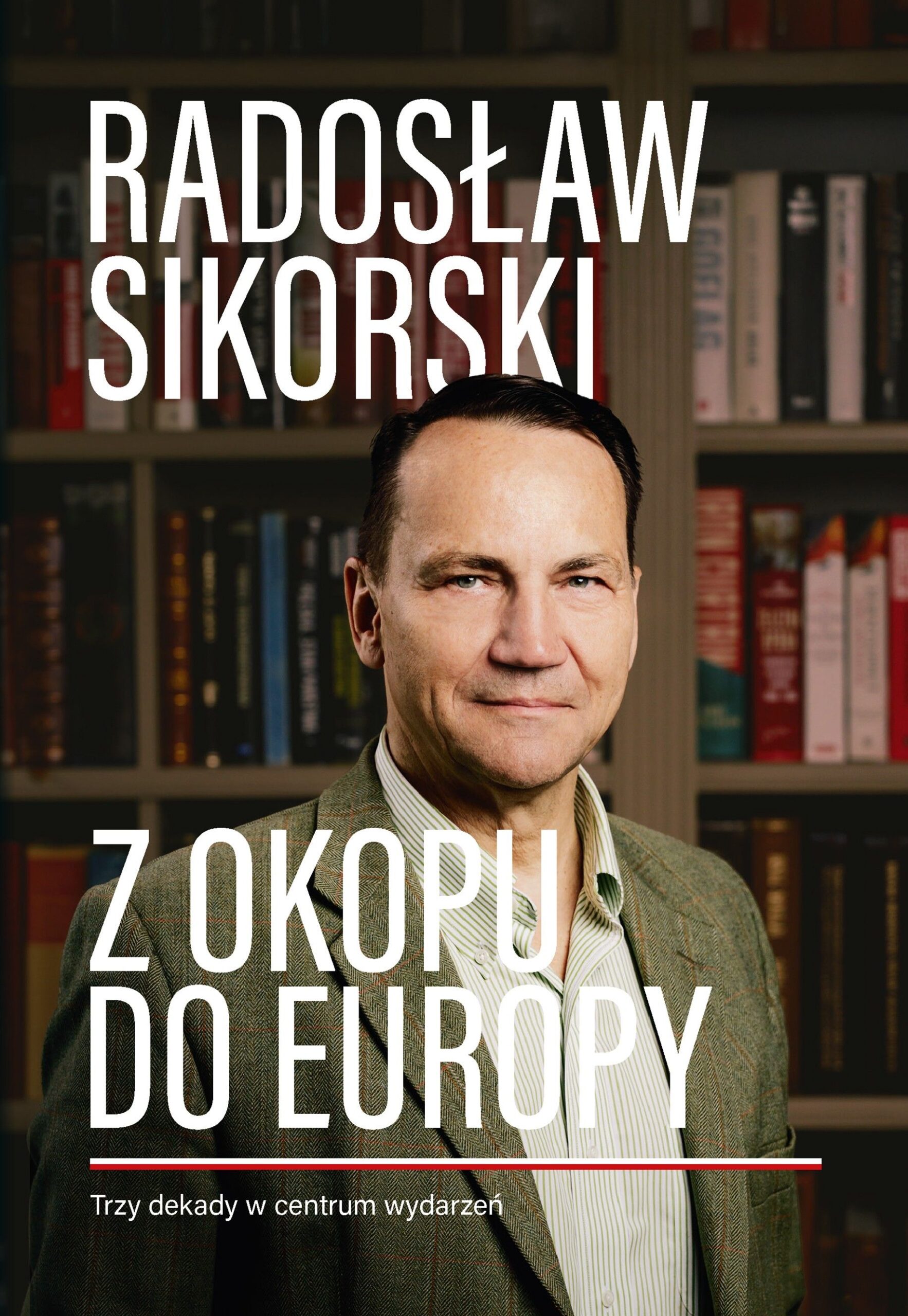
Z okopu do Europy. Trzy dekady w centrum wydarzeń.
Radosław Sikorski
(Znak Horyzont, 2025)
« Woe to those who are right too early! » is what the Foreign Minister and Deputy Prime Minister of Poland, Radosław Sikorski (1963) wrote back in 1997. And as it turns out: that’s him! He called for building an EU defense force way before the 2022 invasion of Ukraine. He warned about Putin’s threat to European security long before others did. His new book Z okopu do Europy (meaning « from the trenches to Europe », which rhymes in Polish), could be read as one very elaborate way to say « I told you so! », and if it is, it’s hard to blame him for bragging.
In the past, Sikorski worked as a journalist for mostly British newspapers. His book — a retrospective of Sikorski’s articles since the 1980s, most of them translated from English — is customized for the Polish market: most articles are translated from English. Few Poles could read his articles in the British media during the pre-Internet 1980s and early 1990s. He’s published books like it before: Polska. Stan państwa (« Poland. The State of the Country ») from 2022, which was a collection of his articles for the Polish magazine Polityka and his personal blog from the period when he was a member of the European Parliament. And Polska może być lepsza (« Poland Can Be Better ») from 2018. They can viewed as a series.
Why republish one’s old journalism? Some pieces are forty years old, from when Sikorski had just started his career as a reporter in Britain. I know a few authors (me included) who would be horrified by the idea of having their first writing scrutinized by contemporary standards. But Sikorski’s old articles are mostly well written and witty. What might cause embarrassment are some of his former political convictions, such as his fierce critique of Adam Michnik, the prominent dissident and chief editor of the major left-liberal newspaper Gazeta Wyborcza. The articles on Michnik are brutal and at times too personal and tasteless, and in his foreword to these articles Sikorski now admits that Michnik, an old-school anti-Communist leftie and a prominent figure of the Solidarność movement, was right to warn about a coming triumph of the radicals, but his warning was « premature »1. Sikorski writes about his longtime relations with Michnik: « First he was my hero, later he stopped being one, and now he is my hero again. »
Exposing oneself to embarrassment and self-deprecation is a quintessentially British virtue, and Sikorski, who spent eight formative years in Britain, wears embarrassment as a badge of honor. (The book even includes transcripts of his interviews with Margaret Thatcher and Henry Kissinger for Polish TV.)
The book is aimed at Poles who more or less remember the chronology of Sikorski’s career, his time in and out of office. For those less familiar, I’ll provide some background.
Radosław Sikorski was born in the city of Bydgoszcz, and while he is not related to the decorated World War II general and Polish prime minister in exile of the same last name, he and his family did do what Poles are good at: they resisted an oppressive regime. In his case, it was the Polish socialist Soviet-satellite regime. Sikorski was the chair of the local student strike committee and distributed anti-Communist literature. In June of 1981, he left for Britain to study English on a fellowship — something unthinkable in some countries of the Soviet bloc, but possible in Poland (the country said to be « the freest barrack in the Soviet camp »). Had Sikorski organized a student strike elsewhere, like in the USSR, he would have had a summer trip to the Kazakhstan steppes, not England.

Sikorski left the country before martial law was declared in Poland in December of 1981 — under which he could have ended up in prison.2 He applied for political asylum in Britain, where he started studying PPE at Oxford (Philosophy, Politics and Economics, the program usually chosen by future politicians). There he became a head of the Standing Committee of the debating society the Oxford Union, and a member of the Bullingdon Club — the Oxford dining society much demonized for its members, notably future prime ministers David Cameron and Boris Johnson. Sikorski once told an interviewer that when members of the club trashed his room as an initiation, Boris Johnson shook his hand: « Congratulations, you’ve been elected. »
Eventually he became a journalist. He went to Afghanistan to report on the Soviet-Afghan War for conservative British journals such as The Spectator and The Sunday Telegraph. In 1987 he received British citizenship, which he renounced in 2006, when he stepped into the position of Minister of Defense in the right-wing government of Kazimierz Marcinkiewicz.
Sikorski admits in the foreword of this book (twice) that he is still proud of his reporting from Afghanistan. He was 23 when he first arrived there in 1986. The BBC didn’t give him any kind of letter confirming his press credentials. He says it’s because they didn’t wish to mess with Moscow: according to his sources, a BBC reporter working from the mujaheddin’s side of the frontline could cost BBC its Moscow office. He went there as a freelancer (as did almost all others of those few who got there). Sikorski travelled with mujaheddin as a reporter, was accepted as a friend and in some situations as a brother in arms. In Afghanistan he had to accompany them not only for reports, but also for protection: he estimates that if he had been kidnapped, his life would have been worth twenty goats.

There are plenty of photos from this period in the book: young Sikorski with a rifle, wearing a headscarf and riding a horse. Another is taken in Tora Bora. One photo he made himself won the World Press Photo prize in 1988, it shows a mummified Afghan family who died instantly at their home in Soviet air raids. He tells the story of the photo in his article « Coda to the Russo-Afghan War », included in the book: how he witnessed the excavation of this family, their remains perfectly preserved like they had been in Pompeii.
In 1989, Sikorski was reporting in Angola when he learned that the democratic opposition had won the first free parliamentary elections in Poland and rushed back home, this time to stay. Now his country was a place for foreign journalists to be. One of them, the American journalist and historian Anne Applebaum, had been his colleague at The Spectator and later became his wife. They climbed on the Berlin Wall the night it fell, witnessing the thrilling turmoil, and have been together ever since. As for many of his generation, 1989 was a good year.
That same year, his family bought Chobielin, a ruin of a manor house near Bydgoszcz. How he and his wife renovate Chobielin became a metaphor for rebuilding a country damaged by years of communist rule: the volume offers two articles on the matter. Sikorski also wrote a book about his renovation journey: The Polish House: An Intimate History of Poland (1997). Chobielin is the scene for Sikorski and Applebaum’s private and public life — it is exactly the kind of manor house where political life of Polish gentry in the late-eighteenth and nineteenth centuries took place. A topos as important for Polish culture as a country estate for British culture.
In 1992, Sikorski entered public service himself. He became deputy to Defense Minister Jan Parys, the first civilian non-Communist Defense Minister in Poland. Sikorski describes how he got there vividly in a 1992 The Spectator article: he was on the roof of Chobielin (of course) as the telephone rang and he got the invitation. Parys and Sikorski shared the same pro-Atlantic aspirations for Poland (joining NATO was not a fait accompli back then). The new gig didn’t last long, and apparently it was not a particularly pleasant one hundred days. Later, he was elected senator of his hometown and joined the government, serving under prime ministers of the right-wing populist, national-conservative Law and Justice Party. As Applebaum shares in her book-length interview published as Matka Polka (« A Polish Mother », 2020), back then « that was a different Law and Justice, to put it kindly. Marcinkiewicz was prime minister, and Radek got along. […] a regular centre-right government, just like centre-right anywhere in the world. That was a group free of the mix of paranoia, servility, and cynicism that we witness today. » In 2007, Sikorski resigned because of a conflict with his deputy minister.
In 2007, Sikorski was elected to the Sejm (the lower house of the parliament) on the list of Civic Platform (known in Polish as PO), a centrist liberal party. This time, PO formed the government, with Donald Tusk as prime minister, and Sikorski the minister of Foreign Affairs. He held this post until 2014, and then became the speaker of the parliament. He resigned the following year, when a private conversation was secretly taped and published. In this probably not-completely-sober conversation with the finance minister Jacek Rostowski, Sikorski said (among other unrestrained opinions on David Cameron) that « the Polish-American alliance is worthless. It is actually harmful because it creates a false sense of security for Poland. » Back then, the remark caused a scandal. Today « a false sense of security » is a rather popular saying in Europe.
This book, if nothing else, is a useful portrait of a politician-journalist who may be the youngest — and most unyielding — of the « Cold War hawks ». Sikorski is forthright about where he now thinks he was right and wrong. He used to be a proud Thatcherite, and he still believes neo-liberalism was the right choice for Poland in the 1990s, when the country had undergone intensive and fast reforms (though he himself wasn’t involved with the economy). In the case of Poland, the numbers speak both for Thatcherism and against it: the country is now the sixth biggest economy in the EU, and one of the top twenty in the world. A less positive aftereffect of the harsh neoliberal reforms of the 1990s can be found in the strong polarization in Poland’s political landscape. Sikorski confesses he was a Eurosceptic while living in Britain, but he later ended up advocating for Europe and its substantial share of defense spending — in speeches in Britain and at the American Enterprise Institute (where he was a fellow in the 2000s). Both speeches can be found in the book.
You could argue that Sikorski’s shift on the EU is part of a larger consistency — his focus on Russia as the greatest ongoing threat to the continent’s security. He came to Oxford as an anti-Communist opposed to Soviet imperialism in Afghanistan, and he has remained one of the loudest critics of Russian imperialism — even during times when that position was out of fashion. From where I sit, I must also add that Sikorski has been one of the loudest and the most consistent advocates in Europe of my country Ukraine — even before the invasion, when Russia held its grip on us and European integration was a faraway dream. His support isn’t all sunshine and daffodils: there are reports of him and Ukrainian president Volodymyr Zelensky yelling at each other during a meeting in Kyiv in 2024, for example. But he stands firm on the Ukrainian side. It’s interesting to read his book alongside Edward Luce’s much praised biography of US National Security Advisor Zbigniew Brzezinski (Zbig, 2025), as the once-mighty emigrant Pole seems to have been a role model for the young Sikorski. Already in the first article in Sikorski’s volume, « Why I will vote for Lech Walesa » (from The Spectator, 1990), he starts with the claim that Brzezinski would be the best candidate for President of Poland, and vows that he would build a chapel to the Virgin Mary if Brzezinski ran. On another page, we learn that Brzezinski was his mentor and friend.
Sikorski himself ran in the Civic Coalition presidential primary election in 2024. He lost to the Warsaw mayor Rafał Trzaskowski. So, woe to those who are right too early? Maybe, but who said that was the end of his presidential ambitions? A secure Europe will still need big mouths and pain-in-the-ass visionaries.

Photo by Barbara Milkowska / MSZ, Council of Ministers of the Republic of Poland, via Wikimedia Commons.
- The articles included in the volume (from 1992, 1994 and 1996), are focused on Michnik’s alleged efforts to whitewash former Communists, and his unquestionable preoccupation with the rise of right-wing radicalism and antisemitism. As he reflects in the same foreword, Michnik’s targeting was off: he « struck the pro-Western Right, which was also me back then, while it turned out years later that a far worse Right is possible, as it would be anti-Western. » The next question Sikorski asks — to what extent Michnik’s warning was a self-fulfilling prophecy — is not just a form of soul-searching. It was discussed more than once after the defeat of Polish liberals in the 2015 elections: did the marginalization of the Right by liberals push a part of right-wing voters to a more radical stance? Sikorski also admits that Michnik was right on the threat of Polish antisemitism, something that was not obvious to him in his milieu until the internet put the views of people from all walks of life on blast. ↩︎
- After a wave of strikes, Polish communists decided to deploy the ultimate restrictions and allow for Polish tanks on the streets — otherwise it would have been Soviet tanks, as had been the case in Prague in 1968 and Budapest in 1956. The USSR tolerated democratic protest in its satellite countries only to a certain degree. ↩︎