 Skip to content


The Bibliothèque Tourguenieff, the oldest Russian-language lending-library outside Russia, is on the second floor of an anonymous apartment building in the 5th arrondissement of Paris. The library was originally founded in 1875 to satisfy the book-thirstiness of exiled Russian revolutionaries, and you can say that it still fulfils its mission.
Once upstairs, you find yourself in a dark warren of musty-smelling books, some of them leather-bound volumes donated by its namesake, the nineteenth century novelist Ivan Turgenev, who was one of the library’s first supporters. (The majority of its collection disappeared during WWII.) |
Today the Bibliothèque Tourguenieff is run by a young native of St. Petersburg called Polina de Mauny, who is also editor of its Russian-language publishing venture, run out of a tiny back-office.
On a rainy night last Friday, the reading-room was packed with young students in Doc Martens and older ladies in glittery Chanel-style suits. They were there to hear Alexei Voïnov discuss Hiver Sans Neige, his account of his flight from Russia after the 2022 invasion of Ukraine. The book has just been published in French. Joining in the conversation was Voïnov’s French publisher Floréal Klein,
Its French translator, Guillem Pousson, and Polina de Mauny, who’d published the original Russian-language edition.
Voïnov, a pale melancholy-looking man of 49 who now lives in Germany, had just come from a meeting to raise support for Evgenia Berkowitz, the Russian poet, playwright and theater director who was arrested in 2023 with fellow playwright Svetlana Petriychuk for opposing the invasion of Ukraine; she and Petriychuk are now serving a six-year prison term in a Russian labor-camp for « justifying terrorism ».
« She’s 1.70 meters tall and her weight is down to forty kilos, » Voïnov says. « We are numerous, we can build something. Why are there so many Russian poets? Poetry is a form of combat. »
Until the 2022 invasion of Ukraine, Voïnov had felt disengaged from politics. He was a translator of French literature who lived with his collection of violets, his husband who is a musicologist, and their labrador. It was Putin’s war that politicized him.
« I left Russia because I had to take action. I didn’t want to be complicit in what this piece of garbage, this disgusting zero, was doing in our name. Exile for me was a form of action, » he explains. « I can’t take up a gun. »
« I can take up a gun! » jokes Polina de Mauny.
Voïnov and his fellow panelists speak of the shame felt by their generation of Russian writers – a shame that doesn’t seem to have been felt by earlier generations of Soviet dissidents in relation, say, to their regime’s atrocities in Central Europe.
« For a couple of years after the invasion, there was so much shame involved in being Russian that even the language itself seemed contaminated, » Guillem Pousson observes. « There was a lot of debate over whether Russian was an intrinsically imperialist language. » He mentions Dinara Rasuleva, a young poet now living in Berlin who found herself « mute » after the 2022 invasion, and only regained her poetic voice by teaching herself to write in Tartar, the language of her childhood. She is now founder of the Lostlingual project which supports writers in minority native languages.
« I understand the violence and the harm caused by Russian, » Pousson continues, « but I sense that now that debate has diminished. » Someone in the audience suggests that we shouldn’t give Putin such power to monopolize the Russian language: Ukrainians from the Russian-speaking East of Ukraine are now reclaiming their right to the language too.
Turgenev, who spent most of his life speaking French but who chose to write in Russian, would surely have agreed that Russian belongs to the freedom-lovers as much as to the tyrants. A woman in the audience asks Voïnov if he’s planning to visit Ukraine. He replies, « My Ukrainian friend wants to take me on her favorite walks in Kyiv, but I don’t dare set foot there: I need permission. I continue to feel this shame that will fill me to the end of my days. »
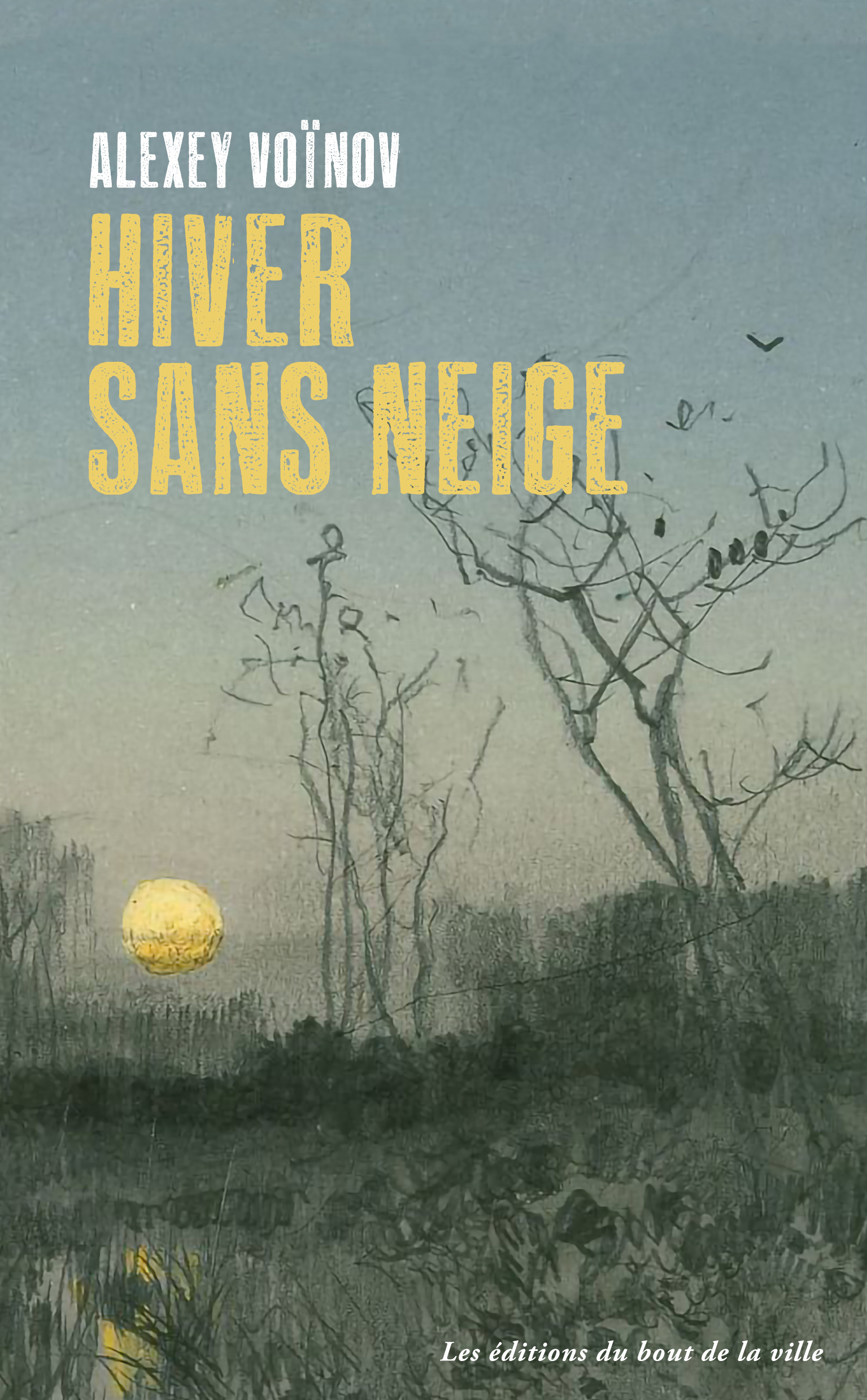
Hiver sans Neige | зима без снега (Winter without snow)
Alexey Voïnov
Translated from Russian by Guilhem Pousson
Les éditions du bout de la ville (2026) | Editions Tourgueneff