 Skip to content

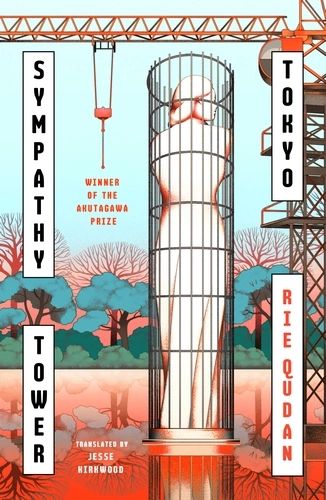
Sympathy Tower Tokyo
Rie Qudan
translated from the Japanese by Jesse Kirkwood
Penguin Random House, 2025
According to its director, Christian Bale found inspiration for his role of banker/killer Patrick Bateman in American Psycho (2000), when he watched Tom Cruise charm his way through a talk show appearance. « There was something about that friendliness, with almost nothing behind the eyes, » Bale told director Mary Harron. He had been struggling to find the right angle to play the role, and he apparently found it in the hollow gaze of a maniacally happy Tom Cruise.
Harron is not entirely clear about which talk show appearance Bale watched, but it’s likely one from the Rosie O’Donnell Show in 1996. The clip on YouTube shows twenty disquieting minutes of Tom Cruise being too friendly, too loud, too flirty. There is something unsettling about the interview, a mix of charm and emptiness, an off-putting vibe you can feel but not name. Like that perfect colleague who never breaks character, a neighbor who never skips the gym, like ChatGPT enthusiastically confirming my every thought — or like Sara Machina telling her younger lover: « I like you, you know. As humans go, you are quite pleasant. »

Sara Machina is the heroine of Rie Qudan’s novel Sympathy Tower Tokyo, a best-seller in Japan and winner of the prestigious Akutagawa prize. Set in near-future Tokyo, the book’s protagonist is Sara Machina (pronounced « ma-kee-na »), a successful architect commissioned to build a new prison — except no one is allowed to use that word. Instead, it will be called « Sympathy Tower Tokyo », and it will not house convicted criminals (another prohibited word) but homo miserabilis: those unfortunates whose upbringing led them to crime.
In the book’s speculative society, homo miserabilis is not deserving of punishment, but of our sympathy. Sara Machina intellectually grapples with many things throughout the novel: the ethics of the project (should criminals get to live in luxurious towers?), the nature of her profession (how does architecture make a city?) but mostly, she grapples with the slow corruption of language: should we keep rebranding things that could make us uncomfortable, like prisons and criminals?
Sympathy Tower Tokyo is a short book with little plot and big ideas. Sara Machina doesn’t discuss her many ideas as much with her younger boyfriend — a handsome shoe salesman called Takt — as she does with an AI chatbot, called « AI-built ». Not only that, but the more Sara Machina speaks with AI-built, the more she seems to be talking like AI-built. (Or like Tom Cruise.) There is something faintly psychopathic about that charming, eloquent star-architect of the novel who robotically programs herself to get eight hours of sleep no matter what:
This article is behind the paywall. Want to keep reading this article?
Subscribe to the European Review of Books, from as low as €5,00 per month.
Already a subscriber? Sign in