 Skip to content


The novel’s grisly premise hits you on the opening pages: Anna Chatterjee’s husband and two surviving children are journeying to the upstate New York prison where Anna is scheduled for release, after serving thirteen years in prison for the manslaughter of her severely disabled youngest son. But Anna has disappeared. Unbeknownst to her family, she was paroled some months earlier, and is now living under a new name as an indentured servant to an evangelical farming couple in Nebraska.
Monica Datta’s Nebraska (Astra House, USA, published June 2026) is the most brilliant and captivatingly weird and funny novel I’ve read in decades. It also requires from the reader a long-haul, high-intensity alertness, along with a willingness to go with the flow. This 462-page work shuffles kaleidoscopically between decades and continents, as it slips among the inner consciousnesses of its seven principal characters.
These are: the Chatterjee family – Prabir, a British-Bengali chemistry professor, teaching mostly in the US, who mail-ordered his wife Anna, sight unseen, from a village in Madhya Pradesh, and who regards her as an unusually inept and evil slave; their daughter, Nina Chatterjee, an architect living in Montreal and Shanghai, and their older son, Neal Chatterjee, an artist surviving off menial jobs in Paris and New York; and Jean-Louis Katz, the French-Canadian Lacanian analyst who was a passenger on the commuter train that kills Anna’s younger son. And finally, B.X. Roy, the neuropsychologist who acquires Katz’s papers at auction, including Katz’s archives on the Chatterjee family, and who is annotating Katz’s text – ie, this novel – offering his own encyclopedic footnotes, sarcastic comments, and willful misreadings. (Roy, I would say, is as close to a presiding deity and authorial proxy as Nebraska offers.)
All of Datta’s characters are multilingual exiles and transients living in a state of chronic cultural dislocation and/or trauma. At least four of the seven, perhaps not coincidentally, might be labeled as neurodivergent, their outlooks ranging from rapturous states of cluelessness-cum-revelation, to totalizing, world-engulfing phobias (the names of certain large scaly reptiles are denoted in this novel, out of sympathy for Neal Chatterjee’s terrors, as « a— » and « c— ») to a mere dark snarkiness. The result is an epic work in which language and sensibilities are deliriously off-kilter, where each new page contains annotations on synesthesia as a common condition in infancy; on the gender of nouns in Bengali, Hindi, and Sanskrit; or on how post-Partition Indians have largely been excluded – and self-excluded – from studies of transgenerational trauma, which skew Judeo-Christian. I particularly enjoyed Anna’s admission that she doesn’t like meat because « she could never tell, really, where she ended and the meat began. »
A comic – well, tragi-comic – novel about a mother who dumps her handicapped eight-year-old from his wheelchair into the path of an oncoming commuter train?? Really??? Monica Datta’s done it, and it’s a work of unbounded genius, and it’s only her second novel, so who knows what she’ll do next. Get Nebraska now, and meanwhile I’m going back to reading it all over again, because I’m not ready to leave the huge world she’s created.
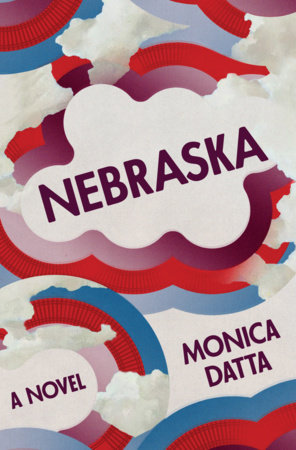
Nebraska
Monica Datta
(Astra House, USA, published June 2026)