 Skip to content


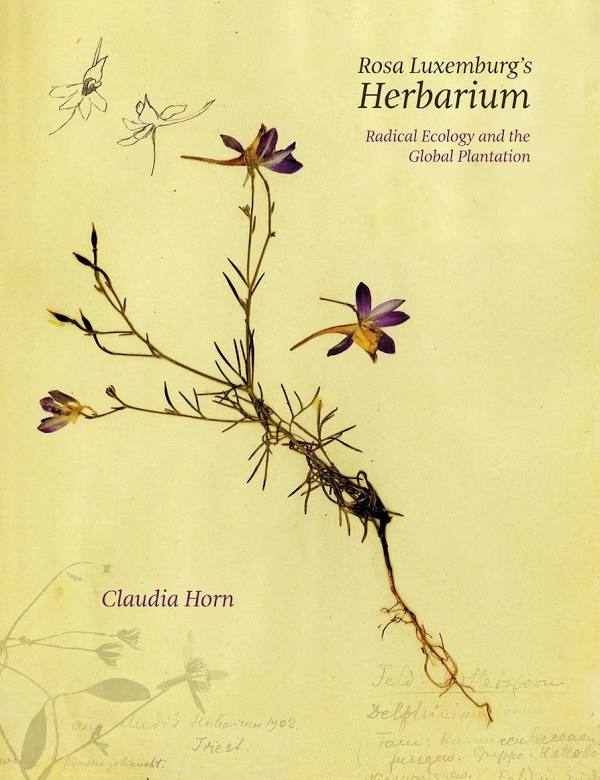
Rosa Luxemburg’s Herbarium
Claudia Horn
(OR Books, 2026)
Rosa Luxemburg was a theorist, politician and revolutionary murdered in Berlin on 15 January 1919, together with her compatriot Karl Liebknecht. She wrote about big words: Kapital, Krise, Sozialdemokratie, Revolution. Years ago, this impatient reader ran aground on her dense essays. But the universe of Rosa Luxemburg has now opened up to me.
On the desk before me lies a fantastic book: Rosa Luxemburg’s Herbarium (OR Books, 2026) by Claudia Horn, subtitled Radical Ecology and the Global Plantation. It consists of facsimiles of the notebooks in which Luxemburg pasted leaves between 1913 and 1918, building up a herbarium. She picked the leaves up from the ground in prison (she spent time there between 1915 and 1918), or friends sent them to her. The pages from the herbarium alternate with essays by Claudia Horn and with letters from Luxemburg, which I read in one sitting.
The essays make clear how nature and ideology are interwoven in Luxemburg’s work. Humans exploit the land, the crops and the animals, full stop. She isn’t romantic about primitive societies, but colonization and plantations were a particularly extreme category of exploitation. But beneath all that, and the labels (« feminist, decolonial eco-Marxist ») I found a Mensch. She writes beautifully about singing to a bird outside her window, and speaks not of her cell but of her room. She tries to stay undaunted, optimistic but never unthinkingly so, she lifts the spirits of the people outside. She could suddenly remark:
Hänschen, a wasp! Really the first young slender wasp, which obviously just woke up this morning, and it’s buzzing away right now in my room! It flew in through the open window and immediately hurled itself against the closed upper pane.
Less than twenty months later, she was seized by a citizens’ militia and handed over to soldiers. One knocked her unconscious with the butt of his rifle; another put a bullet through the head in which these beautiful thoughts lived.