 Skip to content

On the morning of 3 October, a friend I hadn’t heard from in a long time called. The question was right there again: who to vote for?
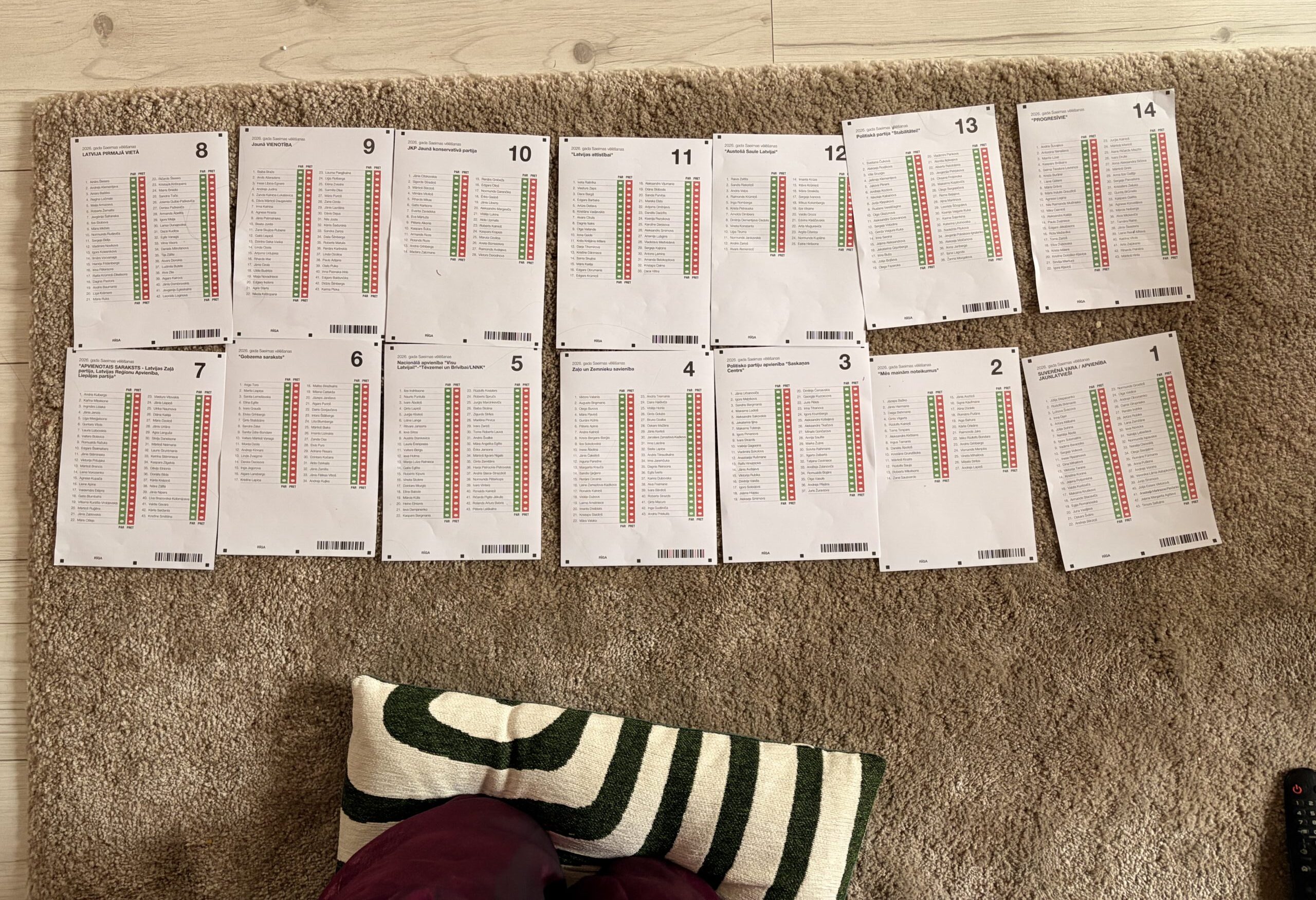
I had already cast my vote early. But as she was about to make her way from Amsterdam to The Hague, where her closest Latvian polling station was, we went through the ballots I had laid out in front of me on the carpet. On Saturday, Latvia elected a new parliament.
Wait, Latvian politics? Who’s in power there anyway, right? So let me lift the lid for you with two hot potatoes that aren’t Latvian-only.
First, Latvia holds part of the outer border of the EU and NATO, next door to (insert the sarcastic confetti here) Russia and Belarus. Four and a half years into its full-scale invasion of Ukraine, Russia sometimes feels like it IS the very backbone of Latvian politics: before left or right comes the hot mega-potato – are you Russia-friendly or not?
Then there’s the other hot potato: Istanbul Convention, the Council of Europe treaty on preventing violence against women. Latvia only joined it in 2024. Conservatives see its use of « gender » as a threat to traditional families (same as everywhere else where conservatives share their concerns; Bulgaria didn’t ratify it for the same reason). The treaty does not require same-sex marriage, but that part got lost somewhere. Last October, barely a year after joining the convention, parliament voted to leave. Thousands protested, the president sent the law back, and the question passed to the next parliament. That would be the one we just elected. Latvia would be the first EU member to leave the convention. Turkey left it in 2021.
These were the questions I saw hovering over the ballots on my carpet. We, the bubble, had been checking with friends, family, colleagues, occasionally hearing rumors about people saying: « Oh, I won’t vote. What’s the difference anyway? »
So – who won?
United List, the center-right alliance (ECR in the European Parliament) led by current prime minister Andris Kulbergs, won 41 of 100 seats. A clear victory, but still short of a majority. Pro-EU, pro-NATO and pro-Ukraine. Good. On the Istanbul Convention, however, its MPs voted to leave. Now the members suggest a referendum or putting the question in the fridge. For me and my bubble: watch closely, get ready to hit the streets if necessary.
Next comes the populist Latvia First. Its leader, Ainārs Šlesers, is a former deputy prime minister whom many know better as an oligarch and Trump admirer. He is not a quiet man: big on social media and uses AI-generated « slopaganda » campaign videos, including one that casts him as flying Agent 007. He promises to restore cooperation with Russia once the war ends. His party courts Christian conservative voters in a country whose biggest holiday is pagan midsummer, and wants Latvia out of the convention. Kulbergs says he won’t form a coalition with him. Tbc.
Third comes Sovereign Power / Young Latvians, led by Jūlija Stepaņenko. Asked who Crimea belongs to, she left the question unanswered. That should tell you enough about her stance on Russia.
Latvia has a large Russian-speaking minority. These voters don’t all think alike, but political scientist Jānis Ikstens describes Stepaņenko’s list as a destination for more radical Russian-speaking voters. The alliance’s supporters are also among those most opposed to the convention.
The nationalist conservative National Alliance is firmly pro-NATO and pro-Ukraine, and firmly against the convention’s definition of « gender ».
The left-of-center Progressives and right-of-center New Unity are pro-EU, pro-Ukraine and pro-convention. New Unity helped introduce legal partnerships, including for same-sex couples. Four years ago, it was the largest party; now it is the smallest in the new parliament (it’s hard times for one party to be in power for two terms and remain popular).
What next? Coalition talks, finding money to spend at least 5% of GDP on defense from 2027 to continue our existence next to Russia – a tough bill for our already stretched budget – and another round of arguing over the convention: parliamentary vote, referendum or fridge.

Election night I spent on my carpet, painting and watching the results. The first came from Latvians abroad, and things looked much better for progressive-minded people. As domestic counts were coming in, the results moved further right.
Turnout was just under 52%, the lowest since independence was restored. My social media feed is now hunting for people who didn’t vote. Suddenly nobody knows any, nor anyone who voted for Šlesers. Oh, bubbles.