 Skip to content


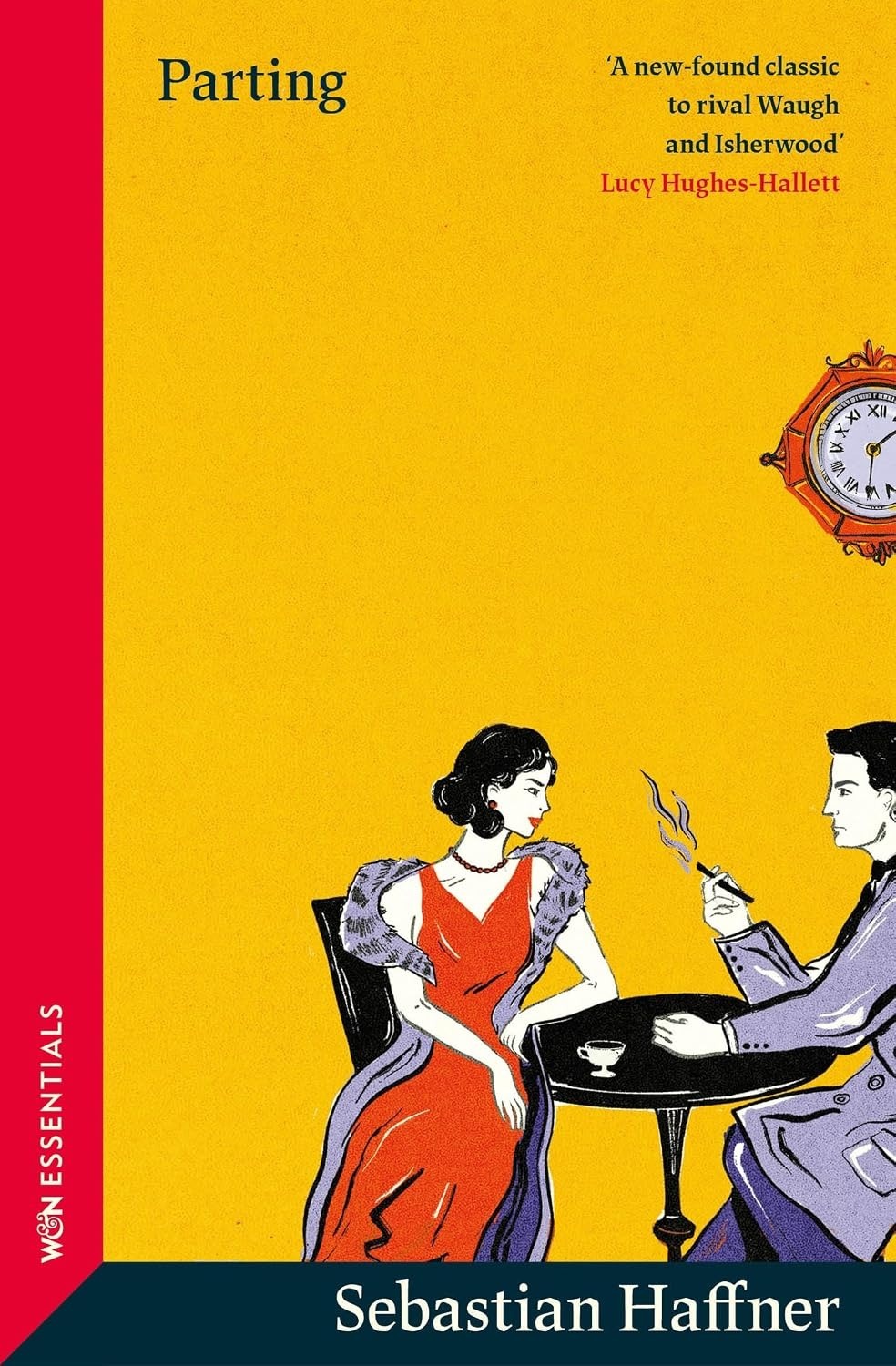
Parting (2025)
Sebastian Haffner
(W&N, translated by Michael Hofmann)
We need to talk about it because a) Haffner is a first-rate writer; b) there’s been hardly any coverage, but believe me, you want to read him; c) the story is a delicious love affair – and since it is set in Paris, let’s call it a folie; and d) Haffner does something strange that I don’t understand. A Current Preoccupation has to be short, so I’ll race through them.
a) First-rate writer. Most famous for Geschichte eines Deutschen. Die Erinnerungen 1914-1933 (2000), a literary sensation in Germany, published in English as Defying Hitler. I devoured his Winston Churchill (1967) and Anmerkungen zu Hitler (1978), two brilliant essayistic portraits in which biography is the engine. Abschied is an autobiographical novel he wrote in 1932, at 24.
b) Wake up!
c) Raimund is at the end of a visit to Teddy, who is studying in Paris and lives among a little band of cosmopolitan young people. The novel stops when Raimund’s train back to Germany leaves the station. The reader knows what Teddy and Raimund do not: the two are on the eve of Hitler’s seizure of power and the worst economic depression of the twentieth century (now that was a polycrisis). They swoon, they sneer, they know the world. Teddy and Raimund repel and attract each other. Teddy is the archetypal difficult girl. The maximum number of meals Raimund can talk her into is two per day. « You mustn’t get too used to it, » she explains. The descriptions of 1930s Paris are vivid. The Louvre is described as a city, its departments are districts, including the one with the ravishing broken bodies:
Suddenly they were all around us, on pedestals or in display cases: rough athletes’ legs and strong pale torsos, an arm here and a piece of breast and shoulder there, all smooth and white and of gleaming marble, with at the edges cracks and ruin, and everywhere the bare, black, rusty wire holding the remains together. There were goddesses, their bodies appearing grave with beauty, and only their robes smiled, stroking their breasts and thighs with the supplest folds; but their heads had been torn off, and from the ravaged neck stuck out a ghastly black metal wire.
One more, please, the first sight of the Eiffel Tower:
And there he stood. Legs planted wide, he stood there and let the street pass beneath him and rose up with his thousand steel muscles, the sky shining through them, and around his head a blackish cloud flew. All around him was room, empty space, freedom and air.
And on it goes with descriptions of the métro, the restaurants, streets and artworks, which brings me to:
d) When Haffner writes about books, he gets into the characters’ heads, but not to describe the book or to discuss the writing. He describes, for instance, reading Aldous Huxley’s Point Counter Point:
I read how he got into his car and drove to his girlfriend – supposedly to his girlfriend, but you already knew he was driving into the arms of his murderers, only he didn’t know it, he thought he was driving to his girlfriend, and today of all days, he was thinking, she would become his lover, it had to happen, there was no other way now. He loved to drive recklessly and drove hard and took the bends very hard, and he enjoyed the wind and the ride and the weather and tore off his hat and tossed it on the seat beside him.
When Haffner writes « you already knew », I am not included, for I have not read the book, but that doesn’t seem to bother the writer. He slips so far into the characters that he knows what they thought, how they were enjoying themselves. The retelling only makes real sense to someone who has read it. Why then does he crawl so deep inside that book?
Theory! Or, let’s call it theorette: literature is the truth before it makes sense. Whatever struck him, he wrote down, before asking why.
P.S.: Apologies, I only had a Dutch translation of the German original at hand, so I have translated into English from the Dutch, without eyeing the German.