 Skip to content

Editor’s note
On 30 October, the Putin regime officially shut down Novaya Gazeta, the last independent – and antiwar – newspaper to be published in Russia. After years of arresting and even murdering Novaya Gazeta’s journalists, raiding its offices, freezing its bank accounts, « They have killed us, » the newspaper’s staff wrote in a collective communiqué. Two weeks earlier, on 13 October, ERB contributor Gabrielle McClellan was in London, attending « The Price of Truth », a conversation sponsored by Pushkin House between documentary filmmaker Patrick Forbes and Novaya Gazeta’s Nobel Peace Prize winning editor-in-chief and cofounder, Dmitri Muratov.
Muratov, dressed in a black suit, leans forward with hands clasped, assessing the audience. His eyes are sharp beneath a heavy, solemn brow. « I am deemed a foreign agent by the Russian government, » he begins, « so each of you has thirty seconds to leave the room; you have associated with a foreign agent. »
The previous day, 12 October, Muratov explains, his entire editorial team at Novaya Gazeta went missing in Moscow – all of them, like him, have been deemed foreign agents.
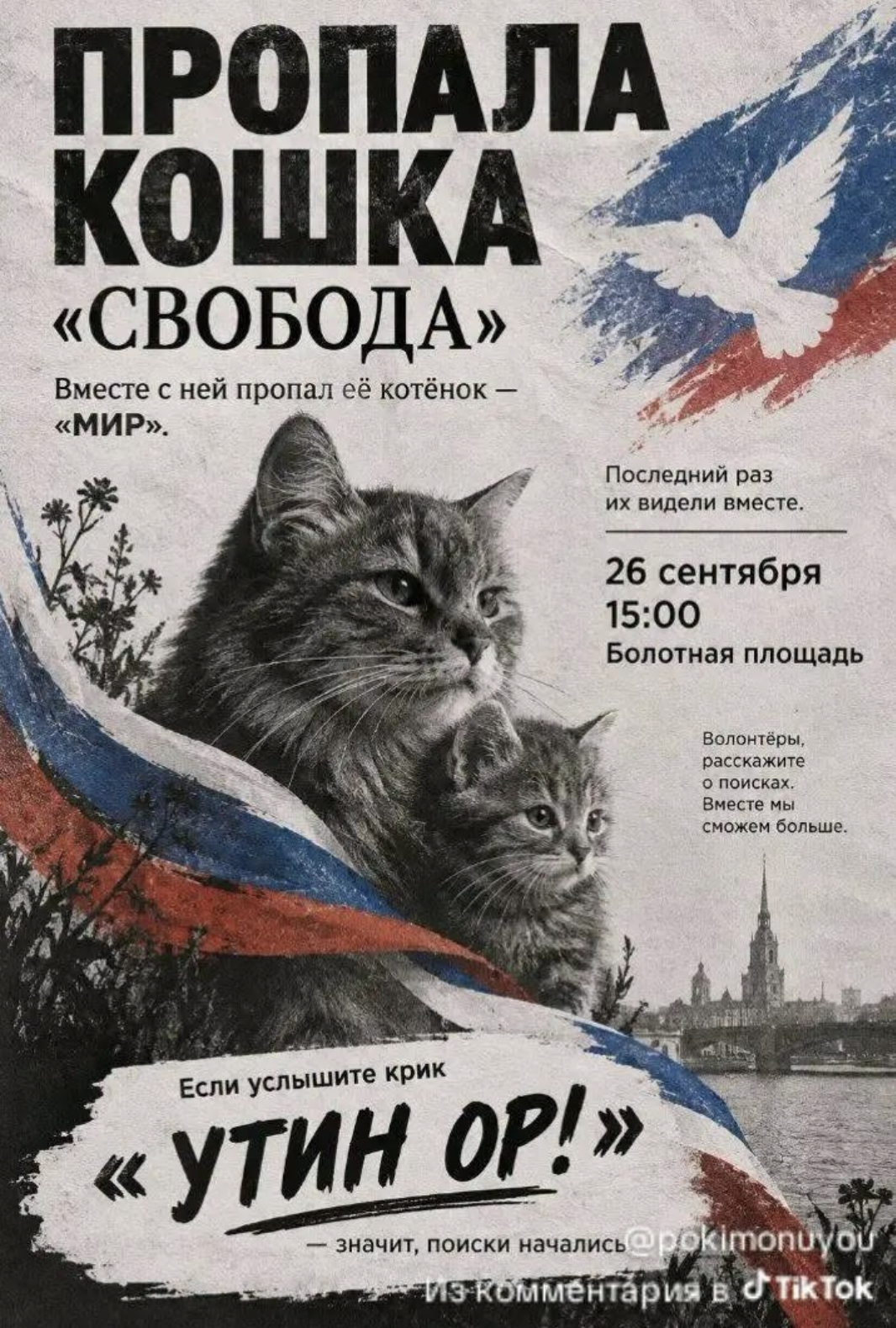
« I am tired of the question, ‘Why is everyone silent in Russia?’ » Muratov says. He holds up posters that have been distributed around Moscow. From afar, they look like missing cat posters, but on further inspection, they are too colorful, too animation-like.
« Freedom is missing, » the poster reads. « Have you seen my cat, Freedom? »
Freedom, the mother cat, and her kitten Peace, shown nestled beneath her chin, have both gone missing; they were last seen in Bolotnaya Square – the Moscow site of the Snow Revolution of 2011 and 2013, when tens of thousands of demonstrators turned out across Russia to decry Vladimir Putin’s election rigging.
Recently, Muratov says, he visited a bookshop located in a communal building in Moscow, the sort of bookshop where you can still find « everything ». The storekeeper handed him two books, explaining that they had been banned by Putin: one was the Russian Constitution; the other was the UN Declaration on Human Rights.
Muratov shows us photographs of Russian journalists and activists who have been imprisoned and tortured in the last few years. He holds up a photo of a woman’s bare back, apparition-like, against a black background: purple and brown and red marks from beating and torture cover her body from shoulders to thighs. « She is here with us, » Muratov says, waving towards the audience, « and she has given me permission to show you what was done to her. » Another photograph is of a young Russian woman. « She fell in love with a Ukrainian man in Sumy, » he says. « When she tried crossing the border to visit him, she was captured by the Russians, electrocuted and tortured, and now is in prison for fifteen years. »
He spoke extensively about Anna Politkovskaya, the Novaya Gazeta journalist who was assassinated on 7 October 2006. She had reported extensively on the Second Chechen War. In the headquarters of the Novaya Gazeta, there is a museum to Politkovskaya which last year was violated by Russian Neo-Nazis. Today, Muratov says, becoming a « torturer » is a highly lauded career path in the eyes of the Russian Federation, a « patriotic » pursuit. But saying the word « war » rather than « special military operation » will earn you ten, fifteen, or twenty years of prison.
In 2022, a hitman hired by Russian intelligence threw chemical-laced red paint at Muratov, permanently damaging his eyes. When asked that night at Pushkin House why he chooses to keep living in Moscow despite the dangers, Muratov replies: « Your choice in life is not death; your choice is the work that you do. »

A final issue of the Novaya Gazeta will appear on 9 November; a European version of the newspaper, based in Rīga, has been published since April 2022.