 Skip to content

In an age when everyone can make themselves heard, who still cares to listen? And what does it mean to be a good listener? In Listening, philosopher and literary scholar Miriam Rasch offers a philosophical and personal exploration of listening as an ethics. Not as a passive act but as an open-ended relationship between the self and the world, always mediated by technology, by technique and by the body. Rasch investigates listening in different registers: the distortions of algorithm and social media, the pitfalls of dialogue, the demands of testimony and witness. In the chapter we publish here in a shortened version, Rasch tries to do in her writing what she proposes: finding a mode of attention that is both conscientious and open. It approaches Virginia Woolf and a Wisława Szymborska poem about a stone with equal seriousness. All to try and let the essay form think something through rather than only argue a point. What could be more fitting for The European Review of Books?
ON STAGE
Sound undulates along the walls of the concert hall, filling the space and vibrating through people’s bodies from front to back and back to front. The stage is barely visible in the smoky, red-lit room. The shadowy figure producing such loudness from behind a high formation fades away against the curtains and in the stroboscopic flashes. I sit slumped back on a plush couch along the wall, trying with all my might to turn off my thoughts.
About three-quarters of the way through the performance, Pan Daijing steps out from behind her instruments, walks past them to the right side of the stage, and, standing in front of the loudspeakers, turns her back to the audience and stretches out her arms. It looks like a total surrender to the sound she herself produces, and an invitation to the audience to do the same.
During an introduction to the festival where Pan Daijing performed, composer Remy Alexander had explained how, when we listen to music, we try to predict what is to come, based on the memory of what we’ve just heard. In that way, memory and prediction guide us through a piece. Experimental music, however, requires you to abandon the urge to predict and not to incorporate the sound into what you already know, not to shove it away if it doesn’t fit within your expectations. I resolved to practice surrender.
How do you actually do that: listen? Not to other people, but to sound itself? Thinking about surrender is different from practicing it.
Six months after the festival, I attend a performance by composer Huba de Graaff, who has been working in experimental sound art since the 1980s. As the performance begins, the audience, scattered around the studio, closes their eyes. A deep concentration descends upon the room. Earlier, De Graaff explained how she collects sounds, some of which are found by chance and some of which she invents herself and then reproduces as best she can by other means. The chirping of a blackbird meets the metallic sound of a bicycle falling and so a whole new sound is created.
I watch the musicians and see how what I hear now comes into being. Then I decide to close my eyes, like the other visitors. Immediately I’m bombarded with images. An anxious mood sets my nerves on edge. The music suddenly becomes scary and menacing, like in a David Lynch film. Memories, associations, and physical affects wash over me. I see my mother, who died not long ago, before me.
I quickly open my eyes again. I look at the concentrated faces around me. What’s going on inside all those bodies while they listen so calmly? I try to imagine the unheard voices of their inner selves, how they whirl, sigh, and scream, barely held together by the bodies sitting still on the benches.
Distracted, again.

SOUND AND IMAGINATION
When we listen to music, we oscillate between remembering and predicting. Can we let go of that? These words echo the ideas of others who emphasize that listening requires, above all, suspending one’s preconceptions. After all, preconceptions are also a kind of prediction based on memories. Listening to music, then, might be a good exercise in battling bias.
It also helps us to notice more than what we see. Preconceptions often revolve around imaging. When I listen to someone, I have an image of that person in my head. This can be a metaphorical image, but it’s often also concrete. Letting that go isn’t easy. Even when I close my eyes while listening to a performance, images assail me. I can’t seem to stop myself from turning what I hear into something visual, as if I’m a listening algorithm translating sound data into readable graphs.
When I think back on my mother’s hearing loss, I see her hearing aid and the confused look in her eyes when she couldn’t follow the conversation, I see her crooked finger, which she used to emphasize her own words even though they were always spoken loud enough. But when I think back to the last days in her house, I am overcome by a very calm silence; I had never heard it that quiet before. It was as if I had entered my mother’s minimal hearing; it filled the living room like an invisible mist of anti-noise.
(UN)COMMON SOUNDS
Listening is super accessible and arduous at the same time. Sensitivity to sound develops as early as the mother’s womb, and still, listening well doesn’t come naturally. Even a short meditation will tell how much effort it takes to sit quietly and pay attention for a few minutes, and how many sounds usually go unnoticed. Apparently, it’s not only difficult to listen to other people; « just » hearing sounds or tones is also hard. I believe the two are connected, that paying attention to the meaningless can make you receptive to the meaningful.
It also benefits our fragmented concentration. In Quantum Listening Pauline Oliveros recounts how she taught herself at a young age to constantly direct her attention back to the sounds around her. It all starts with asking: What do you hear now? And now? And now again, fifteen minutes later? Listen to your own listening and suddenly you hear all sorts of things that previously merged into the background. On my way to Huba de Graaff’s performance, I try it out. I hear a carillon chiming high in the sky, the roar of cars and the hum of air conditioners, the tinkling laughter of children on their way to the next adventure, and sudden silence, rustling with life.
It reminds me of the lockdowns during the pandemic. The streets, the city, and the skies were quieter. So you heard more. I remember how the sound of opening and closing the kitchen drawer struck me. That simple sound was somehow associated with a sense of freedom, because I was the one opening and closing the drawer, causing the sound to come to life, and no one could stop me.
While searching for sources about listening, I found several guides on how to listen to others, nature, and your body, as well as to all the everyday sounds in your home and on the streets. One guide recommended moving slowly around the room while making a recording with your phone. It suggested staying low to the ground in a corner of the room and snaring sounds in a web as if you were a spider, and invited you to keep your eyes closed upon waking and then deliberately opening all your senses at once.
Websites such as Cities and Memory collected #StayHomeSounds, local sound recordings of the pandemic. Artist Elise ’t Hart composed a Symphony for House Sounds, for which dozens of people contributed re-enacted sounds from their homes. In Engaging with Everyday Sounds, music philosopher Marcel Cobussen writes about soundscapes that he recorded during the lockdowns, which made everyday sounds uncommon again. The unknown entered the all too familiar: « My encounter with the (sounds of) the trashcan-wind-pontoon assemblage already revealed the potentiality of the everyday as encompassing both the ordinary and the extraordinary, both the known and the unknown. » This sounds like a Bakhtinian happening, not between people but with things.
Technology often plays a role in these types of listening exercises. It enables you to capture sounds before they disappear, allowing you to study them at your leisure. While Pauline Oliveros had to use an old-fashioned tape recorder, today almost everyone carries a digital recording device in their pocket that can capture sounds and create soundscapes. Creating such field recordings is a form of listening practice in itself. It helps train your attention, as for Oliveros, but it also helps you become aware of a multitude of perspectives.
This richness of perspectives exists not least because sound resonates in an inner space. A space formed by memories and hopes, desires and fears. The sound itself becomes a memory as well. It transforms from a physical event into something immaterial that lives on inside you. Thus, external sounds are constantly in relation to internal voices. Listening can be called transgressive by definition — by making recordings, you capture the transgression. The goal should not be to freeze it in time, but rather to keep it alive and breathing, at every moment you play back the recording. In other words, the goal is not to take possession of the sounds but rather to enable a dialogue with them.
Or is such a focus on inner space too much centered on the self again? Not necessarily. The title of Haytham El-Wardany’s listening manual How to Disappear implies that good listening is a kind of fading out. After concentrating on and paying attention to the noises around you for a while, you will blend into the background. Your body merges into the environment and the voices in your head fall silent.
TIME-SPACE CONTINUUM
In her final novel Between the Acts, published shortly after her death in 1941, Virginia Woolf presents a scene reminiscent of John Cage’s renowned 1952 piece « 4’33 », in which musicians do not play their instruments for four and a half minutes, in order to allow —nonexistent — silence to resonate. Miss La Trobe, the director of the annual village play, also wants to give space to the daily silence-that-isn’t-silence on her stage.
Miss La Trobe stood there with her eye on her script. « After Vic. » she had written, « try ten mins. of present time. Swallows, cows etc. » She wanted to expose them, as it were, to shower them, with present-time reality. But something was going wrong with the experiment. « Reality too strong, » she muttered. « Curse ’em! » She felt everything they felt. Audiences were the devil.
That devilish audience doesn’t get it! Unlike Cage’s musicians, they don’t realize they are part of the performance. To see the present and hear the silence, you have to pay attention. But they are distracted, most of all by their own thoughts. This also applies to Miss La Trobe, by the way; her inner space makes itself heard just as loudly.
« Try ten mins. of present time » sounds like an exercise in deep listening. Pauline Oliveros’s practice of Deep Listening (©) has grown into a polyphonous collection of listening techniques, especially involving the nonverbal. Sounds from nature, the sustained tone of an instrument, the echoes of voices in space, breathing, or wind. Exercises are written out in « listening scores » and « sonic meditations, » around which communities, retreats, and trainings have formed.
Although such listening may seem direct and immediate, it’s highly mediated by sophisticated, albeit mostly analog techniques. Oliveros points out that there are many ways of listening, and the technique you choose determines what you hear. The simplest distinction is between « global attention » and « focal attention. » At a workshop, deep listener Sharon Stewart lets participants, myself included, experience the difference. Outside, we stand still, somewhat uncomfortably at first. Then we close our eyes and, under Stewart’s guidance, listen to the environment. First, we let the floodgates open — global listening — then we follow a single sound — focal listening — then the floodgates open again, and so on. I especially notice that sound moves around a lot, whizzing from left to right, flying up and down, and disappearing into the distance. Noises swirl around us as we stand rooted to the spot like trees along the water’s edge. Ten minutes of present time.
It is also possible to focus on remembered or imagined sounds. Take the following list inspired by Oliveros: Soft footsteps. Children giggling. A door closing. Water dripping. A dog barks. Simple, ancient sounds that are deeply ingrained in human memory, by — yes, by what? Life and nature, songs and stories, as well as movies and commercials. These sounds reside somewhere in our minds, in our inner space. As soon as you hear them, the boundary between outer and inner world is crossed.
I’m reminded of the Mastodon account « sounddescription » (« random sound descriptions from movies and TV series »). Every few hours it lets a sound echo in your head: [car honking], [muffled voices on TV], [machine beeping insistently]. These artificial sounds we carry with us, too. They surface without effort. Understood this way, listening need not be complicated after all.
Deep listening in the here and now is thoroughly physical. It doesn’t belong solely to the domain of the ears; the shoulders, heart, and belly participate as well. « I heard it with my back, » someone told me after Huba de Graaff’s performance. And although I couldn’t imagine what that would be like, I believed him.
Hearing is not just for the ears anyway. After all, we feel the vibrations from sounds in the air. In her « Hearing Essay, » percussionist Evelyn Glennie describes how she listens, as a profoundly deaf musician. Her whole body participates in the process, from the indispensable lip reading to perceiving a range of vibrations through various limbs: « The low sounds I feel mainly in my legs and feet and high sounds might be particular places on my face, neck and chest. » However, Glennie emphasizes that all listening, even by those with the best hearing, relies on picking up vibrations. That’s why she calls hearing « a specialized form of touch. »
After the listening exercise outside, the workshop participants perform another of Oliveros’s compositions: the « Extreme Slow Walk. » I’ve been looking forward to this, the absurdity of it. In the parking lot in front of the studio, we begin walking in slow motion. It takes enormous effort to move as slowly as possible, shifting your weight onto one foot and then taking a step forward like a clumsy yet graceful Big Bird, so much so that I completely forget to listen. Halfway through, with one leg in the air, I think of Oliveros, who constantly draws her attention back to herself. What do you hear now, and now, and now, a minute later? While keeping my concentration focused on my muscles, I try to prick up my ears. And then suddenly, it seems as if my ears are everywhere. In my toes, on the top of my head, yes, even in my back. The soles of my feet listen to the paving stones and even deeper, to the earth beneath.
Deep listening means perceiving as many sounds and tones as possible, from across the time-space continuum. One complicating factor is that humans are part of that same time-space continuum. You will inevitably discover this when you slow down to the extreme.
NATURE SPEAKS
Many listening exercises, including those of deep listening, involve the natural world. Indeed, the fact that listening is in the spotlight today has as much to do with polarization as it does with the desire to restore our relationship to nature. But while polarization calls for interpersonal and verbal listening, nature calls for listening to the nonhuman and nonverbal. And though it has a clear purpose, this type of listening too necessarily begins with not-knowing, which can never definitively transform into knowing.
Nature isn’t typically considered a source of knowledge in its own right. Rather, our current relationship with nature is one of submission, extraction, and domination. We want nature to obey us and do what we want, as efficiently and profitably as possible. Or it’s an object of inquiry, itself inert and lifeless. As the opening sentences of The Mushroom at the End of the World by anthropologist Anna Lowenhaupt Tsing state:
Ever since the Enlightenment, Western philosophers have shown us a Nature that is grand and universal but also passive and mechanical. Nature was a backdrop and resource for the moral intentionality of Man, which could tame and master Nature. It was left to fabulists, including non-Western and non-civilizational storytellers, to remind us of the lively activities of all beings, human and non-human.
Nature was always on the receiving end. But now it’s our turn. First, because nature is making itself heard loud and clear and humans — like everything else — will not escape the consequences of a changing climate. Second, hopefully, because we are finally beginning to take the role of receiver seriously. Instead of treating nature as a resource without agency that we can do whatever we want with, can we learn to recognize it as a speaking entity that we can listen to?
This idea is not new. One of the first books to address humanity’s destructive impact on the natural environment was Rachel Carson’s 1962 book Silent Spring. The title refers to the silence resulting from the mass death of birds and insects, which in turn is due to the use of pesticides. Although environmental pollution may seem abstract, it can be heard simply by listening.
For many communities, however, such listening has always been « natural, » as has the sense of being in a relationship with nature —and not one of master and servant. In Braiding Sweetgrass, for example, biologist Robin Wall Kimmerer explains how for the Indigenous peoples in the Americas, a mutual relationship or rapport with nature is paramount. The « non-Western storytellers » that Tsing mentions have valuable insights to offer on this topic. So do nonhuman storytellers, says Kimmerer. Plants, trees, crops, and animals have inhabited this planet much longer than humans have. We can learn a great deal from their experience: « Plants were here first and have had a long time to figure things out. … What if Western scientists saw plants as their teachers rather than their subjects? »
Anna Tsing refers to her approach to inquiry as « polyphonic assemblage. » Polyphonic, thus, without proclaiming a singular truth, and assembled, so, composed and movable.
Nature, I propose, is a witness, that tells stories without a beginning, middle, and end, and from which a chain of testimonies unfolds, always handed down and therefore always mediated: by the scientific categories we use, by fables and stories, and by technology. Hearing these testimonies begins with opening the senses, which anyone can try. In the backyard, at the park, or on the beach.
The « Embassy of the North Sea » explores how the voice of the sea can be represented in politics and jurisprudence. This has happened before with the Whanganui River in New Zealand, for example, that has been recognized as a legal entity since 2017. The first step in the Embassy’s research is to listen, otherwise, one cannot know what the sea « wants » and how to represent that.
For most people who can hear, the sound of the sea is easily retrievable from memory, whether from personal experience or from movies or TV. Of course, that’s not what the sea really sounds like. The sea can also be called a polyphonic assemblage. The Embassy writes, « What sounds do you hear on the beach? The roar of the surf, the whistling of the wind, a constant noise that swells and softens again, the hiss of the foam dissolving on the sand. »
To most ears, these individual sounds will come across as a constant noise that is sometimes louder and sometimes softer, but mostly indefinable and meaningless. However, labeling something as noise often amounts to dismissing it as without value.
To understand the sea, you need all your senses. When facing the superhuman forces of the sea, one must also exercise humility. On the beach, you are part of a larger context. Nature is not a backdrop for your main character fantasy but a participant in the conversation, moved, like us, by the dialogic principle. And at the same time, cutting through established avenues of communication, always retreating, never fully revealing. To decipher the stories it tells simply by existing, you need patience and curiosity, abandonment and discipline, a letting go of memory and prediction.
TECHNIQUES OF ATTUNEMENT
There were, of course, always the birds. Their twittering was first written down in notations on paper until technology made it possible to record it and later to capture it in distributed and automated ways, covering large areas and long timespans. Technologies that can be employed as much out of an urge to know as out of wonder. Composer Olivier Messiaen, for example, recorded birdsong so he could incorporate it into his work. Using his tape recorder was the initial, technological mediation, but incorporating these sounds into music can also be considered a form of mediation, using highly sophisticated techniques of creation.
As an amateur birdwatcher, I’m stuck to the species in my inner-city garden. Sometimes I use my smartphone to record the noisy evening chorus, during which they seem to sing all at once, without noticing each other. But my recordings are only intended as reminders of a moment and not in any way as art.
My favorite sound is that of the wind in the trees. Tall trees, and not too much wind. The sound should come from the leaves moving, not from the air blowing on my ears. As sound engineer Olivier Nijs says in an interview, « What’s intriguing about wind recordings is that the wind is only audible in the things it touches and moves. Each type of tree has a different sound. Conifers are much quieter than deciduous trees. … A catalpa has thick, large leaves, and sounds coarser than an oak, which is more likely to rustle. Birches have smaller leaves than oaks and need less energy from the wind to be addressed. » It sounds like he is describing the various instruments available to the wind. I would like to learn to play them, too.
On a walk along a river in the countryside, I come upon an overgrown path at the foot of a dike. Two trees — poplars, I think — stand about fifty meters apart, singing a duet high up in the air. I decide to record them with my phone. First I walk back and then up the path again, until I’m standing right between the two trees. Then I turn from one poplar to the other. It’s as if I am performing along with them. When I listen to the recording, I can hear the sound going back and forth between the trees, even through my phone’s mini speaker. I zoom in on the leaves, each one swaying separately yet also moving all together in one fluid motion.
It makes me realize that I am a guest here. I walked up this path to find these trees that have been here for decades. I may be the center of my own world, but that’s it. The trees are doing their own thing. I’m merely a witness. By turning around and walking back, raising my head and the phone in my hand, I change my perspective and with that I change what I hear. It’s like turning an object around in your hand to see it from all sides. Only I’m not holding an object; what I perceive surrounds me. I cannot listen in a distributed way; I can only listen situatedly.
If we are to relate to the world in a meaningful way, we need techniques in addition to technology. Like those of deep listening, field recordings, and music. Plus entirely unique techniques discovered through listening itself. Philosopher Ike Kamphof did this in relation to her chickens. How does one listen to the animals that scurry around the backyard, laying eggs? Kamphof began by focusing her attention on the chickens’ rhythms: « I had to learn how very important it is for chickens to go to sleep at a specific time indicated by their bodies… Human mechanical time says little about their biorhythms. As long as they depended on me as chicks to reach their roost, I had to learn to listen to their bodies, the slowing of their pace, their habit of brushing their feathers together one last time. »
In short, she learned to attune her own rhythm to theirs. Such an alignment succeeds only if you use your whole body. The same goes for Kamphof’s second technique, which is mimesis, or « an inner imitation » of what she observes in the chickens. In the soles of her feet and hands, she tries to imitate the typical way a chicken puts her legs down. This inner imitation leaves any simple form of hearing far behind.
So does the last listening technique Kamphof mentions, « reciprocal articulation. » What really interests the chickens (besides food) and how can their owner play a role in providing that? She asks the chickens questions, like Robin Wall Kimmerer did to plants. Or like Vinciane Despret, who wants to get to know birds by turning the perspective around, asking: What does the bird pay attention to? What does it long for? Or: How does it move through the time-space continuum?
RESONATING WITH A STONE
Resonance is becoming a popular concept, due in no small part to the work of cultural sociologist Hartmut Rosa, who has put it on the map as a value under pressure in technological times, among others in The Uncontrollability of the World. Resonance occurs when you are affected by something external, such as a piece of music, a landscape, or another person. It’s a moment of touch. You feel you are being addressed and that you may react, though you can never fully possess that which touches you. It’s uncontrollable or unattainable; it will always partly escape your grasp. For instance, you can own an LP or a photograph, but not the music or sunset captured on it.
This would render the practice of recording bird sounds with a smartphone — often against the backdrop of a sunset — pointless and perhaps even reprehensible. It could be seen as an attempt to take control over the uncontrollable. For Rosa, it seems impossible for resonance to be mediated by (digital) technology. But isn’t that too strict? I can’t control the wind in the trees, and yet making a recording helps me establish a meaningful relationship with the trees and the environment, with myself, and even with something as uncontrollable as beauty.
Rosa rightly points out that acceleration and fragmentation undermine the experience of resonance. Conversely, that means that resonance demands slowing down and concentration, and that means distance from our screens. Chances are, the moment I grab my phone to start a recording, I receive a message that swallows up my attention, taking me away from the bird chorus or tree duet. I would be better off using a professional recorder or camera, preferably without an internet connection. Even then, however, my experience of resonance would be mediated by a technological device, and I would be preoccupied with trying to control the uncontrollable.
To experience resonance, Rosa argues, one must learn to listen carefully. He frequently mentions the importance of paying attention to the appeal that goes out from the world. « This is what mountain climbers mean when they say that every mountain has ‘its own character,’ and why sailors say that you have to listen closely to the sea to understand it. » I suspect that in doing so mountain climbers and sailors to a large extent rely on intuition, that they have developed a kind of third ear for the natural world before them. But they must also rely on technologies to climb and navigate, gauging depth and altitude for them as a kind of extension of their senses, much like a musician whose instrument becomes an extra body part. Their listening must be a super-focused state of perception, as well as a unification with the world, of which technology is a part. It cannot be done without instruments.
Resonance is an encounter of discipline and surrender, a strange paradox in which the active and passive merge. Something external touches you; it happens to you. And then, it evokes an efficacy of the self: the ability to respond and bring something about through your own actions. Resonance requires both touch and response, but being touched by something beyond your control must come first. Just as listening precedes speaking and the trees are present before I hear their rustling.
In addition to self-efficacy, I believe there’s also something you could call “self-afficacy”: your ability to affect or touch others. The importance of this should not be underestimated. Just as I am the center of my own world, which I share with all sorts of others, creatures, trees, buildings, structures, and systems that interact with me and impact me, so, too, is everyone else. And for them I belong to what’s out there, to that which can touch them in an instant, for better or worse.
Juan Arturo García’s film Time, Displaced tells an enigmatic story about a nuclear reactor in Colombia, where research is being conducted on the primal sounds of the earth, which are both unimaginably loud and tiny. Can you hear a mountain grow? someone asks. Perhaps you can, is the suggestion, if you try to listen to the « mumbling » of atoms, as happens in nuclear reactors. « All matter sounds all the time at an atomic level simply because it is vibrating. Sounds can be heard in the spin of electrons, in the quanta of atoms and in the structure of molecules, » writes Marcel Cobussen. With enough processing and amplification, this rumbling can become audible to the human ear, much like the cosmic background radiation of the Big Bang.
García’s film reminds me of a poem by Wisława Szymborska, in which someone tries to have a conversation with a stone. It starts with a knock on the stone’s front door and a rather audacious plea:
« It’s only me, let me come in.
I want to enter your insides,
have a look around,
breathe my fill of you. »
The rest of the poem gives the account of a failure. The person’s knock draws attention to itself, demands entry, as if saying, « Listen to me! » The stone, however, is adamant and urges the visitor to go away. It has no desire to let this uninvited guest in. And despite persistent pleas, access remains closed.
In Time, Displaced, someone is also knocking on a stone, as if trying to extract the earth’s secrets. There, too, the knocking is in vain. The stone remains indifferent to this human way of communicating or transmitting. The perspective leads in just one direction. Then, the boy picks up an old-fashioned set of clackers, that act as a kind of pendulum. Perhaps these will enable him to descend into the stone’s interior and its constituent particles, which also clack, and that have empty spaces stretching out between them.
Szymborska’s visitor flatters the stone with the empty halls that make up its interior, but that remain unappreciated if they can’t enter, « their beauty in vain, / soundless, not echoing anyone’s steps. » But the stone holds firm. I understand. This person’s pounding shows little empathy. They may consider themselves curious, but it’s at most a narcissistic curiosity, which subjects others to their own gratification. The poem ends in an aporia. One last knock and plea is followed by the stone’s final answer: « I don’t have a door. »
I interpret this as: not-knowing is fundamental. But then, it is all the more remarkable that I was nevertheless able to listen to the stone, through Szymborska’s poem.
AESTHETIC RELATIONSHIPS
Techniques and technologies mediate our relationship to the world, each in their own ways. In such mediation, not only ethics matter but aesthetics too, the doctrine of beauty and of sensory perception. All examples of good listeners (to nature or otherwise), employ particularly attentive forms of perception, an aesthetics you could call it, whether regarding chickens, the sea, mountains, or a stone. From such observation arises dedication; aesthetics and ethics appear intimately entangled.
It’s not surprising when attentive observation develops into a meaningful relationship. To begin with, it trains your sensory discernment. At first, you only hear the uniform noise of the sea or the deafening twittering of the general category of « birds » at sunrise or sunset. Gradually you learn to distinguish details and hear (and see) blackbirds, thrushes, robins, pigeons, wrens, sparrows, finches, great tits, and so on.
Biologist David G. Haskell argues that the senses « bring us great pleasure at the same time that they’re orienting us to the important work of ethical discernment. » To care about a bird, you must recognize it as a « somebody. » And that starts with attentive observation. Your attention is like a line you cast outward and that touches another. Now, you are implicated with one another. Haskell continues, « Using aesthetics — well-informed, deeply rooted aesthetics — as a moral guide is something that needs to come back into fashion. » Birds, he says, are a prime example. They have long provided us with aesthetic pleasure and are thus a « gateway drug » to a different relationship with nature. (Let that ingenious idea sink in: birds as a gateway drug.) By learning to recognize and appreciate the beauty of birdsong — in short, by perceiving it aesthetically — you also learn to know and appreciate birds on another, ethical level. Why wouldn’t that apply to other areas of being as well?
I was delighted to discover that the etymology of the Dutch word « waarnemen », meaning « to perceive », refers back to « paying attention to, caring for ». « Waar » means care or attentiveness, in the sense of wanting to protect or guard. The more general meaning of « to observe » or « to notice with your senses » is what remains in the dictionary (next to temporarily taking over someone’s tasks or position). This rich etymology indicates a connection between hearing or seeing something and taking care of it. At its core, perceiving is a matter of attention, which has to do with concentration as well as care. Aren’t all the different listening techniques I’ve come across in fact techniques for perceiving through paying attention? And thus, techniques for caring, not by simply agreeing, but rather by staying open before making judgments — and so, ultimately, for being able to judge with care?
This brings me back to the complicated notion around which so much of the tech industry revolves. One could argue that online attention is about perception; what counts are the literal numbers of eyeballs that have encountered something. But that throws perception and attention onto the same quantified pile, with care as exiled excess on the road to profit.
Aesthetic discernment — which is also ethical discernment — is indispensable because perception can easily be fooled in an era of deep fakes, AI, and other manipulations. That makes being attentive all the more urgent. Not so much through questioning whether something is real or not but rather in considering how different techniques shape our perception and what their implications are. How aesthetic discernment can be trained, in order to move towards ethical relationships. From the self to the other. And finally, from listening to speaking.
INTERIORITY AND TOGETHERNESS
Even if it is foggy or noisy in there, interiority should be the starting point. Although tech companies like to deny its existence, even a short listening exercise lets you hear its echo. In her journal, Marion Milner describes how she listens not only to music but also to her own thoughts. She discovers there are two Marions: her conscious self and a voice that answers when she lets her thoughts run their course. She resolves to investigate that second voice more closely, including through automatic writing.
It’s not a surprise if a psychoanalyst discovers that her automatic voice — which could be called the voice of the subconscious — speaks from childhood fears, full of negativity and uncertainty, casting an irrational shadow over her adult existence. This seems to explain why she has so much trouble making life decisions; she is ruled by two conflicting selves. However, this realization alone is enough to settle the battle. She writes, « It puzzled me that these back-of-my-mind thoughts should have such power to spread an emotional shadow. Time and again I would find one of them filling me with gloomy forebodings and yet, when I had caught it and turned my searchlight upon it, it was but a little thing, a trivial difficulty which I knew quite well how to surmount. » This sounds like Milner possesses an extraordinarily tidy mind, despite those two selves. A few childhood voices wail through but those can easily be defused — not everyone will recognize themselves in that.
Nevertheless, it’s healthy to listen to your subconscious with the intention of getting to know what you hear, rather than wanting to express it directly. Which doesn’t mean you shouldn’t express yourself; it mainly indicates that the automatic thoughts that bubble up are usually not the most helpful, insightful, pleasant, or desired ones. Or the most true or real, either. Too often, automatism is confused with authenticity.
Apart from this tangle of voices that must be tamed with persistence and rationality, the inner self must remain obscure and impenetrable, a thing as unknowable as anything else around you. We have that in common with the stone. You might say the stone has no inner being; its outside is its inside. Yet that stone too has an existence and a history, and you can approach it as a someone. It has a perspective, at least aesthetically speaking. You can establish a reciprocal relationship with it. It may start with you, but it doesn’t have to end there.
That reminds me of another one of Virginia Woolf’s novels, The Waves. A chorus of different voices tells the story of six, seven friends. Or maybe it’s a chain rather than a chorus. The individual voices, lives, and bodies remain distinct, alternating in their oral testimonies. A shared chain of witnessing unfolds, a collective perception, moreover, one that is embedded within a planetary consciousness.
Woolf captures that planetary stream of consciousness in passages featuring trees, birds and, of course, waves; scenes of night and day and back to night, of sunrise, zenith, and sunset, darkness and light, energy and lethargy, and death. How the birds « swept and soared sharply in flights high into the air, twittering short, sharp notes… Now and again their songs ran together in swift scales like the interlacings of a mountain stream whose waters, meeting, foam and then mix, and hasten quicker and quicker down the same channel, brushing the same broad leaves. But there is a rock; they sever. »
I was about to disappear in the stream of sounds, but then. « Listen: a whistle sounds, wheels rush, the door creaks on its hinges. » I turn my head, hear the noises move around me. « I regain the sense of the complexity and the reality and the struggle, for which I thank you. » I turn another quarter to face the other. « And with some pity, some envy and much good will, take your hand and bid you good night. »
I know I can’t stay quiet, not forever.
I nod, I say, « Goodbye. »

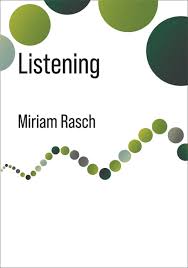
Listening
Miriam Rasch
(Columbia University Press, 2026)