 Skip to content

« Look Mickey! »
By Fernanda Eberstadt
Late October is New York’s sweetest moment. I’m in town for the week – which is about as long as I can stand, before the old demons that originally drove me from my birthplace to Europe get too clamorous.
The skies are guilelessly blue, the maple leaves are teetering on the verge of crazy crimsons and purples; in Union Square Farmers’ Market, the Galas and Northern Spies and Winesaps are laid out so crunchy and tart that the air seems to smell of cider.
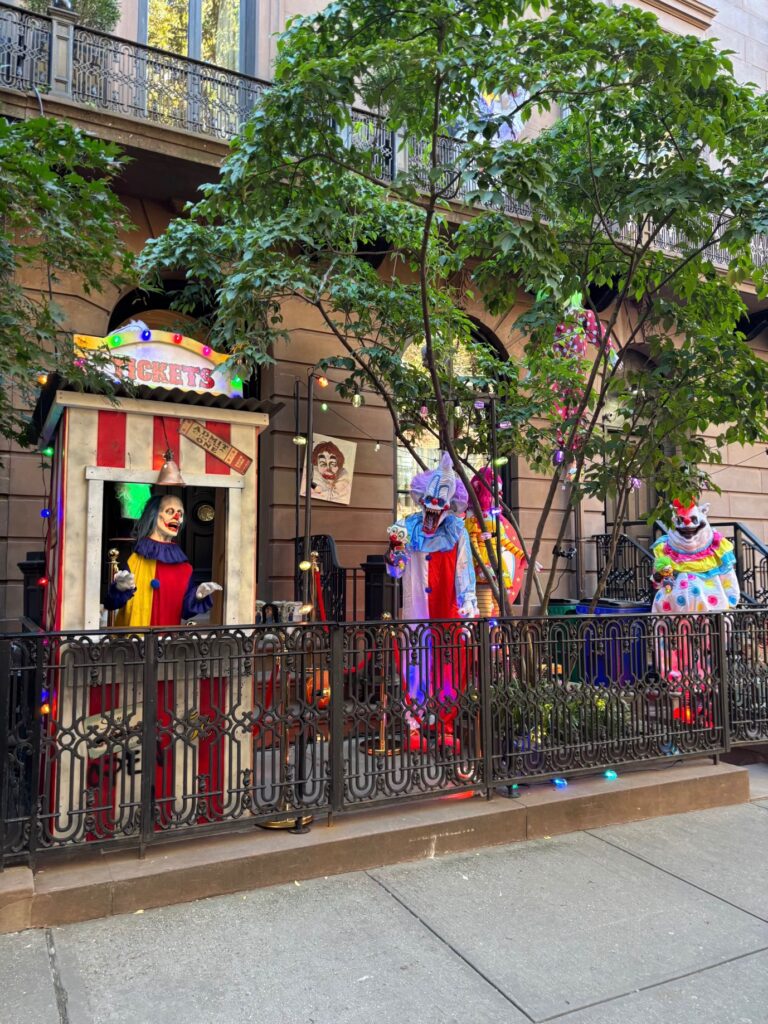
I’m staying with friends in the West Village, where the brownstones are festooned in Halloween decorations as extravagant as theater-sets. The more traditional or eco-minded residents have piled their front steps with cascading pyramids of gourds and pumpkins; the Goths go for wind-machine-wafted cobwebs, Hologram witches and ghosts, life-sized rubber tombstones, and even – in front of one house on West 10th – circus stalls with clowns. The college students wandering the streets from one Halloween party to the next are loud, drunk, happy. New York is Democrat territory, and people are feeling cautiously optimistic about the midterms, excited about the possibility that the Democrats might win back at least one house in Congress. It’s a familiar feeling, this autumnal burst of hopefulness, of new beginnings. Let it last.
The New York of the 60s in which I was born and raised was a dark grungy city, but people also had this fierce innocent faith in the future – in modernity, technology, progress.
Last Friday night I went to the Whitney Museum to see the season’s biggest show: a Roy Lichtenstein retrospective, whose title – « Like new » – seems to encapsulate that twentieth-century faith, including an ironical twist in the « like ».
Lichtenstein (1923-1997) was the ultimate Pop Artist; he painted canvases that reconfigured comic-strips and advertising images by hand, magnifying, like grains of sand on the beach, all the tiny dots that the human eye reads as unified color.
It’s a stupendous exhibition.
Like Andy Warhol, Lichtenstein presents himself as a dispassionate observer of modern society and its consumer fetishes; his lines and colors and sound-bubbles are cracklingly bold, but there’s often a sting in his tail.
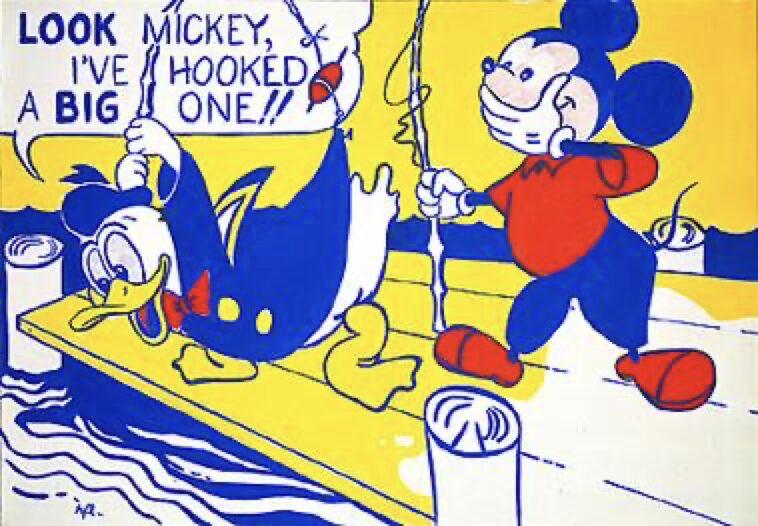
His first breakthrough comic-strip painting « Look Mickey! » (1961) reworks a Disney gag of Donald Duck and Mickey Mouse fishing off a pier. Donald excitedly tries to reel in the hook that’s accidentally got attached to his own jacket; Mickey laughs behind a gloved hand. Lichtenstein added the speech bubble: « LOOK MICKEY, I’VE HOOKED A BIG ONE!! »
Lichtenstein’s painting today looks less like a Pop Art icon than a satire of the powerful. Anybody watching world politics can fill in the name of the « Mickey » (Vlad? Bibi? Elon?) whom America’s present-day Donald is trying to impress by hooking the big fish that is actually his own backside.
Sometimes, as Lichtenstein shows us, « Like New » is just the same old joke in brighter colors.