 Skip to content

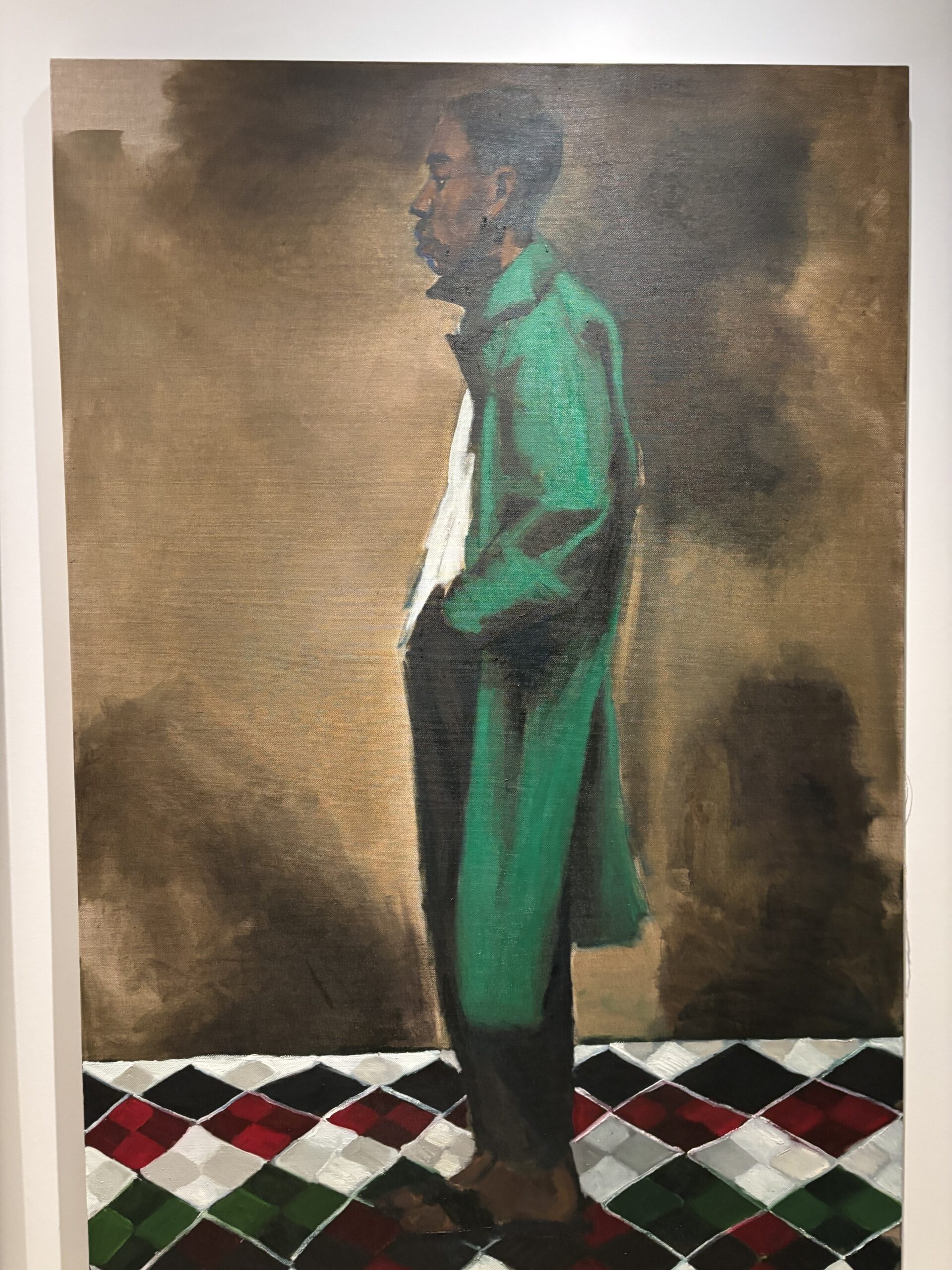
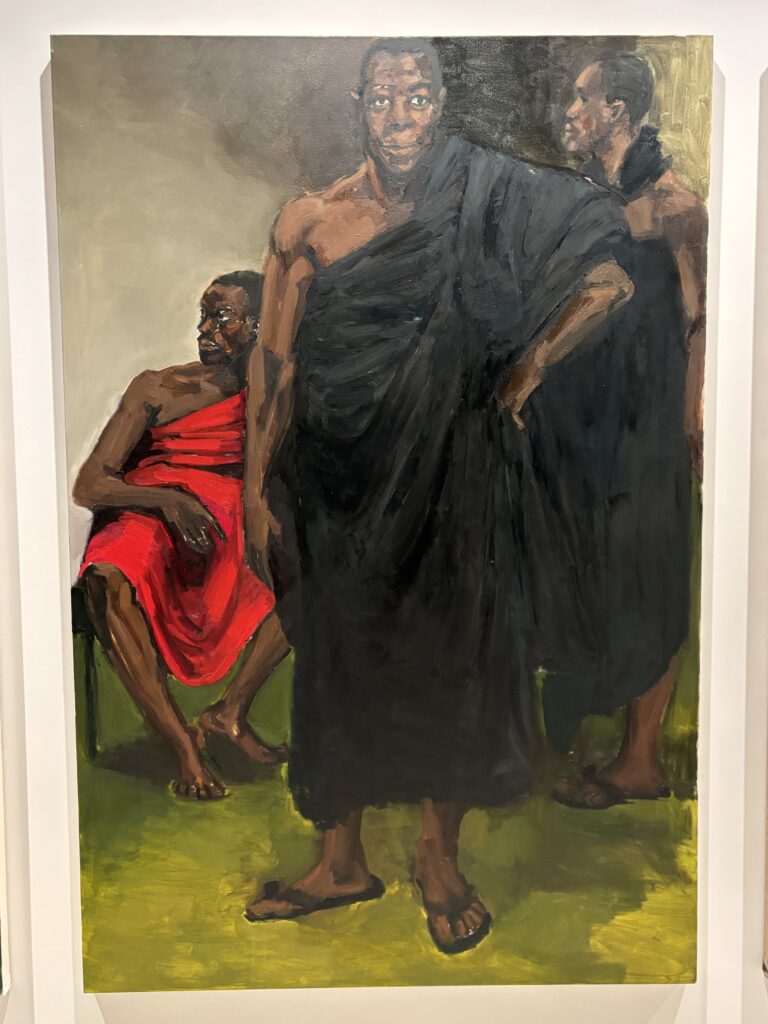
Lynette Yiadom-Boakye, born in London in 1977, is one of the best British artists alive today. Enigmatic, mischievous, troubling, her work comprises rich, densely scrabbled Old Master-like oil portraits of a single figure, or a small group. (Her inspirations are Velasquez and Sargent.) Her subjects are always Black; sometimes they are wearing a necklace of feathers or a ruff like a 17th Spanish grandee; sometimes they are seen cuddling a parrot, or engaged in group activities – holding hands and dancing in a ring, or chatting to someone taking a bath. They often have titles unsettlingly at odds with their subject matter: the portrait of a professorial-looking woman is called « Further pressure from cannibals », while a painting of two smiling dancers is entitled « Shoot the desperate, hug the needy ». But what makes her portraits so haunting is that these intensely meditative, inward-looking figures are all imaginary people. No prime minister or queen can ever commission a Yiadom-Boakye portrait, you will never see Rem Koolhaas or Beyoncé sprawled in her studio armchair alongside a potted plant. Her characters are unnamed and yet irreducibly themselves.
Last Saturday, in London, I saw Yiadom-Boakye’s latest work in a massive exhibition called « Project a black planet: the art and culture of pan-Africa ». Pan-Africanism, as the show’s curators tell us, is a movement of « anticolonial resistance and transnational solidarity ». The exhibition, which had travelled from the Art Institute of Chicago to Barcelona’s MACBA and finally to London’s Barbican, gathered twentieth and twenty-first-century art and archival documents from across the African continent and the Diaspora. There were works by contemporary artists like Marlene Dumas, Chris Offili, El Anatsui. And Yiadom-Boakye had a room to herself, of new oil paintings on linen and full-length charcoal drawings.
The figures she presented ran from group portraits of statesmen-like figures in African-style togas (« uncles », she calls them) to a slouching young man wearing an emerald-green raincoat, artworks whose titles suggested themes of « liberation » as a marred and unfinished process.
Later that evening, Yiadom-Boakye gave a talk accompanied by a slide show. Her talk was humorous, hard-hitting; she did accents of British grandees and African queens and American intelligence operatives. She summoned up the history of the Gold Coast, later Ghana, where her parents grew up under British colonial rule; she told us about the golden stool that was a symbol of Asante power and about the British colonial governor – a « snivelling scumbag with silly mustaches » – who provoked a war in 1900 when the Asantis refused to give it to him as a kind of party-favor. She told us the story of Kwame Nkrumah, the first leader of independent Ghana, who was deposed in a CIA-backed coup. All this world history was interspersed with snapshots of Yiadom-Boakye’s own family, of her parents’ arrival in Britain as young nurses, their courtship, wedding, and later, each of their three small children shown perched behind the wheel of the family’s red Volvo outside their home in South London. Best of all, she read some of her own poems, which are every bit as merry and haunting as her painting. Colonialism has never really ended, Yiadom-Boakye reminds us – the continent’s resources make it too tempting for other powers, including now Russia and China – but neither luckily has the pan-African imaginary whose ardors and subtleties this exhibition commemorates.