 Skip to content

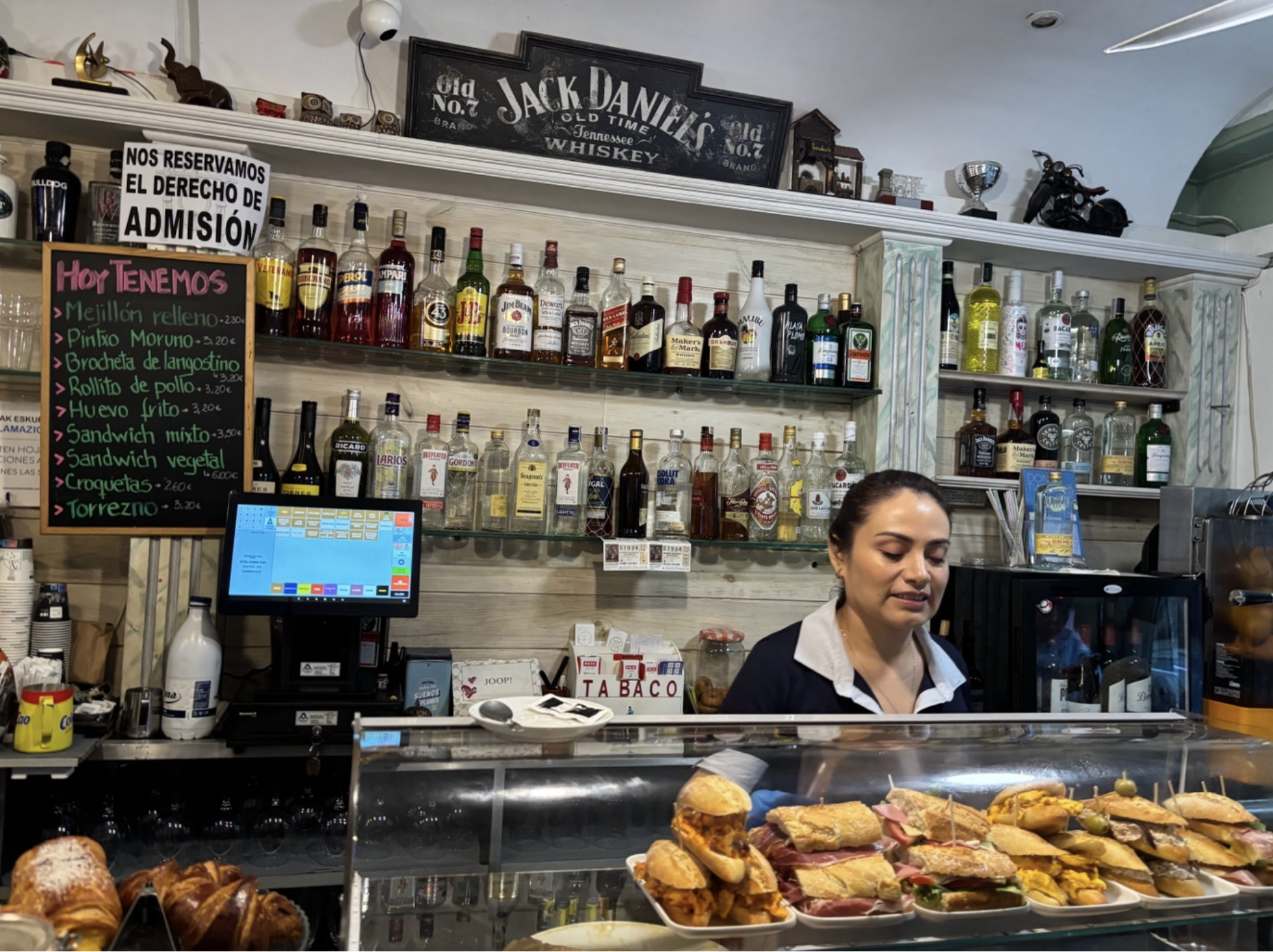
Last week, I went every morning for breakfast to the perfect bar. You stood at the counter for your shot of coffee; the other customers all greeted the owner by name. Nobody was on a laptop; nobody was even on their phone. Behind the bar were shelves displaying tobacco, lottery tickets, bottles of whisky and rum. On the counter, in a glass cage, rows of sandwiches: ham, fried cod, anchovies. (Because this was the Spanish Basque Country, they were called pintxos rather than tapas.) I don’t actually smoke or buy lottery tickets or drink Malibu, I don’t even eat cod for breakfast, but I like having all these treats available. It was in San Sebastián, in the Spanish Basque country. I won’t tell you its name because – sorry – I don’t want you to go there.
The Spanish Basque Country is a curious area. The Basques have always been enterprising – engineers, bankers, industrialists – but the region’s geography – a jagged coastline where mountains cut off the interior from the sea – made communications difficult. Each village was an enclave that spoke its own variety of Basque; people had to go elsewhere to make their fortunes. Franco persecuted the Basques, then starting in the 60s, there were bombings and assassinations by ETA, the terrorist offshoot of the Basque Independence Party, which did a good job keeping the area undeveloped.
In the early 1990s, my husband Alastair and I spent six weeks living in a village down the coast from San Sebastián. In those days, the villages were gloomy, inward-looking; we rented an apartment looking onto the graveyard from an ETA-friendly priest. Alastair was writing a newspaper series about European separatist movements; he interviewed local politicians, including the young deputy mayor of San Sebastián, an up-and-coming member of the center-right Partido Popular, who was later assassinated by ETA.
Soon after, Spain, with French cooperation, finally wiped out ETA. Change was already underway: in 1991, the Basque government hired Frank Gehry to build an outpost of the Guggenheim – exquisite, shimmering – in the grim ex-industrial town of Bilbao. The low-cost airlines piled in; Bilbao and its environs became a cultural and gastronomic destination.
We’ve been back once or twice. Between Covid lockdowns, I remember the joy of finding myself in pintxos bars jammed with shouting laughing young people overflowing into the narrow streets. Now we are back in San Sebastián, and the pintxos bars feel different. Even more crowded. A different kind of crowded. There are lines down the block – foreigners like us, and they are all on their phones. We can’t get into our old favorite, so we go to the bar across the street, one that doesn’t get posted on social media. It’s fabulous. Spider crab on toast; maïs de galina with tiny raw shrimp. Glasses of txacoli poured from on high. We meet a tall shaved-head German who’s celebrating his birthday; a young couple from Manchester; a Hong Kong Chinese guy and his mother who now live in Vancouver. Everyone wants to know what everyone else is eating. The bartender is a handsome grizzled man; he tells us, You really should go to the bar across the street (the one that has a line down the block because it’s on Instagram). He says, « The crowds are insane, it’s like this now every week of the year. » He’s tired.