 Skip to content

So there I am, in a museum in a town that in 150 years has evolved from a community of farmers to an artists’ colony, then to a posh village, and is by now a flashy town of loudmouths with too much money, and I am trying to indulge myself in a tidy exhibition made up of paintings by French Impressionists from the Musée d’art moderne André Malraux in Le Havre, plus three Rodin sculptures and… wait, new sentence: In a corridor near the spectacular expression of Impressionist colors, I spot drawings in which many things seem to be happening. Finely rendered, I see buildings wrapped in and threaded through with pipes, foundations and floors, edifices, constructions, complex formations. What is that! Were they the imaginary prisons by Piranesi (the Carceri d’invenzione) from the mid-eighteenth century? Or the architectural utopias of Charles Fourier (the phalanstère) from the early nineteenth? I check the titles: The Autopsy of Lehman Brothers, The Excavation of the Middle Manager, The Milking of the Middle Class. This is us. Now. These fine-lined drawings, I read a moment later, show the power structures and institutional arrangements of current society.
No color, no French name, no landscape or pretty lady and the museum visitors – it would be a bit cheap to describe them mockingly – walked past them.
The artist was Carlijn Kingma.
I hurried to the museum shop, and there, wedged between the thick, hardbound catalogues of French nineteenth-century art, I found a €5,50 cahier titled De machinerie van de volkshuisvesting (The machinery of public housing); its cover states that a house is not an object of speculation but a home to live in. Plus: a quote from Adam Smith’s The Wealth of Nations (1776) that reads « As soon as the land of any country has all become private property, the landlords love to reap where they never sowed. » (I like to think this quote condemns not the system itself but its excesses, but I fear I’m wrong.)
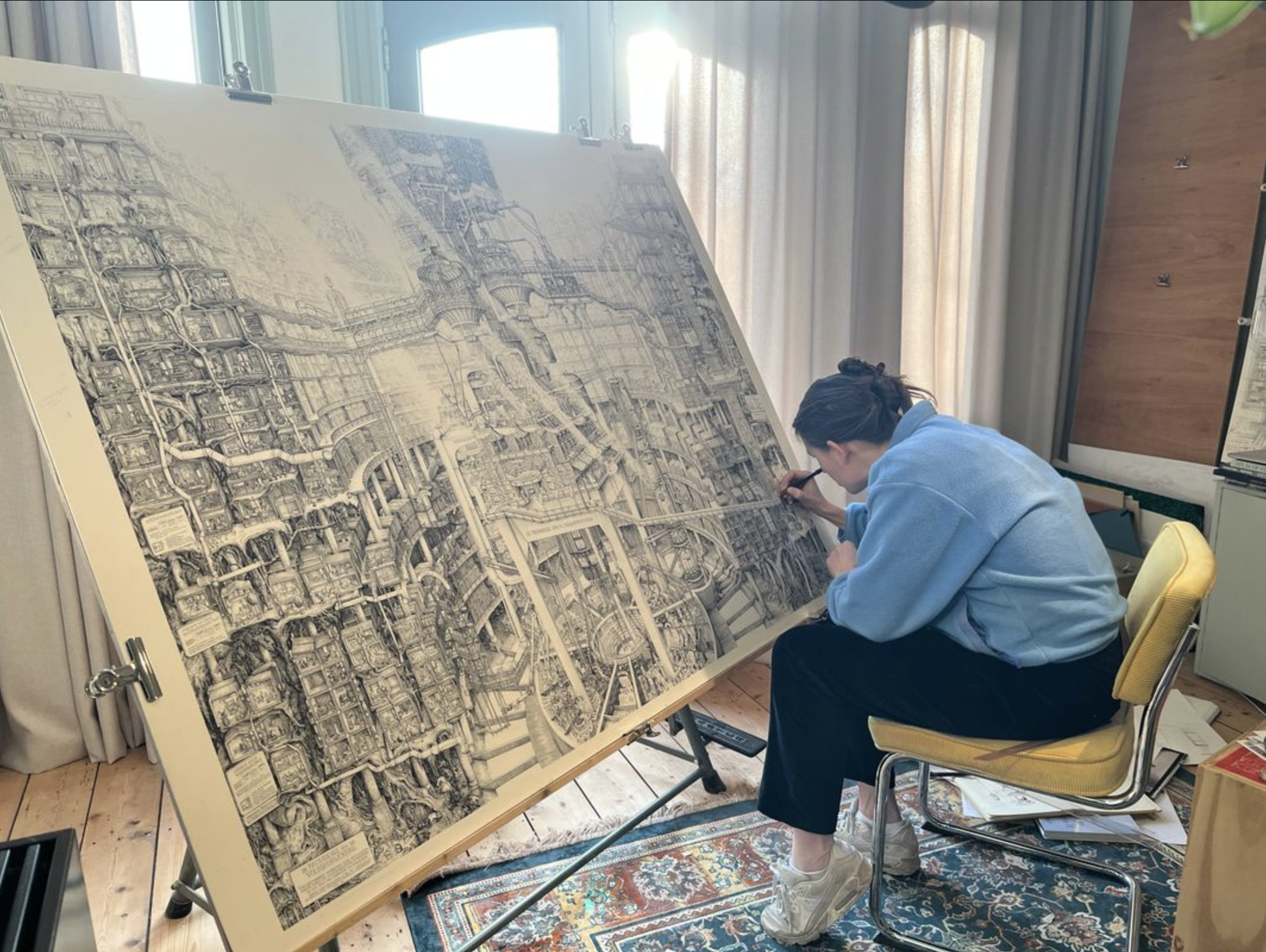
The cahier gathers fragments of the huge drawing that she is working on here in the picture. Carlijn Kingma, it turned out, works alongside researchers and journalists: she shows what goes unseen and calls herself a cartographer of society. For De machinerie van de volkshuisvesting she collaborated with financial economist and investigative journalist Thomas Bollen. The wealth that the people passing her work have gathered in their own houses, or through banks and pension funds in other people’s houses, was sort of the point here. The nice thing is that Kingma and collaborator Bollen also try to show how things could be done differently: how to recalibrate the machinery is part of the huge drawing. The cahier shows fragments of it. Her work also brings to mind the tableaus and diagrams in which economists and thinkers of centuries past traced society’s structures when coloring them ideologically. But in Kingma’s drawings, the many little lines are never all straight; the intricate structures are no utopias but keep bursting at their seams, and here and there, the shapes turn amorphous and proliferate to excess.
P.S. I will enquire and see if we can show her work in one of our print issues!
Carlijn Kingma’s work is now shown in Singer Museum in Laren.