 Skip to content

This week, Latvians went into the wild. The longest day of the year fell on a weekend (21 June), and Līgo nakts / Jāņi — known as St John’s elsewhere in Europe — arrived on Tuesday (the night from 23 to 24 June). Basically, it gave many Latvians time off from Saturday to Wednesday. And we absolutely let the wilderness take us in, as the cities emptied out.
Why are there so many dates for celebrating the shortest night? The tradition comes from our pagan ancestors, whose lives were much more closely synchronised with nature. The shortest night marks the beginning of summer, when the sun reaches its highest point and the fields are about to start delivering harvesr. It is, among other things, a celebration of fertility. The pagan solstice was shifted to St John’s Day when Christianity arrived in the twelfth and thirteenth centuries — that was simply a guaranteed day-off to celebrate. But recently many Latvians have returned to celebrating the actual solstice too. So these days, if somebody invites you to Midsummer, you need to clarify the date — the 21st or the 23rd?
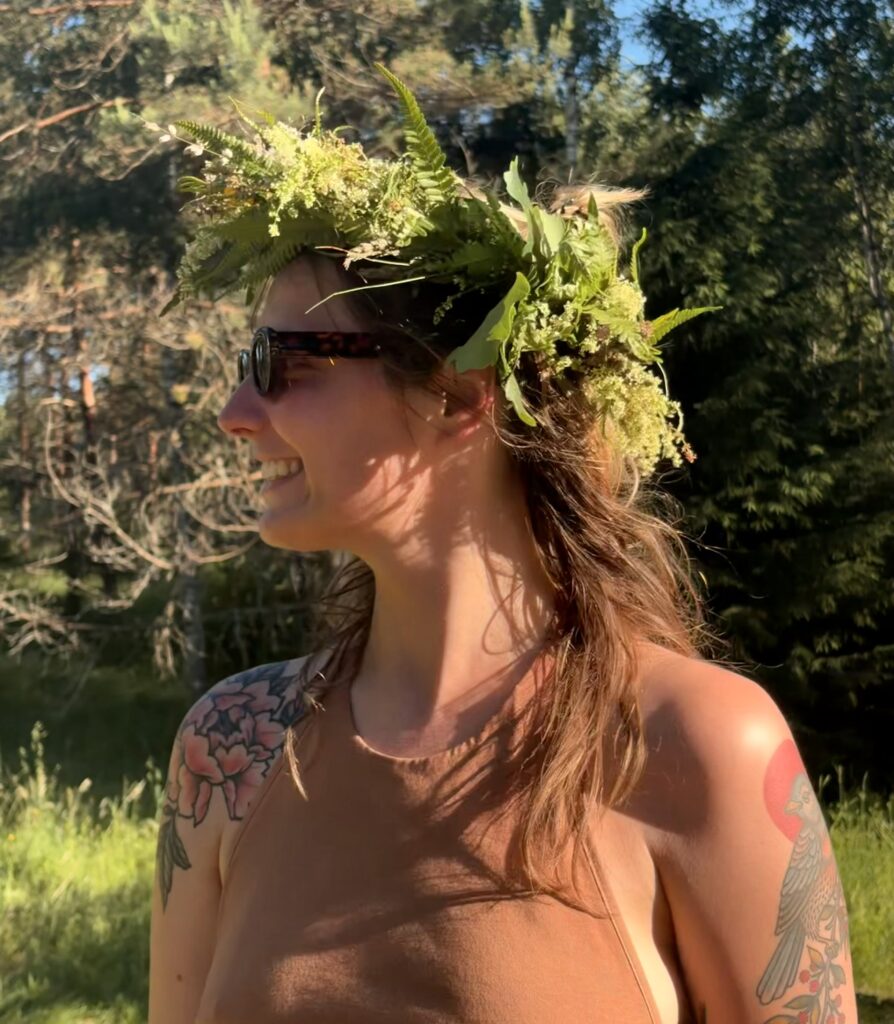
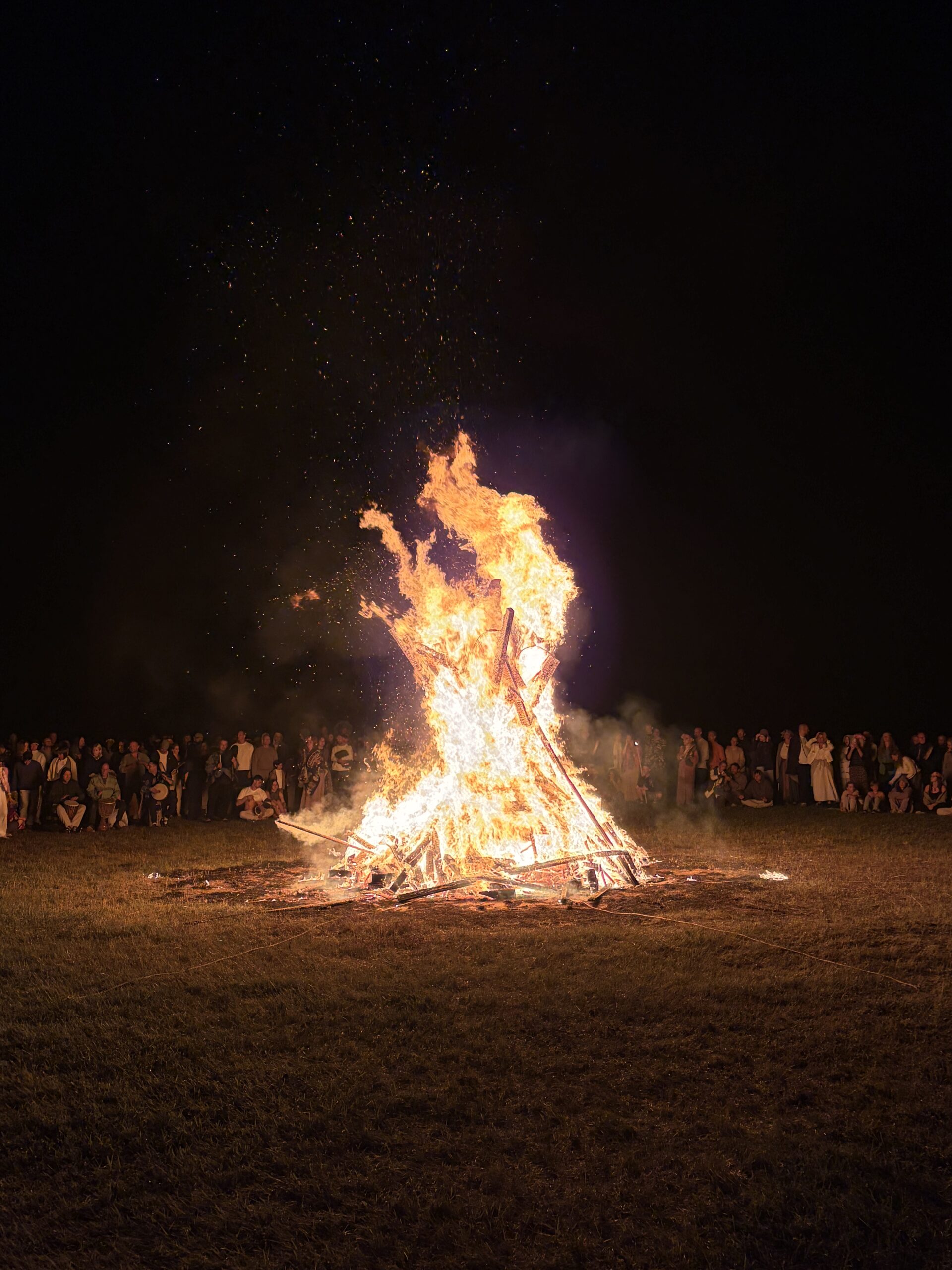
Whichever the night, it comes with a to-do list: keep a fire burning until sunrise, sing through the night, weave flower crowns from wild weeds (at least nine types of flowers for girls, oak leaves for men), and perhaps go searching for the mythical fern blossom. As a child, I genuinely believed this was a beautiful flower hidden somewhere in the forest. Later I learned that the fern blossom is for grown-ups only and has rather a lot to do with boosting demography.
Here’s one of the tautasdziesmas (folk songs) we sing through the night. They can go on forever, built on repetition:
Pār gadskārtu Jānītis nāca
Savus bērnus apraudzīti;
Vai tie ēda, vai tie dzēra,
Vai Jānīti daudzināja.
Every year Jānītis came
To see his children;
Did they eat, did they drink,
Did they chant Jānītis.
In Latvia, the annual preparation begins already in May: Ko darīsi Jāņos?Where are you going to celebrate Jāņi? It is a matter many people get genuinely anxious about. Every year, the experience should somehow surpass the previous one. Those who have a countryside house or the energy to host are lucky; the rest choose wisely. The place has to be beautiful, the people have to be right.
This year, I fully embraced randomness. For the solstice, I joined a celebration of around seventy people on top of a hill overlooking supposedly the cleanest lake in Latvia, about 150km south-east of Rīga. I knew perhaps seven people there. The setting was magnificent: a long table covered in food, a hilltop, the lake below. At sunset, we lit the fire, everyone set new intentions for the coming cycle and threw offerings into the flames to seal them.
Then, after three Latvian folk songs, a DJ took over, turning the folk-vibe into a techno rave. It echoed over the lake. Objectively it was a fine set, but it was also not Midsummer at all. My friend unsuccessfully tried to hand the DJ a USB stick full of Latvian folk music. Oh well. I suppose Jānītis can come over the hill in his best raver’s tradition too.
Visi gaida Jāņa dienu,
Puiši gaida, meitas gaida;
Puišiem alu, puišiem sieru,
Meitām zāļu vainadziņus.
Everyone is waiting for Jāņu day,
The boys are waiting, the girls are waiting;
Beer for the boys, cheese for the boys,
Wreaths of herbs for the girls.
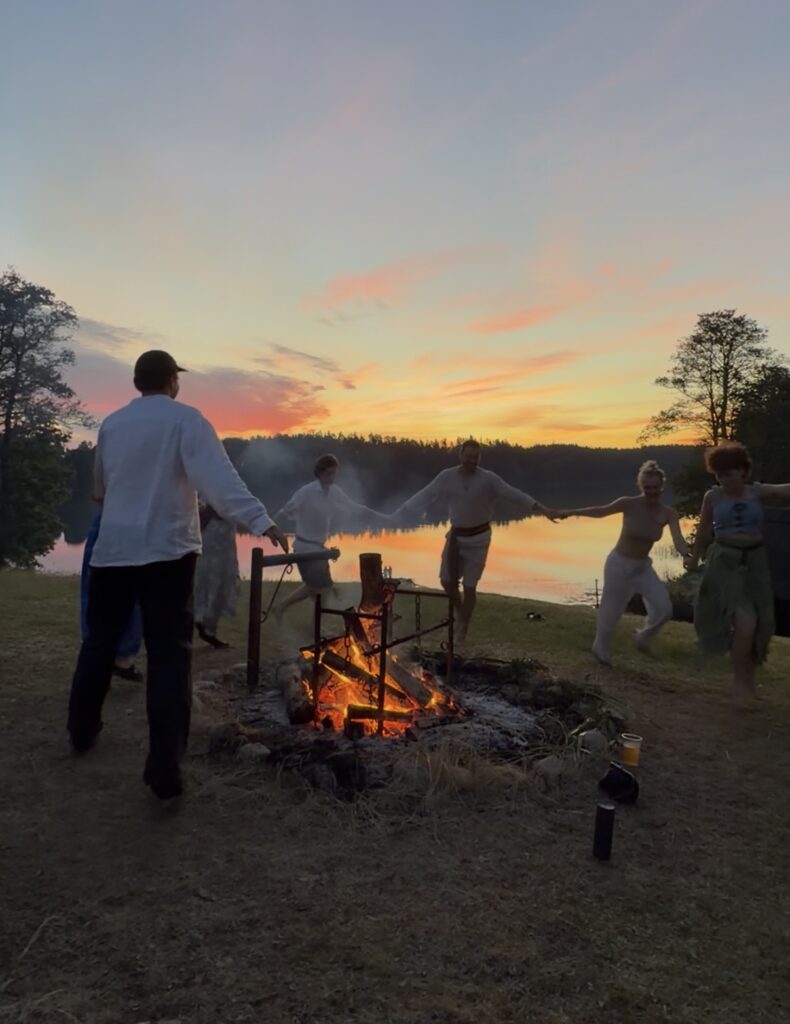
Later, once the DJ set had faded, a smaller group of us gathered around the fire, singing while the northern sky was at its darkest — but never fully dark: around one in the morning, there was still a glow where the sun had briefly dipped into the lake. From then on, it was getting brighter again. We danced, sang, and heard somebody playing Alice in Chains from the sauna. What a remix of Midsummer.
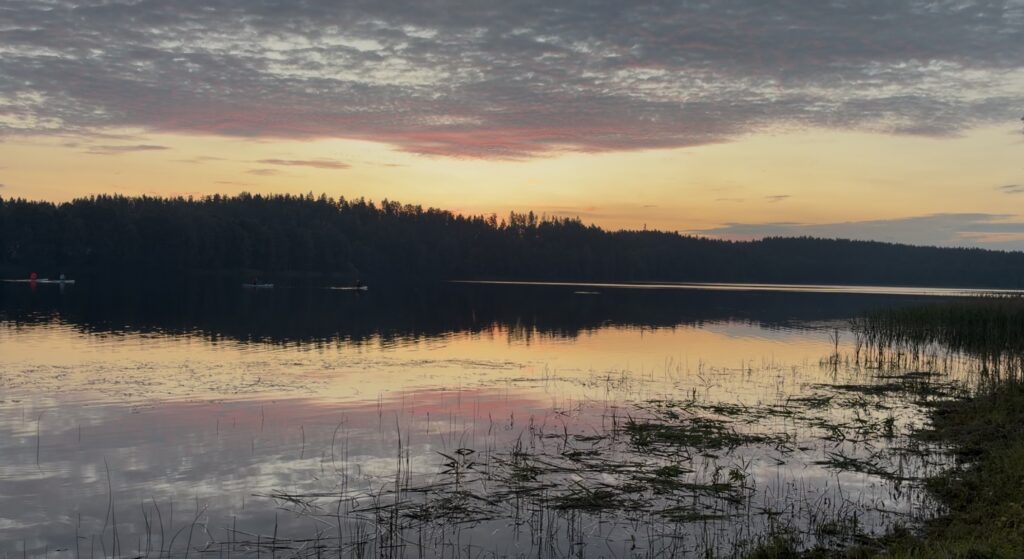
At sunrise, birds took over the soundscape and we swam naked in the lake. As the sun came up, people on paddleboards appeared from all around the shoreline and gathered in the middle of the lake to greet it.
The following night, we lit another big fire and kept it burning until sunrise, when yet another flotilla assembled in the middle of the lake.
Sit, Jānīti, vara bungas
Sētas staba galiņā,
Lai trīc visa tautu zeme,
Lai dzird mani bāleliņi.
Beat, Jānītis, the copper drum
At the top of the fence post,
Let the whole land tremble,
Let my brothers hear it.
But the ultimate Latvian experience still wasn’t over. On 23 June, a friend and I joined a different side quest: a spiritual, tantric festival on the banks of the Daugava, our destiny-river, the largest river in the country, threading through countless folk tales, poems and songs. Beer was forbidden and the programme included meditation, healing workshops, ecstatic dance, introduction to tantra and freeing one’s chakras. That’s the day’s programme; at night, Midsummer traditions were back: a grand fire ritual that involved lighting eight smaller fires before igniting a larger one, rhythmic banging of drums and singing until the sun came up. It was not a typical Jāņi either.
By the time I got home from my week in the wild, I was completely drained. This year’s Midsummer experiences covered such a wide spectrum that I made a resolution for the new cycle: next year, I’ll host my own Jāņi so that I can pick the music. Jānītis may arrive in many forms, but somebody still has to guard the playlist.