 Skip to content

How many beach borders have you seen in your life?
This weekend, I found myself returning to a long-term project that started, as many things do, with a beach conversation — about the origins of religion. It began with a four-hour history of Islam, told by my friend Hazar Deniz Eker, a German-Turk — and forthcoming author in Issue Eleven — somewhere along the Belgian coast.
Back in February, we set off from Oostende, a city near the sea in western Belgium, walking south with no particular destination. The Belgian coast has a pattern: waves on the right, but on the left — a long wall of apartment blocks, the occasional typical narrow Belgian house squeezed in between, then a brief break of dunes and bunkers, and then repeat. By the eighth kilometre, you only notice what breaks that order.
History had definitely happened here. Around the time we reached Mecca in our history-of-Islam conversation, relics of WWII had taken over the landscape. By the time we drifted toward Taoism, we had also realised that this walk was becoming a project: we would come back, and we would walk all the way to Dunkirk. Dunkirk became our Mecca.
That first day, we made it to Nieuwpoort, then took the coastal tram all the way back to Oostende to the nearest train to Brussels, already half-planning the return.
This Sunday, we did return to pick up exactly where we left off to walk to the French border. That’s about 25 km. Very manageable, especially for early birds. On the three-hour train ride there, Deniz updated me on what notable objects we might encounter: Belgium’s westernmost point, France’s northernmost point, both somewhere along our route. And a statue of a golden man riding a golden turtle.
We walk and talk — we turn from religion to racism, to democracy and the full spectrum of world politics, from the US to France, to Turkey, to Hungary, all the way to China. The sun is high and burning my eyes; most of the time I’m staring at my toe caps to avoid it. When I finally look up, I see it: far in the distance, a darker shape and what looks like an industrial tower releasing smoke. Dunkirk, our Mecca, though from here it looks like it’s on fire, perhaps helped along by a bit of WWII imagination.
We know we won’t reach it today; the goal is the border. How will we know we’ve entered France, though? Surely there will be something to mark the passage, a sign or some monument. It’s France, after all. Bienvenue en France! Vive la République! We even plan a ritual: a cigarette at the crossing.
We keep walking. At some point we pass a large, strange squared-circle structure in the sand, easily four metres tall. We note it and move on. The border must be close. It’s getting late, and we have the last train to catch; getting stranded on the beach is not on the bucket list.
You’re reading this essay for free. With a membership, you can read the full magazine, and you get access to our fabulous Library.
Here’s our offer: 3 months unlimited digital access + 1 print edition for € 38,00 € 19,00
You’ll get Issue Twelve in print as your first magazine, right to your mailbox.
« Is that a French flag? » Deniz suddenly asks. Yes, there it is! The blue-white-red is calling us. We speed up. We check the map, try to pinpoint the exact moment of crossing, greet each other in French as we approach —
— and realise we’ve already been in France for half a kilometre. The switch of the mobile operators delayed our actual location; the majestic French flag is part of a random campsite. The large square structure we passed earlier? Not the border either. Just a viewpoint marking Belgium’s westernmost point.
So where the hell is the border?
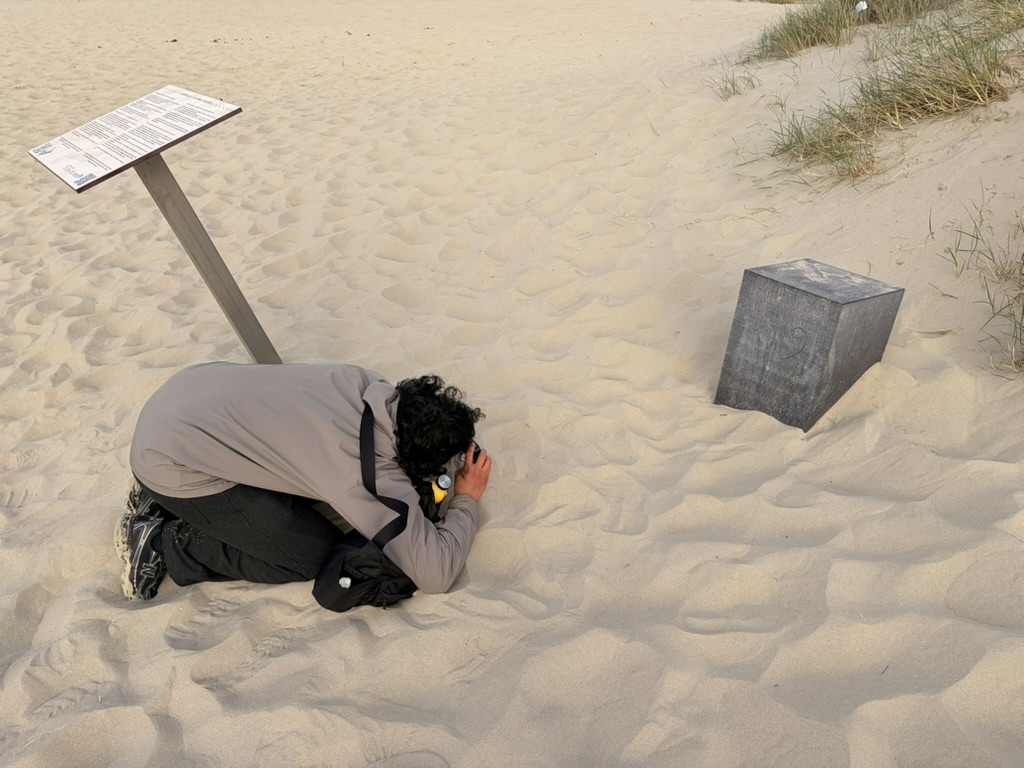
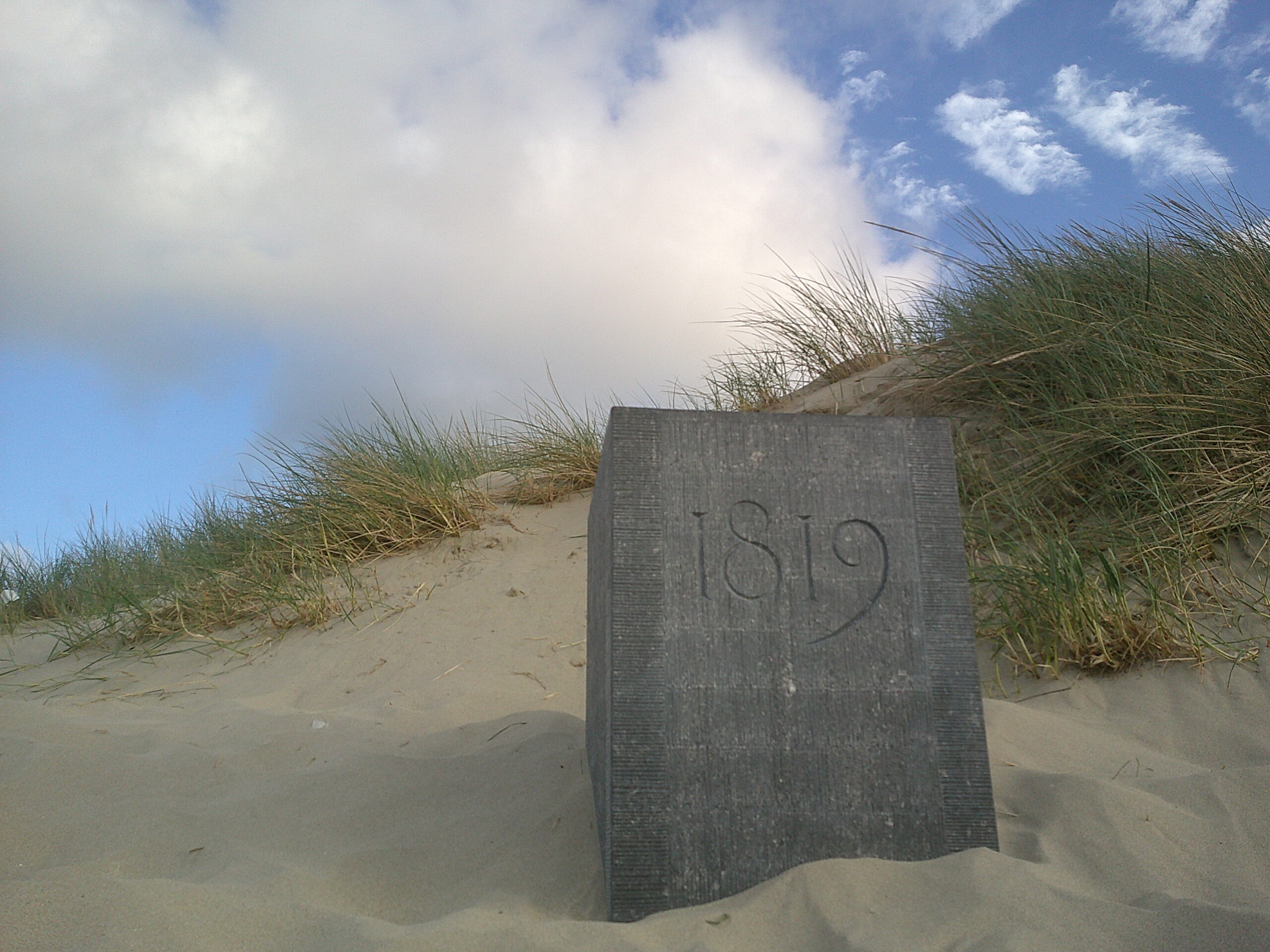
We turn back, searching. And then we see it: a small squared stone, right where the dunes become dry grass. It says 1819, which I later look up — that’s when the stone was put here. The stone looks oddly out of place, and it also happens to mark France’s northernmost point.
We stop, smoke that French cigarette, take a few pictures. Then we rush, because the last train from De Panne / Le Panne leaves in 30 minutes, and we still have nearly an hour on foot.
Uber saves us. Three hours back to Brussels; we play two chess games, but the mood is somewhere between awe and mild disbelief. How can a border — the French border — be so underwhelming that you accidentally miss it?