 Skip to content

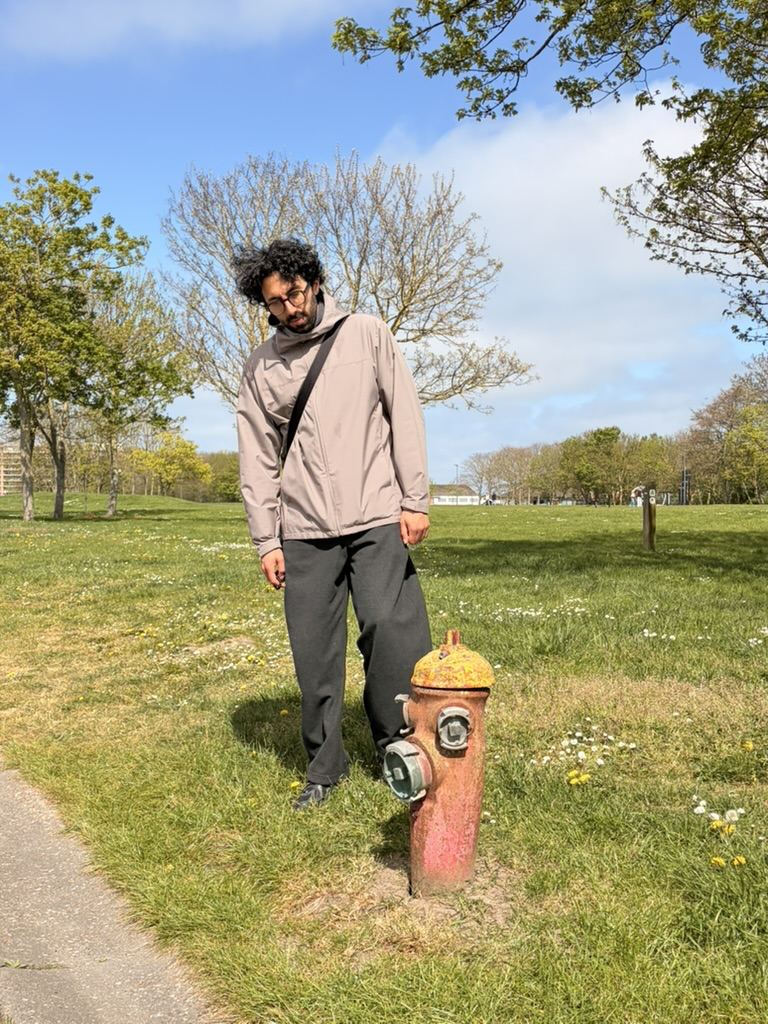
After a particularly active Current Preoccupation from mid-April 2026 — featuring a walk to the Belgian-French border and Issue Eleven contributor Hazar Deniz Eker — we published his essay, « Feeling political together ». We texted Deniz about it and borders.
ERB
What is your relationship with borders?
Hazar Deniz Eker
Growing up between two nationalities, German and Turkish, EU cornerstone and permanent candidate, Schengen and no Schengen, I’ve first consciously thought about borders on the annual mass Turkish diaspora pilgrimage, when all the first-, second-, and third-gen immigrants collectively load their cars with comparatively cheap European chocolate and drive through the Balkans to the motherland over the course of three days. Borders were omnipresent on the trip.
While some were barely noticeable — Germany to Austria, Austria to Slovenia — it was the prolonged waiting periods between Croatia and Serbia, or Serbia and Bulgaria, or Bulgaria and Turkey, where I, aged six and bored out of my mind, came to realize the immense privilege I held in my EU passport.
But once you see them, borders are everywhere. Driving into Bulgaria, the first thing you see upon entering is a worn-down sign that reads « Istanbul, 620km ». For the next 620km, the sign doesn’t show up anymore, but the country you’re in becomes nothing but transit — such is the all-encompassing power of Turkish patriotism and neo-Ottoman nostalgia that the whole world becomes one border holding you back from a glorious return.
While I don’t abide by that notion anymore, locals in the borderlands between the world and Turkey certainly have adapted to it. Throughout our ride, be it in Croatian gas stations, Serbian rural communities or as we left Dimitrovgrad in Bulgaria en route to Edirne in Turkey, little signs would pop up by the road, in broken Turkish, advertising tea, grapes, and cheese.
This trip is a great microcosm for how bordering works: while we like to think of borders as definitive, they’re always changing. To me, the German passport holder of Turkish origin, the borders are at worst a nuisance and at best a reminder of home. To the migrant on the Balkan route to Germany, the borders are sites of increasing surveillance and brutality. To us, it’s commodified Ottoman nostalgia; to locals, it’s contested lines originating in war trauma.
ERB
Your essay in Issue Eleven. Is your algorithm full of populists? From left and right? (So no bubble)?
HDE
My algorithm used to be a leftist echo chamber where I could daydream about a moneyless, classless, fluid, liberal arts, unemployed, and Gen Z-led future.
Now it’s mostly food, but lately, I’ve been trying to diversify it by watching more alt-right content. Can’t say I’m happier because of it, but it helps to know what’s out there.
ERB
What is this « feeling political together »?
HDE
American scholar Lauren Berlant argued that you can split political messaging in two: its content and its noise. « The lived intensities and desires that make messages affectively immediate, seductive, and binding, » — which, if I may reduce a great, long scholarly text to a single more accesible term, basically refers to a vibe.
Berlant wrote about the communication of vibes in politics back in 2011 — arguing that in the aftermath of crises and in protest, increasingly populist politicians overly rely on spreading a feeling of being political together, rather than emphasising any particular policies.
Since then, other scholars like Anton Jäger have added to her arguments while her thesis has become common-place: populists in Europe deliberately refer to irredentist myths of glorious nations long gone and hype up deportations, while the EU’s Migration and Asylum Pact, largely influenced by the far-right and about to be implemented in June, purpousfully chooses vague wording to the worry of increasingly defunded humanitarian workers and NGOs.
Point is: just focusing on vibes is dangerous. It obscures political intentions and distracts, but in times of polycrisis, vibes stick. The essay is about how I fell victim to them myself: be it in utopian leftist parties in Paris that don’t lead anywhere, deepfaked oppositional hope we hold onto in Turkey, or the many, many movements we feel vibrating through our for-you pages, political optimism can be cruel, and in the case of my essay, left me hungry.
ERB
Is it a positive thing? Sort of the same identity-politics that populists cater to?
HDE
Berlant also referred to the feeling of being political together as an intimate sociality, and in times of raging loneliness epidemic and increasing numbness to news, that’s more than necessary. I recently travelled to Budapest to cover the Hungarian elections, and the ecstasy of that event, and of monumental political change after sixteen years, certainly brought large swaths of a nation together, leading to post-election polls placing Tisza support at around two-thirds.
Undeniably, it can be a positive — it just becomes problematic when noise trumps content.