 Skip to content

We stepped off the ferry — an open motorboat, with room for twelve passengers — onto the dock. We’d come for a day’s outing to Orford Ness on the Suffolk Coast in the UK, me and Alastair. (It was our 33rd anniversary, but we weren’t telling anyone.)
WG Sebald writes about Orford Ness in The Rings of Saturn (1995). He describes looking out at it in 1972, back when it was a closed military zone, and appeared as remote as « a penal colony in the Far East ».
Today Orford Ness is open to day-visitors but it’s still forbidding. Not an island, but a peninsula — a skinny spit of land attached by one claw to the mainland that’s reachable only by boat.
It’s an oddity, for sure — one part salt marsh, the other part « shingle desert », possibly the longest spit of shingle in the world. An ever-shifting geomorphic freak, raked over by quick-change weather: high winds, multiple storms that you can see barrelling in from the mainland and then out to sea again. Until the winds change direction and bat the thunderstorms back in your face.
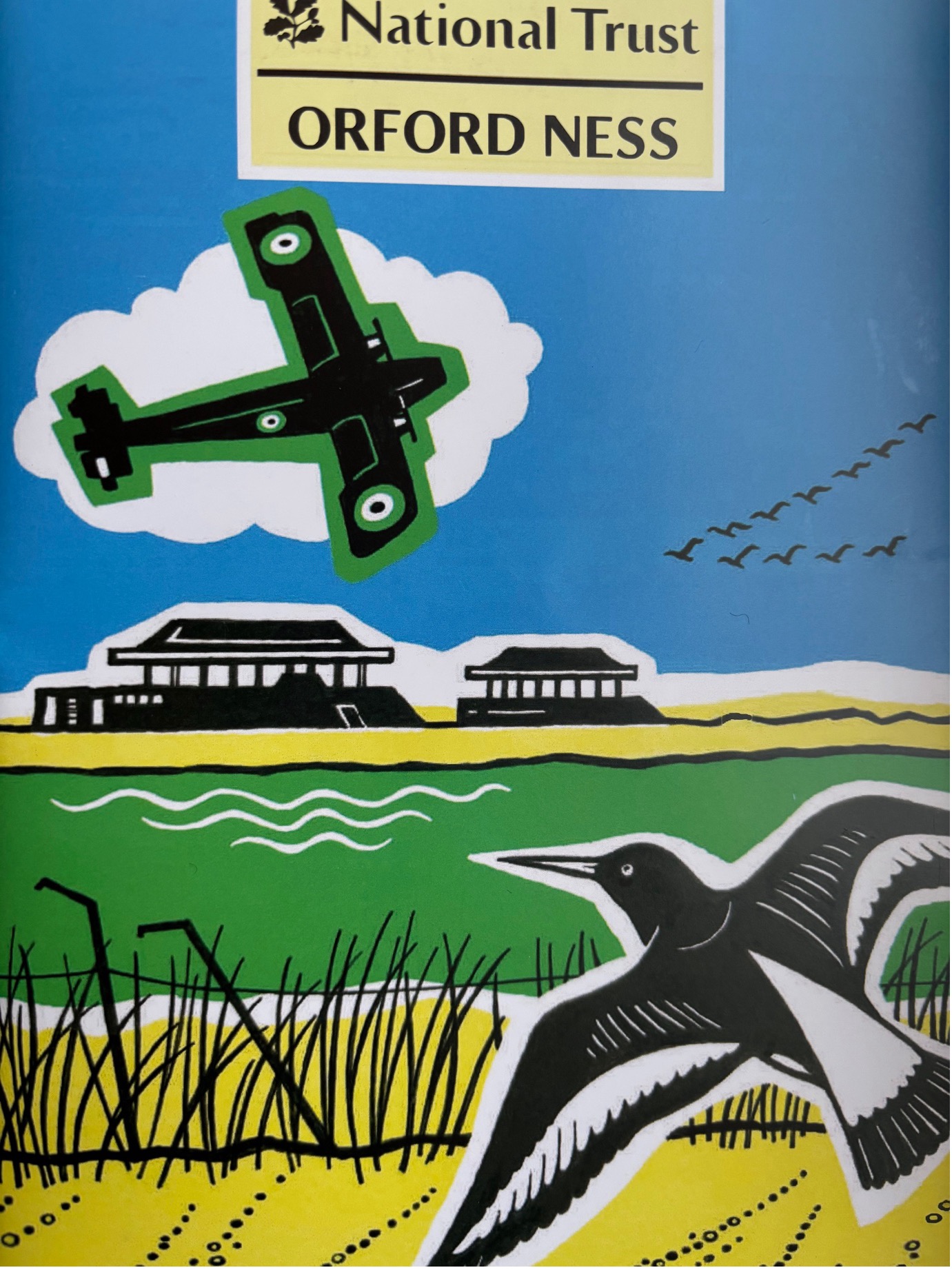
Today Orford Ness is uninhabited by humans, but you could see how waves of human use have swept across it, starting with the twelfth century river-walls built to protect the strips of rich grassland from the encroaching salt marsh. Eight hundred years later, the humans got more interested in fancy ways of killing each other than in grazing their livestock. In World War I, it housed a fighter-plane testing ground and the research laboratory where radar was developed. By World War II and its aftermath, Orford Ness became a nuclear weapon testing site and home to Cobra Mist — the sinister grey hangar you see at a distance, where from 1968 to 1973 the US/UK joint command tracked Soviet sputniks and potential missiles.
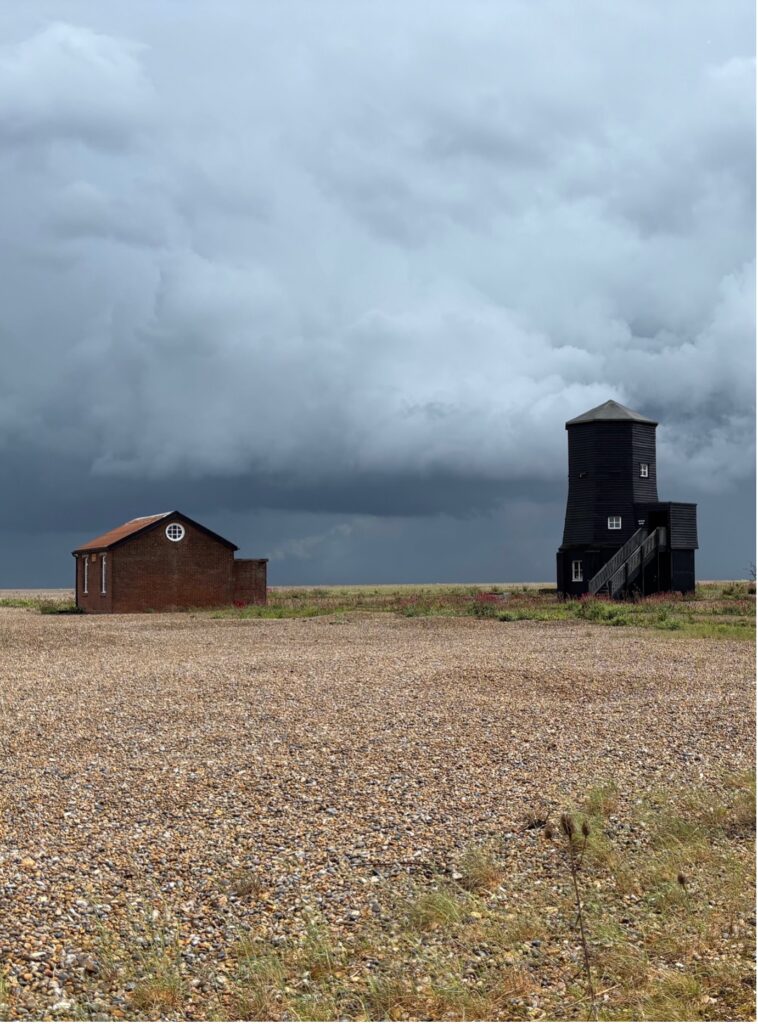
This long history of top-secret warfare gives Orford Ness its air of post-military-industrial desolation, of being at the ends of the earth and beyond the end of history.
Sebald, when he comes back in the early 1990s, writes that local fishermen had given up night-fishing on Orford Ness because « they couldn’t stand the god-forsaken loneliness of that outpost in the middle of nowhere, and in some cases even became emotionally disturbed for some time. »
With the end of the Cold War and the rise of rewilding, Orford Ness has taken on a new life. The National Trust bought the site from the Ministry of Defence, and has turned it into a nature preserve, where starlet sea anemones, pink sea thrift, oystercatchers, sedge warblers and short-eared owls abound. Scientists think they’ve discovered a previously unidentified beetle. (I’m citing the wall-texts here — on our particular visit, the winds and rain were way too fierce to spot much besides a nesting kestrel and a swan with five smudgy cygnets hiding in her skirts.)
But I did understand better the British cult of the National Trust — the charitable institution that owns and operates so much of the nation’s real estate, including this patch of « desert ». Previously my experience of the National Trust was of old ladies congregating in the damp linoleum-floored tearooms of stately homes. More recently, the National Trust has taken a battering from revelations about how many of those stately homes were built on slave-owning and slave-trading wealth. It’s made little difference to its popularity.
Here’s a telling figure: the National Trust has MORE THAN FIVE TIMES as many members (5.38 million) as all the UK’s political parties combined. After being shown around Orford Ness by the National Trust’s volunteer rangers and told of its « philosophy of non-intervention » for this fragile site, I had the feeling that its direction might be more public-spirited and forward-looking than most national politicians. That’s not saying much, I guess.