 Skip to content

I started reading « The future is for everyone; the path to a positive AI future », an essay by Mark Zuckerberg, the intellectual equal of Elon Musk,
« We are fortunate to live at an incredible moment in history. »
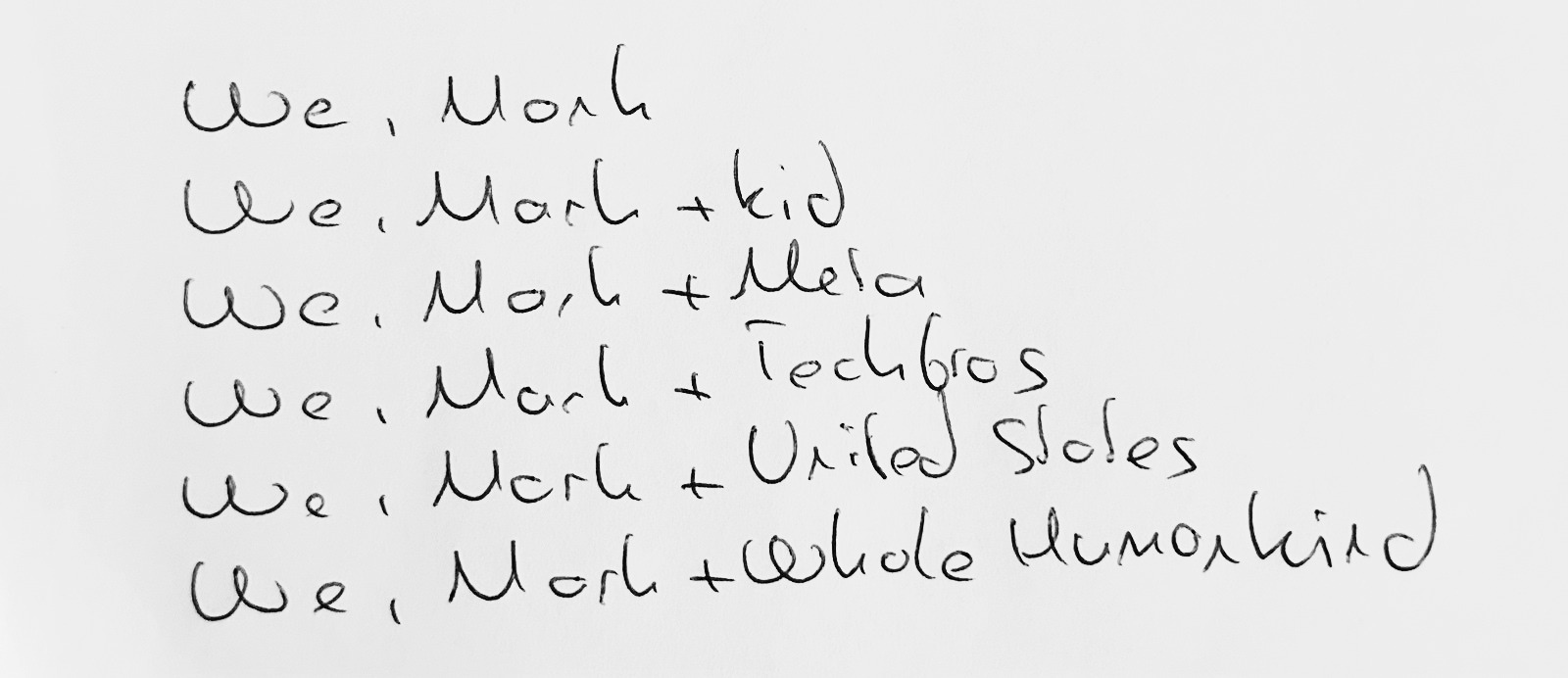
Instant annoyance. Who were these fortunate we? The people working on AI? The entire world population? Only Americans, perhaps? I read on and encountered many we‘s (over a hundred) and made out six categories:
1) All people on earth. As it is again in the second-to-last sentence: « The arc of human civilization has bent towards putting more power in people’s hands to live and shape the world in the ways we believe are best. »
(Sometimes Zuckerberg has to use us: « the future will be created by all of us. »)
2) Zuckerberg and his daughter were another easily recognizable we: « My daughter loves to bake so my agent plans personalized recipes for us to make together each weekend, orders the ingredients, and then offers suggestions as we‘re baking. »
3) A we for Zuckerberg as the academically angehauchte essayist: « We propose a philosophy based on individual empowerment… »
4) A we for Meta: « At Meta, we will focus our efforts on delivering personal superintelligence… »
5) A we for the tech sector: « All labs should observe its objectives and our ability to control them carefully, and if there is any indication of harmful behavior then we should coordinate and adjust appropriately. »
6) A we for we Americans: « We must ensure the leading AI systems are ones that encode our values, grow our economy, and advance national security. »
Zuckerberg blends them all together. When you read: « we must ensure that superintelligence primarily empowers individuals, » the universal we is still hanging between your ears while the actual we here is Meta, that he positions against competitors as focusing on individuals first.
Another example: in the paragraphs on cybersecurity and biosafety, Zuckerberg argues that « we should encourage close cooperation between frontier labs and the government. » We there, is the entire tech sector, but the position of we is actually the position of Meta. Long before the essay ends, the distinction between « Meta creates this » and « humanity wants this » has become indistinguishable.
Zuckerberg wants the American government and public to see Meta as their best AI partner. His primary strategy: equating his company’s interest with the interest of the tech sector, of the United States government, of all Americans and lastly: of the entire world population. We‘re supposed to accept that it’s good for Meta to sell superintelligence, because what’s good for Meta is good for us. The listener only needs to feel that the speaker’s interests and their own coincide.
I now feel a strong urge to move on to other words from this essay, like water-positive (« We are committed to being water-positive. ») but it may be in our best interests that we now leave this essay.