 Skip to content

The painting stopped me before I had finished reading its label. I had walked through three rooms of the Accademia Carrara already, past Venetian altarpieces and Lombard portraits, with that slightly distracted pace one adopts in museums when the mind is present but not yet arrested. Then this.
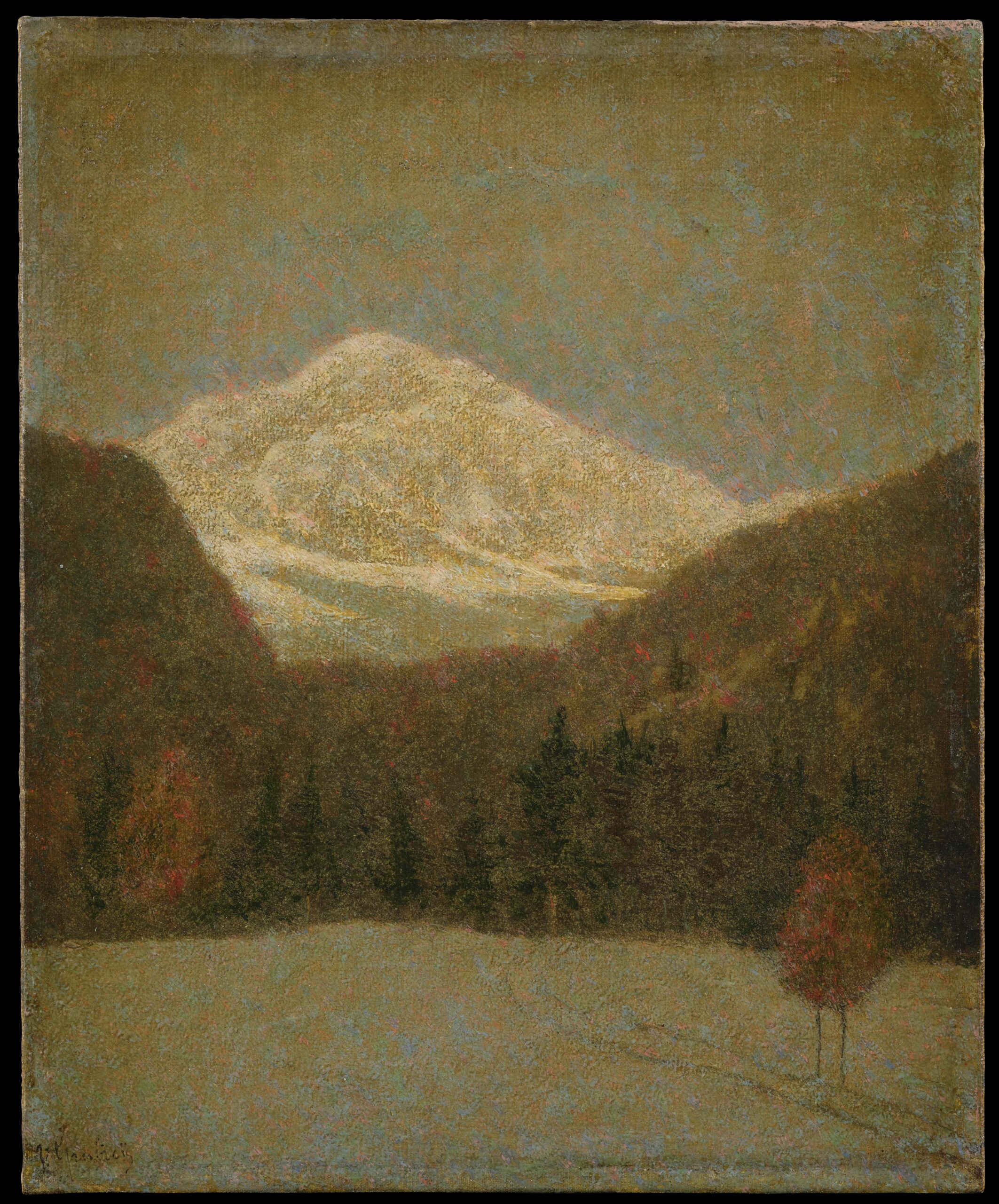
Neve in agosto. Snow in August. Vittore Grubicy de Dragon, ca. 1887. The canvas is not large. It shows the slopes above Schilpario — a small commune in the Province of Bergamo — in high summer, and they are white. Not the catastrophic white of an avalanche, but a quiet, workmanlike white, the kind that simply belonged there. A few dark pines anchor the lower edge. The sky above is neither dramatic nor indifferent. Everything in the painting seems to be occurring without performance.
I stood there for what I later estimate to be ten minutes, though it felt neither long nor short. I had come to the Carrara with a specific purpose: together with my studio 2050+ I was in the middle of curating Fuoripista (Off Track), an exhibition at Gres Art 671, one of Bergamo’s contemporary art museums, dedicated to winter sports and the transformation of the winter imaginary. The show held several registers simultaneously — works by contemporary artists alongside old masters, research contributions, archive materials, athletic performances — all circling the same question: what has happened to winter, not only as a climatic event but as a cultural construction, an aesthetic category, a way of being in landscape? I had come to the Carrara hunting for material, for resonances, for the kind of historical grounding that gives contemporary anxiety its proper depth. I was not expecting to be stopped in my tracks.
What held me is not primarily the painting’s quality, though it is extraordinary in its restraint, in Grubicy’s pointillist discipline applied to silence and cold. What held me is the specific grief of looking at a document. Because that is what Neve in agosto has become in the intervening century and a quarter: not a landscape but a record. A notarized testimony to conditions that no longer obtain. Snow in August above Schilpario. The mountain, roughly two thousand meters high, still there. The snow, gone.
I grew up knowing the mountains of the Bergamo valleys as places of reliable winter. Not the grand, photogenic winter of the Dolomites or the high Alps, but a modest, working winter — functional cold, serviceable snow, the kind that closed schools twice a season and made the roads up to the ski resorts genuinely precarious by November. Schilpario was part of this world. The Presolana group to its side, the Orobie behind. These were not glamorous mountains. They were local and familiar mountains, the mountains you drove to on a Sunday with chains in the boot, where the ski lifts were a little battered and the rifugi served polenta. They were mountains where winter was not an amenity but a condition.
That winter is dissolving. Not suddenly, not in a single catastrophic event that one could point to and mourn cleanly, but gradually, in the manner of slow losses that are almost worse for their gradualism.
The numbers confirm what the body already knows. Since the late nineteenth century, average annual temperatures across the European Alps have risen by approximately 2°C — roughly twice the rate of the global average over the same period. The warming has not been uniform: from 1980 onwards, the rate accelerated to around 0,5°C per decade. At mid-mountain elevations, the period of snow cover has shortened by nearly a month since 1970. At Schilpario’s altitude — somewhere between 1000 and 1500 meters, the zone most sensitive to the rain-snow threshold — these are not projections but observations, already in the past tense. What Grubicy recorded as August snow is not merely a seasonal anomaly of a warmer world: it is evidence of a climate that no longer exists.
I went back to Schilpario in January, four months after my visit to the Accademia Carrara. I went deliberately, with the painting still in my mind, wanting to see what Grubicy’s mountain looked like in its winter season. The drive up from the valley takes forty minutes. The temperature at the base is eight degrees Celsius. In January.
The ski resort — if that word still applied to what I found — is a study in institutional persistence. The lifts were there. The signs were there. The piste map on its wooden board at the entrance still showed the mountain in its ideal condition, slopes blazing in the optimistic red and blue of a cartographic winter. What was not quite there was the snow. There were patches, grudging accumulations on the northern aspects where shadow preserved a few inches of what passed for a snowfall in December. A machine somewhere on the upper slope was running, forcing artificial snow from a cannon, and the sound carries in the still air — mechanical, slightly desperate, the sound of something working very hard to produce the conditions that once simply existed.
Two lifts were operating. One was closed, its chairs hanging empty and slightly forlorn in the grey air. A small group of skiers, mostly families, picked their way down the single open piste with the careful deliberation of people navigating an obstacle course. The grass showed through in several places. The children were wearing helmets and bright jackets and they were making the best of it, as children do. But around the edges of the resort, the meadows were simply open, brown with dead grass and a few weeks of cold but no meaningful snowfall. A herd of deer had come down close to the tree line. In any previous January of my memory, they would have been pushed far lower, deeper into the valley, by a snowpack that made the upper slopes uninhabitable.
I ate lunch in the rifugio. The owner, a man in his fifties whose family had run the place for three generations, talked to me with the flatness of someone who had explained something too many times. « È così da qualche anno. » It has been like this for a few years. He said it without self-pity, with a pragmatism that was perhaps the most chilling thing about the conversation, because pragmatism in the face of catastrophe is what adaptation looks like before it tips into resignation.

You’re reading this essay for free. With a membership, you can read the full magazine, and you get access to our fabulous Library.
Here’s our offer: 3 months unlimited digital access + 1 print edition for € 38,00 € 19,00
You’ll get Issue Twelve in print as your first magazine, right to your mailbox.
In November 2025 our exhibition opened in Bergamo. In February and March 2026, the winter Olympics and Paralympics arrived in Milano and Cortina. I watched the opening ceremony on television with the same attention I gave to Neve in agosto in the museum — looking for the document beneath the performance. The snow for the events at the competition venues was partly engineered: produced, stockpiled, redistributed by machines operating well in advance, stored under insulating blankets, deployed with the precision of a logistics operation. The natural snowpack is insufficient. The Olympics require winter, so winter is manufactured. With no surprise, these Games, like their recent predecessors, have generated fierce controversy over the financial and environmental costs of the infrastructure built to fabricate the conditions they required.
Things were very different a century ago. The first edition, held in Chamonix in 1924, was a contained affair — a handful of nations, a few hundred athletes, events staged in a single compact Alpine valley whose winter credentials required no engineering whatsoever. The Games belonged entirely to the geography that produced them. Snow and cold were not inputs to be managed but the unquestioned premise of everything. A century later, the Games have grown into something of an entirely different order: thousands of athletes from scores of nations, competitions spread across vast and sometimes climatically incongruous territories, an apparatus of infrastructure, organisation and spectacle that dwarfs anything Chamonix could have imagined. Along the way, through modernization, winter itself was detached from the climate and geography that had produced it.
In its Alpine version, its most spectacular and celebrated version, winter was exported, first as a sport, then as a lifestyle, then as a brand. It was replicated in places where it barely existed, or didn’t exist at all. It was conjured by snowmaking infrastructure in mountain ranges that the original mountaineers would not have recognized as winter venues, or locked into colossal, energivorous, indoor facilities in the middle of the desert. It was packaged and sold — as imagery and experience — becoming another commodity. And like most commodities, it turned out to be subject to the logic of extraction: the more intensively it was exploited, the more precarious its underlying conditions became.

There is something clarifying or even obscene about this. The world’s most visible celebration of alpine sport takes place in conditions that are, to a significant degree, technologically fabricated. The mountains are still there. The infrastructure is still there. The athletes are extraordinary. But the winter — the actual meteorological phenomenon, the thing that makes alpine sport not merely possible but meaningful, the thing Grubicy painted as a simple fact of August in 1887 — must now be engineered into existence at enormous cost, environmental and financial, to sustain an artificial imagery that the climate is actively withdrawing.
This is the double loss I kept returning to, standing in front of that painting in the Carrara, walking the brown slopes above Schilpario, assembling the materials for Fuoripista in the knowledge that the exhibition was, among other things, an act of mourning. There is the material loss: the ecosystems dependent on snowpack, the hydrology of the valley rivers, the microclimates of the high meadows, the deer coming too early down to the tree line. These losses are measurable. And then there is the other loss, harder to quantify and perhaps for that reason more easily dismissed: the loss of winter as a lived cultural imagination. The loss of the thing you drove toward on a Sunday morning in November with chains in the boot.
The last chapter of Fuoripista featured early digital simulations of snowfall and a video-gaming station through which visitors could ski thousands of slopes worldwide — digital documents that will act as future relics of a lost season. As winter withdraws, we may find ourselves in a world where snowy mountains are streamed rather than lived.
Grubicy painted his mountain and its August snow as a fact. He was recording what was simply there — the painting as a faithful document. Snow fell above Schilpario in August 1887 and there was nothing remarkable about it.