 Skip to content


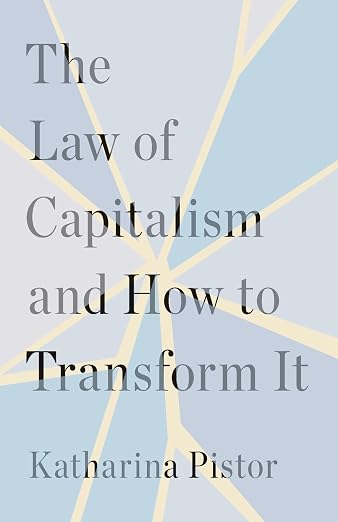
The Law of Capitalism and How to Transform it
Katharina Pistor
Yale University Press, 2025
A new phone, peeled out of its packaging, greets me with a sprawling text of terms and conditions. I do not read the text. Nobody does. I hit « Agree ». In that instance, something remarkable happens: the law recognizes my gesture — performed with routine nonchalance — as an expression of free consent to enter into a binding contract. There was no way of changing the terms of the contract. Or of disagreeing with them while still using the phone. But the law treats my ineluctable submission to the terms and conditions as though it was the result of a fair bargain between me and the company at issue. It is a common trick the law performs, turning submission into agreement. Law, it turns out, is capitalism’s operating system.

Look around, the law is everywhere in capitalism: property is a legal title, individuals like you and me are contracting parties, corporations are legal subjects, and any purchase is recoded as a contract. In part, this is an old story. The role of law in turning land into property that can be owned to the exclusion of others is tied up with the origins of capitalism itself. « Law itself … becomes the instrument by which the people’s land is stolen, » Karl Marx writes in the first volume of Capital. That is how « landowners grant themselves the people’s land as private property. »
Land becomes mortgageable, speculable and inheritable. Over time, the role of law has only become more central, and still more problematic.1
As a code through which assets are created and privileges distributed (« This is mine! »), the law enables the accumulation of capital, the concentration of wealth and the increase of inequality. The way in which the law recodes land means, for example, that some people can be evicted for failing to make their mortgage payments while empty luxury houses are turned into assets that serve as investments for their absentee owners. The law protects property, be it the one-bedroom apartment held as security by a bank or Jeff Bezos’s nine-cabin sailing yacht. In the eyes of the law, they are treated the same. More sneakily, the law justifies what may otherwise just seem odd — if not morally repellent: from property rights that back up forced evictions, to contracts that enable the accumulation and abusive use of personal data. I did hit « Agree ». Legal arrangements have led us to live in capitalism like fish in water.
Whichever crushing malaise or bugging quirk surrounds us, we should separate what must be accepted from what can still be changed. Shifting the boundary between what is considered natural and what, conversely, is open to human intervention, has been the main struggle for emancipatory movements over the centuries. Gender roles and racial hierarchies are socially constructed, like the socio-economic system we call capitalism. Does this mean that capitalism, like gender roles and racial hierarchies, can be changed?

My go-to place for thinking through the contingency of the social world remains Max Horkheimer’s endlessly re-readable essay, Traditional and Critical Theory, first published in German in 1937 in an attempt to define the program of the Frankfurt School. Philosophy had become estranged from struggles of emancipation, Horkheimer argued, because it took the world for granted. Traditional theorists busied themselves with the « assiduous collecting of facts » to better navigate the world as it was given to them. They amassed knowledge that they presented in ordered hypotheses and in the process, they constantly recreated and reified the world in whose confines they were acting. They lacked a sense of self-reflection.

For Horkheimer, to the contrary, the point of philosophy was to change the world, to deny that « all its wars and all its senseless wretchedness » are « an unchangeable force of nature, a fate beyond man’s control ». The object of critical theory was thus the social world itself, and everyone in it as « producers of their own historical way of life in its totality ». The impetus is clear enough: realizing that something is not natural but made means that it can be remade differently.
There is an elevated sense of possibility on the inhale. We hold the world in our hands, as it were. On the exhale, a deflating sense of reality takes over. Those who are bugged or crushed by the system and wish to change it, experience the world as withdrawn from them, not bending to their will. The world is, in Horkheimer’s words, « not their own but the world of capital ». You want to transform capitalism? Then you have not yet understood the penetrating, pernicious ways in which capitalism reproduces itself, produces you.
Enter Katharina Pistor, a German professor of law at Columbia University, New York — once the place of refuge for the Jewish Horkheimer and his associates during Nazi persecution. A few years ago, Pistor made a splash with her book The Code of Capital (2019), starting out with the affirmation that: « Capitalism is a legal regime ». Because capitalism is made by law, the law can also make it into something else.
The urge to remake the law is fueled by the fact that, as it stands, the law enables the rich to become richer while it keeps checks on the poorer segments of society. Thomas Piketty’s story about Capital in the Twenty-First Century (2013) resonates here, about how wealth is increasingly produced by wealth, and not by labor. In Pistor’s rendering, the evolution of capitalism becomes a story of how the law has evolved, of How the Law Creates Wealth and Inequality, as the subtitle of Code of Capital announces.
Pistor (1963) studied law in Germany and continued her career in the United States. She first specialized in the legal transformations of post-socialist societies and drew out the many things that went wrong with transplanting rule-of-law playbooks there. One of her main themes has been the ways in which law shapes the world of finance, and thereby the world at large.
In The Code of Capital, Pistor gives the example of legal developments in support of transactions in which investors bet on the future, without holding any underlying assets. All types of so-called derivatives work like that (futures, options, swaps, etc.). Legally, they are contracts the value of which depends on the change in the value of something else — like changes in stock or commodity prices, in interest rates, currency values, you name it. Or they depend on an event like a party’s inability to make their mortgage payment. Because the difference between such speculative contracts and gambling is far from obvious, they were not legally recognized or enforceable, until they were.
Since the 1980s, the global derivatives market has grown explosively, accounting for economic growth almost entirely captured by the richest one percent, and also accounting for the 2008 financial crisis — when the 99 percent faced the consequences of break-neck speculation. At the core of the financial crisis were individual mortgages bundled together in « Collateralized Debt Obligations » (CDOs) and the financial derivatives written on them, especially « Credit Default Swaps » (CDS) — or « dog shit wrapped in cat shit », as Steve Carell’s character concludes in the film The Big Short (2015).
Ever new kinds of derivatives and related legal arrangements gained recognition in courts, crafted and defended by well-paid lawyers who were in turn spurred on by clients with deep pockets. Financial firms and their legal teams even managed to tweak the law so that when a contracting party declares bankruptcy, large creditors have first dibs on any remaining assets, ahead of the ordinary Joe who is left to search for crumbs.

Pistor intervenes in this dense field of financial capitalism with the additional twist that all of this is made possible with and through law. She portrays lawyers themselves as the « masters of the code ». They are graduates from places such as Columbia Law School, which positions Professor Pistor herself as a grandmaster.
One could perhaps see her argument coming. But Pistor does not preach to those already converted. She portrays the law in a hyperrealist fashion so that even the last hold-out neoliberal sees that capitalism is not a natural given, but a product of contingent choices embedded in law. When one continues to ponder the possibilities of change, it becomes clear that Pistor exaggerates the power of law and lawyers. If the law makes capitalism, what makes the law? The Code of Capital still lacked the account of legal change that her latest book now offers.
I read Pistor’s The Law of Capitalism and How to Transform It (2025) as an expression of love for the law in bad times. Her love now shows less in her dedication to the details of legal doctrine, but in law’s transformative potential so that the world we hold in our hands will somehow be less shitty. As a legal regime, Pistor insists, capitalism « is a matter of human choice » and « if that is so, different choices are at least imaginable. »
Her latest book is shorter, less patient and more tangibly driven by the urge to transform capitalism. She showcases the role that the law plays for capitalism through telling vignettes, but her verdict is stronger from the outset. The law has been instrumental in shoring up wealth, and time and again, it could be tweaked to resist and undo progressive interventions into the economy.
In what counts as a signature move of critical thinking, Pistor does not just gesture towards alternatives to the present legal coding of capitalism but asks why, given the long list of ills that capitalism has produced, this legal regime has still turned out to be so damn resistant to progressive change. She attributes this resistance to the law itself, to « capitalist law », as she calls it. This requires some unpacking, bear with me.
Three main features mark « capitalist law ». First, much of the lawmaking is left to private parties, such as banks and other financial institutions. In the 2008 financial crisis, disputes about what counted as a « default » — a party’s failure to meet their financial obligation, like the paying of a mortgage — were for example decided by committees of the International Swaps and Derivatives Association (ISDA), a private club of big derivative players and their lawyers. Lawyers grouped in the ISDA write standard contracts that banks and other financial institutions then use when they trade derivatives. Crucial legal developments (like whether someone’s house is foreclosed) thus take place outside parliamentary legislation, and to the exclusion of ordinary public courts.
The second main feature of « capitalist law »: different actors have unequal access to courts. The law for example enables corporations to sue against states before international arbitral tribunals, even if their claims are at best spurious. The claim by ExxonMobil and Shell (formerly Dutch, now British) against the Netherlands due to the phase-out of gas extraction in the province of Groningen is a case in point. Conversely, victims of corporate abuse typically find themselves without access to courts even if they have a lawyer: legal rules themselves restrict such access. Consider the plight of the victims of the oil spills and human rights abuses caused by Shell in the Niger Delta. No court found itself competent.

The third feature: law comes with interpretative wiggle room, which can be exploited by those who have the means and legal acumen to do so. Pistor turns to the example of tax legislation intended to favor « partnerships », which was a typical legal form for small businesses. But what is a « partnership », really? In the end, the law was tweaked to shield large investors’ profits from taxation, shifting their profits from one corporate partner to another. Pistor’s point: « it takes a lawyer to pull this off. »
Lawyers enjoy immense legal coding power because the law is malleable and gains shape in everyday practices that they themselves dominate.
« It does not have to be this way » is Pistor’s by now predictable interjection. Because the law is malleable, it can be bent into other directions. The Law of Capitalism is peppered with examples that evoke a sense of possibility, of how the law of capitalism used to be different, or still is different in some more socially minded parts of the world.
Pistor recalls that Roman law knew of different types of goods that were private, common, or belonged to no one. Today’s thinking about property instead starts from the rights holder rather than the object in possession. But how would it transform capitalism if the approach of Roman law was rekindled? What would Roman law categories change about the legal protection of Bezos’s luxury yacht, which in the eyes of the law is for now indistinguishable from somebody’s only apartment?
Or take the limitations on the liability of corporations and corporate owners, shielding them from risk without any limit on their rewards. The corporate form of a limited liability company, in which owners are liable only to the extent of their investments, has become a common feature of our capitalist world. The related legal developments were helped along by a broader ideology: limiting liability, the argument goes, is necessary to attract capital and to engender entrepreneurial risk-taking. But, as Pistor points out, the state of California had no economic disadvantage even though it introduced limited liability as late as 1932. Overall, she argues, the limitations of corporate liability have just gone too far, and their economic rationale does not hold up. Her arguments do garner my sympathy. It’s clear that the law should not protect the fossil majors from paying up for damages they knew would follow from burning fossil fuels. But how far should that liability go? Should it include shareholders who were also in the know? Several pension funds invested in fossil fuels would then also take a hit. If only the devil were not in the detail.

The legal coding of data is another important point ripe with transformative potential. Tech companies can willingly use, trade and amass the data they draw from consumers who did nothing more than hit the agree button while fumbling for their bike-keys. Pistor argues for challenging the legality of companies’ data ownership and denying them related rights.
On second reading, however, many of the examples are as alluring as they are curt, leaving a desire for more. They also point to the difficulties of trying to tweak parts of a system without engaging its premises — of change without changing.
One should be forgiven for thinking that on the other side of capitalism, « beyond capitalist law » (Pistor’s last chapter), lies the promised land of socialism. Not for Pistor. Her program is reformist, not revolutionary. The choice between capitalism and socialism is anyway too constraining for her: « Real existing capitalism or socialism, however, are not the only possible ways of organizing socioeconomic systems. » That is upsetting for capitalists and socialists alike, but probably fair enough.3
When it comes to the direction of any transformation, however, Pistor’s imagination falters and she deflects to « a path for social justice ». What we are talking about is, in fact, capitalism with a more human face — with lesser concentrations of wealth, more respect for human dignity, more regard for planetary boundaries, etc.
« It also follows from the premise that capitalism is a legal regime, » Pistor continues, that « transformative change is possible only through law. » Pistor anticipates several hard-nosed objections to this bold claim and wrestles them down, which includes a skirmish with the work of Greek-French philosopher Nicos Poulantzas (State, Power, Socialism, 1978). Poulantzas and Pistor agree that the law is more than just a mirror of economic relations, that it enjoys a « relative autonomy » vis-à-vis the ruling class. But for Poulantzas, who never wavered in his commitment to socialism, the law is much better at stabilizing capitalism than at transforming it. Class struggle, not the law, remains the driver of change.

For Pistor, to the contrary, the possibility for change lies in a subjective, even individual stance. She counts on the lawyers themselves to get the transformation going. Those « masters of the code » who made the law of capitalism into what it is today, are the ones who should now make into something else.
Out of all people, who would bet on lawyers to carry the revolutionary torch or even the reformist banner? I am a lawyer, please do count me in. Around me, I see others who wish to join. But just like more snowfall on my street this year compared to last does not defy climate science about global warming, the broader picture of lawyers’ readiness to transform capitalism looks quite different.
Consider that it takes three years to get a law degree from a place like Columbia Law School. The tuition fees run at USD 85.000 per year. Thanks to parents’ deep pockets or some financial aid, the average student loan of its graduates is « only » USD 200.000. Most of them won’t have a choice other than taking a high-paying job at a firm that is bound to do what brings in money: shielding Shell from liability rather than trying in vain to vindicate the rights of its victims. Capitalism has its ways of making sure that most masters of the code stay in line.
Whether we hold the world in our hands, Max Horkheimer knew, depends on how human labor is organized. And as critical theory realized this, he wrote, « it became a critique of the economy ». Re-enter Pistor: « capitalism is a legal regime. »

- What one makes of the role of law in capitalism surely depends on how charmed one is by capitalism itself. There are good reasons for seeing the workings of capitalism in many items on today’s laundry list of miseries. Now, and now for real, it may be time to push « beyond capitalism ». I sympathize with Aaron Benanav’s account under that headline over at the New Left Review (2025). But I will try to keep the grandiose question of whether capitalism is either « good » or « bad » for another day and proceed on the simpler premise that maybe there are a lot of shitty things that the law does in capitalism. ↩︎
- What one makes of the role of law in capitalism surely depends on how charmed one is by capitalism itself. There are good reasons for seeing the workings of capitalism in many items on today’s laundry list of miseries. Now, and now for real, it may be time to push « beyond capitalism ». I sympathize with Aaron Benanav’s account under that headline over at the New Left Review (2025). But I will try to keep the grandiose question of whether capitalism is either « good » or « bad » for another day and proceed on the simpler premise that maybe there are a lot of shitty things that the law does in capitalism. ↩︎
- I loved rereading Rosa Luxemburg biting critique Sozialreform oder Revolution? (1899) in which she rips apart the progressive potential of any social reform that loses sight of the revolutionary horizon. Luxemburg could still argue with the confidence of « scientific socialism » and its certainty that the class conflict inherent in capitalism would drive history towards capitalism’s overthrow. It really is a delight to read but attempts to map it onto the present are forced, at best. ↩︎