 Skip to content


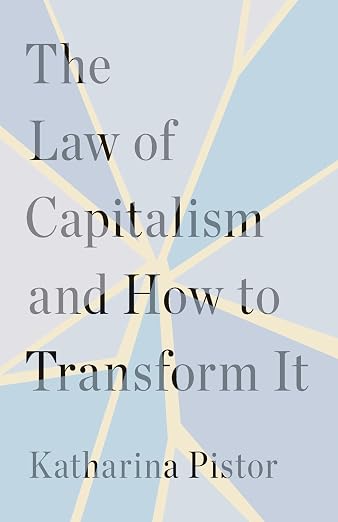
The Law of Capitalism and How to Transform it
Katharina Pistor
Yale University Press, 2025
A new phone, peeled out of its packaging, greets me with a sprawling text of terms and conditions. I do not read the text. Nobody does. I hit « Agree ». In that instance, something remarkable happens: the law recognizes my gesture — performed with routine nonchalance — as an expression of free consent to enter into a binding contract. There was no way of changing the terms of the contract. Or of disagreeing with them while still using the phone. But the law treats my ineluctable submission to the terms and conditions as though it was the result of a fair bargain between me and the company at issue. It is a common trick the law performs, turning submission into agreement. Law, it turns out, is capitalism’s operating system.

Look around, the law is everywhere in capitalism: property is a legal title, individuals like you and me are contracting parties, corporations are legal subjects, and any purchase is recoded as a contract. In part, this is an old story. The role of law in turning land into property that can be owned to the exclusion of others is tied up with the origins of capitalism itself. « Law itself … becomes the instrument by which the people’s land is stolen, » Karl Marx writes in the first volume of Capital. That is how « landowners grant themselves the people’s land as private property. »
Land becomes mortgageable, speculable and inheritable. Over time, the role of law has only become more central, and still more problematic.1
As a code through which assets are created and privileges distributed (« This is mine! »), the law enables the accumulation of capital, the concentration of wealth and the increase of inequality. The way in which the law recodes land means, for example, that some people can be evicted for failing to make their mortgage payments while empty luxury houses are turned into assets that serve as investments for their absentee owners. The law protects property, be it the one-bedroom apartment held as security by a bank or Jeff Bezos’s nine-cabin sailing yacht. In the eyes of the law, they are treated the same. More sneakily, the law justifies what may otherwise just seem odd — if not morally repellent: from property rights that back up forced evictions, to contracts that enable the accumulation and abusive use of personal data. I did hit « Agree ». Legal arrangements have led us to live in capitalism like fish in water.
Whichever crushing malaise or bugging quirk surrounds us, we should separate what must be accepted from what can still be changed. Shifting the boundary between what is considered natural and what, conversely, is open to human intervention, has been the main struggle for emancipatory movements over the centuries. Gender roles and racial hierarchies are socially constructed, like the socio-economic system we call capitalism. Does this mean that capitalism, like gender roles and racial hierarchies, can be changed?

My go-to place for thinking through the contingency of the social world remains Max Horkheimer’s endlessly re-readable essay, Traditional and Critical Theory, first published in German in 1937 in an attempt to define the program of the Frankfurt School. Philosophy had become estranged from struggles of emancipation, Horkheimer argued, because it took the world for granted. Traditional theorists busied themselves with the « assiduous collecting of facts » to better navigate the world as it was given to them. They amassed knowledge that they presented in ordered hypotheses and in the process, they constantly recreated and reified the world in whose confines they were acting. They lacked a sense of self-reflection.
This article is behind the paywall. Want to keep reading this article?
Subscribe to the European Review of Books, from as low as €5,00 per month.
Already a subscriber? Sign in