 Skip to content

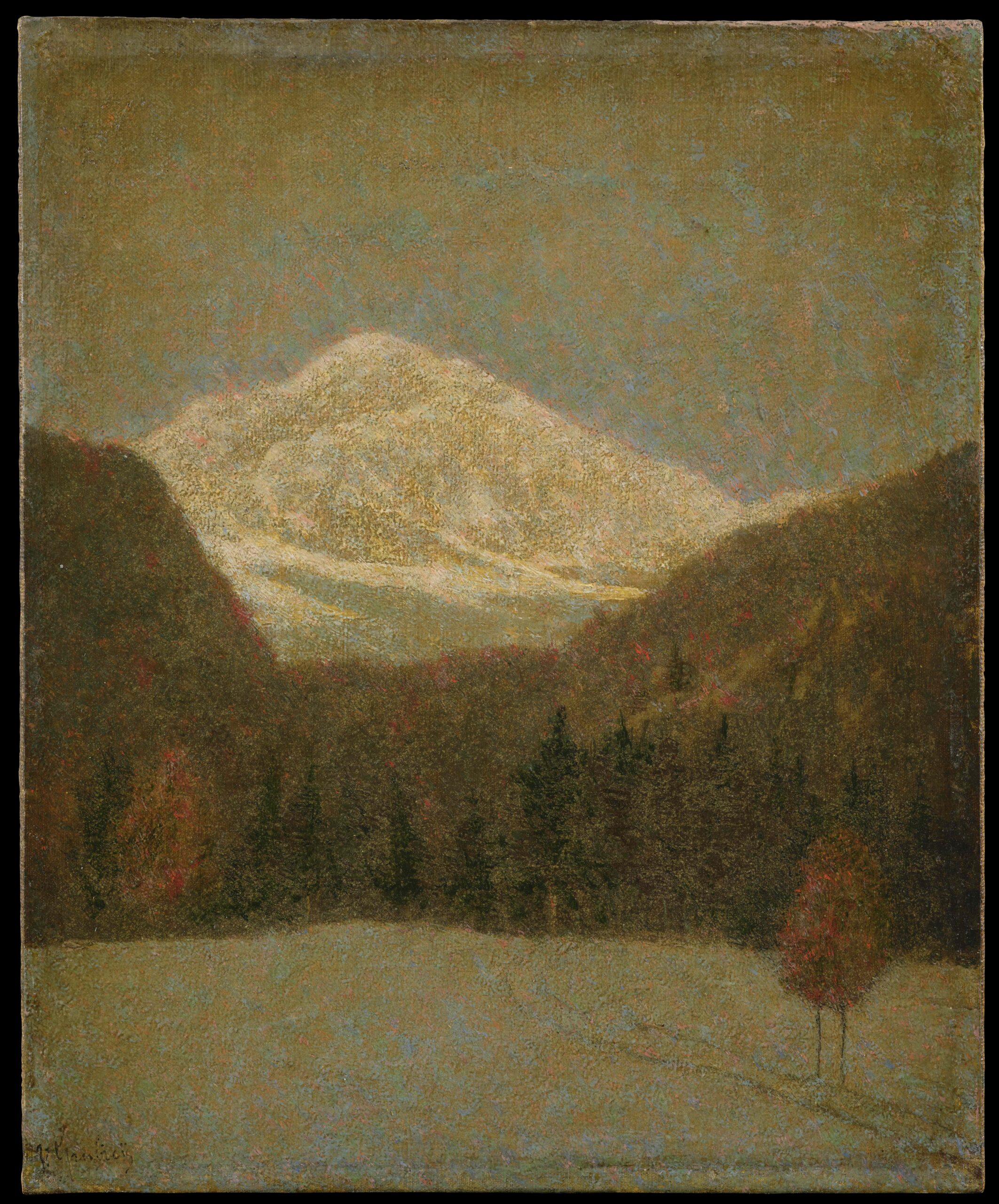
The painting stopped me before I had finished reading its label. I had walked through three rooms of the Accademia Carrara already, past Venetian altarpieces and Lombard portraits, with that slightly distracted pace one adopts in museums when the mind is present but not yet arrested. Then this.
Neve in agosto. Snow in August. Vittore Grubicy de Dragon, ca. 1887. The canvas is not large. It shows the slopes above Schilpario — a small commune in the Province of Bergamo — in high summer, and they are white. Not the catastrophic white of an avalanche, but a quiet, workmanlike white, the kind that simply belonged there. A few dark pines anchor the lower edge. The sky above is neither dramatic nor indifferent. Everything in the painting seems to be occurring without performance.
I stood there for what I later estimate to be ten minutes, though it felt neither long nor short. I had come to the Carrara with a specific purpose: together with my studio 2050+ I was in the middle of curating Fuoripista (Off Track), an exhibition at Gres Art 671, one of Bergamo’s contemporary art museums, dedicated to winter sports and the transformation of the winter imaginary. The show held several registers simultaneously — works by contemporary artists alongside old masters, research contributions, archive materials, athletic performances — all circling the same question: what has happened to winter, not only as a climatic event but as a cultural construction, an aesthetic category, a way of being in landscape? I had come to the Carrara hunting for material, for resonances, for the kind of historical grounding that gives contemporary anxiety its proper depth. I was not expecting to be stopped in my tracks.

What held me is not primarily the painting’s quality, though it is extraordinary in its restraint, in Grubicy’s pointillist discipline applied to silence and cold. What held me is the specific grief of looking at a document. Because that is what Neve in agosto has become in the intervening century and a quarter: not a landscape but a record. A notarized testimony to conditions that no longer obtain. Snow in August above Schilpario. The mountain, roughly two thousand meters high, still there. The snow, gone.
I grew up knowing the mountains of the Bergamo valleys as places of reliable winter. Not the grand, photogenic winter of the Dolomites or the high Alps, but a modest, working winter — functional cold, serviceable snow, the kind that closed schools twice a season and made the roads up to the ski resorts genuinely precarious by November. Schilpario was part of this world. The Presolana group to its side, the Orobie behind. These were not glamorous mountains. They were local and familiar mountains, the mountains you drove to on a Sunday with chains in the boot, where the ski lifts were a little battered and the rifugi served polenta. They were mountains where winter was not an amenity but a condition.
This article is behind the paywall. Want to keep reading this article?
Subscribe to the European Review of Books, from as low as €5,00 per month.
Already a subscriber? Sign in