Toco tu boca. Con un dedo toco el borde de tu boca. Voy dibujándola como si saliera de mi mano. My literature teacher reads aloud chapter seven of Rayuela, known to anglophone readers as Hopscotch, by Julio Cortázar. I am a high-school girl ready to fall in love, my notes filled with hearts on the margins. Como si tuviéramos la boca llena de flores o de peces, de movimientos vivos, de fragancia oscura. After class, I walk up to the teacher and ask why, in a romantic chapter like this, would he decide to talk about fish, why would he say that fish swim in your mouth when you kiss? My teacher smiles at me. She waits for the classroom to clear and asks if I have had my first kiss yet. I feel my face going red as I answer no. « You will understand as you grow older », she says and tells me to go get lunch.
Y si nos mordemos el dolor es dulce. I had my first kiss at eighteen and as I had a guy’s tongue in my mouth I thought about Julio Cortázar and his fish, swimming from one mouth to the other.
Julio Cortázar was born in Belgium by accident. His father was an Argentine diplomat, it was 1914 and World War I forced the family to stay in Europe for the first six years of his life. Despite this « accident », Julio Cortázar was Argentinian: no one from Argentina would let me say anything different of one of their most famous authors. He published several short story collections, novels (Los premios (1960), Rayuela (1963), 62 modelo para armar (1968), Libro de Manuel (1973), Los autonautas de la cosmopista (1983)), essays, poems and even a comic book.
Cortázar was internationally known for his ability to narrate seemingly boring situations through a fantastical lens: for example, he has a short story called « On How To Climb A Staircase ». He is also renowned for his word-play and formal innovation: Rayuela can be read front-to-back or starting from chapter 73. One of the most sensuous passages in literature is written in his made-up-language, giglico: « As soon as he began to amalate the noeme, the clemise began to smother her and they fell into hydromuries, into savage ambonies, into exasperating sustales. »
He was obsessed with jazz, boxing and socialism. A friend to Gabriel García Márquez, Mario Vargas Llosa and Carlos Fuentes, Cortázar was the Argentine representative of the Latin American Boom and his books were translated into dozens of languages. His short story collection A Certain Lucas has just been republished by New Directions (2025).
At thirty-six years old, Julio Cortázar moved to France where he would live until his death. It is said his love for Paris was as consuming as a carnal love. When he first arrived, despite being completely broke and alone, the beauty of Paris turned his sadness into aesthetics. He would smoke and walk around the city like a flâneur conjured up by Charles Baudelaire. Rayuela happens along the streets of Paris — from Nôtre Dame to Carrefour de l’Odéon — as the reader follows the story of Oliveira and La Maga. « We went around without looking for each other, but knowing that we were walking to find each other. » Countless readers, myself included, have read in Oliveira and La Maga an ideal couple: she, a mysterious and quirky woman; he, a bohemian and creative man. But their relationship was also unjust and incredibly painful.
Mario Goloboff, Miguel Herráez, Miguel Dalmau, Jesús Marchamalo and Marc Torices have all tried to narrate Cortázar’s life with their biographies. But there is always something that the archive cannot offer, something that exceeds the hard facts. I have been reading him my whole life but I don’t know him. In that blank space, his love letters help me imagine another side of him. I want to imagine that side, because just reading his work is not enough anymore. Was he romantic? Was someone taking care of him? Was the love that defined my teenage years, the same that permeated his life? Did his kisses feel like fish swimming in the mouth?

I arrive at the library of Poitiers University and walk up to the receptionist. With my best accent, I say « Bonjour, je recherché Julio Cortázar archive. » The man looks at me in amusement. I repeat, trying to recall the two months of French I took when I was fifteen, « Bonjour, je recherché Julio Cortázar archive. » He thinks about it for a second, and then smiles. « Ah, » he says, « Julio Cortázar. » I smile back. « Oui. » He then turns around and gestures for me to follow him into another room.
We walk through the library until he points, proudly, to a section. « Julio Cortázar, » he says. The bookshelf has a header that reads « Latin American Literature ». I see his books next to Gabriel García Márquez, Mario Vargas Llosa and Carlos Fuentes. This is not what I need. « Julio Cortázar AAR-KIVE, » I say. « Oui, Julio Cortázar, » he points. This goes on for a while. Finally, after repeating the word « archive » countless times, he takes me to another room and hands me over to a woman, saying: « Julio Cortázar AR-SHIV, si vous plaît. »
After a lot of pointing and gesturing I am handed a box with Julio Cortázar’s name. To my surprise, however, his name is not a signature. I thought I was approaching his personal archive, his letters, his notes, his manuscripts, even his diary if he had written one, but all I can see are newspaper clippings, boxes and boxes filled with them. The archive is not from Julio Cortázar but about Julio Cortázar. I sigh and start taking notes.
In the newspapers, I read about his last visit to Argentina, as he had been foreign to his own country during the dictatorship. I read the reviews of his books and dozens of his interviews. I read headlines in different languages: « Conversazione con Cortázar », « Cortázar between political compromise and literature », « Mon université c’était la solitude: Cortázar », « I make love with language », « Un cronopio llamado Cortázar », « If they gave me the Nobel Prize I would reject it ».
There is one that makes me stop. La tristeza mató a Cortázar en París. The name of the article is almost as big as the name of the paper, Diario16. Next to it, a photograph of Cortázar where he isn’t looking at the camera. I re-read the headline: Sadness killed Cortázar in Paris. Why did Julio Cortázar die of sadness? Why in Paris, the one place where sadness turned into beauty? And why was he killed by grief?
I ask my friend Alonso what he thinks about love. He shows me his arm. On it there is a tattoo that reads: « As if you could pick in love, as if it were not a lightning bolt that splits your bones and leaves you staked out in the middle of the courtyard. You don’t pick out the rain that soaks you to the skin when you come out of a concert. » It’s a quote from Rayuela.
It’s forty degrees in Zaragoza. I enter the library and as I give my name, I see the woman’s eyes shine. « The researcher is here! », she says to her coworkers. She introduces herself as the director of the library and walks me over to a small table next to her desk. « We set this up so you could work here », she says.

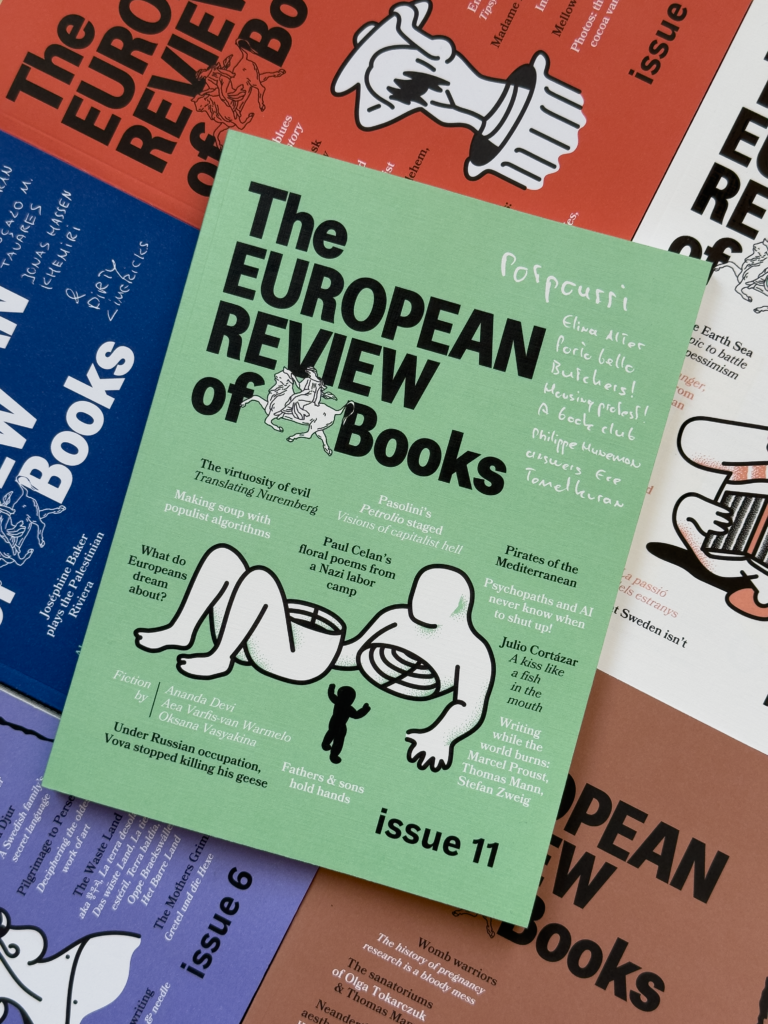
You’re reading this essay for free. With a membership, you can read the full magazine, and you get access to our fabulous Library.
Here’s our offer: 3 months unlimited digital access + 1 print edition for € 38,00 € 19,00
You’ll get Issue Eleven in print as your first magazine, right to your mailbox.

After I leave my things, she takes me around the library until we get to a bookshelf with a small plaque: « Legacy of Aurora Bernárdez ». I see books by Jean-Paul Sartre, Gustave Flaubert, Albert Camus, Lawrence Durrell, Paul Bowles, Italo Calvino. Aurora Bernárdez translated all of these authors into Spanish. I also see all possible editions of Julio Cortázar’s books: his novels in Polish, Russian, Hebrew, Chinese. The librarian, Verónica, tells me that they have just acquired Aurora’s personal library. I am the first person to visit. « We are very happy, of course », she says, « but it was a terrible thing that they did. They should never have separated her library from Cortázar’s in Madrid. »

Julio Cortázar and Aurora Bernárdez married in 1953. He had declared his love for her before leaving Argentina for Paris, not thinking that she would follow him. Their love has become mythical in the literary sphere: it is said that Julio would read a page from a book and tear it from the spine so that Aurora could read at the same time. She was always his first interlocutor, the first dialogue he wanted to have.
In his homage essay « The Trumpet of Deyá », Nobel Prize winner Mario Vargas Llosa says that it was impossible to tell which one of the two had read more or better. She was the first and only reader of Rayuela, as Cortázar told his editor before sending him the final manuscript. In his letters he calls her an « ugly bug » and he intertwines this pet name with mentions of love and kisses, as well as reminders to water the plants.
Aurora and Julio both worked in Paris as United Nations translators until they bought a house in Deyá, Mallorca. Aurora was a writer too, but she never published in her lifetime. Her brother and her husband were both famous authors: publishing must have felt daunting. Her whole life she devoted herself to translation. Her short stories and poems were only published in 2017, three years after her death. So far they have not been translated and have received limited attention. Most of the reviews tie her work to that of Julio (I guess very much like this essay).
When I visited Cortázar’s tomb in Montparnasse and saw Aurora’s name, I thought that this had been a legendary love and they had died tragically together. What a fool I was. Has love ever been so simple?
On 27 July 1968, fifteen years after their wedding, Cortázar sent a letter to his editor Paco Porrúa saying that he and Aurora were separating. At the end of the letter he also said: « There is someone that fulfills my life and with whom I hope to traverse the rest of my life ». A new woman.
I meet my friend Marcos at a coffee shop in Paris. He arrives with a package of madeleines. We are going to need them today if we plan to follow the tight schedule. I have in my hand a copy of a map of Paris created by the Cervantes Institute that highlights 21 places to visit: Quai de Conti, Pont des Arts, the Louvre Museum, Rue du Jour, Au Chien qui Fume, Pont Neuf, Rue Dauphine, Rue de la Huchette, Nôtre Dame, Rue du Sommerard, Rue Valette, Rue Monge, Rue Médicis, the Jardin de Luxembourg, Rue Monsieur-le-prince, the Carrefour de l’Odéon, Rue Tournon, Rue Saint-Sulpice, 32 Rue Madame, Rue de Babylone, Montparnasse Cemetery. All of these are the places that Oliveira and la Maga visited in Rayuela. Andábamos sin buscarnos pero sabiendo que andábamos para encontrarnos.
Though originally committed to the project, Marcos soon derails from the Rayuela-map. We visit Rue Monge, the Jardin de Luxembourg and Rue de la Huchette but soon we enter Place Sainte-Geneviève and a bookstore. Paris cannot be contained in 21 places. The map folded in my pocket, we walk through Montparnasse Cemetery eating madeleines. We see the tomb of Jean-Paul Sartre and Simone de Beauvoir, filled with drawings of red hearts. We pass by the tomb of César Vallejo, my favorite Peruvian poet. We say hi to Susan Sontag and see, in the distance, a man painting something on the bark of a tree.
At the tomb of Carlos Fuentes I feel compelled to leave a Mexican token and place a Pulparindo candy beneath a rock. The man has gone, and we go see what he painted on the tree: it’s a heart. We reach the tomb of Julio Cortázar. Aurora’s name is next to his, but on the upper half of the tomb there is another name. I don’t recognize it, so I disregard it. In the photos I took, it doesn’t even appear. Designed by Julio Silva and Luis Tomasello, the tomb resembles an open book and I was only looking at one of the pages.

I wish I knew more about Ugné Karvelis. Here is what I know: she was born in Lithuania in 1935, lived in Germany, then studied in Paris and New York before working as an editor for the French publisher Gallimard. As the director of the Latin American division of Gallimard, Karvelis was in charge of acquiring and accepting translation proposals — she even translated some books herself from Spanish into French. Because of her, famous authors like Octavio Paz, Mario Vargas Llosa and Julio Cortázar reached a French audience (and market!). In her pictures I see that she was beautiful. But, despite her decided importance, there is little known about her. It is said she had a strong temperament, to a fault. It is said she liked drinking a little too much. It is said she turned Julio Cortázar into an extremely political figure, a romantic man blind to the authoritarianism of the Cuban Revolution. It is said his worst, overtly politic, too didactic books — like El libro de Manuel — were written during the years he was with her, perhaps because they had met in Havana. Considered a surrealist writer, his openly political works were deemed minor. Ugné was not only Julio’s partner but his literary agent. Never mix pleasure and business, some people say.
On 12 December 1972 Julio sent Aurora a letter regarding their divorce. This was to be d’accord instead of au tort d’un seul des époux which would imply a public accusation of adultery. He was, at the time, with Ugné Karvelis. The letter offered a « divorce plan » that went as follows: Aurora, unhappy at Julio’s constant traveling, goes back to Buenos Aires. There, she sends Julio a separation letter.
Enclosed with the original was an outline of a letter written by Julio pretending to be Aurora. It started like this: « I don’t see why I should give you any explanation when you have never given me any either. If I have chosen to go to Buenos Aires it’s because I will not be lonelier here than in Paris ».
I imagine Julio writing this letter in the house he once shared with Aurora. Ugné was gone for the day. He was probably smoking a cigarette. In order to make it realistic, Julio would have had to recall events from the past: his absences, Aurora’s loneliness, the silence of the house he was currently in. Months later, Aurora sent him the letter back with her signature. They had officially divorced.
Aurora Bernárdez was, according to the published correspondence, the first person Julio told about his separation from Ugné. It was but one line: « The only thing I know is that I will not go back to Ugné. » Afterwards, Cortázar’s publishing rights went to ALIA — an association created by Karvelis — and he gifted her five percent of all the rights. The letter with this gift is the only correspondence found between them after their separation. It was not amicable. Many of his friends hoped that Julio and Aurora would get back together. In their books about Julio, they mythologize his first marriage. But it didn’t happen. In fact, this letter to Aurora about the end of his relationship with Ugné, marked the beginning of something else. It was sent from Montreal, Canada where in 1977 Julio went to a writers’ symposium. That is where he met Carol Dunlop.

I could have told this story differently. It could have begun with Carol Dunlop if only I knew more about her. But most of what I know, I know through Julio Cortázar and one should never believe a man in love. Like many other women married to writers, Carol is defined by her husband’s archive.
Carol Dunlop was born in Quincy, Massachusetts in 1946. She was a photographer and writer. Her son, Stéphane Hébert, was born in 1968. In November of 1977, a month after meeting Julio in Quebec, she received a letter in the mail. In it, he invited her to move to France so they could write together. What follows is the story of a woman who leaves her home in order to follow a man, just as Aurora had done twenty-five years before. In his letters, Julio describes her as « blue eyes, sweet and quiet, the calm after the storm ». Carol moved in (Julio bought a new apartment in Paris for both of them), her son visited regularly, and in December of 1981 Julio and Carol got married. Months later, in May of 1982, they began what Cortázar had proposed in that first letter. They started writing a book together: The Autonauts of the Cosmoroute.
Co-written by Julio Cortázar and Carol Dunlop, with drawings made by Stéphane Hébert, the novel narrates the story of a Wolf (Julio) and a Tiny Bear (Carol) as they travel in a red van (their dragon Fafner) from Marseilles to Paris in 33 days and stop at many gas stations along the way. When reading it, I was astounded at the fact that I could not tell whether Julio or Carol was writing. While the novel underscores the amazing feat of the journey, it’s the day-to-day activities that make up the story: Carol writing a letter, Julio making tea. Love like a drizzle, not a storm.
Julio Cortázar had many women in his life: his first wife Aurora, his second partner Ugné, his best friend Cristina Peri Rossi, his lover Manja Offerhaus, his inspiration Edith Aaron. But it was only Carol Dunlop (I would know, after reading his five volumes of collected correspondence) who « gave him a reason to live ». At 65, Cortázar was madly in love with a woman 32 years younger.
Epilogue to The Autonauts of the Cosmoroute (translated by Anne McLean):
« Reader, maybe you already know: Julio, el Lobo, is finishing up and putting this book in order alone, this book which was lived and written by la Osita and him the way a pianist plays a sonata, the hands united in a single quest for rhythm and melody. […] I watched her embark on her solitary journey, where I could no longer accompany her, and then on the 2nd of November she slipped through my fingers like a trickle of water, without accepting that the demons would have the last word, she who had so defied and fought them in these pages. I owe it to her, just as I owe her the best of my final years, to finish this story alone. I know very well, Osita, that you would have done the same if it had fallen to me to precede you in the departure, and your hand writes along with mine, these final words in which the pain is not, never will be, stronger than the life you taught me to live as perhaps we’ve managed to demonstrate in this adventure that comes to an end here but goes on and on in our dragon, goes on forever on our freeway. »
Carol Dunlop died on 2 November 1982 of a mysterious disease. In August of that year, the couple had been forced to leave Nicaragua — where they were traveling in support of the Revolución Sandinista — in order to get medical help in Paris as Carol was experiencing continuous pain. She was admitted to the hospital during those two months and Julio never left her side. A virus had stopped the production of leukocytes and platelets. The doctors tried several treatments, including one to the bone marrow in order to produce more white blood cells. During this time, Cortázar sat next to her, reading aloud or playing music.

Carol died keeping a secret from Julio. In a letter to Cortázar’s Serbian translator Silvia Monrós-Stojakovic, she says « I have known for a year, and I am the only one that knows besides the doctor, that Julio has chronic leukemia. He does not know and should not know because he has so much hope for life ». Carol, Silvia, Cristina (Julio’s best friend) and Aurora all knew he had a terminal disease. According to their common friend, Tomás Borge, Carol said to him « I wish Julio died before me in order to spare him the pain of my death ».
The letters Julio sent after her death are succinct. He informs their friends about Carol’s death and says he is in terrible pain, both emotional and physical. The sadness pains him so much it might kill him.
After Carol’s death, Aurora insisted on moving in with Julio. According to his letters, she singlehandedly made him regain five of the ten kilos he had lost. But even with Aurora’s care, sadness stayed with him like a shadow. Aurora also helped Julio publish The Autonauts of the Cosmoroute, she translated and revised Carol’s writing into Spanish. Her hand an invisible but present hand in the sonata of Cortázar’s love with another.
After Julio died, on 12 February 1984, Aurora became responsible for his entire estate. She contacted everyone they knew in order to compile the five volumes of correspondence I have read for this very essay. She safeguarded his manuscripts. She arranged his archive. Aurora was the one who, following Julio’s wishes, buried him next to Carol Dunlop, in a tomb in Montparnasse. But thirty years later, upon her death, her last wish was to be buried with Julio. And Carol. Given the lack of space in the tomb, her body was incinerated.

I go back to Aurora’s posthumous book. In it I find a small note in which she lists the books she would take to a deserted island:
Don Quixote by Cervantes
Essays by Montaigne
Cortázar
À la Recherche by Proust
Cortázar appears alone. As if she could take him whole.
In his short story « A Small Paradise » (from A Certain Lucas) inhabitants of a country are happy because they have had their blood filled with little golden fish. The fish — that are not really golden but gilded — course through their veins and arteries; seeing glimpses of gold through their eyelids makes the people merry. When boys and girls fall in love they do so in the conviction that within their heart some little gold fish has also found its mate. However, these fish can also get stuck in the veins which, if not fixed with an injectable ampule, can be fatal. Perhaps that was their mysterious disease. Perhaps some little golden fish are still swimming through Julio, Carol and Aurora’s veins. Perhaps it was not sadness that killed him at all, but the fish that moved through the mouth when you kiss.


You’re reading this essay for free. With a membership, you can read the full magazine, and you get access to our fabulous Library.
Here’s our offer: 3 months unlimited digital access + 1 print edition for € 38,00 € 19,00
You’ll get Issue Eleven in print as your first magazine, right to your mailbox.