pxl


The cudgellers’ dilemma

What Goya’s Black Paintings can tell us about current Spanish climate struggles

 | Published in 


How prescient was the late eighteenth- and early nineteenth-century Spanish painter Francisco Goya? In 2019, while Madrid was hosting the annual UN climate conference, the Prado Museum mounted an exhibition called +1,5ºc Lo Cambia Todo (+1,5 ºC Changes Everything). 1,5 ºC above pre-industrial levels is the threshold set by the 2015 Paris Agreement, after which the planet would become unliveable. The exhibition, in partnership with the World Wildlife Fund, showed some of the Prado’s masterpieces digitally altered to suggest how climate change would affect the scenes thxey depicted. The King of Spain’s horse executing the levade in Velázquez’s Equestrian Portrait of Felipe IV (1635-1636) was up to its neck in floodwater. Standing on its hind legs turned out to be essential. The young couple with a sunshade in Goya’s El Quitasol (1777) were now refugees sheltering in a grim tent-city. 

In October 2022, the UN climate agency announced that because of the world’s failure to reduce emissions, there was now « no credible pathway » for staying below the 1.5 ºC limit. A week later, Goya once again featured in the climate battle. This time, the Prado’s Majas — twin paintings of the same young woman reclining on a divan, in one image dressed in skin-tight white satin, in the other naked — became the object of a guerrilla intervention. Two young activists from the environmental collective Futuro Vegetal glued themselves to the Majas’ gilded picture frames, with an ominous black « +1,5 ºC » scrawled on the wall between them. 

La maja desnuda (1797-1800) & La maja vestida (1803)

Although it was only three years after their own 1.5 ºC exhibition, this time 1.5 ºC did not « change everything » for the Prado, which now condemned « the use of the museum as a place to make a political protest of any kind ». What would Goya — whose work is so often seen as a cry against tyranny and human folly — have thought of that stance? 

By chance, I came to Madrid the same day as Futuro Vegetal’s action to see another Goya painting that had become entangled in the climate argument. The next morning, when I got to the Prado, I sensed some nervousness among gallery staff, but otherwise no sign of the previous day’s drama.  The Majas, reclining unperturbed, still gazed nonchalantly at the viewer. The warning about 1.5 ºC had been erased from the wall (but not from the planet; the limit was exceeded in 2024).

The object of my pilgrimage was downstairs, in the room that houses Goya’s Black Paintings.

In 1819, in his seventies and subject to bouts of severe illness, Goya retreated to Quinta del Sordo, a farmhouse outside Madrid, where he painted a series of works directly onto its walls. After his death, they were removed and transferred to canvas. Disgusted with the murderous reign of Fernando VII, Goya’s scenes of religious bigotry, cannibalism and devil-worship reveal his bleak view of humanity. Art historian Robert Hughes calls them « freakish, vivid precursors of modernity ». The Black Paintings were intended only for the artist’s private consumption, which possibly is why they seem to speak to our own world today.

Perhaps the most enigmatic of the series is the one known as Duelo a Garrotazos (Duel with Clubs) which depicts two men bludgeoning each other, while they sink ever deeper in a swamp. I’d first read about the painting when I was preparing my doctorate on human responses to climate change. For the French philosopher of science Michel Serres, Goya’s mural is an allegory of our failure to understand Nature, separate from the « human nature » of language, politics and logic. In Le Contrat Naturel (1990), Serres argues that we are ignoring the earth and its elements — water, fire and mud — which are now roaring back at us. Serres uses Goya’s Duelo to illustrate this dilemma, observing that the two cudgellers are unaware that the landscape is their real adversary: « Goya has plunged the duellists knee-deep in the mud. With every move they make, a slimy hole swallows them up, so that they are gradually burying themselves together… [in] the marsh into which the struggle is sinking. » 

Goya (1820-24); Duelo a Garrotazos [Duel with Clubs] (Museo Nacional del Prado)

This deadly triangle of one non-human and several conflicting human actors is a configuration we see everywhere in the climate crisis today, with rightist governments reversing their predecessors’ environmental policies and fossil fuel companies encouraging people to measure their carbon footprint, while meanwhile the floodwaters rise.

Spain’s version of this three-sided conflict, however, is perhaps the most unexpected. In the last eight years, Prime Minister Pedro Sánchez’s socialist government has rolled out a nationwide programme of renewable energy. However, the government’s plans for a rapid transition to low-carbon electricity have come at a price. With government support, energy companies have planted mega solar parks and wind farms across the country without properly consulting local communities, and people are mobilising against them.

I live in Andalucía, where the cudgellers’ dilemma is getting played out with a vengeance. 

Andalucía is the region with the fastest growth of renewable energy in Spain. Olive and almond groves are now cheek by jowl with kilometres of outsized solar panel factories and giant windmills, and the opposition to these megaparques is fierce and organised. Aliente is a nationwide alliance of over 180 grass-roots organisations, which mobilises rural communities against what they see as the « current day colonialism » of renewable energy being extracted and exported from people’s land, while the profits flow to big corporations. With their slogan Renovables sí, pero no así (yes to renewables, just not like this), they argue for alternative approaches in which communities have a say in decision-making and a more equitable share of the benefits of renewable generation.

In the rich hilly terrain of the Serranía de Ronda, a mountainous region in the province of Málaga, where I live, local groups have made some gains in fighting the mega parks. My neighbour Raquel Elia Munirraz has a vineyard near the Roman amphitheatre of Acinipo. As she explained to me, she and her partner installed solar panels in the 1990s and pride themselves on producing ecological wine. When she learned that a solar park was proposed close to the ancient site with a high-voltage power line running through her land, her first thought was, « Renewable energy and environmental destruction? How could this be possible? » As the secretary of the local environmental group, Salvemos, she has succeeded in pushing back against the project next to the Roman ruins, but is still filing objections and appeals against other sites being proposed. 

Just before Christmas, I went to an art exhibition in our nearby town of Ronda that included a sculpture by Raquel. The front consists of a barren heap planted with batteries encased in wire, supporting tiny mirrors, with olive, fir and ivy leaves visible behind. It depicts a « disturbing reality », Raquel tells me: one side of the mountain represents life, while the other represents desolation. With local communities’ fighting climate-friendly government policies, it’s hard not to think of Goya’s parable of the cudgellers sinking in the mud. 

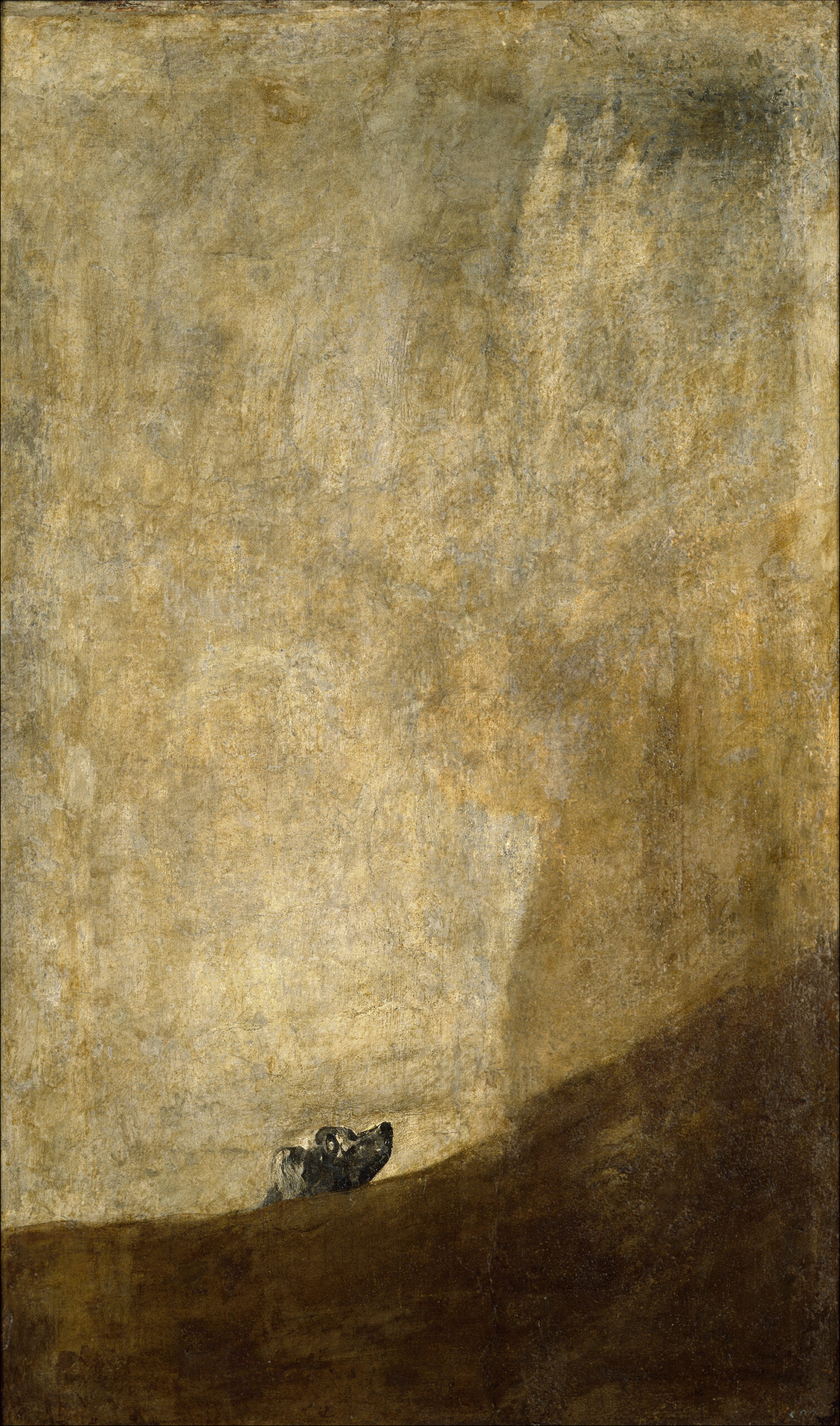
And, as Michel Serres warned, it’s the mud that demands attention. In February 2026, excessive rain caused extensive flooding and landslides in the valley beneath Ronda. Thousands of people including my family were evacuated from their homes and returned to find them deep in muck. In this case, it is less a fight than a struggle for survival recalling the most mysterious and heart wrenching of Goya’s Black Paintings. Perro Semihundido (The Drowning Dog) is a distressing image of a dog apparently sunk in a mire from which it cannot free itself, while it can only look skyward in hope of release. 

If we imagine that Goya’s Black Paintings presaged this predicament, the twist is that they probably didn’t. Analysis has confirmed that the paintings we see today were damaged by their late nineteenth-century transfer from the farmhouse walls to canvas, and that restorers then repainted them to hide the damage. It turns out that the cudgellers were probably duelling in long grass, not mud. The dog may not have been submerged at all: the strange, sloping mudslide was likely a late nineteenth-century restorers’ invention to cover up the damage they’d inadvertently done to the dog’s body — a cover-up that has created this haunting allegory of the natural world destroyed by human error. Goya would have appreciated the irony.

Read more