pxl

Processing evil

Nuremberg & the birth of simultaneous translation

https://europeanreviewofbooks.com/wp-content/uploads/2026/04/Artboard-14@2x.png

 | Published in 


At his first examination by US army doctors following his arrest, Hermann Göring was discovered to have painted his fingernails and toenails bright red. He was addicted to morphine. After he sobered up to present his defence, the highest-ranking Nazi to stand trial at Nuremberg was gloating, manipulative, unrepentant. He often seemed to come out ahead in cross-examinations. When the prosecution screened footage of Nazi ceremonies and rallies, Göring visibly preened at the sight of himself. Rebecca West, who covered the trials for The New Yorker, wrote « when his humour was good, he recalled the madam of a brothel. » 

The Nuremberg trials (1945-6) were the first draft of historical judgement on the devastation of World War II. Yet it is probably Eichmann’s 1961 trial in Jerusalem that became the defining legal reckoning with the Holocaust in popular memory. Perhaps this is because Eichmann’s trial was later and televised, or because, thanks to Hannah Arendt, we have come to find the figure of the impersonal bureaucrat more grimly appropriate to the vast industrial scale of death. But if the Jerusalem trial (and Arendt’s assessment of it) have since shaped how we think about perpetrators, it is certainly not because Nuremberg lacked the more compelling villain. Where Eichmann embodied the banality of evil, Göring stood for something like its virtuosity.

By the time the trials began, the Allies had already lost two prisoners to suicide. To prevent further losses, the commandant of Nuremberg prison introduced new protocols: daily searches, a 24-hour watch; custom-built tables designed to buckle under a man’s weight; as they slept, prisoners were instructed to lie with their hands outside their blankets so that nothing could be concealed. 
Nuremberg had been one of the sites targeted via aerial bombing with explosive and incendiary bombs deliberately combined to ignite a firestorm. In the gleeful language of the British press at the time, it had been Rotterdamned; it had been Hamburgered. The streets smelled of death. As the British deputy chief prosecutor Sir David Maxwell Fyfe recalled in his memoirs, « people peeped at us from bunkers under partly shattered houses, apathetic and wretched. » The rubble heaped at the sides of the roads buried so many corpses that it was feared they would contaminate the water supply.

The eightieth anniversary has seen renewed interest in the trials. Harvard Law School made their archive of 750.000 pages of trial documents fully searchable for the first time. 2025 saw the release of Nuremberg, a film starring Russell Crowe as Göring and Rami Malek as the army psychiatrist Douglas Kelley, trying to understand the Nazi mind. And a travelling exhibition called One Trial, Four Languages, dedicated to Nuremberg’s interpreters and the birth of simultaneous translation, is still moving from city to city in the US, South America and Europe — showing in Leipzig and Barcelona later this year. The most urgent contemporary resonance for this trial conducted amid the wreckage of a devastated city, may come from the dead lying trapped among the rubble in Gaza. Eighty years on from Nuremberg, it is the state of Israel that’s facing charges of genocide in the International Court of Justice. 

That charge was not actually among those levelled against the defendants at Nuremberg: it would be codified only later, in the 1948 Genocide Convention. Here, the defendants were charged with crimes against peace, with war crimes, crimes against humanity, and conspiracy to commit the above. Of these, the charge of crimes against humanity was the legal breakthrough: for the first time, a state would be held liable for actions against its own civilians. Not everyone liked the idea. The trial had to strike a precarious balance, satisfying the competing aims of each Allied victor: the Soviets wanted reparations; the British sought a quick trial; the Americans, conscious that their own Black citizens lived under a legally enforced system of racial segregation, were uneasy about prosecuting a state for the treatment of its own people; the French insisted on the charge. Finally, there were worries that a trial conducted in four separate languages would drag on. This required a linguistic innovation. In order to cut the required time of the trial from four years to one, Nuremberg would be the premiere of the new system of simultaneous interpretation.

Side note I: The Movie

Side note I

THE MOVIE

The central drama in the movie Nuremberg (2025) unfolds between Göring and an American army psychiatrist, Douglas Kelley. Russell Crowe plays Göring with a put-on German accent that gives the film an old-fashioned quality: he might almost be a Bond villain, stroking a white cat. (In reality, Göring outdid Hollywood: he kept lion cubs.)

Here, the Reichsmarschall possesses a smirking, purring menace, but opposite him, Rami Malek’s Kelley exists in a kind of blur. The film cannot settle on what it wants him to be. It may be that the filmmakers, worried about overcomplicating the easy moral dichotomy that comes with any narrative featuring a Nazi, cannot quite decide how to handle their subject. But Kelley was stranger than he appears here.

There is, for instance, no mention of the measures taken by Kelley after Robert Ley hanged himself in his cell. Ley had been head of the German Labour Front. Kelley wanted to determine whether the man’s crimes originated in brain damage, and arranged for an army pathologist to remove the brain from the prison morgue. It was shipped to America in a crate marked « Spices ». Closer examination revealed nothing conclusive. But by then Kelley had a new theory: that these men who had organized such enormities were not, in the clinical sense, mad. They were ordinary men shaped by their circumstances. And this, the film wants you to believe, is the finding that undid him.

Like others who spent time with Göring in confinement, Kelley seems to have admired his intelligence. He kept Göring’s papers, letters and mementoes — and he appears to have taken his death as a model, too. In Nuremberg’s final scenes, Malek’s Kelley appears dishevelled, alcoholic, warning on a radio programme that what had happened in Germany could happen elsewhere. Presumably, this is intended to have contemporary resonance. The film mentions his eventual suicide but declines to show it. The precise details of what happened on New Year’s Day 1958 were reported in an interview with Kelley’s son, Doug Kelley Jr.

Kelley had attended a party the night before. The next evening, the whole family was gathered at home to watch a football game. Kelley’s father was over. Kelley was cooking dinner when he burned himself and exploded with rage. Moments later, on the staircase, he addressed his wife, father and three children. He told them he had swallowed a capsule of potassium cyanide. He would be dead, he said, in thirty seconds. And he was.

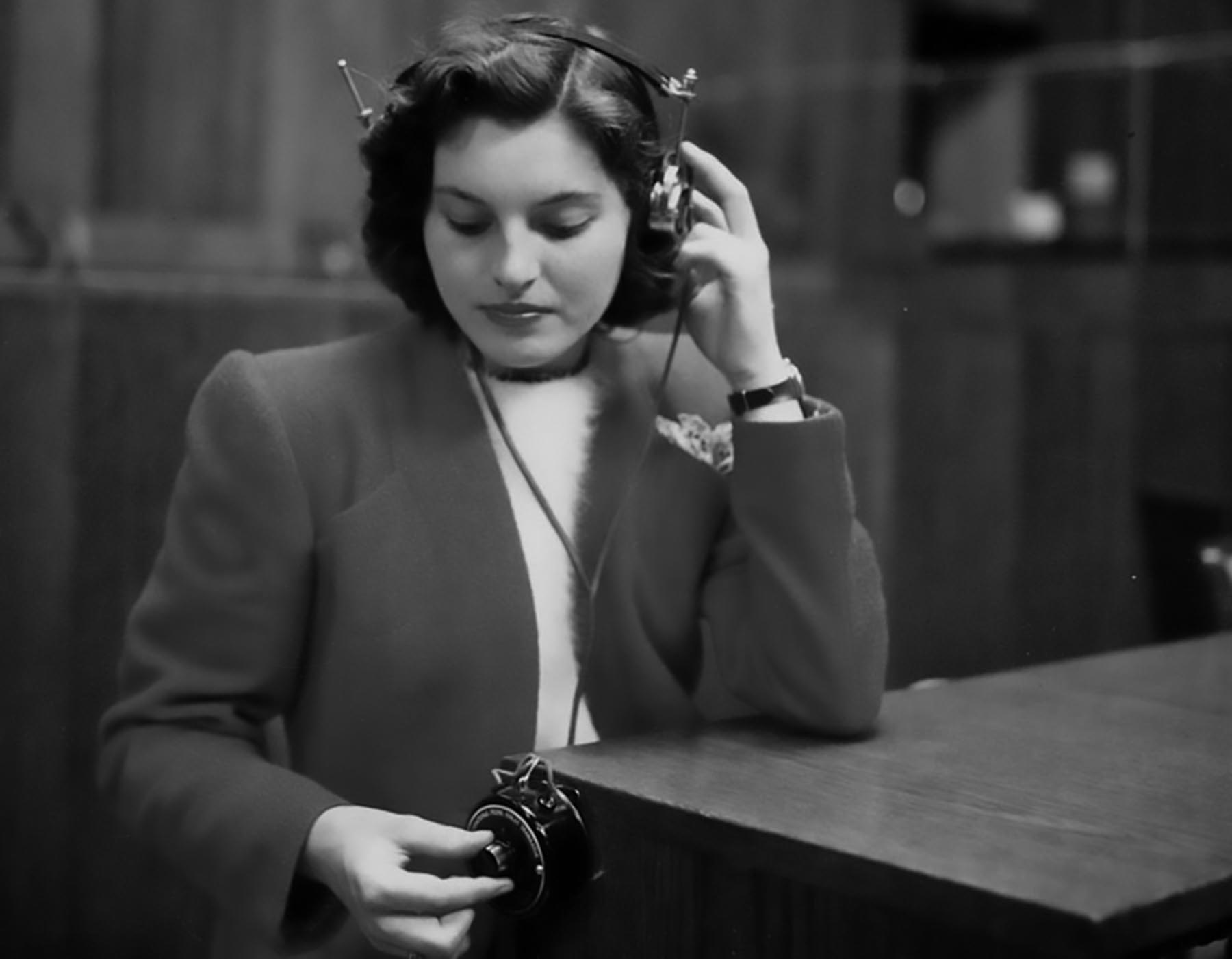
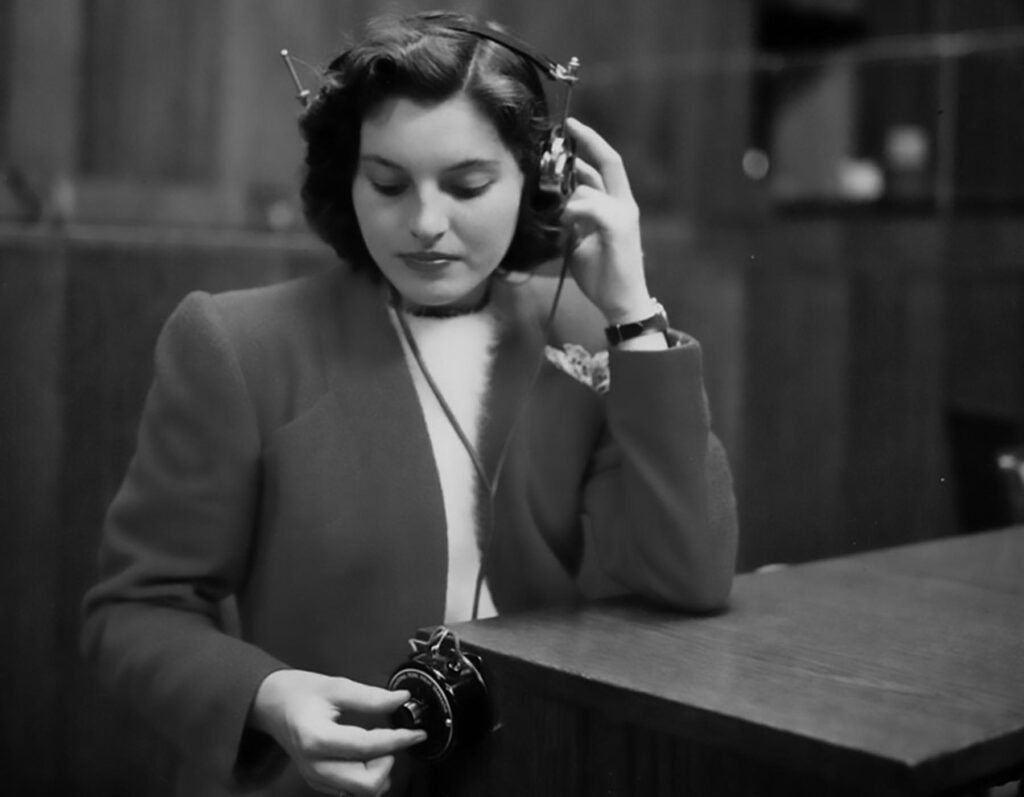
The work of these translators is visible in many images of the trials: the defendants wear headphones, listening to the voices of the translators (in some images, they’ve got sunglasses too, manufactured by Polaroid Corporation to shield their eyes from the glare of press photography). But it’s only more recently that exhibitions like One Trial, Four Languages have taken a closer look at the men and women behind those voices: who they were, what they heard day after day, what became of them, and how, under the pressure of humanity’s greatest crime, they built a method the world still relies on.

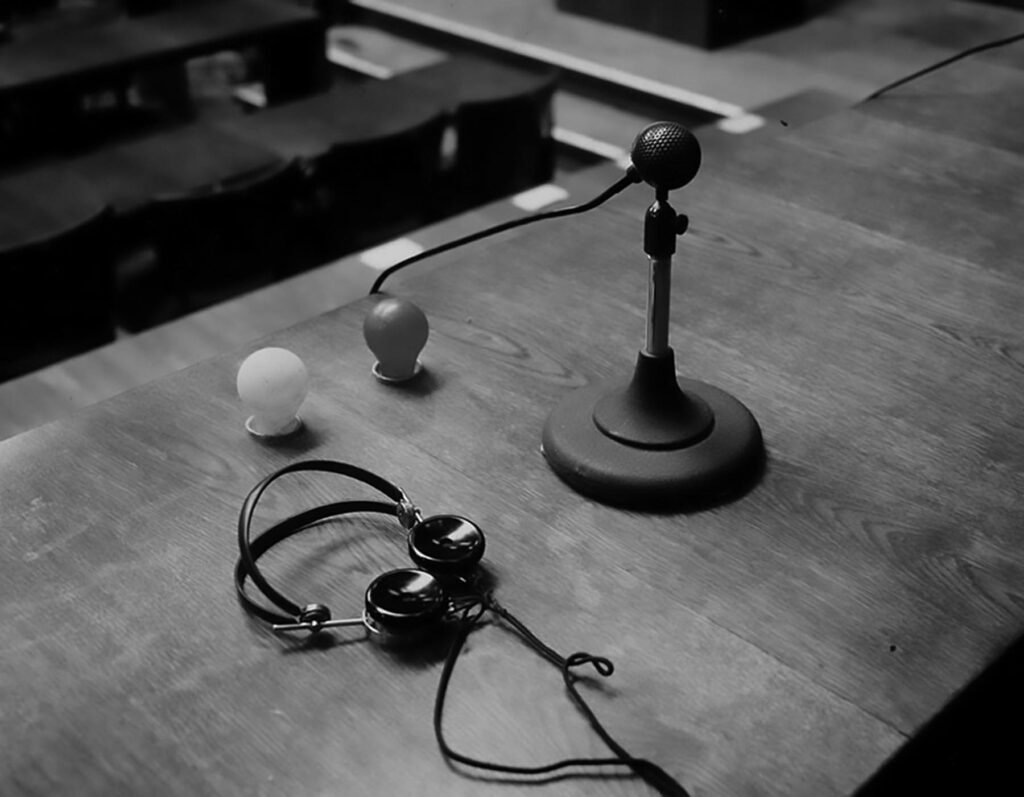
Under the direction of Leon Dostert — a French-born scholar who served as Eisenhower’s personal interpreter before becoming Chief of the Translation Division — a new technique was developed to work in real time, providing immediate translations for the prosecution (in English, for example), the defence in German, and the judges listening in Russian and French. And this all needed to happen almost instantly. Translators were trained never to fall more than eight seconds behind their speaker. Say, a Russian witness was giving evidence about the siege of Leningrad. As they spoke, their testimony would be played back to interpreters sitting in glass booths off to one side, who would immediately translate. The entire courtroom would then listen in through IBM headphones over five channels. Channel one would play the original audio; channel two was English; three Russian (which, if the speaker was Russian, would take the original audio); channel four carried French; five, German. IBM provided the machinery, but this was a human system requiring exceptionally specialised translators. 

You’re reading this essay for free. With a membership, you can read the full magazine, and you get access to our fabulous Library.

Here’s our offer: 3 months unlimited digital access + 1 print edition for € 38,00 € 19,00

You’ll get Issue Eleven in print as your first magazine, right to your mailbox.

The fullest account of their training can be found in Francesca Gaiba’s The Origins of Simultaneous Interpretation (1998), and the details she provides are extraordinary. The interpreters’ vocabulary would have to be broad enough to allow them to become the voice of train operators, resistance fighters, industrial magnates, concentration camp survivors, the Nazi leaders themselves. To test their fluency, candidates were asked to name ten trees, ten automobile parts and ten agricultural implements in two languages — many failed the task in their mother tongue. Months of training determined that the best translators were between 35 and 45 years old; younger applicants didn’t have the vocabulary, older people couldn’t keep up. Men were preferred to women, not because they did a better job, but because the trials showed that listeners were prejudiced in favour of a male voice. Even among the translators who made it through the gruelling application process, many froze up when the trial began and had to be reassigned to menial tasks. Among the translators, this became known as being sent to Siberia.

IBM installed yellow and red lightbulbs in three places around the courtroom: in front of the presiding judge, at the speaker’s rostrum and at the witness stand. These lights are another clue someone watching the archive footage of the trials might have of the presence of the translators. Each light supplied a different message. A yellow flash indicated the witness was speaking too fast and signalled for them to slow down. The red light was used in two ways: a short flash meant the translator had missed something, the witness should stop and repeat the last few sentences; a longer illumination meant that a break was needed, the translator could not continue, perhaps because they were coughing, or weeping.

Contemporary artist Lawrence Abu Hamdan recreated this apparatus in a 2021 work called the Witness-Machine Complex. With his team, Abu Hamdan searched through the trial film looking for moments when these lights were activated. If the bulbs were out of frame, they looked for their glow leaking onto the clothes and skin of those nearby, or listened for the click they made as they ignited. Abu Hamdan found seven places where the testimony being given at the trials was altered or impacted by this system of translation.

French resistance fighter Marie-Claude Vaillant-Couturier had been at Auschwitz. As she gives her testimony the yellow light flashes, signalling that her translator is finding it difficult to maintain pace and that she should slow down her speech. What comes next is spoken in an unusually slow, mechanical, precise manner, every word pronounced carefully and deliberately for the record.

Vaillant-Couturier says:

One night — we were awakened — by unbelievable screams — the next morning — we learned — from the men — who work — in the Sonderkommando — the « gas Kommando » — that they had — they did not have enough gas — they had thrown — live children — into the furnaces.

The translators had to maintain a regular speed: somewhere around 130 words a minute. The very best of them could continue to translate at peaks of two hundred words, but the mental strain was intense. They worked shifts of ninety minutes at a time, during which they couldn’t cough, couldn’t sneeze, couldn’t stop to wipe their nose. Peter Less was one of the translators working from German to English. His entire family had been killed in the camps. Reflecting in a 2008 video interview on how it felt to give voice to the men who had carried out that mass murder, he said: « You have to disassociate your feelings from your job. You can’t just get up and say liar, liar. You have to translate these lies with a straight face. It’s not easy, but you have to leave your feelings at home and become a machine. » Not all the translators were able to detach. Several reported nightmares featuring scenes from the trial, or images from films they had been shown. One interpreter was released from his duty because of the guilt he felt at having been a member of the German armed forces: « I cannot go on. They are talking about the Warsaw ghetto, the uprising, the massacre. I was one of the German troops who had to do this, » Francesca Gaiba records in The Origins of Simultaneous Interpretation. Another candidate, a young Jewish girl who had performed well in all the pre-trial tests, suddenly found herself crying and unable to speak in the courtroom. « Because of those men, twelve of the fourteen men in my family are dead. »

Foreign staff were forbidden to eat at German restaurants. The only shop they could access was the PX, or post exchange — a military store inside the courthouse itself, stocked with American goods and accepting the special occupation dollars in which staff were paid. On Fridays, in addition to their salary, interpreters received a weekly PX allocation of chocolate, stockings, soap, cigarettes and razor blades, goods which had vanished from German shelves and were in high demand among the local population. 

Almost all accounts of Nuremberg feature the same details: horror and boredom in the courtroom, the devastated old town, and a widespread atmosphere of sexual opportunism. The Allied occupation force was given the nickname of the « government of interpreters and mistresses ». The main site of nighttime activity was the Grand Hotel. In the lobby, American bands played jazz, banned under the Nazis, but now performed by, as Gaiba quotes one of the US judges, « thin, overpainted, half-starved German girls, » who sang in heavily accented English. In a letter home, US prosecutor Thomas J. Dodd wrote: « The girls were theater stars before the surrender. All of them work all day cleaning up debris — they live in cellars, etc., at night, as does the rest of the population. The people look sullen to me. I do not trust them. » In 1947, during one of the follow-up trials, someone threw a grenade into the hotel lobby.

Side note II: The MACHINE

Side note II

THE MACHINE

IBM supplied the equipment for the simultaneous translation of the Nuremberg trial, IBM engineers manned the machinery, the records of the trial were stored on IBM cards and, when it came time to review the evidence and prepare a transcript, that was handled by IBM too. They did it all for free. Part of their mission, they said, of promoting « world peace through world trade ». As a result of their purported benevolence, the company was awarded lucrative contracts setting up similar systems at the UN, many of which are still used today. But as Edwin Black details in his masterful study IBM and the Holocaust, IBM could just have easily appeared at the Nuremberg trials as a defendant: there may be no foreign company that bears more responsibility for the rounding up and extermination of the enemies of the Third Reich. As each country fell, IBM machines kept whirring, tabulating precise lists of everything marked for destruction or exploitation: Jews, Communists, rubber, milk-cows, scrap metal, ammunition, fertiliser, rock-salt, horses, spare aeroplane parts.

The machine upon which IBM built its fortune was first conceived around 1881 by a twenty-year-old German-American employee of the US Census Bureau named Herman Hollerith. He came to his invention almost by accident. Taking the train one afternoon, he noticed how railway conductors had developed a system whereby a passenger’s physical characteristics — height, hair colour, style of clothing — were punched into the ticket according to a special pattern. This « punched photograph » could be read by other inspectors, who would know if someone else was using the ticket. Hollerith realised this principle could be applied elsewhere: information of all kinds could be stored on punched cards. Soon, the company was operating worldwide. The German IBM subsidiary was called Dehomag, run by a man named Willy Heidinger.

When the punch cards from the 1933 census started to arrive at the Dehomag offices in Berlin’s Alexanderplatz, they began to be sorted at a rate of 450.000 cards per day. Staff were given free coffee to keep them awake. The mechanical sorter operated by passing each card over electrical brushes; where a hole had been punched, a circuit was completed, and the card would then be moved into the appropriate bin. Each punched card detailed a person. Column 22 of the cards specified religion, punched at hole 1 for Protestant, hole 2 for Catholic, hole 3 for Jew. Columns 23 and 24 stated nationality. Very quickly, the regime could target specific sections of society. Following the census, the Reich Statistical Office reported: « The largest concentration of Jews [in Berlin] will be found in Wilmersdorf. Approximately 26.000 observant Jews account for 13,54 percent of the population. » 

Cross-sorting these cards, the state could identify the exact number of Jews in any given area: how many worked this or that trade; how many spoke this or that language. Sorting this data gave the Nazis their first targets for confiscation, arrest and expulsion: the Polish-speaking Jews. At the opening of a new IBM facility in Berlin, Willy Heidinger gave a speech. « We are like the physician… we dissect, cell by cell, the German cultural body. We report every individual characteristic… on a little card. These are not dead cards… they come to life when sorted at a rate of 25.000 per hour. » He continued: « [This] task provides our nation’s Physician [Hitler] with the material he needs for his examinations. Our Physician can then determine whether the calculated values are in harmony with the health of our people. It also means that if such is not the case, our Physician can take corrective procedures to correct the sick circumstances. » 

In almost every concentration camp, there was a special department for IBM Hollerith machines. The machines recorded intake numbers of prisoners, their place of origin, demographic category, whether they were fit for work, if they had been released, died by suicide, escaped or had been killed. The punch cards at Auschwitz recorded a little euphemism: Sonderbehandlung or « special treatment » was marked with a number 6. It meant death by gas.

Each camp had its own Hollerith/IBM identification number:

Auschwitz 001; Buchenwald 002; Dachau 003; Flossenbürg 004; Gross-Rosen 005; Herzogenbusch 006; Mauthausen 007; Natzweiler 008; Neuengamme 009; Ravensbrück 010; Sachsenhausen 011; Stutthof 012 

Which could be cross checked against the number for category of prisoner: 

Political Prisoner 1; Jehovah’s Witness 2; Homosexual 3; Dishonourable Military Discharge 4; Clergy 5; Communist Spaniard 6; Foreign Civilian Worker 7; Jew 8; Asocial 9; Habitual Criminal 10; Major Felons 11; Gypsy 12; Prisoner of War 13; Covert Prisoner 14; Hard Labor Detainee 15; Diplomatic Consul 16

The Nuremberg trial revealed this system of death in vivid detail. As Edwin Black documents in his book, the Hollerith machines provided such ready lists that « the Gestapo came with lists, from Standesamt, looking for Jews in certain alphabetical groups. On one occasion, they took all the Jews whose names came within the alphabetical register S to V. » Those were rounded up and shipped to Mauthausen concentration camp, where most of them died within weeks. At one point during the trials, a translator was interpreting an official report from Mauthausen — Hollerith code 007 — in which it was recorded that on one day in March 1945, 203 people had all died from « heart attacks ». 

As Alfred Steer, Head of the US Language Division from 1946, wrote:

I shall never forget… one translator, working on the death-record books of a Nazi concentration camp… His voice shook as he realized with horror the full implications of what he was saying: ‘Those people died in alphabetical order!’

In the follow-up trials to Nuremberg, charges would be brought against the industrialists who had facilitated the Holocaust: supplied the gas, erected the camps, sold the synthetic rubber produced by its slave labour. But this entire system of deathly bureaucracy would not have been possible without a new technology of organisation: the IBM Hollerith machines. Before Nuremberg, IBM profited from the organization and execution of genocide; at the trial, they profited from its reconciliation.

Wolfe Frank was one of the star interpreters at the trials. His father, a wealthy half-Jewish Bavarian industrialist, took his own life as the Nazis came to power. Frank himself, with one fully Jewish grandparent, would have been classified under the Nuremberg Laws as a Mischling and barred from employment. After he fled to England, he learned English so well that he became one of the few interpreters at the trials whose mastery of both languages meant he could translate in either direction. Frank was stationed in the suburb of Zirndorf. His rank of captain meant that once the evening’s entertainments were over, he was supposed to travel back in a standard army truck that set off just five minutes after the dance hall closed. Frank didn’t like this arrangement, which, as he wrote in his memoirs, « precluded any extracurricular activities, such as sex… I needed a car. » With the help of the Grand Hotel barman, he found one, trading food and medicine to a sick local woman in exchange. Now Frank could stay out longer, enjoy the company of girls, and explore the city in his Opel Olympia.

Occasionally, the individual personalities of the translators could impact court proceedings. Virginia von Schon was a well-educated German-American from New York. Interpreting testimony about the « humane » conditions of a concentration camp, she relayed to the court that the facility was equipped with a library, a swimming pool, a gymnasium, even… she stalled, unwilling to go on. Another member of the team had to lean over to her microphone and provide the absent word: « They had a brothel, your honour. » 

Such discretion could cost a translator their job. One interpreter was let go when she softened the language of a concentration camp guard, providing « you just had to ignore the Jews » as a translation of « auf die Juden pissen »: you had to piss on them.

Of all the defendants, Göring was the most adept at manipulating the system of translation for his own purposes. First, he tried to emphasise its absurdities. After a long, complicated question, full of careful quotation and exact technical terms, he would state that the translation was unclear: could the question be repeated? Another tactic was to use his English. He spoke the language well and would listen carefully as his answers were translated before fiercely pointing out errors, using every opportunity to call the process into question. Accused of having suppressed a penal sentence, he remarked that the word in question was niederschlagen. A better translation, he said, was: « suspend » — and was that not perfectly legal? 

This performance of superiority carried on throughout Göring’s trial. Shortly before it opened, he began to micro-manage his defence, providing his counsel with long written instructions that detailed exactly which questions he should be asked and in what order. This allowed Göring to deliver rehearsed statements in complex formal language with lots of run-on clauses. Since German regularly defers the crucial verb in a sentence until the end, this meant his translators had to supply important items of meaning before they had actually appeared. Wolfe Frank wrote of the need to « tune into » the speaker, to anticipate what they were going to say before they said it. The trial became like something between a duel or a pact between the translator and the witness. Some translators broke down during Göring’s testimony, wrecked by the unbearable pressure. When this happened, the Nazi leader would openly gloat, triumphantly compelling them to repeat long statements about the faultiness of their own performance.1

The courtroom relied on 36 interpreters working across four languages. But the Russian and French teams were chronically understaffed, and when the Americans eventually realised that a gap in any single language could slow the entire proceedings, they began seconding their own multilingual staff to other delegations to fill the gaps. Of all of these, Wolfe Frank was chosen to translate the court’s final judgment.

The defendants’ bench at Nuremberg, with Göring in the first row on the left, leaning on his elbow. (Das Bundesarchiv, Bild 183-VO1732

But at the crucial moment, the audio equipment failed. No sound came through. Frank began counting into the microphone: Eins, zwei, drei, to check whether the signal was being carried. Göring, listening through his headset, caught the interpreter’s eye and gave him the thumbs up. The greeting was met with a death sentence. « I spoke as if hypnotised, into the microphone before me, » Frank wrote of the moment. « Tod durch Erhängen — death by hanging — instead of Tod durch den Strang, death by the rope, which is the accepted formula in German. » 

But he wouldn’t hang. Throughout the proceedings, Göring had been concealing a cyanide capsule — where exactly it was hidden has never been established. On the eve of his execution, he took it, cheating the hangman — and the prison commandant’s anti-suicide protocols.

Side note III: The POEM

Side note III

THE POEM

A railroad station with only two platforms

against a hill of yellow sand;

no dead to be seen that day —

or any day if possible;

at any rate, only briefly.

But the smell of the region,

even on the main road,

pestilential.

Next to the station, a barracks marked « Cloakroom »

and a door marked « Valuables »;

and in the open a corridor, five hundred feet or so long

with barbed wire at both sides

and a signboard, « To the baths ».

At the end, a house like a bathhouse

with concrete troughs to the right and left

in which geraniums were growing,

and on the roof the star of David in copper.

After climbing a small staircase,

three small rooms,

hardly six feet in height.

In the morning the freight train arrived — forty-five cars;

almost seven thousand had boarded it

but now some were dead.

When the train stopped, two hundred Ukrainians, doing as they were ordered,

opened the doors

and with leather whips

drove the living out.

Then, through a loud speaker,

all who had come on the train were ordered to undress

and hand over eyeglasses and false teeth —

nothing to be wasted! —

and a little Jewish boy handed out pieces of string

to everyone to tie their shoes in pairs.

Excerpt from Holocaust by Charles Reznikoff

In November 2025, to mark the eightieth anniversary of the Nuremberg trials, Harvard Law School made 750.000 pages of trial documents fully searchable for the first time. At nuremberg.law.harvard.edu, anyone can examine trial transcripts, briefs, document books, and evidence files from the proceedings. The effort to document the trials and make their findings public began even while testimony was still being heard. By the time the judges pronounced their verdicts in October 1946, court reporters and translators had already begun the monumental task of transforming the stenographic records and multilingual documents into a published archive. The result was 42 volumes of transcripts and supporting materials — a « six-million-word trial » — printed in English, French, German and Russian, with copies deposited in major libraries around the world.

It was from these volumes, and from the documents of the Eichmann trial, that the American poet Charles Reznikoff made his book-length poem Holocaust. Before 1945, Reznikoff had written about what was happening to the Jews in Europe. But when the war ended and the full scale of the destruction was known, he stopped. For thirty years he did not return to it. Only after the Eichmann trial, after he had worked out a method in his multi-volume Testimony — a history of America built from court records — did he feel able to return to the subject. Holocaust appeared when Reznikoff was eighty, and had one more year to live.

To compare the Reznikoff poems to the court records is immediately to get a sense of his method: he strips away. He removes particulars to unearth an eternal landscape, where a few sharp details stand out and give weight to what is universal. Enter « yellow sand » in the Harvard archive, and you find exactly four results. Enter « geraniums » and you will find two. They all relate to the same testimony. Robert Franciosi wrote an essay which tracks this section from the Nuremberg transcript through its revisions into Reznikoff’s poem, showing his radical paring back of the testimony through which he eliminates most specific mentions of location and time.

In the archived testimony, the relevant passage begins: « A small special station of two platforms leans against a hill of yellow sand, immediately to the north of the road and railway: Lublin-Lemberg. » The witness describes how « concrete troughs to the right and left contained geraniums or other flowers. » And when the train arrives from Lemberg, it brings a precise number of passengers: « 8700 persons; 1450 of whom were already dead… 200 Ukrainians, forced to do this work… drive all the people out of the coaches with leather whips… » before the passengers are given the instructions, « To tie one’s shoes together with a little piece of string handed everyone by a small Jewish boy of 4 years of age. » 

Most of Reznikoff’s method feels like an attempt to remove the surrounding clutter, to focus on what is happening in its brutal clarity. Yet when reading the transcripts, some omissions — removing the age of the boy, no longer four years old, but only « little » — can feel as though he is sparing us the worst of the truth.

Once the International Military Tribunal had delivered its verdict, Frank was offered a new job: Chief Interpreter of the Subsequent Proceedings. Held between December 1946 and April 1949, these twelve further trials focused on the facilitators and profiteers of Nazism: the industrialists, physicians, jurists and military commanders who had made the machinery of the Third Reich run. But things were stalling. Disagreements between the Allies meant that the subsequent trials would not be carried out in four languages, only two: English and German. The Soviets and the French wanted to prosecute their prisoners their own way. An army lawyer named Telford Taylor took over as Chief Prosecutor, but there was growing pressure to wrap things up. Plans to try four hundred people were whittled down to 177.

 Of these 177 defendants, only twelve were sentenced to death. Crimes which would have seen defendants hang at the IMT were now drawing prison sentences; many got off with time served. The developing Cold War meant that the US had a new favourite enemy, and anti-Communist Germans were useful again. For translators like Wolfe Frank this meant sitting through day after day of horror without the anticipation of justice. Morning and afternoon sessions filled with reports of mobile gas chambers, work camps, fire pits. « There were days when I could not eat and I had to drown myself in alcohol before I could sleep, days when my reaction to anyone or anything remotely German was not normal. » 

Armand Jacoubovich was a member of the French translation team whose parents had been murdered in the Holocaust. In his granddaughter’s memoirs, she recalls how at the end of his life, he would not let nurses cut his hair and screamed at orderlies until he had to be sedated. A nurse reported to his family: « Sometimes he recites things… it sounds like legal language. Like a trial… I wouldn’t bother you with it, only sometimes it’s rather gruesome. » 

Before Wolfe Frank left Nuremberg, he crashed his Opel Olympia and killed someone, but there were few consequences. A representative from the insurance company contacted the family, who, Frank writes, « were really rather glad to get rid of the old man who was eating and not producing. » He handed over twenty cartons of cigarettes. « Not much to compensate for the loss of a life. » 

With the trials over, the simultaneous translators each went their own way. Leon Dostert, the head of the original team, started to collaborate with IBM in the pioneering field of Artificial Intelligence. In 1954, he would build an « artificial brain » — the 701 translator — the world’s first machine for automated translation. At its unveiling, a girl input a sentence in Russian and the machine spat out the English equivalent: We transmit thoughts by means of speech.

Late in his life, Wolfe Frank took up simultaneous translating again. This time he worked for the EEC in Brussels, but he quickly became frustrated by the officialdom. Here, there was no more « tuning in » to the speaker, but rather a lot of waiting while a phrase like « Thank you, Mr Chairman » was relayed across seven different languages.

On 10 March 1988, Frank drove from his home in rural Wiltshire to a farm road nearby. He climbed out of the driver’s seat, fixed a hose to the exhaust pipe, sealed the windows with masking tape and then waited inside as the chamber of his vehicle filled with toxic gas.

  1. It is worth asking what account Hannah Arendt would have given of Nuremberg, with Göring as its central figure. Some of the contempt that Arendt finds for Eichmann centres on the idea that he is not a worthy adversary. Neither she nor the court in Jerusalem had expected to find such a non-entity; it seemed to diminish the reckoning. How could such a crime be committed by this mediocrity? Until he joined the Nazi party, Eich- mann had been a travelling salesman for the Vacuum Oil Company. But Göring was a World War I flying ace and drug addict who, when he entertained aristocrats at his hunting lodge, liked to wear antlers and dress as the god of the hunt. Would this theatricality be more appropriate to measure against the crime, or less? ↩︎

You’re reading this essay for free. With a membership, you can read the full magazine, and you get access to our fabulous Library.

Here’s our offer: 3 months unlimited digital access + 1 print edition for € 38,00 € 19,00

You’ll get Issue Eleven in print as your first magazine, right to your mailbox.

Read MORE