Photographs by André Luís Alves
Volodymyr remembers his mother plastering the walls of their house with clay. The house isn’t that old. Reliefs of the wolf from the Soviet cartoon Nu, pogodi! and the bear from the 1980 Moscow Olympics sit on the grey façade — both pierced by fragments of an artillery shell. The window between them is still covered with plastic sheeting, most of the others are too. The explosion happened three years ago, but only now has Vova received compensation. After three inspections, the committee awarded him 198.000 hryvnias (almost €3900). This summer he will finally put in new windows and repair the roof.

He will get old-fashioned wooden window frames that open only partway. He is not conservative, but he trusts only what he has tested himself. He once worked in landscape design in Kyiv and Moscow, painted a turquoise, flower-patterned ceiling in the local church, and for years worked as an arborist, pruning and tending trees. He knows exactly how he wants to fix the house and he will do it with his own hands.
On the porch are century-old millstones he found on the outskirts of the village. Vova says they carry good energy. He wants to wall them in beneath the wooden veranda he is planning to build. The walnut timber is already waiting. Inside the veranda, colored glass panes will scatter the light like a kaleidoscope, casting reflections on the snow-white walls of the corridor. Above the front door he will place a line from Ukrainian poet Taras Shevchenko: « In one’s own house — one’s own truth, one’s own might and freedom. »
Who is Vova? He is the owner of a flock of geese. He starts every morning by feeding them; every afternoon he drives them back into their shed. Sixty mammoth geese, brought from the Donetsk region, spend their days on the beach at a bend of the Inhulets, the river that winds through Velyka Oleksandrivka. This is the most beautiful place in the village. Couples meet here for dates, boys train, people of all ages swim in summer, and in winter villagers plunge into the icy water for the Epiphany. It was Vova who restored this beach: he brought in tons of sand and tidied what had once been a dump.
The shell that blew out his windows and punched holes in the walls of his house landed just as he was returning from taking the geese to the beach. That is why he jokes that he owes them his life.

Velyka Oleksandrivka lies in the open steppe of Ukraine’s southern Kherson region. Russian troops entered it on 10 March 2022. Residents were shocked. By most accounts, the invaders met no armed resistance. They did not immediately move on to repression. For a time, the Ukrainian flag remained in front of the administration building. The local authorities tried to calm people down, fearing violence — but it was in vain.
Three days after the Russians entered the village, around two hundred people with blue-and-yellow flags gathered by the Taras Shevchenko monument opposite the Soviet-era House of Culture. « A peaceful protest to confirm that Velyka Oleksandrivka, together with Kherson, is Ukraine. Not KhNR! » (Kherson People’s Republic) shouted the man at the head of the march through a megaphone. Participants chanted « Glory to Ukraine! » and « Velyka Oleksandrivka is Ukraine! » At some point several shots were fired into the air. The protest ended, but the very next day it was held again. This time the Russians fired at the asphalt and threw stun grenades. The residents dispersed.
That was when the occupiers came to Vova for the first time. An armored personnel carrier stopped by the river. A machine-gun-mounted vehicle pulled up outside his house. Men in black got out. Together with the regular Russian troops — many of them Buryats and Dagestanis — the Rosgvardiya, Russia’s National Guard, and the Russian Federal Security Service (FSB) also entered the settlement.
« Have you served?, » one of the officers asked.
« Yes, I served in the Donbas, » Vova replied. He knew the Russians had lists, so he saw no point in hiding it.
« Right, come with us. »

Vova was not only a veteran of the war that broke out in eastern Ukraine in 2014, but also head of the local veterans’ organization. The Russians suspected he had organized the protests. In fact, it was his wife and daughter, both called Anya, who in a Facebook post called on people to go out and resist. The Russians in Velyka Oleksandrivka did not believe that women could have initiated the protests. Vova says that Anya, his wife, nearly twenty years younger than him and originally from the Poltava region, was « a fiery, real Ukrainian woman, more patriotic than I am. » And his daughter recalls: « We just couldn’t look at those occupiers. Our anger was stronger than our fear. »
The Rosgvardiya officers entered the house and saw two diplomas — one for a degree in law, the other in ecology. At that time, Vova was living with his wife as well as his mother, who had cancer. « Your mother is weak. If you want us to keep the infrastructure working, you’ll be the new village head, » one of them said, inviting him to collaborate. Vova replied: « Our village elects the head in a vote. We’re on Ukrainian territory, and no one has cancelled the laws yet. » They offered him food and some basic supplies. He refused. For the moment, they left him in peace.

From the very beginning Vova knew one thing: he was not going anywhere. He repeated this phrase several times on the day I first met him in October 2022, two weeks after Velyka Oleksandrivka was liberated by the Armed Forces of Ukraine. It also happened to be the day of his 55th birthday. The sky hung grey and the wind tossed rust-colored leaves.
Back then, Vova did not want his name or face published or his story told. « You’ll record me, write about me, and then, dear God, something will change, » he said, hinting at potential re-occupation. « I’m here, I’m not leaving, you understand? I won’t be going anywhere. » So I kept coming back — each time wondering if I got things right.
Most of the villagers had left in the early days and weeks of Russian occupation, fearing for their lives and safety. The price for escape was often the loss of their property. Vova’s neighbor Oleh — a farmer who had left with his family — lost his combine harvester, tractors, all his grain and livestock. Few had stayed put. The head of the village left. The priest left. Many men left the village and joined the ranks of the Ukrainian Armed Forces.
Arrests began quickly — both according to lists assembled in advance by the FSB and on the spot, targeting anyone potentially under suspicion. A patriotic tattoo, one word too much or an improper look was enough for detention.
Vova helped villagers get to Kryvyi Rih, the closest big city under Ukrainian control. He drove people out in his car, taking back roads, sometimes travelling two hundred kilometers. Leaving the village became harder over time, especially after the bridge over the Inhulets river was destroyed.
Vova did not take money for evacuations.
He says he does not like money and, in fact, he hardly has any, although this has not always been the case. He has tried many different things in life: in his youth, he studied clarinet in Kherson, in the 1990s he opened beer joints in the region, he blocked trains in agricultural strikes, ran a gardening firm, founded an ecological association.
For many years now he has kept his own bit of land. In the cellar, among jars of preserves, wine and chacha, goose eggs lie in a crate meant for artillery shells. The eggs develop in a homemade incubator and Vova sells them to poultry farmers. Besides geese, he keeps turkeys and a pig. He grows potatoes, onions, cabbage, cucumbers and tomatoes, dill, parsley, grapes, melons and apricots. He is almost always outside in the yard.

When spring came to southern Ukraine in 2022, Vova did what he always does — despite the occupation. In the mornings he practiced wushu on the beach, then he bustled in the garden in his military jacket and slippers, in the afternoon he cooked borshch in the summer kitchen. « We walked around the village as if we were in charge, so ordinary soldiers began to respect us. Over time we lost our fear, » he recalls.
Soon the occupiers decided to find out exactly what Vova was doing. Why wasn’t he leaving? Was he working for the army? In April, they took him away for the second time. With a black bag over his head and his hands in handcuffs, they drove him somewhere near Nova Kakhovka, a city on the left bank of the Dnipro River.
There they beat him and asked what he knew about the actions of the Ukrainian Armed Forces. They asked about routes and troop movements. According to Vova, they were experts — they asked « psychological questions », the kind meant to trip you up. The interrogations lasted a week. They released him before Easter, at the end of the month. He walked most of the eighty kilometers journey home through the occupied Kherson region. The Russians confiscated Vova’s car. He stopped doing evacuations.
An officer from Ukraine’s Security Service (SBU) involved in coordinating the local resistance in Velyka Oleksandrivka told me Vova was « a sort of partisan ». Vova boasts that at the very beginning of the occupation, using information on Russian troop movements collected by his wife, he planted a mine on a road used by a Russian convoy. It detonated under an armored personnel carrier.
As he was evacuating people in his village, he got to know Russian soldiers at the checkpoints. Together with his acquaintance Roman, a former village council deputy, they set up a wiretap on them. Vova gave the checkpoint soldiers Ukrainian SIM cards they had asked for because they wanted a stable internet connection. From then on, their conversations were monitored by the SBU. « It came easy to us, because we all had one goal, » Roman told me, as he explained the scheme.
Like many villagers, Vova passed information about Russian positions to the Ukrainian army. « Why shouldn’t we give the Russians a little headache? » Vova’s friend Serhiy told me when he visited Vova to give him a jar of honey. He’s a hunter with a broad smile and military trousers, who also passed on information.

On the day a shell blew out the windows of his house, Vova was on the beach with the geese. It was July. While he was there, a KAMAZ truck of the Russians stopped next to his house. As it drove off, a Ukrainian shell landed right next to the truck. And so the Russians suspected Vova of giving away their positions to Ukrainian forces.
When he came home, he started tidying the debris from his entrance hall. He heard a strange knock in the living room: an icon had fallen. The whole shelf had come off. « My God, why this now? » he thought. After putting the shelf with the icon back in place, he looked out of the window: the Russians had come for him again.
They took him to a torture site in the cellar of a house near the village school. For a long time afterwards, he could not rid himself of his memories of that place. There were usually two or three detainees there. The Russians beat, tortured and humiliated them. They forced them to shout: « Bandera is a faggot! » All the prisoners did it. In the breaks between torture, almost everyone prayed. « We would have done anything to get out of that hell, » Vova recalls.
Meanwhile, Vova’s mother was getting worse. When the Russian commanders left the site, the Dagestanis who were then in charge would let Vova go home to administer her injections. They told him: « Go quickly, so the Russians don’t see. » But it didn’t help. His mother died in mid-July. « At least they let me bury my mum, » Vova recalled.

His wife had left in May; his daughter in June. Life in the village was becoming dangerous and unbearable. After his mother’s funeral, Vova expected the Russians to take him again. He asked one of the Buryats who used to come to his beach, to look after the geese in case of another arrest. He gave him a bottle of chacha. « On Lake Baikal, we can only dream of grapes like yours. After the war, I’ll come and visit you with my wife, » the soldier said.
They came for him at the end of July, nine days after his mother’s death. Rosgvardiya officers kicked in the door of Vova’s house. They hit him, cracking his ribs, and he fell to the floor. They fired several shots in the room and dragged him outside. He was wearing nothing but a pair of trousers. They told him to dig a hole. In pain, Vova took up the spade and began to dig.
« Looks like a firing position, » joked an officer known as Shadow. Vova laughed too.
« Where’s your military uniform? » the officer asked.
Vova kept it in the attic. His mother had advised him not to hide it at all. She told him: they’ll see that you’re a soldier just like them. But his wife said he should not keep it in plain sight. The Russians found the uniform and asked where he had served. He explained: in the 79th Brigade, in the airborne assault troops. Standing by the pit Vova had dug, Shadow pointed his weapon at him and told him to count to five. At three, Vova heard two shots above his head.
« You’re lucky — that’ll be your callsign, » said Shadow. Vova replied he wasn’t lucky. « It’s just that today is the Day of Saint Volodymyr. »
They took him back to the torture cellar. They put a bucket over his head and connected it to a tapik, a field telephone used for electric shocks. First his body shook. He remembers sparks and heat. He lost consciousness.
They led Vova and his friend Serhiy out to a rubbish dump. They promised to release the prisoner who killed the other. Both refused. « Torture is a game, and the torturer also has his weak points, » Vova told me.
During one interrogation, the Russians found his wife’s number in Vova’s phone and called her. Anya decided to return to Velyka Oleksandrivka. To get there from Kryvyi Rih she could take a bus to nearby Dolhove, and from there cross the river near the destroyed bridge and travel onwards with volunteers. But that day no one wanted to go, because of the shelling. The bus driver convinced Anya to get back from Dolhove to Kryvyi Rih — after all, she wasn’t even sure if she could help Vova.
On the way back the bus came under fire.
An anti-tank missile hit it and burned it. Five of the eight passengers were killed. Among them was Anya. When Vova reached the scene of the tragedy, he found her body, and what remained of her possessions and documents.

After seven months of occupation, the Russians disappeared almost overnight. They left behind destroyed houses and burnt-out cars marked with Z’s. The bust of Shevchenko stood smashed, and « Akhmat Strength » had been scratched on the Red Army monument. In the basement of the school, where the soldiers had lived, they had written: « We’ll be back soon. » There were other inscriptions too, including: « Sorry! That’s how things turned out. »

On his 55th birthday, shortly after the liberation, Vova drank. Following his wife’s death, he drank for six months. After Velyka Oleksandrivka was liberated, a large part of the residents returned. Soon internally displaced people from the left bank of the Kherson region began arriving. And although Shahed drones were constantly flying over the village, life was restored: families were reunited, farmers started to seed the land, people sipped coffee in the local café. But for Vova all this did not matter much. He heard voices — his mother’s and his wife’s. He would go out to the bench by the house and listen to them. He thought about taking his own life. When he drank, his tormentors came back to him. He says he had Stockholm syndrome. Maybe the Russians had no choice? In the end, they hadn’t killed him — so he was living thanks to their mercy, he thought. Long ago in Moscow, Vova had seen Putin in an Orthodox church. He says he « looked like a prince ». He told me: « If you look into the abyss long enough, the abyss begins to look into you. »
Vova says that everyone judges the occupation according to their own understanding. Those who were not there do not understand it at all. He says that after the liberation of the village, people tied a man with a mental disability to a post and accused him of collaborating with the Russians. « The real collaborators left with the Russians. We must have mercy, » Vova says.
When he could not find peace, he prayed. He had begun learning prayers by heart during the occupation. At home he has an old Bible printed in Old Church Slavonic.
Vova works in his garden from morning until night, so he likes to have a hearty breakfast.
During the occupation he lost ten kilos. He says he cooks like his mother. In the summer kitchen he hung a portrait of his wife. For a time, he slept with his dog, a Chinese Crested, and gave him massages. He said the dog was « a bundle of nerves ».
He wanted silence. He gave up the internet and television. Instead, he read books.
Shevchenko’s poems, which he likes to quote: « Had you but learned the way you ought, then wisdom also would be yours, ». Then, sing-songing with laughter: « We are not we; I am not I! I have seen all, all things I know: There is no hell, there is no heaven, not even God, but only I! » He also read Hemingway’s For Whom the Bell Tolls and Tolstoy’s Confession. At times he studied The Secret Teachings of All Ages, a synthesis of the Western esoteric and occult tradition written by Manly P. Hall in 1928.
Vova says he has seen signs. A year after his mother’s death, a white dove came to the house and stayed for nine days. And at the end of the summer, the cactus Anya had bought bloomed with nine flowers.

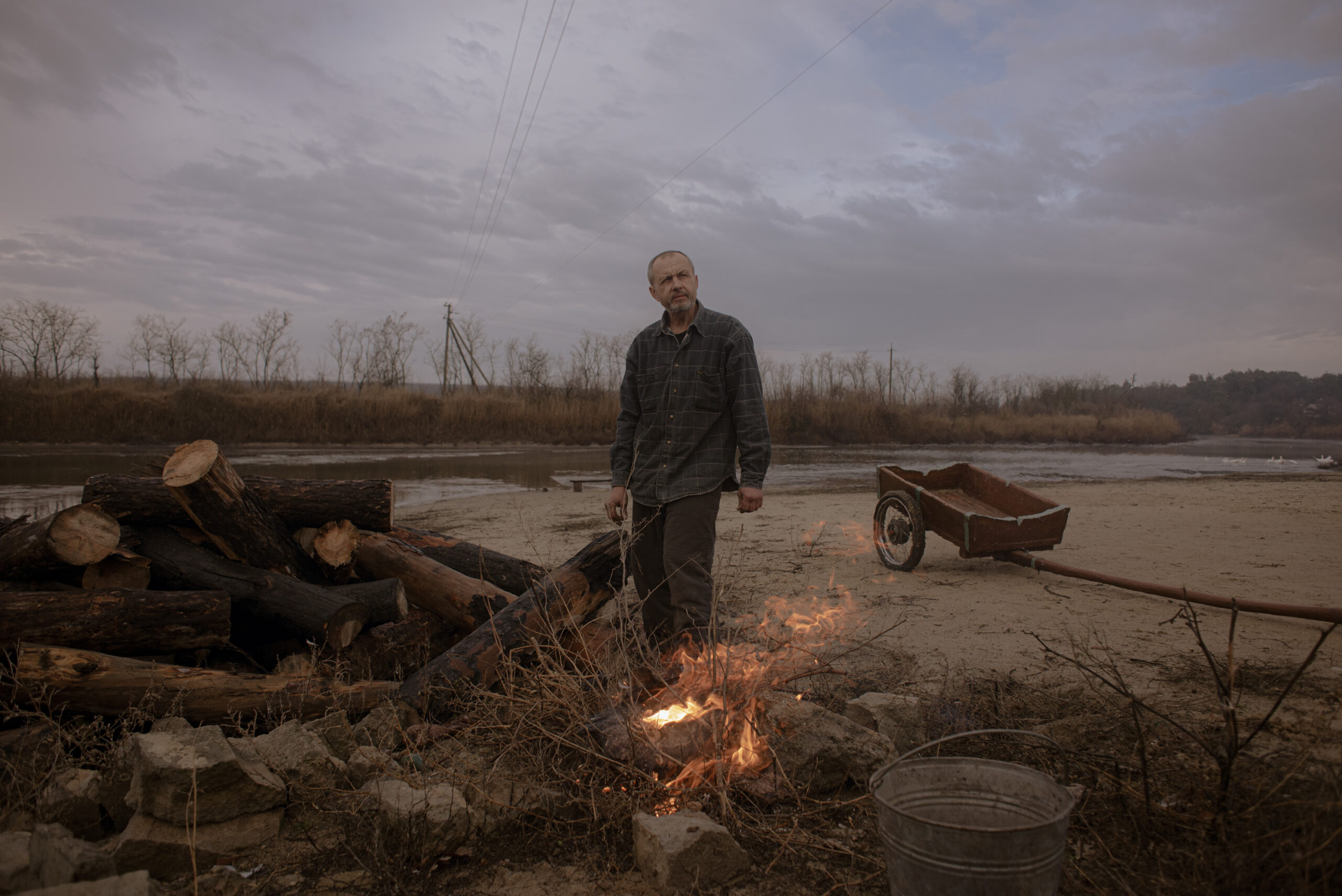
Every January at Epiphany, the blessing of the waters is held by the Inhulets river in Velyka Oleksandrivka. In 2024, the river had only partially frozen, with slabs of ice floating on the water. Vova placed a massive two-meter cross on a mound of stones in the middle of the beach. At its foot, he put the icon « Faith, Hope, Love and their mother Wisdom » — the same one that had fallen off his shelf when the Russians came for him. He decorated the cross and the icon with a white embroidered cloth. He also brought a pile of firewood to the beach and laid planks along the shore to make it easier to enter the river. He had been organizing the Epiphany celebration on the beach in Velyka Oleksandrivka for the past two decades. He says he believes in God but does not go to church.
Early that morning, he lit the bonfire. The air smelled of winter meadows, wet sand and burnt wood. A few dozen people gathered. Father Vasyl read a prayer. The young priest had left the village after a month of occupation and returned after liberation. Men and women on the beach repeated the words of the prayer, each absorbed in their own thoughts. Some of them crossed themselves and waded into the icy water.

Sasha, a stocky sixty-year-old soldier, had come from Donbas on leave to see his family. He came out of the water bursting with energy and hugged Vova, thanking him. Maksym, a forty-year-old villager who had lost a leg while clearing mines from a local forest, watched from a distance, exchanging glances with Vova. In the evening, old friends of Vova’s arrived in a black car, wearing leather jackets and chains round their necks. Men with cocky faces greeted him with broad smiles. « We’ve seen it all, » Vova says of them and their stories from the 1990s, the tumultuous decade following the collapse of the Soviet Union. Back then, Vova used to keep a gun at his home.
His old friends joked that he is « the most God-fearing Jew around ». Vova does indeed have Jewish roots, but the family used to hide that fact. Now that life has made him an outsider, he thinks perhaps this is what was meant for him from the beginning.
After the sun set, Vasyl, one of his friends, drank vodka and warmed himself by the fire. « No wonder Russians want our land. Velyka Oleksandrivka was founded by Empress Catherine and now Putin is gathering up the stones she scattered, » he told me. « And what are you doing on this Orthodox land? »
That night, Vova was visited by his old friend Vitaliy. Before the war, Vitaliy had been a priest of the Ukrainian Orthodox Church, the traditional Moscow-linked branch of the church, in nearby Kalynivske. At the beginning of the invasion, he left with his wife and five children for Bulgaria. In the summer of 2023, he returned to Ukraine, left the Church and joined the Armed Forces. He was now fighting in the Azov Brigade infantry unit in the Kharkiv region. Vitaliy said he was ready to die in battle. He was quoting Azov’s founder Andriy Biletskyi and convincing Vova that this war will be « eternal».
Vova, listening closely in his dimly lit summer kitchen, seemed half-convinced. He said that the way Ukrainians were fighting Russia gave hope for Ukraine’s victory. « People are becoming stronger. They are more united. They are not afraid. The nation is being tempered in battle, » he said but added: « But Moses led the Jews out of Egypt for forty years. We must be cold-blooded… »

« I’m an anarchist, » Vova said bluntly in the spring of 2025, as he plucked the white feathers from a dead goose. He laughs a lot. In his youth, a woman from the village told him that Nestor Makhno, Ukraine’s anarchist peasant army leader, had once stayed in a stone building near a road that leads to the beach, one of the oldest in Velyka Oleksandrivka. Vova says he is « a patriot of the land, not of the authorities. » He is disappointed by the return of the old order, by the fact that the poor remain poor and that those in charge are not the ones who are bleeding. « A bad peace is better than a good war, » he says.
After the occupation, Vova had stopped killing geese because he had « had enough of death ». But then he went back to it — today he sells roast geese to the military. In the local bar, where soldiers watch videos of drone strikes on their smartphones, drink coffee and eat pizza, there is a notice advertising his roasted birds. The shop assistant says everyone in the village knows Vova. From time to time, soldiers rent rooms in his house to spend a little time with their families.

He likes hosting others because his house is somewhat empty. It’s almost spotless as if no one lived there: the floors shine, the curtains are white, and the bookcase is filled with a bust of Lenin, souvenirs, icons and few family photographs. Vova does not know who will live here when he is gone. He has had four wives in his life and has three daughters: Nastia, Anya and Katia. Two of them live in Ukraine, one in Russia. He only speaks regularly with Anya. He says he was often not there for those who needed him and then it was always too late.
This summer he will finish renovating the house. He would like to build a terrace by the Inhulets beach. When he’s feeling buoyant, he dreams of breeding the great bustard, an endangered steppe bird of southern Ukraine. But he will probably do something else: at the spot where his wife Anya died, he wants to erect a burial mound. One like those left behind by the ancient peoples of this land. Soon the apricot tree Anya planted will bloom.