On Friday 9 June 1458, a pirate ship swerved and fired on two Bristolian trading boats as they passed the coast of Malta, on their return from the Levant. I found the event transcribed in a fifteenth-century legal document.1 The Katherine Sturmy and the Marie were captained by the Bristol merchant Robert Sturmy, and contained over £18.000 worth of Syrian and Mediterranean goods — nearly £11.6 million today. The attacking ship was captained by the notorious pirate Giuliano Gattilusio (1435–1480). The pirates pursued the merchants for three days, before capturing both ships. The survivors who returned to England described how crew members were « horribly and grievously without pity and compassion murdred, slayne, drowned and cast into the sea. » In the words of the Viceroy of Sicily, the assailants « placed… the said Robert and others who after the harsh battle and cruel slaughter and bloodshed remained half-alive, on the Isle of Malta. And they sailed to Libya with the two ships. »
According to official records, Sturmy died on 11 June, leaving a widow in Bristol, Ellen. Gattilusio commandeered his ships with their precious cargo and steered them to Libya. Sturmy’s business partner, John Heyton, survived and made his way home with the other surviving crew members.

When he returned to England, Heyton brought a case before King Henry VI « in his own name and that of Robert Sturmy ». He argued that they deserved compensation for the value of the lost goods, plus an additional £10.000 damages for « the hevyous affraye, grievous woundyng, maiming and bloodletting of them done by the Genoese… and for their lechecrafte [medicines], costs and expenses done by them in coming home by straunge countries. »
The pirate Gattilusio was out of reach in Libya. Instead, the Genoese residents of London and Southampton — who had no connection to the events off the Maltese coast — were charged for the value of the lost goods. When the Genoese were unable to pay, they were imprisoned and put on trial in London. In my readings of medieval history, this is a unique event. It was highly unusual for an immigrant group to be effectively held hostage in England in retribution for actions taken by their countrymen overseas. The coverage of the time speaks to the significance of the incident. One English chronicler described how the London Genoese were arrested and « adjudged to pay for the harmys that their nacion had done ». In the medieval period, the term natio was used to describe a person’s place of birth and mother tongue. This discourse and emergent structure of nationhood was already present in the Middle Ages, even if the modern nation-state was not yet in operation.
Sturmy’s voyage came at a tipping point in this history of migration and nationhood, in terms of both European colonialism, and English legislation around national minorities. Sturmy’s stolen commodities — spices, raw minerals, gold coins — would become the basis of early modern trade and settlements across the Atlantic. The Genoese who happened to be in Southampton and London in 1458 were thus caught in the crossfire of international struggles for economic power across the Mediterranean.

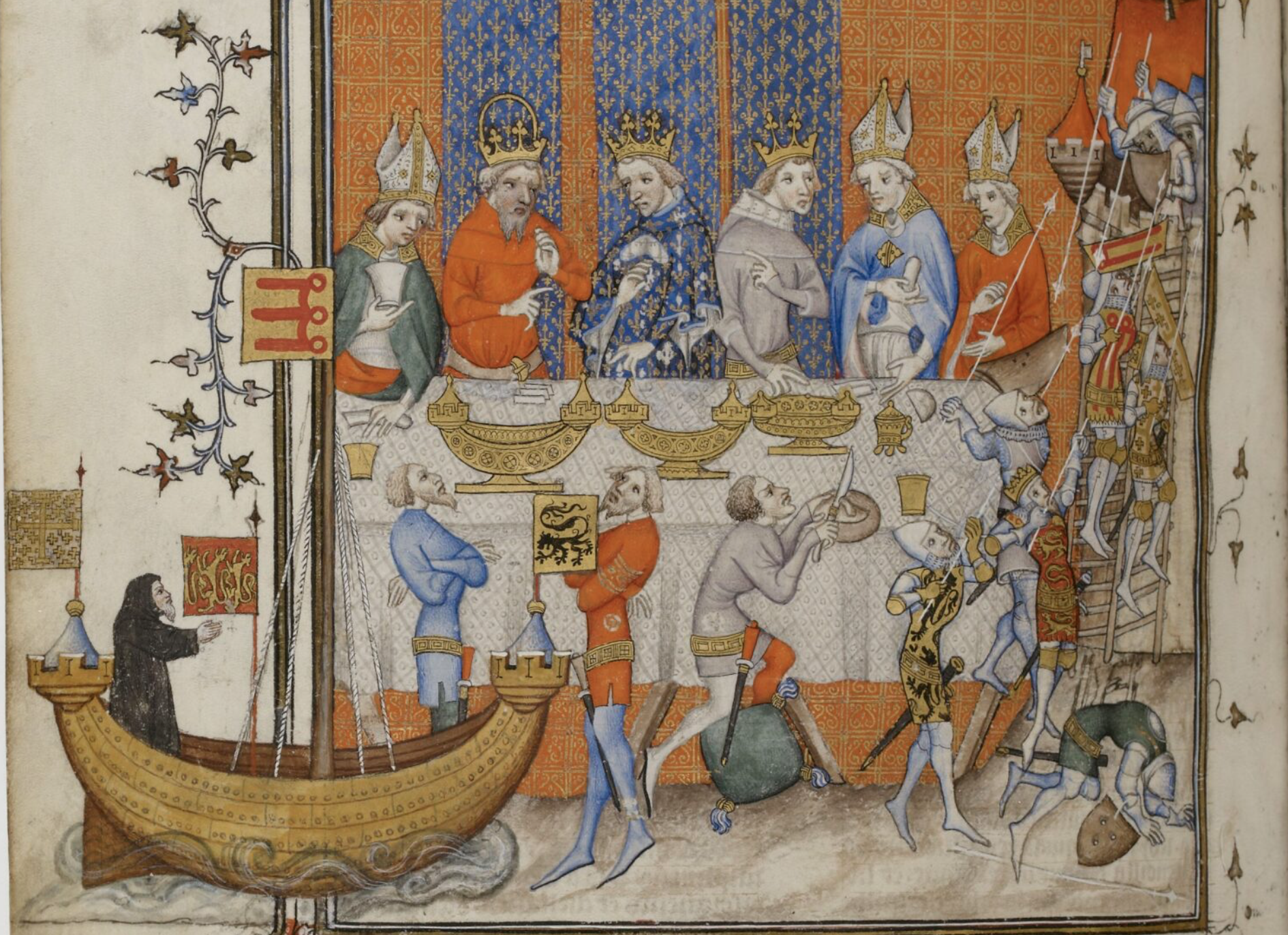
The trials of the Genoese took place between August and November 1458. The records give a sense of the status of the incident. As evidence for the prosecution, John Heyton submitted an inventory of his lost cargo: sweet wines, the mineral alum, spices, silks, precious stones, coins and more, totalling £18.166 13 shillings 4 pence. These were high-status, international commodities, with the potential to shift the fortunes of their traders and the city to which they were returning. These items were found in markets across the Mamluk Empire: in Aleppo, Jerusalem, Acre. From there, such goods made their way across the Mediterranean, typically in Italian ships.
Genoa and England were in competition across the Mediterranean, and Genoa was winning. The Genoese had established trading colonies, including Chios and Mytilene (the capital of Lesbos) in the Aegean Sea, and Caffa (in modern-day Crimea) on the coast of the Black Sea. This allowed Genoese merchants to dominate the European market for Mamluk- and Mongol-traded goods. Meanwhile, English traders had not established a direct route from England to the eastern Mediterranean. The scale of Sturmy’s venture suggests that he was attempting to cut out the Genoese intermediaries in this trade.

Gattilusio was a key player in this international conflict. Born in Mytilene to a Genoese father and a Greek mother, Giuliano was a member of an estranged branch of the powerful Gattilusio family. The Gattilusio lordships extended across Genoese territories — the family attempted to distance themselves from association with Giuliano as the reports of his piracy spread. In 1458 — at the tender age of 23 — he was at the height of his piratical career.3 He had invested his wealth in a number of alum mines, and was part of the association of Italian investors who managed the tax revenues from the island of Chios.4 Sturmy’s trip drew Gattilusio’s attention because the goods on his ships were a challenge to Gattilusio’s own profit network. As an investor and accountant, Gattilusio calculated that violence was the best solution to the potential disruption to the market. At the end of the battle, this bureaucratic pirate had one less competitor.

At the trials of the Genoese in London, a man called William Denys of Devonshire came forward to give evidence. He made his pilgrimage to Jerusalem in 1458, at the same time and along the same routes as Sturmy’s trading vessels — their ships passed one another in the Mediterranean. On his return voyage from Jerusalem, he passed through Rhodes, Corfu and Poreč. In each location, he heard new reports of the capture of Sturmy’s ships. From Poreč he travelled to Venice, where the rumour was that the Genoese state had sent sailors to aid Gattilusio. At each stop on the voyage around Europe, the event was being discussed: information circulated between locations connected by trade and pilgrimage. The goods on Sturmy’s ships were significant and valuable enough that their loss was an international sensation.

In August 1458, the Genoese residents in England were put on trial for the value of Sturmy’s lost goods. The trial transcripts do not name individual defendants — they are grouped anonymously as Januenses : the Genoese. But names of Genoese residents in England around the time of the trial can be found in the fiscal records. In 1440, the English Parliament introduced a tax, called the « alien subsidy », to be paid by all non-native born residents of England over the age of twelve. Property owners, or « householders », were charged sixteen pence each, per year, while non-householders were charged six pence. These « alien subsidy » records document the immigrant population of medieval England: payments were listed alongside names, occupations and place of residence. The records have now been digitised and are searchable as an online database.
In the decade 1450–1460, out of 150 Genoese residents whose names are preserved in the records, 108 are listed as non-householders, with 42 householders. Among these aliens who paid their taxes between 1456–1459 must be the Genoese who were locked in the Fleet prison: Rafaell de Aurea, Lewis Baptiste, Baltezardus de Barde, Kirigo Bronyon, Gentil de Camilla, Edward Catan, Gregory de Frank, Francus Furnariis, Siprianus Furnell, George de Gene, Jeronimus Ilome, Lancelettus de Lago, Augustino de Lario, Cosine de Negre, Angelus Penel, Franciscus Salvage, Everard Salvyot, Anthony Senturian, Napoleone Spynell, Raphaell Spynell.
These men were merchants, attorneys, brokers and clerks, and mostly lived in London and Southampton: cities with active international trading ports. It is not necessarily the case that all these men were imprisoned when Sturmy’s ships were stolen: some may have left England before the event. But their names record the existence of a community, grouped in several centres around England, near the ports and streets where these men had moved to work.

The Genoese submitted their first defence on 22 August 1458: « First we say that the pirate who captured the ships of the English is not Genoese, nor is he a subject of Genoa, but rather a notorious pirate, born in Greece on a certain island called Mitilini Vellenio [Lesbos] over which the Genoese government has no authority. » When, according to the records, the Genoese were asked « if any Genoese were in the ship with the said pirate at the same time he captured the English, they said that they did not know. » In their initial plea, the defendants accept the logic of the case — agreeing that if Gatillusio were shown to be Genoese, then as Genoese citizens, they would be liable for damages. They attempt to exonerate themselves by claiming that the pirate belonged to a different national group.
Until the fifteenth century, immigrants to England were typically not required to produce or keep identification papers. The introduction of the alien subsidy tax reflected a developing sense of national « English » identity, and an increasing move to legislate on the basis of it.5 The tax included people from the dependent territories in Ireland, the Channel Islands, Normandy and Gascony, but excluded those from Wales. The « fiscal alien » had already been a category since the fourteenth century. New laws had repeatedly targeted « alien merchants », controlling what fabrics or wines immigrants could import, and how much they could sell. « Aliens » who were involved in overseas trade were legally distinguished from English merchants who worked in the same field, with aliens paying higher duties on commodities. In parliamentary records, the « resident alien » was often the subject of debate. This category was the product of international, territorial conflicts.
Medieval immigrants could stop being aliens if they could afford it. In 1377, at a moment of particular crisis during the Hundred Years’ War, all French residents in England were threatened with expulsion — excepting those who were willing to swear their allegiance to the English King. The chance to swear an oath of fealty came at a price — a « letter of protection » could be purchased for £2 or — even better — for £50,6 a «letter of denization » made the formerly « alien » subject legally identical to someone born in England. Thus, from its very inception, the English immigration system deployed a discourse of national security as a pretext to make a profit from non-native residents. Anyone in possession of a letter of denization was exempt from the alien subsidy tax — but since the tax of 6p or 16p was much lower than the cost of denization, the real benefits of becoming a denizen were social and legal: the price of belonging. This was the beginning of a codified and commercialised immigration process which polices access to British nationality on the basis of access to material wealth.
In the Middle Ages, « citizenship » was local. A person needed a residence permit to move from one town to another. The terms « denizen » and « citizen » could be used synonymously, for English- born subjects. But legally speaking, a person born outside of England could not apply for citizenship, but denization. Thus began the modern-day process of naturalization.
Targeted as a group, the majority of these Genoese residents could be assumed to be « alien » residents, but the question of their legal status is not raised in the trial documents. Their nationhood is given as Genoese. When the Genoese residents submitted their plea that they were innocent because the pirate was not Genoese but Greek, they effectively submitted to the legal framework of their prosecutors, which categorized them as precarious, alien subjects in their host nation.

It did not work. On 23 August 1458, the reply came: Genoese were informed that they collectively needed to find £40.000 (nearly £26 million in today’s currency) to guarantee their right to remain in England, otherwise they would be sent to prison. The targeted community included wealthy merchants — but none so wealthy. Unable to find the money at short notice, an unspecified number of the Genoese were committed to Fleet Prison, while others were put under house arrest or under the custody of the London sheriffs. Experiences of the medieval Fleet Prison varied wildly depending on the financial capacity of prisoners. A prisoner had to pay for their lodgings, and some cells were private, while others had to share not only a cell but a bed. What it was like for the Genoese was not recorded. All their ships and goods were confiscated.
The sociologist Zygmunt Bauman writes that the legislation of citizenship is a defining feature of modernity.7 The premodern trials of the Genoese prefigure modernity in that sense: the legal dispute relies on the recognition that national identity is a category with legal, fiscal and administrative implications. They expose this reality: that the medieval English court was able to use national identity as the basis for incarceration. This carceral approach to a minority group in England is morbidly familiar, even though the premodern world had not yet become fixed within the lines of present-day borders.
When the Genoese were charged to find £40.000 — more than twice the value of Sturmy’s ships — the transactional nature of the nascent immigration system was made clear. In the trials, these Genoese were not seen as dangerous and not presented as disloyal subjects — but a sum needed to be paid, and these immigrants were the closest people who could be found to pay it.

On 7 November 1458, the Genoese in Fleet Prison were called before the court. The records describe how they were « interrogated ». The Genoese contended that they did not have the authority to speak on behalf of their birth country. They were assigned a date to respond in writing. They had already been held in prison for over two months.
On 14 November the Genoese presented their second written declaration. The letter introduces the defendants as « the merchants of Genoa beyng here within this full noble realm of England in diverse prisons ». The legal status of those within the group was likely varied: some aliens, some householders and some non-householders. However, the statement makes it clear that all the defendants were settled residents. Their language echoes across time with the Yiddish term: doykayt, « being-here »: a word adopted by the Jewish Bund in the nineteenth century to articulate their political commitment to diasporic identity, a rooted existence in Eastern Europe — which continues to be used today in diasporic communities. The state of being-here is a state of belonging somewhere, predicated upon the recollection of elsewhere.
In this second plea, the Genoese argued that the court had been given no specific offence which could be proved to have been committed by any Genoese merchant « beyng here ». They state their hope that an ambassador can be sent from the Duke of Genoa to the King of England « in all Godly haste » to respond to the case. Writing from prison, the Genoese prayed that « by God’s grace » their letter had answered the charges. They prayed to be freed from prison and for their goods to be returned to them. They hoped for a « reasonable trial », and that if they were found innocent, that they would be repaid for « the damages that they have sustained in this kingdom ».

In late medieval England, most urban immigrants were transient and did not own property. Immigrants had to apply for the right to own property and become a householder. Transient migrants received a lower taxation charge but were accordingly more precarious. Merchants without any legal right to remain in England — « merchant strangers » — were only legally permitted to stay in accredited homes. These visitors were dependent on individuals’ hospitality — and their whims. Today, immigrants are often still characterised as « guests » in the host nation — these medieval « hosting laws » literalised that notion.
On 15 November 1458, Heyton and his associates sent a bill to the court, replying to the Genoese’s second letter. The first defence of the Genoese had argued that the pirates were Greek, not Genoese. Heyton’s new letter referred back to this first defence. He commented sharply that the latest submission of the Genoese was « insufficient, contrary and repugnant and discordant. » He stated that their second letter was a fraudulent and cunning attempt to delay the English merchants’ case.

The Genoese humbly submitted another plea to be let out of prison. In response, Heyton found a new witness, who swore before the court that Gattilusio and his crew were Genoese, not Greek. The lords deliberated and stated that Heyton should submit a list of the goods which have been lost and their value. On 27 November, Heyton submitted his valuation of the ships. That is the end of the transcript of the trials.

The medieval terms « denizen » and « citizen » were also used to describe the population of heaven: those with eternal right to remain in the transcendent City of Jerusalem. A saint was the archetypal « hevynly citysein », having gained access through martyrdom. In that sense the « citizen » as a category was opposed not to the immigrant but the pilgrim. The citizens of heaven had once been itinerant travellers on earth. As the legal and administrative system of « denization » developed, that language became part of the late medieval discourse of salvation. To reach heaven, a good Christian still needed to purchase indulgences — in the same way that even a model immigrant needed to purchase a letter of protection. Being understood not as a nation but as a city built around a shrine, the architecture and structure of heaven provided a model for Christian societies on earth, walled cities with cathedrals at their centre.
In Geoffrey Chaucer’s dream vision, the House of Fame, the dreamer, self-referentially named « Geoffrey » is pulled through the air by an eagle. The bird speaks, inviting Geoffrey to « behold this large space, / This air’ and see how ‘in this region, for certain, / Dwelleth many a citezeyn » (ll. 877–81). When Geoffrey finally looks down, he sees the « eyryssh [airy] beasts », which are natural phenomena: « clouds, mists, and tempests, / Snows, hails, rains, winds » (ll. 965–7). These images construct an idealised state of belonging which is immaterial — atmospheric. Instead of defining citizenship as something identity-based, fixed through legal frameworks and bound to land, these airy citizens are defined by vapours and aether. The category of citizenship could describe a person with residency rights in a new town on earth, but these beings, by contrast, are here — though where, exactly, is hard to say. The ideal citizens were the saints in heaven. In between heaven and earth, the clouds and winds were the citizens of the air.

On 25 July 1459, a little more than a year after Gattilusio’s attack, the still imprisoned Genoese were charged to pay £6.000 in damages. The delayed verdict is noted in the Crown’s administrative records, the Calendar of Patent Rolls: dated July 25, the note gives a commission to « John Stourton of Stourton, knight » along with Richard Chock, William Canynges, William Coder, Philip Mede and — appearing last in the list — the prosecutor John Heyton. These men were to « receive from the treasurer of England » the stated sum, which they were responsible for distributing among « the king’s lieges of Bristol and other cities and towns of the realm according to their losses at the time when certain ships of Robert Sturmy and John Eyton, laden with goods of the said lieges, were taken and spoiled near the island of Malta by certain of Genoa; which sum the king granted to them by advice of the council. »
The trials had ended in compromise and financial loss for both sides. The first defence of the Genoese — that Gattilusio was Greek — had been thrown out. But the sum awarded was an ambiguous response to the case. Heyton had sought nearly £30.000. The Genoese had originally been charged with finding £40.000 to secure their right to remain in England. Heyton received far less than the money sunk in the enterprise, suggesting that the court did not judge the Genoese residents to be fully liable. The enormous charge of £40.000 was written off. At the same time, £6000 is not the «reasonable » sum which the Genoese had petitioned for, at over £3.8 million in today’s currency. It was likely calculated based on the original sum which these individuals had invested in the voyage, not the value of the lost goods or ships. The King and council put an end to the matter. Imprisoned for eleven months, the Genoese, beyng here, were finally free to return to their lives. The River Fleet beside the prison — which today is a subterranean waterway running through the London sewers — flowed out into the Thames, and from there into the sea.
Above them, the winds, rains, and the other citizens of the air blew on the sails of the boats still arriving at the harbour.

- Stuart Jenks, ed., Robert Sturmy’s Commercial Expedition to the Mediterranean (1457/8): with editions of the trial of the Genoese before king and council and of other sources (Bristol: Bristol Record Society, 2006). ↩︎
- Christopher Wright, The Gattilusio Lordships and the Aegean world, 1355-1462 (Leiden: Brill, 2014), pp. 237-8. ↩︎
- Jenks, p. 15. ↩︎
- See Ki-ch’ang Kim, Aliens in Medieval Law: The Origins of Modern Citizenship (Cambridge University Press, 2000). ↩︎
- W.M. Ormrod, Nicola McDonald, Craig Taylor, eds., Resident Aliens in Medieval England (Turnhout: Brepols, 2017), p. 8. ↩︎
- Zygmunt Bauman, Modernity and the Holocaust (Cambridge: Polity, 1989), p. 56. ↩︎