 Skip to content


The narrator of Aea Varfis-van Warmelo’s Attention-Seeking Behaviour (May 2026 with Peninsula Press) is a compulsive liar. For the sake of her honest and uncomplicated new lover Normal Ben, she attempts to reckon with her life of lies and deception. The narrator of Aea Varfis-van Warmelo’s Attention-Seeking Behaviour might also be the most unreliable narrator out there. Read an excerpt.
The first time I tried to fix my lying I was nineteen. I didn’t know what was wrong with me exactly but I knew I was miserable and I suspected it was either a symptom of or the cause for being a liar, so I thought a professional, a therapist, would be able to help fix it. I told a doctor I was depressed and she told me I might be exaggerating what were normal feelings by giving them too much significance in my head. This was technically true, but also essentially the definition of depression, so it offered little comfort. She advised that I have a bath when I felt this way, to distract myself. On my second visit I lied and told her I’d been imagining what it would be like if I « wasn’t here anymore », and then she believed I was depressed. She referred me for six sessions of talking therapy after confirming I had no plan to kill myself in place.
I didn’t have much faith in the idea of talking therapy being able to help me. In fact I felt there was a distinct irony to the idea of my treatment relying on talking, when it seemed that my being able to talk was most of the problem in the first place.
When I met the therapist — a nice woman who had an air of intelligence about her, like a piece of old furniture — I felt so embarrassed that I could only muster an intimation towards my lying. I told her that I often felt swept up in my feelings and stories, so there was a possibility I might be tempted to round my recounting too well, or to depart from the truth to explain why I feel the way I do. I suggested that maybe she should challenge me if she felt she needed to — that maybe this would be useful for me.

She said this: she obviously couldn’t challenge every story of mine or I would never trust her, and instead I would have to have faith in her ability to see through me. Could I trust her to mentally note when something seemed false, and discern internally why I might lie about it?
I said that seemed acceptable to me, but obviously had no faith in her ability to read through me. Her air of intelligence dissipated.

You’re reading this essay for free. With a membership, you can read the full magazine, and you get access to our fabulous Library.
Here’s our offer: 3 months unlimited digital access + 1 print edition for € 38,00 € 19,00
You’ll get Issue Twelve in print as your first magazine, right to your mailbox.
I have to admit that I may not have been serious about curing my lying. I think I was mainly interested in being told I was correct to be miserable, that I was someone who deserved sympathy and those who found me disquieting were wrong to. I’m not sure that any of this would have been conducive to being cured. But as I was sitting in front of this woman I felt small, I felt nineteen years old and like there was something unspeakably wrong with me, that I’d been corrupted on a cellular level as some inevitable consequence of my living, my upbringing, what had been done to me, how I’d been spoken to and moulded by the world. I didn’t have faith in her ability to read through me, nor did I have faith in her ability to help me, but I felt like I should try. So I told her what she needed to know:
I was born a normal child and my parents loved me as best as they could. My childhood was unusual by British standards but fairly conventional by European ones. I lived in Athens until I was sixteen where I spoke English at home, French at school and Greek everywhere else. My parents’ backgrounds are needlessly confusing so I won’t get into them, but they’re the reason I have an English accent. Those are the basic details I feel are important for someone to know me. Being francophone was engineered by my parents, who thought it would be useful if I had an extra language, so I was placed in a French school as soon as I could walk and spoken at relentlessly by adults until I absorbed the language. I’m not sure if there’s anything psychologically interesting in that, but it occurred to me recently that I didn’t actually realise I was speaking or being spoken to in different languages until I was four or five, which is a little embarrassing to admit honestly, it’s a pretty late age to have realised that. I was thinking about this while trying to remember the first time I felt genuine sadness — I wanted to trace the feeling through my life — and I realised it coincided with the realisation about languages. I think there were lots of reasons to be feeling that way although I don’t remember it really being prompted by anything, I just remember standing in the garden in my favourite dress and having the thought, just realising that I was not happy in the way I felt I should be, which upon reflection was quite a delayed realisation actually because there were plenty of reasons for me to be unhappy at the time since I think it was around then my mother started getting sick so it makes sense, although I don’t actually think any of us were aware of that sickness as a substantial and lasting thing, it just seemed kind of incidental until of course it very much wasn’t, when I was seven or so and she was diagnosed and then I remember very distinctly their two faces looking down at me and saying — in English — that things might be harder at home and I’d have to show a degree of independence that hadn’t been asked of me yet and I didn’t know what prognosis meant but I was promised it was good and I remember feeling like I had to perform relief to them as they told me this but actually all I felt was frightened sort of sick with the feeling which was also quite new to me but also like that wasn’t allowed like that feeling was the opposite of what was being asked of me so I just kept it to myself and then after that there was just less talking less standing in the garden in my favourite dress and more perfect aeons of solitude of coming home and not having my day dragged out of me of saying I was playing with my friend and being believed of buying myself hours of uninterrupted time alone so yes I’d finally discovered that awful great power of constructing my life as I wanted it to be of ferrying misinformation back and forth between my teachers and parents of telling my friends about my other better friends of hiding in the park instead of going to ballet and this won’t surprise you but obviously I started stealing around then too although it wasn’t significant theft so maybe it’s not worth mentioning like just petty crimes you know I was hardly committing larceny at seven years old but yes anyway months and months and months of construction of saying what it took to get what I wanted of making it easy for people to leave me alone and there would be small snags moments of suspicion that would open up passage to a drip of vile guilt which began to freeze through me and for a moment I’d feel like every kindness I’d received was not deserved like whatever love the world could give me was a loan and soon it’d all be revoked but I found the perfect cure to that feeling was just another lie that it abated everything and expanded my false world until almost when I least expected it although I knew it would come eventually something would go terribly wrong there’d be a major snag and the full cold force of dread would come crashing down on me like a debt collector’s knock at the door like a sickness like standing in front of shopkeepers or teachers feeling stupid and small and crying suddenly with fear more than remorse and speaking so quickly and poorly in my non-mother tongues and saying sorry I’m sorry I’m sorry please don’t tell my parents please hysteria brimming and clutched at my throat until I’d say you don’t understand my mother is sick and I am frightened I am alone I am scared she will die and that last part was a lie I was certain she would live and frankly in that moment I often wondered if I was faking the tears too because truly they were fear really they weren’t what they were supposed to be not actual guilt or apology and honestly you know I don’t know if I’ve ever felt guilty about lying I think I’ve only ever felt frightened of being found out frankly and when I was standing there looking up at these adults I could see them torn between compassion and reprimand and in the shopkeeper’s case they’d simply put their hand out and I’d return my loot and thank them deeply like I truly loved them which for a moment I probably did then I’d leave the shop feeling full of death and I’d have to walk the feeling off but when it came to the teachers well they would usually write a note for me to take home that explained to my parents the reality behind my fictions and I’d put it in my bag at the bottom of it I’d shove it in there hard and then later by the bus stop I’d take my books out of my bag and then toss them back in out then back in out then in again and again until the note looked suitably and credibly crushed like it had genuinely been forgotten and not hidden and then I’d come home and be mute with fear but my day would still be mine there’d be no questions about it so I’d go to my room and slide under the bed and sleep there for three days though I’m still not sure why I did that and then a few days would pass and teachers would be dodged like a lack of eye contact disproved my existence and then I’d come home and finally they’d ask about my day in a way that suggested they knew the answer already and I could feel the phone call they’d received reverberating through the house and I always wondered how they’d even spoken to each other my parents and teachers who mostly didn’t speak the same languages but evidently they’d managed well enough and the crumpled note would be revealed and it being allegedly forgotten was apparently worse than it being hidden although I doubt they meant that and my world would crumble and I’d sob with hysteria at the throat again now spilling out and heaving I’m sorry I’m sorry I’m sorry it won’t happen again I’m sorry I love you I’m sorry I promise I promise I really promise never again I won’t do it again I won’t, but I did. I simply always did.

I told her those were the facts as I was thinking of them that day. On another day I would probably tell that story very differently. I did not tell her about the bodies.
She asked me if I’d lied about anything. I said only the larceny, « I actually committed larceny all the time. »
There was no diagnosis because she wasn’t medically qualified to give one, which seriously disappointed me. But she said that there was a lot for us to talk through in our five remaining sessions and if I was willing to work very hard in that time and devote myself to truth then we could make some real progress together. She asked if I was willing to be brave, because this work would require bravery. I nodded while I sobbed, thanked her for listening to me and not thinking I was a lost cause. I said yes, yes, I am willing to work hard, I am willing to be honest, I am, thank you. Outside her office I found the massacred corpse of someone who had leapt from the roof, their skull burst open like a pomegranate.
I went home and stayed there for a week, then never spoke to her again.

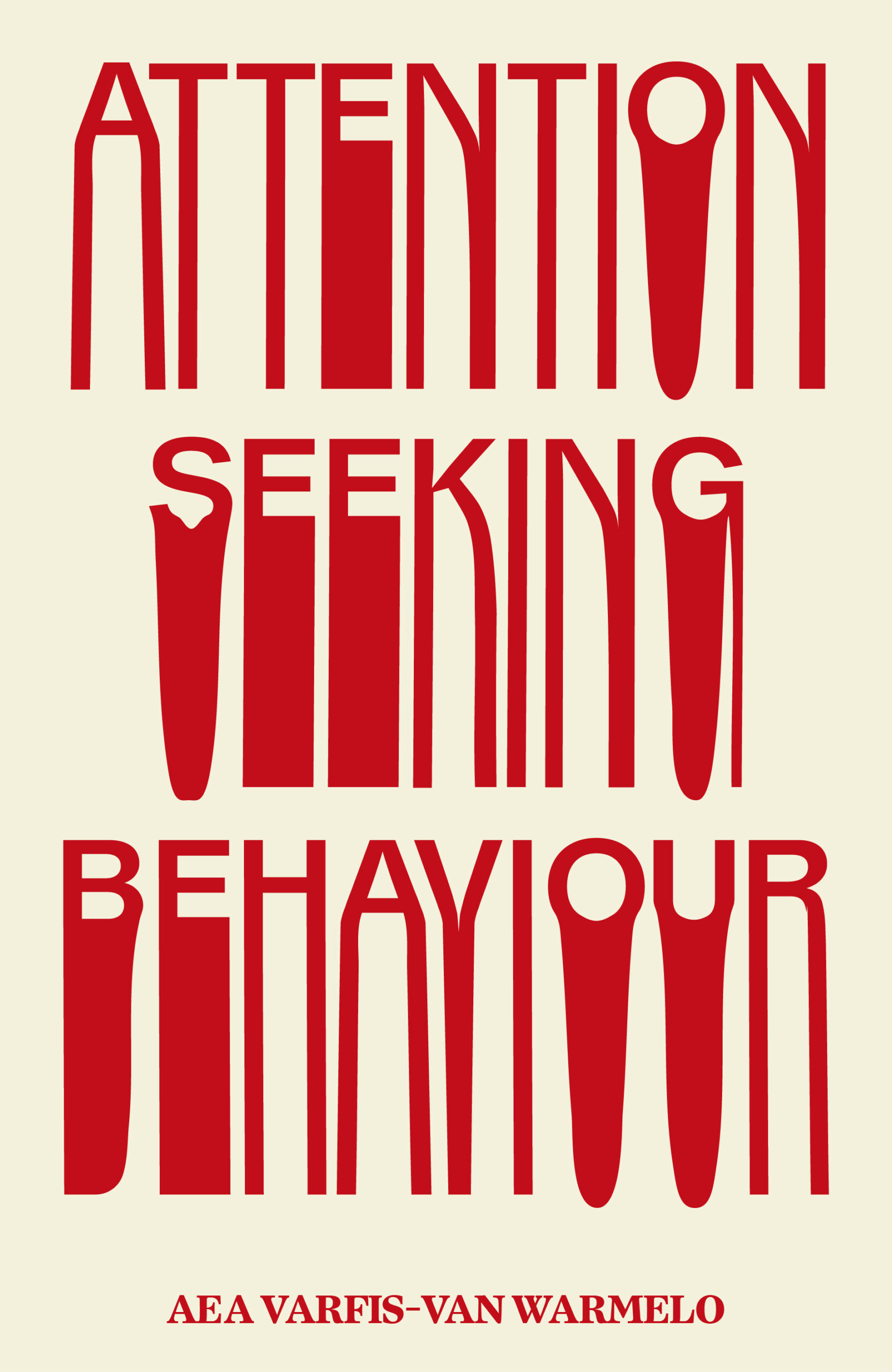
Attention-Seeking Behaviour
Aea Varfis-van Warmelo
Peninsula Press, 2026
You’re reading this essay for free. With a membership, you can read the full magazine, and you get access to our fabulous Library.
Here’s our offer: 3 months unlimited digital access + 1 print edition for € 38,00 € 19,00
You’ll get Issue Twelve in print as your first magazine, right to your mailbox.