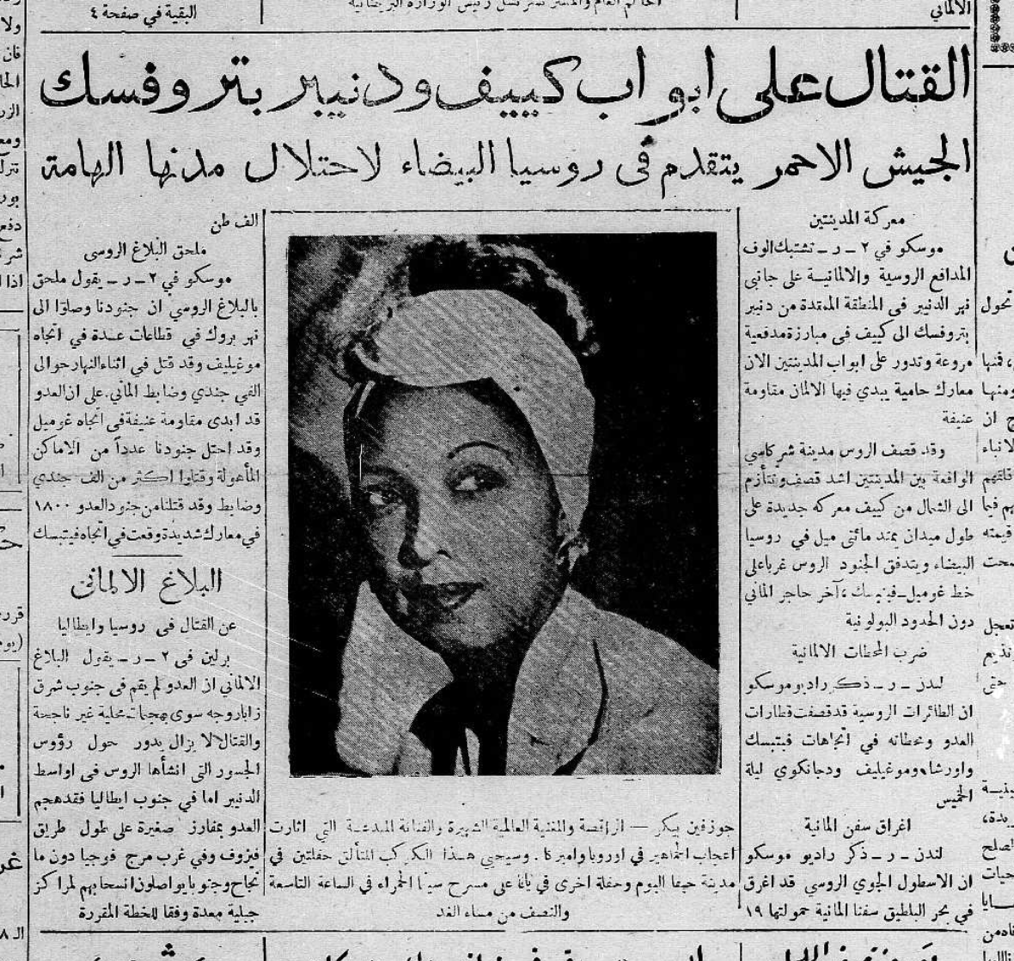
This essay focuses on one night — 3 October 1943 — when the Arab and Jewish elite of Haifa, a Mediterranean port town then under the British Mandate, were gathered in the Bat Galim Casino, along with British officers and international businesspeople, to hear the legendary Joséphine Baker1 in a performance benefitting General Charles de Gaulle’s Free French fighting force. That night, eighty years before the attacks of 7 October and their genocidal aftermath, now seems just a heartbeat before the Nakba. Many of the people watching Joséphine Baker would later be expelled from the city they loved, possibly by others sitting next to them in that same casino. Many Palestinians driven out of Haifa found refuge in Gaza, Lebanon, and the region. Where are their descendants now?
Announcement of Baker’s performances in Haifa and Jaffa from the front page of the newspaper Falastin, 3 October 1943
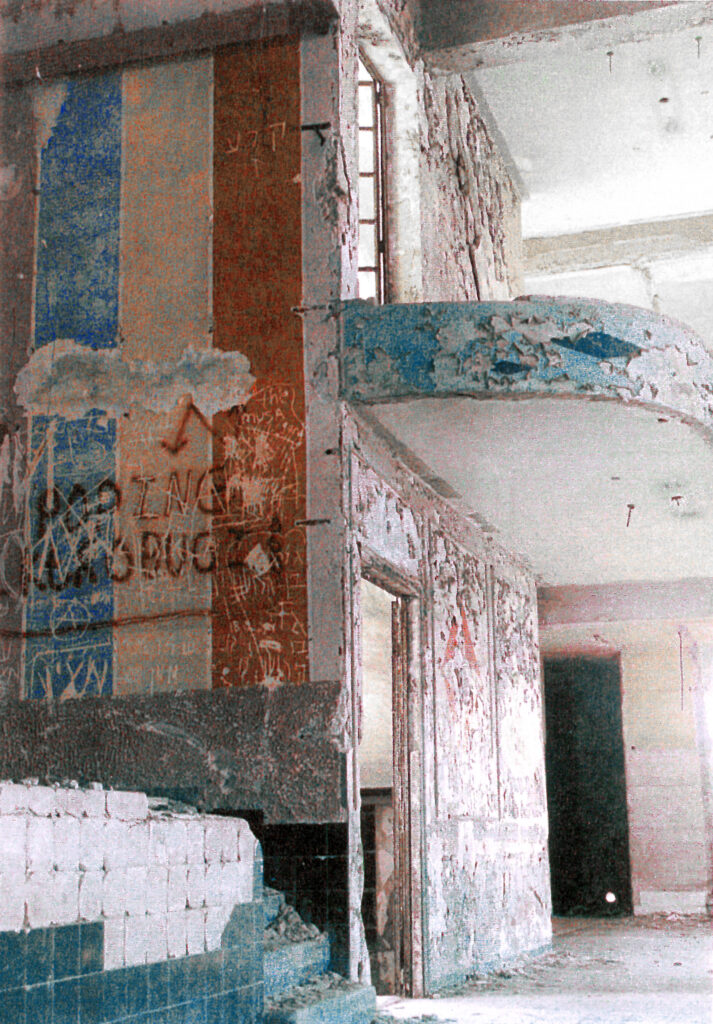
A few years ago, exploring the Municipality of Haifa’s archives, I found an unframed color copy of a photograph. The print had developed bent corners, or dog-ears. (In German we call them donkey ears, and in Hebrew, so my husband says, there is no term for this phenomenon. Growing up in Haifa, he thought it’s just how photographs are.) The dog-ears were probably created because the print had been stored among other loose pages too large to fit the archive shelf, and because it was subject to the city’s humid climate. The photograph, preserved only in this one color copy, had lost the vividness it possessed when it was developed in a local photo shop. Its damaged state strangely mirrors that of the object it depicts.
The photograph, taken in 1994, shortly before the building was demolished, is of the Bat Galim Casino. It is an interior shot the likes of which I have not seen — perhaps because the building was closed off for so long and the photographer must have snuck in to take the photograph. Along with the severe decay of the structure — bleached by the salty winds that blew in through the broken windows — one can still discern the faded blue, white and red of a French tricolor, immediately adjacent to a section of the ruin that seems to have been a performance stage. Against the walls covered in graffiti that have long since lost their meaning and color, the flag appears to be an original feature.
What is a French tricolor doing painted across the full height of a casino in British Mandatory Haifa?
Remnants of a painted tricolor on the theater stage of Bat Galim Casino in Haifa, shortly before the building’s demolition, 1994 (Photographer: Simcha Afek ?. Courtesy of Buildings & Sites Conservation Department, City Planning Office at the Haifa Municipality.)
But what is a French tricolor doing painted across the full height of a casino in British Mandatory Haifa? Though I have searched exhaustively in archives and libraries, this is seemingly the only evidence of the flag to be found. I would have gone further still and undertaken an analysis of the paint layers, but the original building no longer stands. An investor bought the site in 1991 and convinced the Preservation Department of the Haifa Municipality to let him raze the original structure and start from scratch. Yet the new casino remained an unfinished, bunker-like shell that straightaway began its own process of deterioration, never having been used for anything other than maintaining its property value.
This one spectral image of the tricolor serves as a clue, a faded ghost connecting us to the larger geopolitics of the region. I hope the reader will join me on this venture through the casino’s architecture and its history. In the meantime, you can bend the corner of the next page for a glimpse of the night Joséphine Baker performed here.
The neighborhood, the architect
Bat Galim, begun in the 1920s, was one of a series of residential and municipal developments by the German-born émigré architect Richard Kauffmann, intended to form « a small part of the Palestinian Seafront of the Future. »3 Thus, the « Palestinian Riviera » that US President Donald Trump demanded in February 2025 had already been born here, one hundred years earlier — a Riviera that Kauffmann hoped would run « from Gaza via Jaffa, Tel Aviv, to Haifa-Akko » (« Akko » being the Hebrew name for the city of « Acre »), and that unlike Trump’s repugnant proposal would include Arabs among its residents and proprietors. In the light of what followed, an upscale Arab-Jewish development like Bat Galim might sound almost utopian, but in fact Kauffmann’s urban planning schemes were part of a colonial settlement project that has now come full circle.
In his master plan for the Palestinian Seafront of the Future, Kauffmann designed the Bat Galim garden neighborhood as part of the modernist seafront and bay area, with a palm-lined avenue as the main boulevard running perpendicular to the sea and a bathing beach. In 1933, when the new neighborhood began to grow into an elegant residential area for British military personnel and their families, the Society for the Development of Bat Galim asked the architect Alfred Goldberger to design a casino and a swimming pool at the end of the same boulevard.
This article is behind the paywall. Want to keep reading this article?
Subscribe to the European Review of Books, from as low as €5,00 per month.
To provide the best experiences, we use technologies like cookies to store and/or access device information. Consenting to these technologies will allow us to process data such as browsing behavior or unique IDs on this site. Not consenting or withdrawing consent, may adversely affect certain features and functions.
Functional
Always active
The technical storage or access is strictly necessary for the legitimate purpose of enabling the use of a specific service explicitly requested by the subscriber or user, or for the sole purpose of carrying out the transmission of a communication over an electronic communications network.
Preferences
The technical storage or access is necessary for the legitimate purpose of storing preferences that are not requested by the subscriber or user.
Statistics
The technical storage or access that is used exclusively for statistical purposes.The technical storage or access that is used exclusively for anonymous statistical purposes. Without a subpoena, voluntary compliance on the part of your Internet Service Provider, or additional records from a third party, information stored or retrieved for this purpose alone cannot usually be used to identify you.
Marketing
The technical storage or access is required to create user profiles to send advertising, or to track the user on a website or across several websites for similar marketing purposes.
 Skip to content