Translated by Bianca Ferrari
The following is a brief translated excerpt from the last chapter of Mattia Salvia’s new book Cosplayers (Produzione Nero). The book examines political cosplay in the twenty-first century: a Trump voter dressing up as a border wall, politicians in superhero uniforms, disillusioned young people wearing the outfits worn by murderers of politicians or CEOs. This is cosplay at the intersection of internet culture and geopolitics. How does it work? On whose side (the powerful or the powerless) might it stand? In what follows, a Ukrainian great-grandmother inadvertently becomes a pro-Russian icon.

You’re reading this essay for free. With a membership, you can read the full magazine, and you get access to our fabulous Library.
Become a member and get Issue Ten in print as your first magazine, right to your postbox.
Anna Ivanovna, a great-grandmother from a small village in the rural outskirts of Kharkiv, spent her life working as a wheat silo operator. She married Ivan, a Russian man from the neighboring Belgorod region, and gave birth to four children, all of whom have passed away by now. A simple life, far from the spotlight — until, by sheer happenstance, she became the unexpected face of the war between Russia and Ukraine.
At the start of the invasion in 2022, Ivanovna’s village of Velyka Danylivka found itself on the front line. Pounded by heavy Russian artillery, the area became a no-man’s-land until early March 2022, when a Ukrainian platoon entered the village. The troops noticed that Ivanovna’s house was still inhabited and decided to stop by and drop off food. Mistaking the soldiers for Russians, Ivanovna stepped out to greet them, Soviet flag in hand — an encounter that would quickly spiral into farce and fame.
In a video recorded by one of the soldiers, the troops reveal they are actually Ukrainian, snatch the flag from her hands and throw it on the ground, then walk all over it. Ivanovna becomes upset. She shouts that her parents died for that flag and refuses the food. The video quickly went viral. Days later, Russian state TV aired it as pro-war propaganda. Ivanova became known as « Babushka Z » — the letter used in the early days of the invasion as part of the Kremlin’s wartime branding efforts. Ivanovna became a symbol of Ukrainian oppression, held up as proof that the people of Ukraine are patiently waiting for Russia to set them free.
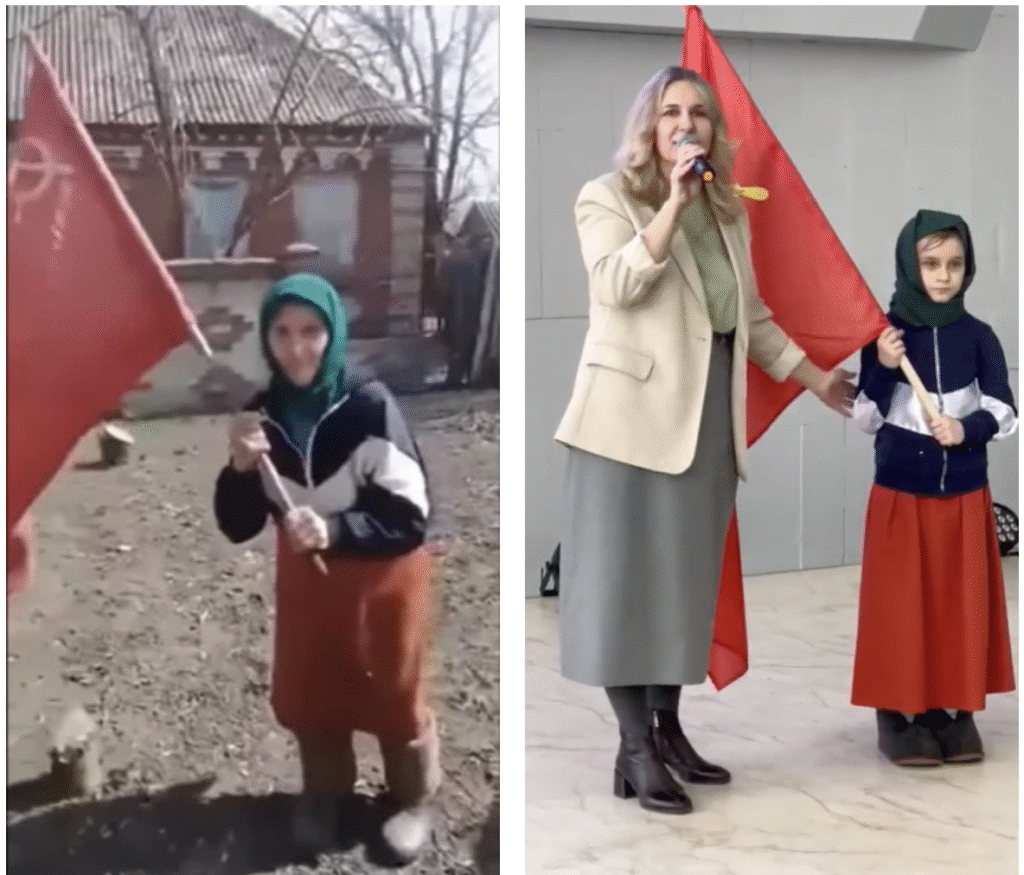
Within weeks, Ivanovna’s image could be seen on murals and at bus stops all over Russia, complete with her iconic blue-and-white sweatshirt, her headscarf and her red flag in hand. Statues were built in her image — one was erected in Mariupol after Russia’s occupation of the city in May of that same year. Online, Ivanovna became Mother Russia personified: memes depicted her waving the Soviet flag over the Reichstag, or surrounded by soldiers and children helping her hold it up. In one version, her shadow is shaped into the contours of the Statue of Victory in Volgograd.
This propagandist intoxication is swiftly followed by a sobering aftermath. Already that May, Ukrainian authorities published a new video revealing a whole other side to the story: Ivanovna was not, as Russian propaganda would have had us believe, a Russian patriot oppressed by Ukraine, but rather an elderly woman simply frightened by war. In the video, Ivanovna explains she had heard the soldiers speaking Russian and thought her village had fallen under their control. That’s why she came to meet them in front of the house — she was trying to convince them not to bother her.
« I wanted to show them that we, too, had a Russian flag at home, » she says in an interview. « A flag from when we fought together. » To her, the Soviet flag was « a symbol of love and happiness that belongs to every family, every city and every republic. » When the soldiers ripped the flag out of her hands and walked all over it, she was terrified. Despite the video’s dramatic ending, the situation quickly calmed down: she picked up her flag, her husband accepted the food, and the pair went back inside.
The following day, the soldiers returned to drop off some more food. Later, they also helped her and her husband evacuate Velyka Danylivka after their home was hit by Russian artillery. Once Ivanovna’s true political affiliations became clear, the Russian propaganda machine quietly dropped her image. In the end, after her fifteen minutes of fame, all that was left to Ivanovna was hostility: her neighbors kept believing her to be a traitor and ostracized her.
And yet, Ivanovna’s story — and its powerful imagery — continued to capture the Russian imagination well after its public debunking. More than 5000 kilometers away, in the Siberian region of Transbaikalia, eight- year-old Anya Kuzhleva became a local star thanks to her Babushka Z cosplay.
According to an interview with her mother, the idea behind the costume came in September 2022 when the child was preparing to recite a patriotic poem at a local festival. Her parents, active in various war-support initiatives, had encouraged her to make candles and write letters for soldiers. Anya’s performance, while dressed as Ivanovna, was a success. She soon began touring her act to local military sites — barracks, an airport, a train station. Eventually, she and her costume became a fixture at a training camp for conscripts about to be deployed to Ukraine.
Within months, her name was known to local authorities, who invited her to perform at morale-boosting events in support of the special military operation. « I read poems at the training camp and gifted my flag to a soldier, » Anya recalled. « He first planted it above a shelter but said he would hang it on his future tank in the Donbas. He promised to write ‘from Anyetta’ on it, and that it would become my tank. »

In a way, Anya Kuzhleva became what Anna Ivanovna never was: a genuine, grassroots example of Russian patriotism, embodying the narrative that Russian authorities had tried to impose. One might even say that to them, Anya’s character was more real than the real Anna: her cosplay was truer to the myth of Babushka Z that had been rejected by its originator.


Mattia Salvia’s Cosplayers is published in Italian by Produzione Nero.