 Skip to content

Global displacement has reached its highest level in recorded history. « But it is not only that. The world loses home altogether, » says Ece Temelkuran. Her new book, Nation of Strangers, explores moral, political, and spiritual homelessness in today’s world. Temelkuran claims that we are building a new nation whose citizens are strangers in various ways. The book, composed of letters to strangers everywhere, will be published in several languages in and beyond Europe this spring. We asked Temelkuran for one extra letter. It is a letter to you, dear reader. Do you feel at home? For how much longer? If the letter speaks to you and you feel like writing in return, we would be delighted to receive your response. Please send it to info@europeanreviewofbooks.com.
Dear stranger,
24th October, 2025 Kraków
I’m writing to you from, of all places, Kraków, Poland. It is a rainy morning. Still too early for tourists to studiously stroll around with their makeshift nylon rain covers. The supplier vans are making their rounds to cafes and restaurants, preparing the old town to look postcard-perfect for the rest of the day. The historic square will soon begin to offer that smooth time tunnel atmosphere, as if the past were a more harmless place. The streets are about to be ready with their exquisite beauty to comfort the tourists who have come to see Auschwitz. How many Polish dumplings, the famous comfort food, can soothe the lead-heavy darkness of those who have just visited the old wounds of fascism?
Ironically, my trip is also about fascism — the renewed version of it. I spoke about it yesterday in Kraków, and tomorrow I’ll be speaking again in another Polish city, Łódź. And once more, I will tell all those who seek hope that it will be our faith in humanity and our innate urge to create beauty that will sustain us against the dark cloud of radical evil. The political action will and can only come from our faith in our inherent beauty as humans. You see, I am in search of words to heal the human soul tarnished by contemporary fascism. And that is why I am writing to you. Do you still have words to heal humanity?
You and I have made our homes in language. We built books with the only indestructible material of humankind: words. We constructed them so that in them, we and the readers could make sense of the wuthering mundanity around us. We lived in the language, so the world — once we raised our heads from the page to look at the streets — became meaningful and bearable. Once uttered, our words moulded a delicate yet mighty cloud, a home. And our cloud home was owned by no one, yet everyone can belong. The most magical aspect of this home made of words was that it was constructed without extracting anything from the Earth. Language is the only man-made wonder created out of nothing — a poetic rejection of dialectics.
Yet today, the proud violence and the shameless cruelty are creeping towards our intimate, the poetic core from where the words of beauty and meaning originate. The essence of humanity, our language, and thus our home, are under attack. On one side, rising fascism terrorises the language, stupefying it. Fascism decimates the intellect not only among its supporters but also among those who are struggling against it by trapping them in a repetitive « no. » On the other side, humanity’s new, obscure toy AI, with its immoral masters, is invading the land of meaning by enslaving the foot soldiers of language, the words. When a clever and endlessly talkative machine-entity asks us, « Would you like me to write a poem? » is it still possible to keep remembering that « it » doesn’t feel? What is feeling if it is not the language? When these two disasters intertwine, can language remain our home?
I left my initial home, Turkish, at the age of 43 and began writing in this sour language, English. I made a crooked home with its foreign vocabulary and its sounds. Like the food you prepare with substitute ingredients when away from home, this home too is a bit tasteless, yet a home, nevertheless. Funnily, some people love calling me an exile. They believe the brand is exotic even when the whole world is losing its home one way or another. I’d rather call myself unhomed. I use the word hoping that many will realise that they, too, are unhomed. You don’t have to be a refugee, immigrant, or exile to be unhomed. After all, this is a time when we all feel unhomed morally, politically, and many will soon lose their homes to wars, climate change, and political oppression.
As our basic human morals don’t match the blunt cruelty of our world, we become morally homeless. Like a rough sleeper, we carry our moral values on the streets, trying to find shelter for them. We build communities to protect ourselves. We go inward.
Since our political demands — dignity and equality for all — have become irrelevant to realpolitik, many of us find ourselves politically homeless. Like any refugee, we look for political accommodation. We find temporary places, yet not a permanent residency that would feel like home.
And then, of course, millions of us become physically homeless every day. Wars, inequalities, climate catastrophe, and the desire to be free or simply to be, drive thousands to begin new lives in foreign lands.
Even if you feel at home in time and space today, you know that you are already in mourning for the future loss of everything that is beautiful. This is the first time humanity is mourning in the future tense. The future, too, is unhoming us.
In myriad ways, we are all becoming strangers.
Stranger is a joyful word. There is a possibility for instant yet profound solidarity in that word. It’s like escaping a pretentious party to smoke and finding a comrade who is equally exhausted from the fake smiles that sustain the illusion of « everything is normal. » How existentially delicious those bitter conversations are when you both despise the play inside and laugh together with the humble pride of being on the outside. An à-la-minute home is built on the spot between two people — a home with words and a shared smoke cloud of truthfulness. Nobody smokes anymore, but you know what I mean. I imagine that the truthful moment of feeling at home built between strangers, the outsiders, can be enlarged to the entire humanity when many more acknowledge their unhomedness. A new home can be built in this unhoming world among humans with the last thing we can own when all is lost: words. Do you think one can still build homes with words?
I walked to the old Jewish quarter yesterday, alongside all the other tourists walking to the same destination from every direction. We all walked towards an absence to see what is no longer there. Why is it that the old Jewish quarters are always such lively spots in European cities, you think? With bars, restaurants, art, design and everything that reminds us of the beautiful? Why do we rush to these spots like blood pouring into the wound to heal? Perhaps, to prove to ourselves that we can survive while staying beautiful, even after Auschwitz. But this time, with this new brand of radical evil, with a genocide ongoing, with what words, with whom and toward which destination will we rush to make a language home? Do you still have faith in words? Or, like any true believer, do you have doubts?
What is the beautiful enough word to save us this time around?
Are you still at home? For how much longer?
Shall we go out for a minute for a cigarette? We can just talk a bit if you don’t smoke. You know, nothing is normal and I’m so exhausted of this charade. Tell me about your home and how you keep it intact.
Yours sincerely,
Ece
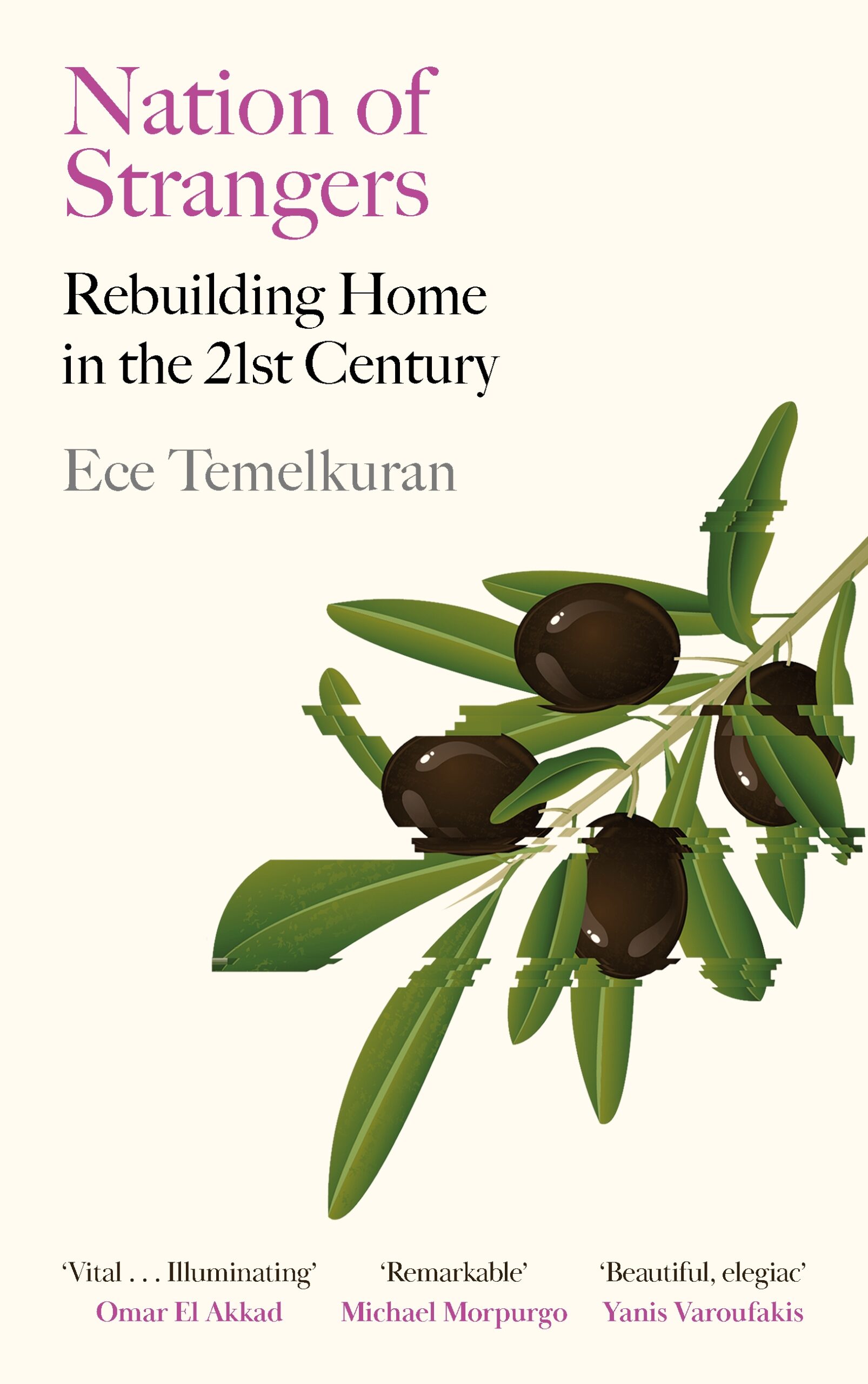
Nation of Strangers, Rebuilding Home in the 21st Century
Ece Temelkuran
Canongate (2026)

You’re reading this essay for free. With a membership, you can read the full magazine, and you get access to our fabulous Library.
Here’s our offer: 3 months unlimited digital access + 1 print edition for € 38,00 € 19,00
You’ll get Issue Twelve in print as your first magazine, right to your mailbox.