

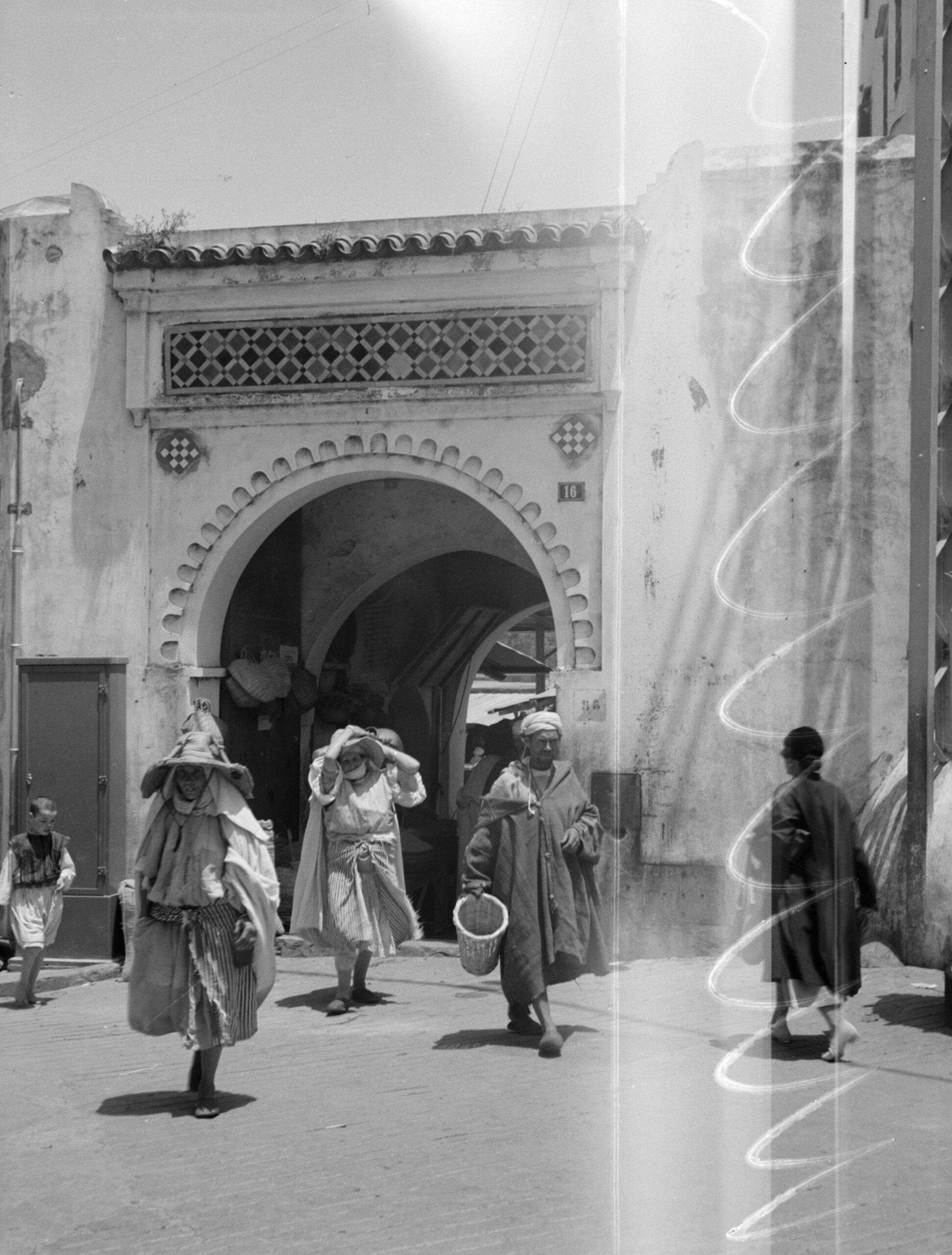
Five people are passing through a gate leading to the souk of the Tangier kasbah on a winter’s day in 1935.
To the viewer’s far left, a boy walks barefoot. In the middle, two Berber women draped in layers of cloth are wearing large straw hats. One carries a hefty clay vessel on her back; the other, closer to the photographer, shouldering a basket, gazes casually at the camera. Towards the center, a man in a cloak and turban carries an empty basket. These four people seem to be returning from the market. To the right, a woman in European clothes is the only figure who is walking in the opposite direction, with her back to us.
The characters appear unrelated, each is in his or her own world.
Their layered clothes suggest it’s winter. The short shadows tell us the time is around midday. In the gate’s vaults, straw bags are displayed for sale. Through the gate, one can see market stalls; in one of them, I detect the head of a mannequin. Then the grains get too coarse.
In my practice, which I call Documentary Architecture, I examine archival images for material clues and digital traces, searching for a geography that cuts across history and scale, from the graininess of photographic paper, or the granularity of aggregate in concrete, to the geopolitical carving of entire regions. This Tangier street scene is one of the treasures I keep revisiting: it complicates the colonialist narrative by showing how modernism interacts with earlier traditions, capturing something of that moment when, as Walter Benjamin writes « the past flashes up at a moment of danger. » At this gateway between Europe and Africa, this « moment » is part of the emergent language of early twentieth-century modernism, sometimes local and sometimes colonial, that appeared along the Mediterranean basin from Tangier, Oran, Tunis, Benghazi, Tripoli and Cairo via Jaffa and Haifa to Damascus and Beirut. This street scene predates the shifting borders of the war zones of North Africa and the Middle East during the Second World War, but also the brutal reality of national and settler-colonial borders that make it impossible to view this coastline today as one continuum.
The arch of the gate is decorated with a pattern of miniature arches. The alfiz above it features a stone masonry grille that allows the wind in. Lower down the arch are two numbers written in Arabic numerals. (The numerals used in Europe are confusingly referred to as Arabic, although they are different from the numerals used throughout the Arab world.) The number 16 is on an enamel plaque. Below it, the number 35 or 55 is stencilled. The digits do not align. It is more likely 35. Both numbers refer to the fact that the city is governed by a foreign administration. At the turn of the 20th century, Tangier was under French colonial control. After 1923 it was designated an international zone and was governed by eight European states, which turned the city into a cosmopolitan hub. While the old city was inhabited almost exclusively by Moroccans, whether Christian, Muslim, or Jewish, the late 1920s and mid 1930s saw new modern architecture and infrastructure being built for European expatriates in the surrounding neighborhoods.
This Tangier street scene was taken by the Dutch photographer Willem van de Poll, who in 1935 was travelling around North Africa working for different foreign news agencies. It is not clear whether the photograph was ever published. Squiggle marks on the contact sheets found in Van de Poll’s archive suggest he wanted to crop the figure of the « European » woman from the image. We cannot be sure whether she is European or a bourgeois Moroccan woman. She is fashionably dressed. By the mid 1930s, Tangiers already had small department stores or magasins de nouveautés selling European imports and luxury items, sites where European consumer culture and early forms of branding took architectural form.
Seen in profile, she is wearing a dark beret over her curly hair, which is pulled back into a little bun. The silver grains of the photograph seem to form a gleam of a pearl earring. She is draped in a long coat over a light-coloured dress that reveals only her ankles, the low heels of her shoes. She seems to walk a tightrope, balancing on a line of shadow cast by the electrical wires above her, which alongside the Arabic numerals are yet another hint of colonial domination.
Her presence in the frame may have interrupted the orientalist scene that Van de Poll had spontaneously hoped to capture. But rather than being an act of decolonization, his crop reinforces the colonial imagination. Removing the « European » woman creates the impression that the Tangier Medina is inhabited by people who may be thought of as ancient or out-of-time, even though all these figures, coloniser and colonised, were caught up in the maelstrom of colonial modernism.

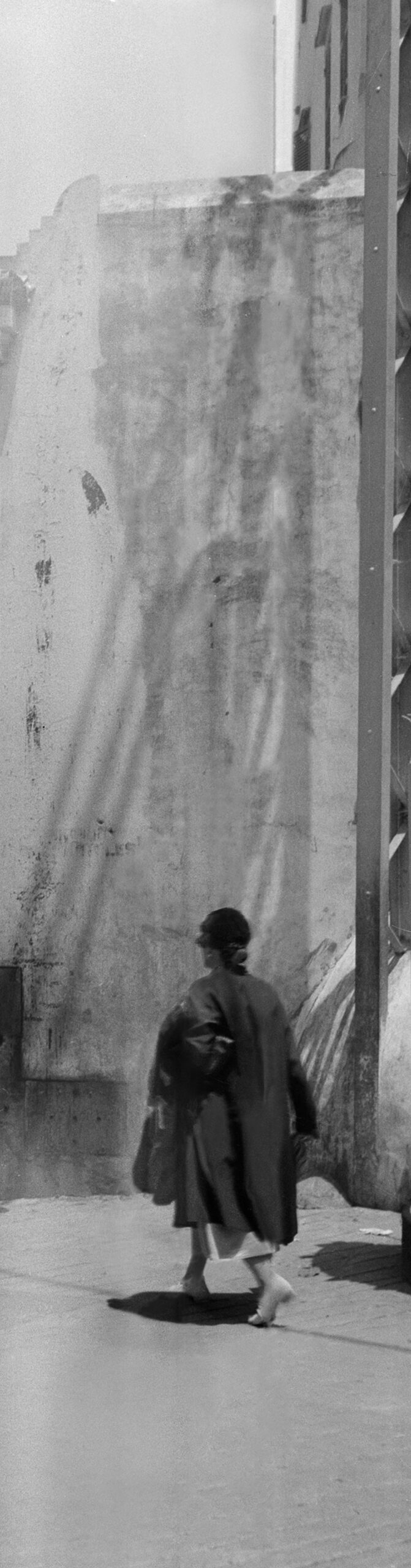
Restoring her figure from the crop marks Van de Poll scribbled over them was a careful act of digital restoration. Unearthing the arrangement of black-and-white grains that comprise her image restores a moment of colonial encounter rather than patching over it.
It creates new sets of images. The thick grease-pencil line of the China marker, hastily drawn across the image, performs a schoolmasterly gesture, instructing, correcting, asserting control over the woman and the electricity pylon alike. (I remember the long, near-perfect red lines my East German teacher would draw down my school essays, a gesture of correction meant to be both authoritative and punitive.) Scribbling over the woman’s figure, the photographer seemed to renounce her as part of his work. Yet in rescuing this woman from the margins of the photographer’s erasure, a new composition begins to emerge.
In this new image, we see the woman herself, her back turned, striding purposefully away, set against the electricity pylon, its shadows, and the concrete wall. What was once a peripheral detail now becomes an image of twentieth-century urban modernity and female independence. Apart from the scalloped roofline, there are only faint traces of non-European ornament; the scene now reads as distinctly modern.
My act of « appropriation » borrows from the conceptual artist Sherrie Levine’s feminist strategy of re-signing the works of earlier (male) artists to expose authorship and gendered power in art history.
Her 1987 After Edgar Degas series, in which Levine rephotographed Edgar Degas’s lithographs depicting women in fleeting, accidental, but also intimate moments and poses, interrogates both the voyeuristic gaze embedded in these impressionist images and the exploitative dynamics between artist and subject. Beyond critiquing authorship and appropriation, the work reflects on the broader economies of image circulation and the ethics of representation — questioning the act of stealing or commodifying fleeting moments from subjects who remain unacknowledged, uncompensated, and perhaps unaware of their continual reproduction within the visual archive.
The special condition in which such works exist creates thus an interesting paradox: at the moment of their appropriation, they have to a certain extent been unchained from the system of circulation and value that shackled them to the art market, a situation in which the cultural value of art works cannot easily translate into financial value.

You’re reading this essay for free. With a membership, you can read the full magazine, and you get access to our fabulous Library.
Here’s our offer: 3 months unlimited digital access + 1 print edition for € 38,00 € 19,00
You’ll get Issue Eleven in print as your first magazine, right to your mailbox.
As such, the defacement, missing parts, or parts out of place or on the margins, are an important excess that allows us to think about new modes of interaction between objects, assemblies and social forms. In retrieving Van de Poll’s excised image from the trash bin, I recall Charles Baudelaire’s observation that rag-pickers are an invitation to materialist historians to study the detritus left by progress. To salvage those seemingly insignificant collections of wrecked and damaged works, to « make them speak », perhaps to « eavesdrop » on them, is to refuse to accept their irrelevance and to expose cultural and political constructions that are hidden, fossilised, or packed into the objects. My own act of « rag-picking » differs slightly: this is a diptych, marked by two signatures — Van de Poll’s and my own. By reversing his erasure and mending her clothes and rearranging her hair and polishing her shoes with silver grains, I enable the woman to be seen in her entirety and to read the original scene in all its complexity.
My own act of « rag-picking » differs slightly: this is a diptych, marked by two signatures — Van de Poll’s and my own. By reversing his erasure and mending her clothes and rearranging her hair and polishing her shoes with silver grains, I enable the woman to be seen in her entirety and to read the original scene in all its complexity.
