

Translated by Bianca Ferrari
The following is a brief translated excerpt from the last chapter of Mattia Salvia’s new book Cosplayers (Produzione Nero). The book examines political cosplay in the twenty-first century: a Trump voter dressing up as a border wall, politicians in superhero uniforms, disillusioned young people wearing the outfits worn by murderers of politicians or CEOs. This is cosplay at the intersection of internet culture and geopolitics. How does it work? On whose side (the powerful or the powerless) might it stand? In what follows, a Ukrainian great-grandmother inadvertently becomes a pro-Russian icon.
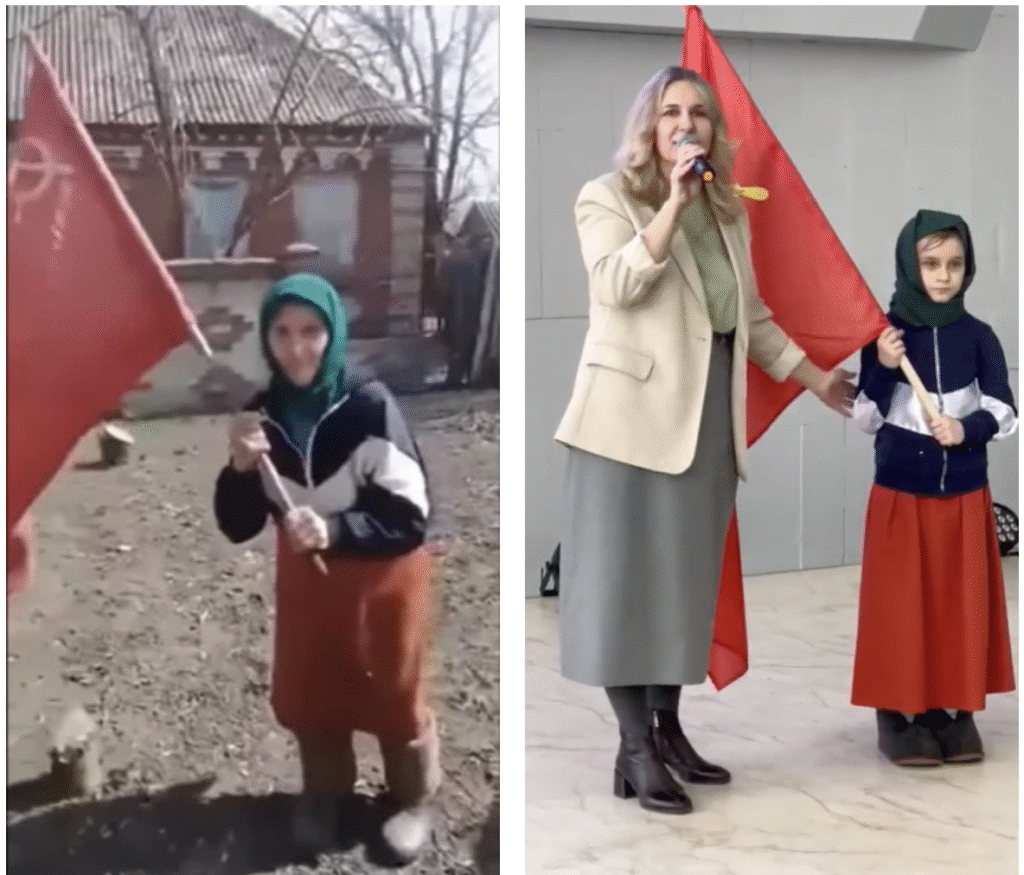
Anna Ivanovna, a great-grandmother from a small village in the rural outskirts of Kharkiv, spent her life working as a wheat silo operator. She married Ivan, a Russian man from the neighboring Belgorod region, and gave birth to four children, all of whom have passed away by now. A simple life, far from the spotlight — until, by sheer happenstance, she became the unexpected face of the war between Russia and Ukraine.
At the start of the invasion in 2022, Ivanovna’s village of Velyka Danylivka found itself on the front line. Pounded by heavy Russian artillery, the area became a no-man’s-land until early March 2022, when a Ukrainian platoon entered the village. The troops noticed that Ivanovna’s house was still inhabited and decided to stop by and drop off food. Mistaking the soldiers for Russians, Ivanovna stepped out to greet them, Soviet flag in hand — an encounter that would quickly spiral into farce and fame.
In a video recorded by one of the soldiers, the troops reveal they are actually Ukrainian, snatch the flag from her hands and throw it on the ground, then walk all over it. Ivanovna becomes upset. She shouts that her parents died for that flag and refuses the food. The video quickly went viral. Days later, Russian state TV aired it as pro-war propaganda. Ivanova became known as « Babushka Z » — the letter used in the early days of the invasion as part of the Kremlin’s wartime branding efforts. Ivanovna became a symbol of Ukrainian oppression, held up as proof that the people of Ukraine are patiently waiting for Russia to set them free.
This article is behind the paywall. Want to keep reading this article?
Subscribe to the European Review of Books, from as low as €4,16 per month.
Already a subscriber? Sign in