

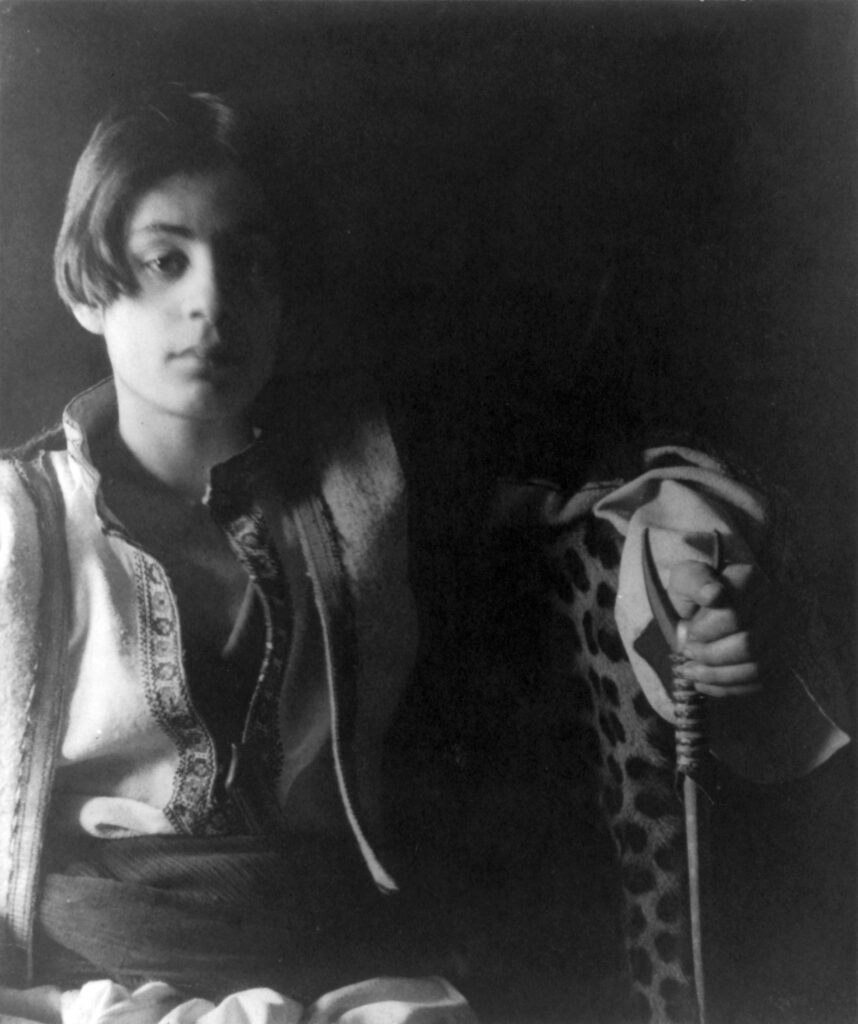
Kahlil Gibran (1883-1931) was born into a Maronite Christian family in Lebanon and emigrated to the United States when he was twelve. He gained some fame as a Symbolist style artist and poet in Greenwich Village, writing in both Arabic and English, and died young of cirrhosis of the liver. The Prophet was published in 1923, but it was only really in the sixties that this collection of vaguely mystical, anti authoritarian teachings became a cult work revered by Elvis Presley, The Beatles, David Bowie — a book found on every self-respecting bookshelf, including that of the fiction-writer Jonas Hassen Khemiri’s childhood home in Sweden.
Photographer: F. Holland Day, c. 1898. Library of Congress [Public domain)
One day you will find it on your mother’s bookshelf, thin as a map, small as a notebook. The cover is light blue and decorated with dark blue flowers. The title is written in red: Le Prophète and the name of the author in black: Khalil Gibran. On the inside of the book, in blue handwritten ink: your mother’s name.
The name of the writer is more similar to your family name than any other writer whose books you have read so far. It’s probably the first time you see a name that starts with the letters KH on a book cover, Khalil, like one of your cousins, like your grandmother’s favorite butcher. KH as in your family name, the sound that you’re never sure about how to pronounce. KH as in « cat » when you are in your home country, KH as in « Bach » when you are in your father’s country. But who cares about names? Nobody. You live in a world that tries to convince you that names are superficial things, names are easily exchangeable, no name has more power than another name, a person’s name is just an empty symbol, but still, something happens when you see that writer’s name, on that book, when you’re fifteen years old and hold The Prophet in your hands for the first time.
A few days later you have finished the book with the help of a French dictionary and then you carry the book with you for weeks. It’s so small that it fits in every coat pocket. You never bring it out and recite Gibran’s ancient wisdom, you don’t say « the lust for comfort murders the passion of the soul » to a basketball friend who is dating a hair model, you don’t say « it is only that which has given you sorrow that is giving you joy » when mum is happy because dad finally comes home, but you bring The Prophet with you wherever you go, and you dream of one day finding a place where you won’t need to « fold your wings that you may pass through doors », nor bend your head « that they strike not against a ceiling ».
The book’s words become a weapon, no, they become a kevlar vest, a superhero’s suit, thanks to the book, the world can’t reach you, no substitute teachers, no bouncers, no cops, no security guards, no robbers, no employers can hurt you, simply because you have the prophet’s words in your coat pocket. For your final project in high school, you write an essay about Gibran, you compare his life with his work, you investigate if he really lived in alignment with his teachings (as if it’s even remotely possible for anyone to live in alignment with one’s words), and you only feel slightly disappointed when you realize that the book was written in English instead of Arabic, and published in 1923 instead of say the early eleven hundreds.

You’re reading this essay for free. With a membership, you can read the full magazine, and you get access to our fabulous Library.
Become a member and get Issue Ten in print as your first magazine, right to your postbox.
Fifteen years later you are a published writer. During an literature festival in Iceland, you end up next to an American publisher on a tourist bus heading to the house of Halldór Laxness, and now you have enough university credits in Literature that you understand that some names are high currency, and therefore great to mention, you speak about Perec and Danticat, Duras and Calvino, Baldwin and Kincaid. You never tell her that the first book you walked around with in your coat pocket was called The Prophet because now you have understood that Gibran is low currency, the name doesn’t give any respect, The Prophet is too easily digestible, too image-heavy, too commercial. The American publisher buys the rights to publish one of your novels, you fly to New York before the publication date, you are meeting in a skyscraper in Midtown, the publisher’s lobby is full of warmly lit book covers, first editions of Nabokov, Morrison and Khalil Gibran’s The Prophet.
But something is wrong, his first name is misspelled, it says Kahlil instead of Khalil.
He chose to change it, the publisher says, when you are waiting for the elevator that will take you up to her office among the clouds. He changed from Khalil to Kahlil when he moved to the US.
The elevator comes, you enter.
That book has paid for this skyscraper, the publisher says and smiles. You don’t ask her how many copies it has sold over the years, but it has to be millions because the book is piled up in every American bookstore you enter, and in one store there’s a note claiming that Gibran is the « third best selling poet in the world » after Shakespeare and Lao-Tzu.
Even though the book is everywhere, you try your best to avoid it. You never re-read it, maybe because it feels strange that a text that you thought was yours, turned out to belong to the world, maybe because it reminds you of an old version of yourself, like an old sweater that you have outgrown, and you don’t want to look backward, you want to push forward, next book, next project, next city, next country (or you are terrified of re-reading The Prophet and realizing how much you still (against your will) like it).
Fifteen years later you move to the US to write a new book, you spend ten months at a library in New York, working on a long novel about three sisters. For the first time in your life, you write in a language that is not your mother tongue. At first, you tell yourself that it’s the sisters’ fault, that they demand their story to be written in English. Toward the end, you realize that it’s you who are linking English with power, and it’s the authority of English that makes it possible for you to fill all these pages. You’re the one who has limited grammatical knowledge of English, which makes it liberatingly impossible to play tricks to try to impress the reader. You’re the one with enough distance to English, which makes it possible to write personal memories that would be hard to write in your mother tongue (because when you write in your mother tongue you always have to hide behind experiments (you have to invent an unexpected form (for example writing in second person instead of first (or using a lot of parentheses (in order to dare to be yourself (maybe Khalil who became Kahlil felt something similar (maybe he needed to write in English to give us his truth (why is that (why do we have to leave ourselves in order to become ourselves (what is hidden on the other side of the sea (on the other side of the form (behind that new name (behind that worn-out mask that looks like our face (who could we become if we allowed ourselves to change languages (change countries (change I’s (you who is I who are we, wish we knew))))))))))))))))).
Soon thereafter you are asked to write a preface to The Prophet. You reread the book and encounter a different text than when you were fifteen. But the power in the simple sentences is still there. And the longing for freedom shines just as brightly. All these wings in the text: wings of birds, wings of humans, wings of voices, wings of love, wings of gifts, wings of death. Your wings, my wings.
The lifelong dream of one day finding a place, a language, a world, a name, that will make it possible for us to spread our wings, stand straight, and never « fear to breathe lest walls should crack and fall down. »

You’re reading this essay for free. With a membership, you can read the full magazine, and you get access to our fabulous Library.
Become a member and get Issue Ten in print as your first magazine, right to your postbox.
