


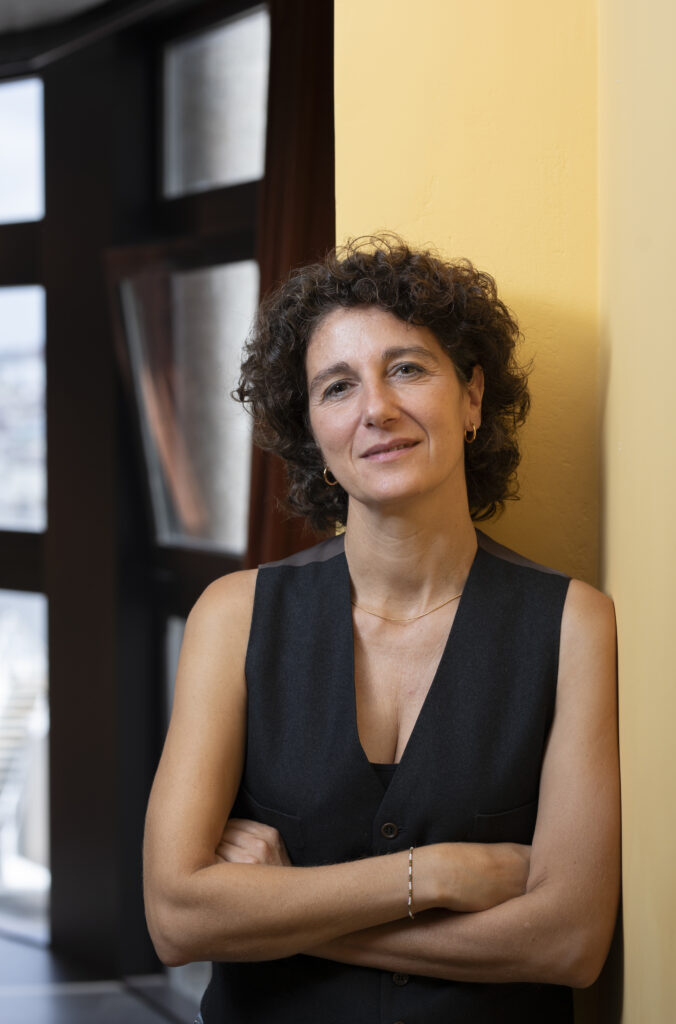
Marina Garcés, born in Barcelona in 1973, has published more than ten books that have been translated into a dozen languages, from Un mundo común (2013) to El Temps de la Promesa (2023). In her autobiographical essay Ciutat Princesa (2018), she uses the 1996 eviction of activists who had turned an abandoned Barcelona cinema into an autonomous social center in order to argue for the protection of shared spaces where people can learn together. She teaches and researches at Universitat Oberta de Catalunya, and has long been an active community-organiser in Barcelona, co-founding in 2002 Espai en Blanc (Blank Space), an open and multidisciplinary experimental philosophy project.
La passió dels estranys (The Passion of Strangers) is a critical exploration of friendship, a bond Marina Garcés describes as the only « stable form of social interaction…that has not produced its own institution or legal status. » In late June, on the eve of Sant Joan, I interviewed Garcés via videocall.
In The Passion of Strangers, you discuss some of the stereotypical discourses around friendship. Are such discourses dangerous?
We have inherited a conceptual framework that idealizes friendship. Our philosophical tradition speaks of friendship as a true or perfect relationship: while reproductive, economic or political objectives run through other bonds, friendship seems to have no other purpose beyond itself — it is therefore pure, it contains all possible virtues. This idealisation is reproduced in everyday language, in the way we talk about friendship, and this ends up causing many frustrations in real life: it becomes very easy to feel that real friends are never quite up to par.
You’re reading this essay for free. With a membership, you can read the full magazine, and you get access to our fabulous Library.
Here’s our offer: 3 months unlimited digital access + 1 print edition for € 38,00 € 19,00
You’ll get Issue Eleven in print as your first magazine, right to your mailbox.
There are plenty of articles out there now about how to « break up with a friend » or « identify toxic friendships » — is it trendy to let friendships end?
I think there is a therapeutic concern that is colonizing a large part of the discourse about friendship and that has to do with emotional management within a capitalist paradigm of relationships. We’re constantly being asked to handle our relationships in terms of emotional benefit, keeping what serves us, and discarding what doesn’t.
This therapeutic — capitalist, really — type of friendship involves calculating our value not only based on the number of contacts we accumulate (that’s the simple and obvious version), but also based on how we manage these relationships to our own benefit. I think this is seriously damaging the ways we understand friendship.
Is it misleading, then, to say things like « My friends save me from the ills of the world? »
Friendship isn’t really supposed to take care of that, is it? This therapeutic logic, of immunity, of refuge, strips friendship of the power of strangeness I think it has: a friend is always a stranger in our lives, and that is the opposite of a paradigm of immunity or toxicity.
In the book, I describe friendship as a relationship of resistance — one that can contribute to a society where bonds and affections are not only structured hierarchically, through domination and exclusion.
Let’s talk about strangeness.
When I talk about strangeness, I am not referring to objective differences; in fact, the first stranger is oneself. Strangeness is a mutual dimension — it means setting out on a path where we don’t entirely know who we are or who we can become.
To say that friendship has to do with recognizing this being out-of-place in relation to something, is therefore to acknowledge that we are mutually strange when we begin a friendship. And this does not mean that a friend must come from far away, belong to another race, speak another language, or be a freak.
But we’ve learned far too well how to hierarchically live with strangers: first, my people, then, the others. And we can say this using different political languages: both with extremely racist or classist discourses; or through ideas such as multiculturalism, which might sound more egalitarian but, at the core, are also based on differentiating who are ‘the others’. Properly organised differences put everyone in their place and with their own breed. Trouble comes when this classification cracks or wobbles, either because of resistance, social struggle, antagonism, or simply unexpected mixes: being where you don’t belong, making friends with those who are not like you… This is where transgression lies, and in the book, I make a strong political proposition for us to think of ourselves as a society where our coexistence is truly among strangers — instead of a prefabricated society with perfectly separated and well-managed identities.
What is the role of the strangeness that we are exposed to, when we live in the city?
In Ciutat Princesa, I talk about the neighborhood as a political unit or space for coexistence. I argued that there is a tendency to idealize this space, to have a very romantic vision of what it is like to live there — as if neighborhoods, like friends, had always been there. But that is not true — cities, towns, neighborhoods are dynamic, made of people who come and go, more or less violently.
This phenomenon can accelerate depending on which economies we are talking about: overtourism, gentrification, the expat economy… These are all manifestations of the coming and going of life-in-common, which can be more or less stable and create more or less solid social networks. Right now, we are in a moment of high volatility and violence in the ways in which we arrive in and leave the places we live in, and this makes me wonder where the neighborhood is — where is that space-time in which we can share some kind of proximity with those who are close to us?
What do you mean?
For example: right now, you and I are having a conversation at great physical distance, yet we are talking with great proximity. I think reimagining relationships of distance and proximity is interesting in order to go beyond romantic ideas of neighbors. Who are our neighbors, today? And how can we extend neighborly relationships to other dimensions of our common life, beyond what can only be sustained physically?
Does a new philosophy of friendship, this passion of strangers, help us answer that question?
It does. If we think of the city (that is, a place where we live among strangers) as a sounding board of possible friendships, I believe we can open up a less hostile sense of it.
You often talk about teaching your children that friendly practices, gestures of proximity between strangers, are not exceptions in a world of enemies, but signs of a different, warmer society that can be real.
One of the reasons feeding our paranoia is the language we use to tell stories of friendly people. Often these will be explained in grand terms, as if they were exceptional: we hear extraordinary news of a neighbor helping another, a migrant climbing up the side of a building to save a child who is hanging from a balcony… Why do we make these events sound rare, rather than its being normal to help each other? Making human acts of generosity and closeness sound epic and extraordinary normalizes disaffection and indifference, and makes closeness and mutual help exceptional.
Is friendship a revolutionary concept?
You’re reading this essay for free. With a membership, you can read the full magazine, and you get access to our fabulous Library.
Here’s our offer: 3 months unlimited digital access + 1 print edition for € 38,00 € 19,00
You’ll get Issue Eleven in print as your first magazine, right to your mailbox.
If we don’t lock it into an ideal — which is the big trap — yes. Friendship is revolutionary as long as we keep its potential of questioning alive: questioning who we are in relation to others, how we make nobler promises and how we invent new forms of coexistence.

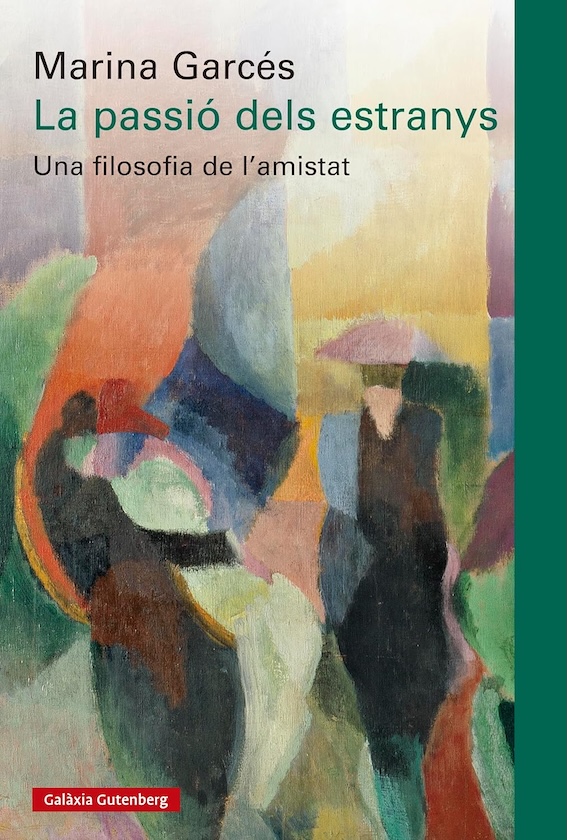
LA PASSIÓ DELS ESTRANYS:
UNA FILOSOFIA DE L’AMISTAT
Marina Garcés
Galàxia Gutenberg, 2025