

Three years into the war, the trains are running on time.
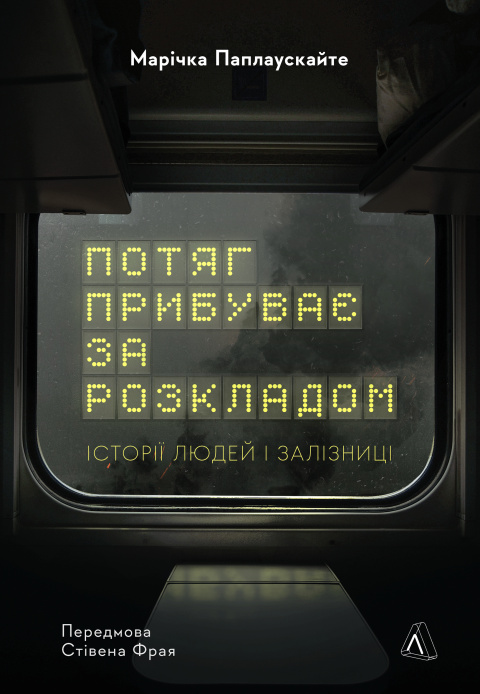
Потяг прибуває за розкладом: Історії людей і залізниці [The Train Arrives on Time: Stories of People and Railways]
Марічка Паплаускайте [Marichka Paplauskaite]
(Київ: Лабораторія, 2024 [Kyiv, Laboratory])
Before his death in 2010, the historian Tony Judt began a book on the history of railways, to be titled Locomotion. The essays that were published in The New York Review of Books give us an idea of his views on the subject, as does the posthumous book Thinking the Twentieth Century (2012), a dialogue with his friend and fellow historian Timothy Snyder. Judt mourned the particular decline of the railways in Britain and the United States. Since 1987 he had lived in New York, but he was born in London and trains were an important part of his childhood. His interests as a historian gravitated toward Europe, be it French intellectuals or Czech dissidents; his private Europe — « My Europe » — was, as he put it, « measured in train time. » Trains in continental Europe, unlike their British and American counterparts, had persevered, mostly, but still their future needed bolstering: « If we throw away the railway stations and the lines leading to them — as we began to do in the 1950s and 1960s », Judt wrote, « we shall be throwing away our memory of how to live the confident civic life. »1
Twelve years after Judt’s death, his insights into that confident civic life — and our ability to remember it — were enlivened by the most dramatic, most earth-shaking events in Europe since WWII: the Russian full-scale invasion of Ukraine. Millions of Ukrainians left the country during the first weeks of the invasion; four million were evacuated by train, including a million children. Thousands of dogs, cats and other pets, too. This occurred despite the shelling of railways and stations (a significant portion of which would end up under Russian occupation). Despite all this, Ukrainian Railways proved to be outstandingly inventive in saving people’s (and pets’) lives. Soon after the invasion, remarkably, it even managed to get back on schedule. And soon after the invasion, two managers of Ukrainian Railways made a bet with Polish friends from a big NGO that Ukrainian trains would maintain their 95% on-time-arrival rate. So reports the Ukrainian journalist Marichka Paplauskaite in an as-yet-untranslated book on Ukrainian trains. Spoiler: they won. Some days the rate is 99%. In Poland, Paplauskaite tells us, the rail system’s on-time-arrival rate is 80%. In Germany, Deutsche Bahn barely reaches 70%.


Ukrainian Railways proved to be outstandingly inventive in saving people’s (and pets’) lives.


You’re reading this essay for free. With a membership, you can read the full magazine, and you get access to our fabulous Library.
Become a member and get Issue Ten in print as your first magazine, right to your postbox.
The Train Arrives on Time: Stories of People and Railways appeared in June 2024. It is, first and foremost, a book of stories about the people who worked on the railways in the first year of the invasion — from the top managers down to the attendants and blue-collar workers from the smallest stations. Paplauskaite herself, editor-in-chief of the Ukrainian magazine Reporters, is from a family of railway workers, and was happy to take the offer of the Ukrainian publisher, Laboratory. (The book was the publisher’s idea and in fact was supposed to be written by Paplauskaite’s friend, but the friend fell out of a window, broke a leg, and couldn’t travel.) On one level, it is a reporter’s dream gig: Netflixy material from the first days of the invasion, with access to Ukrainian Railways’ managers and travels with, for instance, the former British Prime Minister Boris Johnson, whom Paplauskaite interviewed in a driver’s compartment. The British actor and writer Stephen Fry accepted the invitation to write the introduction, which was translated into Ukrainian. A substantial part of the material to which Paplauskaite had access is still classified.
On another level, the gig was perilous, and Paplauskaite was lucky to survive. On 26 December 2023, when she was about to depart from Kherson to Kyiv, the Kherson railway station was attacked with missiles. Together with another 140 passengers and railway staff, Paplauskaite made it to the shelter. The attack was timed precisely before the arrival of the Kyiv train, the only one that day. A policeman who helped passengers died; several people were wounded. Nevertheless, soon after the attack, passengers were shuttled by buses to the neighboring city of Mykolaiv to board another train to Kyiv, on which they took their seats according to the original tickets. Their train arrived on time. It wasn’t the first such episode; Kherson has been attacked constantly since it was de-occupied in November 2022.3 On 3 May 2023, a missile attack on Kherson’s station hit the rails near a train that was set to depart for Lviv. One car was burned immediately, another was badly damaged. Fortunately, the passengers were still at the station, and only one attendant was wounded. The train departed fourteen minutes late and arrived in Lviv on schedule.

It’s the familiar tale of Ukraine’s resilience, sure, but the story of Ukrainian trains arriving on time despite the shelling means something more. Ukrainians (along with many other Slavic nations) have long been stereotyped (and self-stereotyped) as sloppy and unproductive. Yet they’ve been able to take for granted the rigor and punctuality of their trains, very much in contrast to some European countries, which are certainly superior by many other criteria.
Paplauskaite captures this phenomenon with a mosaic of stories — surprising, intriguing, heartbreaking. There’s the one about a situation room set up during the first night of the invasion: initially a secret office in Kyiv, it became an improvised office-on-the-move, with six top managers of the company literally moving from place to place on a one-car train, making decisions ad hoc, and on site. Or the one about station managers near the Russian border, and the tens of thousands of railways workers providing military intel about Russian troops — sometimes literally counting Russian paratroopers landing from above — or directly sabotaging the Russian offensive. Or the one about Zelensky’s decision not to leave Kyiv: Ukrainian Railways prepared a secret evacuation train, which he never used. Or how the company repurposed its old cars into medical ones for evacuating the badly wounded.
Or the story of Oleksandr Pertsovsky, who left a well-paid job at DHL in Singapore in 2016 to reform the Ukrainian national postal service, and who then became Ukrainian Railways’ head of Passenger Transportations in 2020. (Ukrainian Railways has two main divisions, for passengers and for freight. The former is subsidized; the latter, historically, has been tightly linked to industry, especially coal and steel, and therefore more subject to the political and economic pressures of Ukrainian oligarchs.) He became CEO in 2024. Pertsovsky was among those managers aboard the situation-room-on-wheels, while also trying to evacuate his parents from the eastern city of Severodonetsk when it was under severe attacks. (He succeeded.)
Or the story of Iryna Yurchenko, an attendant who, like many other employees, lived on the train through the drama of evacuation, and whose son Dmytro « Orest » Kozatsky, a photographer and soldier, was among the defenders of Azovstal Iron and Steel Works during the siege of Mariupol. Dmytro became world famous for a photo taken at Azovstal — a soldier standing in the ray of light from above in the dark plant, hands spread out. Captured at Azovstal, Dmytro was returned in a POW exchange on 21 September 2022.
The train that was picking up Boris Johnson had nary a drop of milk onboard; managers considered all possibilities, including a quest for a Polish cow.
There are a dozen other stories about railway employees who spent months at their workplaces, be they trains or stations, worried about loved ones, helping passengers navigate the chaos of overloaded stations and cars. (The standard car has seats for forty passengers, but on the worst days of the evacuation, cars were packed with more than 120, every spare centimeter filled.) There are also stories about the railway workers who were killed.
The heartbreak is juxtaposed with the anecdotal, and at times the absurd. Paplauskaite delivers tales of « railway diplomacy », when Ukrainian Railways was tasked with the transportation of foreign presidents, prime ministers and celebrities. The burden of maintaining « Rail Force One » was as new for the railways as having to withstand the shelling.4 For example: before one of the first such visits (about which the rail team would only be alerted at the last minute, due to strict security measures), finding proper sustenance for diplomats required great inventiveness. The train that was picking up Boris Johnson in Poland at 4:30am one day in early April, 2022, had nary a drop of milk onboard; managers scrambled, considering all possibilities, including a quest for a Polish cow. It took twenty minutes and an improvised excuse to hold the train; the milk for Boris Johnson’s tea was from the nearest gas station, and he was none the wiser.

Ukrainian Railways is a state within a state, owned by the state (i.e. Ukraine), reporting to the Ministry of Infrastructure. With almost 200.000 employees, it is the largest employer in Ukraine. It owns factories, trade schools, sanatoriums for railway workers, and even its own dedicated artesian water well for servicing the trains. It has a monopoly on both freight and passenger railway transportation — 21.000 km of tracks — in the largest country in Europe.
Paplauskaite’s book is not a history of Ukrainian Railways, though some bits of history shine through. Telling that history would require a vaster canvas, and that’s the larger point: one can’t really explain the tremendous job that Ukrainian Railways has done in wartime without telling the history of the state-owned company, and — a larger point still — one can’t tell the history of independent Ukraine without the longer history of its railways.
In the nineteenth century, Ukraine’s railways were built by two empires: by Habsburgs in the western part, and by Romanovs in what is now central, eastern and southern Ukraine. That’s why the track gauges were different widths — a difference that was only harmonized after the western part was annexed by the Soviet Union after World War II, whereupon all the gauges from the Pacific Ocean through Siberia and all the way to the Hungarian border were one width: a steel curtain beneath the Iron one. (These days, Ukrainian railways use a broader track gauge than most European « standard gauge » railways. The road from Ukraine to the European Union has many bumps.)


The extensive construction of railways in the east and south of Ukraine shaped the developing industrial landscape of the country in the second half of the nineteenth century, with long-term consequences for its political fate. When the short-lived Ukrainian People’s Republic fought for survival in 1918-1919, its government had to leave Kyiv, and at one point spent some time on the train. It was mocked by its opponents and in Soviet propaganda for controlling only the territory under its train car.

After Ukraine became independent in 1991, its railway infrastructure remained connected to Russian railway infrastructure for years, having to report its statistics to Russia and requiring approval for its international routes. In the economic crises of the 1990s, though, Ukrainian Railways was a relatively good and reliable employer. At least part of the credit goes to Georgy Kirpa. In the mid-1990s, Kirpa was a regional manager in western Ukraine; then-president Leonid Kuchma appointed him head of Ukrainian Railways in 2002, and then Minister of Transportation. Kirpa oversaw the creation of new stations and the reconstruction of old ones; his old-school management style was popular, as was the relatively substantial social care that his governance provided its employees.5 His tenure was also marked by several large-scale corruption scandals (for example, a questionable project of building a Danube–Black Sea channel), and by his questionable taste (he was entrusted to build a summer presidential residence in the Carpathians; the decor reflected the typical post-Soviet appetite for pomposity).
Kirpa was thought to be Kuchma’s heir apparent as president: he proved himself both loyal and effective, and was on good terms with Kuchma’s family and close circle. But ahead of the 2004 election, Kuchma chose Viktor Yanukovych instead, a notorious pro-Russian local boss from Donetsk, known for his cruelty and criminal record. Kirpa submitted, supported his rival, and even used his position to help steal the election: masses of « ghost voters » traveled by trains to vote for Yanukovych. This ranked high among the frauds and abuses spurring the huge protests throughout the country that came to be known as the Orange Revolution. The protesters achieved the repeal of the fraudulent election results; a new election was held 26 December, which Yanukovych lost. The next day Kirpa was found in his Kyiv house with a bullet in his head. Suicide or homicide was not clear. Some said he believed that the revolution would lead to investigations into his activities, and he committed suicide rather than die in prison, while others claimed it was murder: he hadn’t supported Yanukovych enough, or maybe he knew too much. There is still a Kirpa Street near Kyiv Railway Station, and several other streets are named after him in Ukraine.

Kirpa’s example illustrates a broad Ukrainian ambivalence about the corruptions of that era — you could steal, but if you also cared for your people, if you built something, it was fine — and it reflects an enduring albeit unofficial Ukrainian social contract of live-and-let-live. People in power tolerated petty corruption, and common people tolerated the corruptions of those in power. Any business could thrive as long as it didn’t interfere in politics and paid its share, and the state tolerated small violations of the law (which made sense when the law itself was often absurd). That balance, in fact, is what Yanukovych and his « family » would eventually disrupt, wanting to control everything and to extract the maximum, using every tool that power would give them. Which would lead, in time, to the Maidan Uprising of 2013 and 2014.
Masses of ‘ghost voters’ traveled by trains to vote for Yanukovych.

It’s hard to overestimate the meaning of the railways for Ukrainians. In Soviet times, neither cars nor planes were common modes of transportation for most people. Travel by train, particularly in sleeping cars, was the norm, be it a vacation or a business trip. Soviet bureaucracy required frequent travel from the hinterlands to the capitals; micro-management in a pre-digital era meant that someone locally in charge had to go to Moscow or to a capital of a republic for various approvals, which meant hundreds of kilometers back and forth. The cars weren’t exactly pristine: the sheets were wet and grey, the smell was distinctive, and cockroaches were familiar fellow travelers. Familiar, too, were the slippers and pajamas that Soviet passengers took with them, and the special rituals they followed: home-made food for the journey, sometimes alcohol, to be shared with neighbors on the train. Full introductions were a must; long and detailed conversations were welcomed. Almost everyone in Ukraine can tell a bunch of stories about traveling by train, and it’s hard to find a contemporary novel that doesn’t mention it. Contemporary Ukrainian poetry and prose are abundant with trains and railway stations, the people and the atmosphere. The most famous Ukrainian drag queen, Verka Serduchka (the stage name for young comedian Andriy Danylko), made their name by playing a railway train attendant in the mid-1990s — bossy, chatty, slightly rude, street smart and down-to-earth — a character instantly recognizable to anyone who’d ever been on a Ukrainian train.
For a while, Ukrainians called any intercity expresses ‘hyundais’.
The train remains, that is to say, a key cultural heritage, even if in the 1990s and into the twenty-first century, the social norms would rapidly change. (The trains’ comfort level would change too, though not as fast.) Especially after 2004, as the Ukrainian economy grew, more people chose to travel by car and by plane. That was the time when a Ukrainian middle class emerged, a middle class whose time became more expensive, and who demanded speed, comfort and a limit to small talk. 2007, not coincidentally, was the most dangerous year to travel in Ukraine by car: 9574 people died in car accidents. (The next decade was safer, partly because the financial crisis of 2008 ended the era of cheap credit and conspicuous consumption.) Even back then, though, a third of the population didn’t travel at all, even within Ukraine.
In 2010, Viktor Yanukovych made a comeback as presidential candidate, and this time he prevailed. Paradoxically enough, Yanukovych’s government — which would eventually fall due to its anti-European politics — facilitated what we might call a Europeanization of the train system. (Paplauskaite tells this story but refrains from these conclusions.) In anticipation of the Euro-2012 Championship, co-hosted by Poland and Ukraine, Ukrainian Railways purchased several new trains from international suppliers: Korean Hyundai and Czech Škoda. And though Hyundais were poorly adjusted to the Ukrainian climate and had technical problems at first, they helped change the perception of train travel as time-consuming and uncomfortable. (For a while, Ukrainians called any intercity expresses « hyundais ».) Soon enough the Ukrainian domestic manufacturer, Kryukivsky, caught up. Intercity expresses, catering to the emerging classes, allowed for comfortable work onboard, boosted mobility between major cities. The paradox culminates in revolution: these improvements — because of the networks they made possible, the cosmopolitan population that could be galvanized — were a precondition for the Maidan Uprising of 2013. Yanukovych’s ministers unwittingly paved the path to their own demise.


You’re reading this essay for free. With a membership, you can read the full magazine, and you get access to our fabulous Library.
Become a member and get Issue Ten in print as your first magazine, right to your postbox.
In retrospect, the years between the revolution and the full-scale Russian invasion will strike a historian as a period of extraordinary and intensive reforms in the country (even if most people expected more), and that included Ukrainian Railways. More routes connected Ukrainian cities, more cars were renovated or replaced, the cockroaches and polyester curtains were long gone. Ukrainian passengers on the Intercity trains grew accustomed to clean new toilets, excellent coffee, and hot dogs in the café car worth standing in line for. A shiny new app was launched in August 2022, and nowadays it’s full of cute or cringy jokes (for which context is required: only if you know something of Ukrainian Railways’ past would you understand why purchasing seats near toilets is rewarded with a badge). Bonuses for purchased tickets are called « hugs ». These are the historical transformations that lay behind the American historian Timothy Snyder’s valentine to Ukrainian trains in 2024’s On Freedom:
For thirty years, I have been riding the trains of post-communist Europe, which even in the rougher years of the early 1990s afforded an easy mobility I never knew in the United States. The railway also opens our eyes to society: As the Ukrainian poet Serhiy Zhadan asks, « What don’t you see in a train station? »
Snyder called it « impressive, if also unsettling, to benefit from the superior performance of the Ukraine railways during the Russo-Ukrainian war », and he noted that « Ukrainian trains are incomparably more functional than American ones. »
Ukrainian Railways is not profitable (but it used to be once). The company ended 2020 with a colossal loss of twenty billion Ukrainian hryvnias (about 574 million euros). It will get better soon, one hopes, with the new CEO, Oleksandr Kamyshin, who took the position in 2021 and led the company through the first phase of the invasion. (Kamyshin became the Minister for Strategic Industries in 2023, and the advisor to president Zelensky on strategic affairs in 2024.)

When the invasion began, Ukrainian Railways evacuated people for free — no one had to even think about tickets back then, and it cost two billion hryvnias (about 57.4 million euros). Enough to get any private company into trouble. After reading Paplauskaite’s book, it’s hard not to ask the question that Judt asked more than a decade before: must a railroad be profitable? If we agree that schools, army, firefighters, paramedics don’t have to be profitable, why exclude railways from the list? Just because they used to be? Isn’t it more reasonable to suppose that the good that railways bring to a society are as necessary as the good brought by other public institutions?
Ukraine’s railways are not merely « socially responsive », to use Judt’s vocabulary; they have proved to be one of the pillars of society, and its essential glue. And more: it’s hard not to see in the railways an allegory of Ukraine itself. Everything is there, across generations of passengers. The product of an imperial modernization push, the infrastructural legacy of which is still visible. Echoes, too, of the railroad’s instrumentalization for Soviet deportations, ethnic cleansing and social engineering. A Soviet style of management that gave way to post-Soviet corruption. Reinventions after revolution in 2014, and the hopes they channeled. The top managers who catapulted from the post-Soviet and international « private sector » back to the state-within-a-state that is Ukrainian Railways. The co-existence of the old paternalist expectations of Ukrainian society and the new, borderline heroic commitment to one’s job. The decades-long institutional memory and the sudden openness to the world.
Paplauskaite suggests that Ukrainian Railways managed not only to survive in war, but also to improve its services, and to do so rapidly, because after the invasion, railway employees were glorified as heroes. The glorification spurred them to live up to those expectations. It gives hope, she suggests, to the rest of society. The Train Arrives on Time feels incomplete here and there, as one can feel a shadow of war on its pages — most pointedly in the still-classified information that is explicitly withheld, notably the location of the secret headquarters, in case it is needed again. As one of the station managers told Paplauskaite, « After we win, we’ll get drunk and we will cry, and then we will be able to tell everything. »

Days before the invasion, all the international airlines left Ukraine. Ever since, travel to the country looks like this: a flight to the airport closest to the Ukrainian border, usually Warsaw and Kraków, and then a train to Przemyśl, the last Polish town, then another train to Lviv, or Kyiv, or Odessa. Kraków’s Główny station, Przemyśl’s railway station and the border check point have been so full of Ukrainians traveling back and forth that acquaintances regularly bump into each other at these new hubs.
Tony Judt, good egalitarian that he was, liked trains because they would not wait for anyone,6 but on this point he was wrong: sometimes they do. In her preface, Paplauskaite mentions a night in December 2022, when snowfall in the western part of Poland created congestion on the railways. All trains were delayed for several hours, including Paplauskaite’s train from Berlin. The Ukrainians onboard risked missing the train from Przemyśl that was to bring them back home. I remember that night, as I too was coming home, waiting in Kraków for my own train to Przemyśl. I was anxious and exhausted by the long journey and a fever (I’d caught a cold before), but a part of me felt superior: our trains, even after being shelled, would come on time, or (rarely) only slightly late. When a train finally arrived in Kraków, it was almost chaos on the platform, and a Polish attendant told me, « Jump in! » (My ticket was for the next train, not for that one.) We were Ukrainians, and Poles knew we were late getting home. No one cared about our tickets that night.
In Przemyśl, the Ukrainian train did wait — not only for the train I arrived by, but for the next one, too, also full of Ukrainians returning home. It was bloody cold in the car while the train stayed at the station, but I dozed anyway, and I don’t quite remember the departure at dawn.

You’re reading this essay for free. With a membership, you can read the full magazine, and you get access to our fabulous Library.
Become a member and get Issue Ten in print as your first magazine, right to your postbox.

- Tony Judt, « In Love with Trains », New York Review of Books (11 March 2010), « Bring Back the Rails! » (13 January 2011). See also « The Glory of the Rails » (23 December 2010). ↩︎
- Instead of « liberated », Ukrainians use a word that would translate more directly to « de-occupied ». Is a city really liberated when attacks make it impossible to take kids to school, and landmines endanger basic commutes? ↩︎
- Ukrainian Railways’ CEO at the time, Oleksandr Kamyshin used that phrase in a social media post: « Safely got the US president Joe Biden to Kyiv and back. Where Air Force One doesn’t fly, Ukrainian Railways steps in. Rail Force One is for leaders brave enough to fight evil. Personally. » ↩︎
- For example, through the 1998 flood in the Transcarpathian region, Kirpa was the head of Lviv Railways (i.e. the western branch of the railways), which built new houses for the employees who lost their home, and invested in the region’s roads, villages and towns. ↩︎
- As an essay by Tony’s son, Daniel Judt, recalls: « I distinctly remember the Christmas when Mom got him a Cook’s European train timetable, stuffed with up-to-date minutiae on the comings-and-goings of even the most local lines. It sat on his bedside table for months. My dad, ever the social democrat and in most respects fiercely egalitarian, took great pleasure in the fact that trains would not wait for anyone. ‘Rail travel,’ he wrote, ‘was decidedly public transport.’ » Daniel Judt, « Going Nowhere », The Point, 13 August 2017. ↩︎