

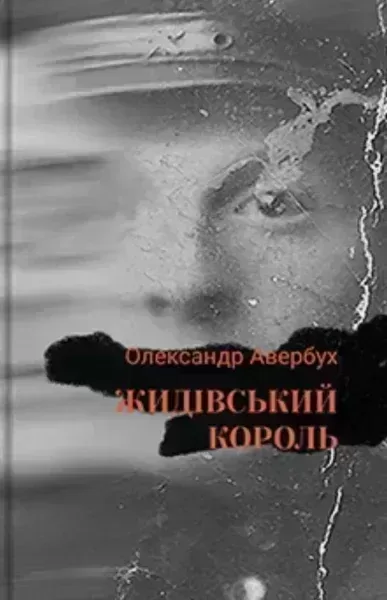
Жидівський король
Олександр Авербух
Київ: Дух і літера, 2021
(Alex Averbuch, The Jewish King)
On poetry and pathos in a bastard tongue
When my great-grandmother lost her eyesight, a Ukrainian woman, Frosya, was hired to nurse her through her last stage of life. It was in the mid-1950s. Frosya was kerchiefed, shapely, tidy, meticulous, foul-tongued, blunt, brutally honest and illiterate. She could read fairy tales, struggling with each syllable, and sign her name.
Frosya took wonderful care of my great-grandmother, who matched her in peevishness, and treated the rest of the family haughtily, to be scolded and bossed around at her whim.
Twenty years after my great-grandmother’s death, I inherited Frosya as my own nanny. Our adoration was mutual. She pampered me senseless. « My little kike »1, she spoke of me fondly to her yard neighbours. The first word I ever wrote was « stsikukha », « pisser », this is how Nanny called me to my face. Even during my primary school years, Nanny loved feeding me borscht off the spoon, with a little blackmailing: « If you misbehave, I’ll tell everybody you still eat like a baby. » I, in response, loved to say, « I spit at God », knowing she was religious. Nanny Frosya influenced me more than anyone else did, definitely more than my Jewish intelligentsia parents would have wished. I still see her in my dreams, alive.
Little was known of Nanny Frosya’s life before her employment with my family. We knew she hailed from a village, was a spinster, had no friends, lived in a communal flat shared with a messy Russian family whom she hated (« the katsaps », she called them, a Ukrainian slur for Russians). Only after the demise of the Soviet Union did I unravel, interpreting her sparse comments, the horrible truth of Frosya’s family’s « de-collectivisation », their survival during the Holodomor, the execution of her parents; and, finally, her joining the army of the proletariat in the next big city, my native Zaporizzhia (the sadly now world-famous atomic power station is 40km away from the actual city, which has been regularly shelled, yet remains free and under Ukrainian command at the time of writing): a failed and stinky industrial giant on the huge, opulent Dnipro River, tamed by Stalin’s megalomaniac Dnipro Dam in 1932, paid for by the wheat confiscated from the Ukrainian peasants.

« Zaporizzhia had
long outlived its
Stalin-time glory… »
SVETLANA LAVOCHKINA
From Zap
A night and a day away from Moscow by a green express, a day and a night away from the Black Sea by a slow passenger train, Zaporizzhia inextricably seesawed between the south and the north. From Moscow came the southbound wheels of Morse-coded news and fashion, and tidings of Red Square […]. From Odesa, the slow sleepers of the south brought sand on passengers’ feet, and the custard sweat of a short extramarital romance.
Zaporizzhia had long outlived its Stalin-time glory, when the famous, megalomaniacal Dnieper Dam construction was making all-Eurasian, all-American news headlines, […] and American Hugh Cooper, the best engineer of dams in the world, outshone his Dnieper fame by building the Hoover Dam. For forty kilometers, the scruffy rococo doddered along Lenin Avenue […] By day, rainbows of smoke rose up to the sky. One of the Dnipro’s tributaries flowing across the city assumed red color, tube-fed by Coke-Abrasive waste. Their shifts finished after sunset, the workers picnicked on Red Rivulet’s banks. In no hurry to go home, they beheld moonshine permeate the evening sky and their livers.
Svetlana Lavochkina, Zap (Vermont: Whisk(e)y Tit, 2017)
At the time of my childhood and adolescence, the smallest, ugliest and stinkiest car in the world, « Zaporozhets », was produced there — in the four years of owning one, before selling it at half-price and with relief, my father spent much more time under it than inside at the steering wheel. A lot of writers hail from this stolid province of the Soviet galaxy, and our native red, white or black dwarfs of home cities and towns never fail, in their slow smoulder, to kick-start us (no less efficiently than the supergiant stars of NYC or Paris), pumping us full with fuel for writing.
If home towns provide writers’ fuel, then whom do we most often take in the passengers’ seats on our first reckless rides? Of course, our dear near ones — only ever so slightly made up. Nanny Frosya was sure to curse her mouth off to the right of my (very loving) gear-shifting hand while I was writing one of my first short stories, with her as a protagonist: « You stsikukha, what kind of bullshit didst thou write about me in your stupid tale? Get off me and close the lid of my coffin! » And I did, for there were many other lids to lift, and with a less loving hand.2
Little did I know that, in another decade, my beloved Nanny Frosya was to be exhumed again, albeit neither in my dreams nor in my scribblings. Some months ago, a poet and literary scholar approached me, touting copious credentials, with a request to review his book. I knew his name from my Facebook friend list and knew we had mutual literary connections but we’d never met. With no literary criticism in my credentials and little time on my hands, I demurred. Yet I was so intrigued by the title that I asked him to send his manuscript along. Thus I met Alex Averbuch and read his poetry collection in Ukrainian, Жидівський король (working title in English: « The Jewish King »).
The book appeared to be a trilogy. Part One and Part Three consist of modernist-style confessional poetry — reflections on the poet’s genetic and spiritual identity — and Part Two is non-fiction in epistolary form. The letters were made of materials provided by his work in the archives, tracing the fates of the Ukrainian Ostarbeiter of World War II — peasants forcibly deported to work at German farms. He had been reading their letters, written from Germany back to their families. Many of these letters never reached their addressees for the simple and horrible reason of the latter’s violent deaths — by German firing squads and gallows, or by starvation. Averbuch confessed in an interview that those letters had been keeping him in such an anguished, obsessive grip, that he could not stop reading them (thousands of them) and felt the urgency of giving the letters a new incarnation in literature, stylizing them into poems, preserving, at the same time, the way they were written.
Thus Nanny Frosya re-appeared, but this time raised to the power of a thousand. A Frosya of a similar, yet much more tragic fate. A Frosya speaking in her polyphonic surzhyk, an intricate hybrid of Ukrainian and Russian, akin to Kipling’s armadillo. 3The term « Surzhyk » says nothing to a foreign reader, yet it plays a pivotal role in « The Jewish King » and is an important phenomenon in Ukrainian society, so it requires some explanation.
For centuries, Russia has been trying to swallow Ukraine, both geopolitically and culturally, specializing in the linguicide of Ukrainian by the governmental banning of its use and the murdering of its prominent literati speakers. « But we are one people, there is no such thing as the Ukrainian language, » the Russian adage has been. « It’s just a dialect of Russian, weird and funny at best, but, to be frank, outright vulgar and rude: a distortion of the literary norm, a dialect incapable of expressing serious thought. » It is with this adage — I imagine it written in the shape of a « Z », and perched invisibly but almost palpably over the « Z » that adorns Russian tanks, thus completing the full swastika — that Russia burst into Ukraine on February 24 this year.
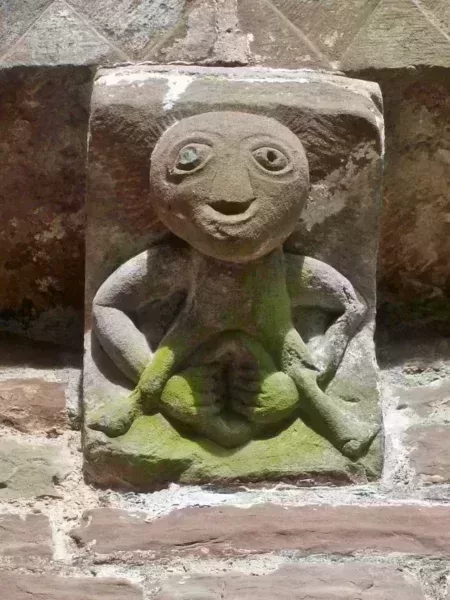
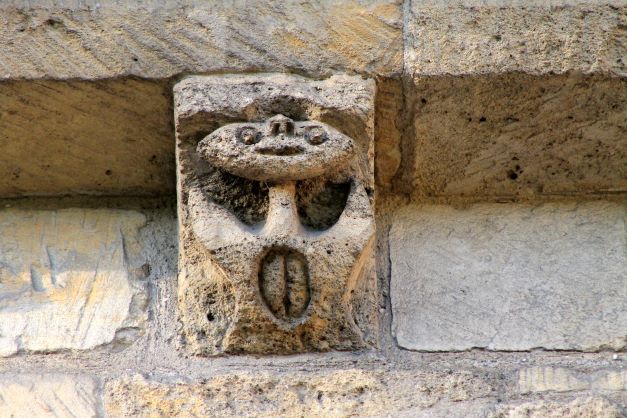
Two Sheela na Gigs
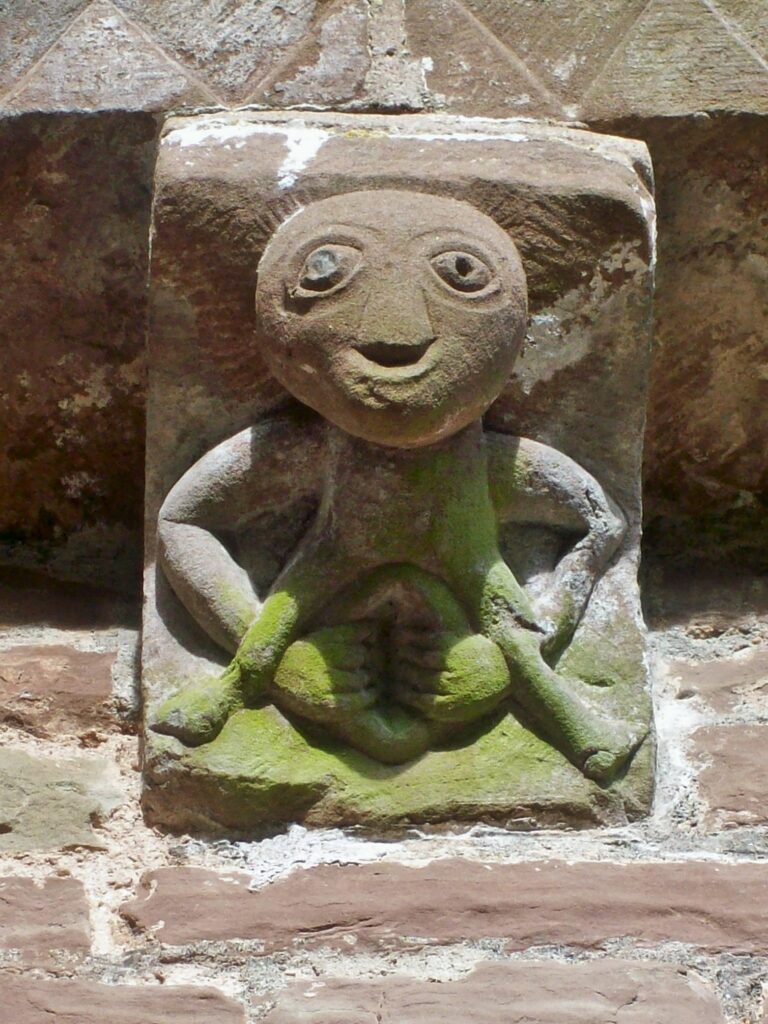
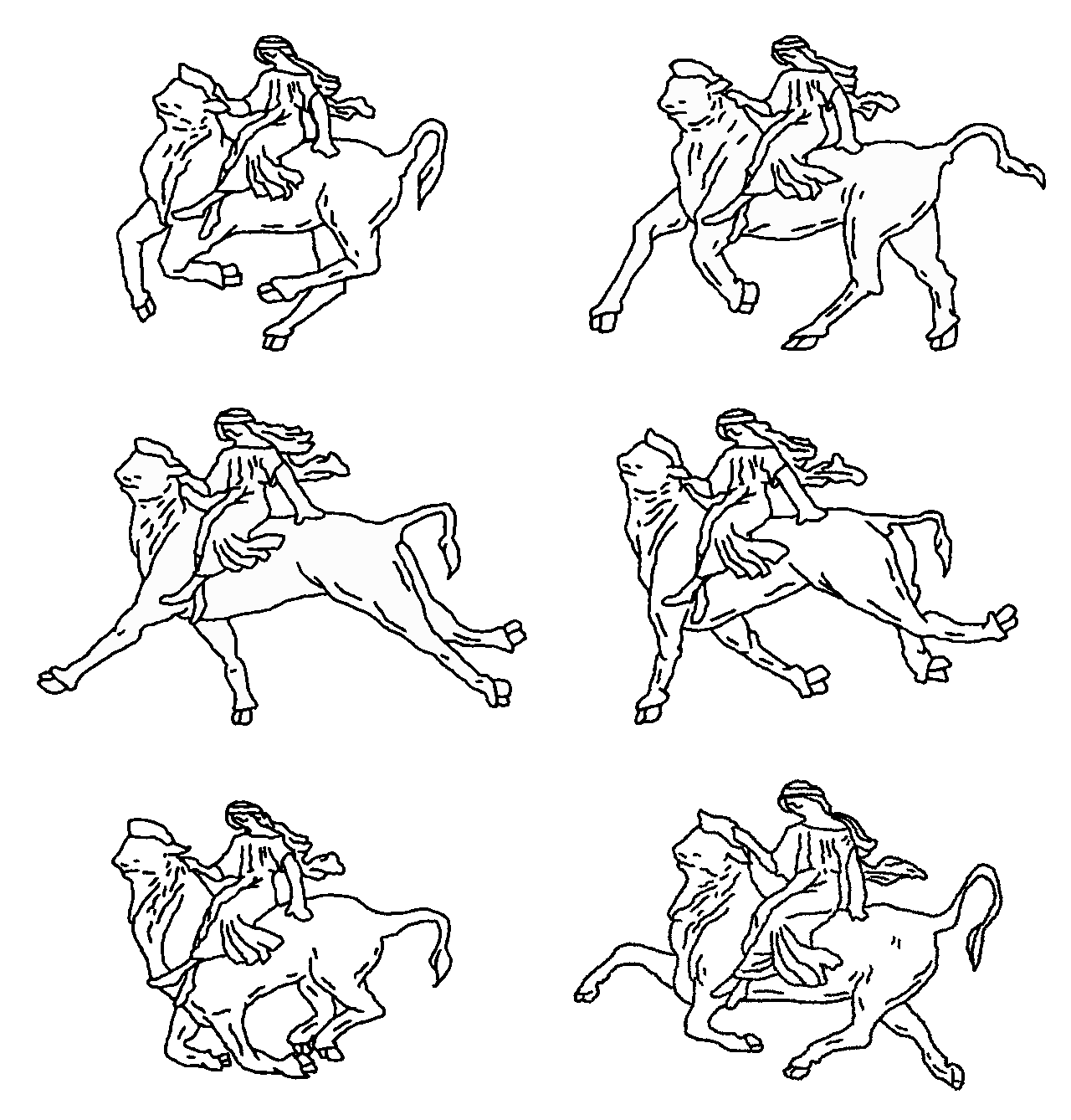
Sheela na Gigs — Slavic and Irish goddesses of fertility — are architectural grotesques of naked women extravagantly showcasing their enormous vulvas. They are found throughout Europe on churches, cathedrals and castles. Most of the remaining Sheelas today are found in Ireland, Great Britain, France and Spain.
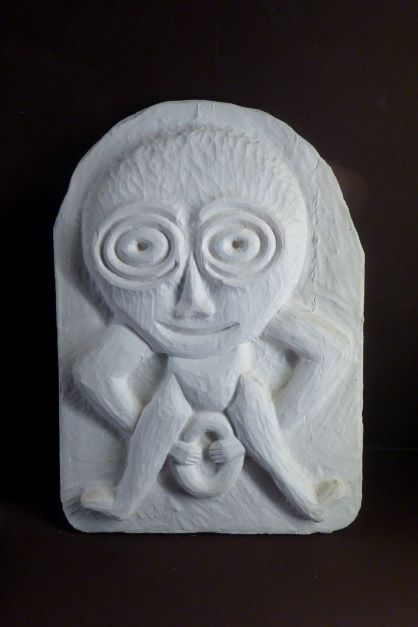
Over centuries, linguistic violence tracked physical violence, but with unpredictable byproducts. Ukrainian vocabulary was massacred but the meat of Russian word roots got into the mincer of the vertiginous Ukrainian morphology, grammar, syntax and spelling. 4Linguistic rape tracked physical rape. Mokosha, the Ukrainian incarnation of Sheela na Gig, opened its fertile depths for the Russian alkali rapist, sucked it in and munched and munched, until the Russian words became polished like bottle shards by the acid tide to smooth opaqueness. This was how surzhyk came into being.
The most famous word of this bastard tribe, and the most comprehensible for the non-speaker of either language, is the pronoun шо, or « what ». It’s the informal way of responding to someone addressing you in a conversation, or an expression of astonishment, disgust, ironic disbelief. In Ukrainian, the word is що (shchó), in Russian, что (shto). The « t » shard of the « shto » is polished into a smooth hiss. This word furnished the title for one of the most influential literary magazines in Ukraine, founded in 1995 and edited by poet and essayist Alexandr Kabanov, publishing both Ukrainian and Russian-language literature of Ukraine. 5It needn’t be said that despite all attempts at eradication, Ukrainian has survived and is flourishing. The ongoing wars only catalyze Ukrainian art and literature.
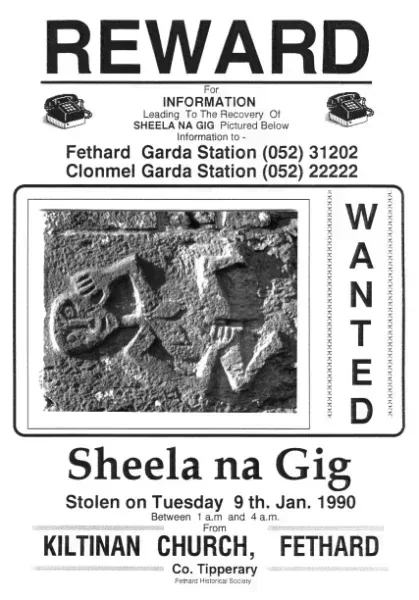
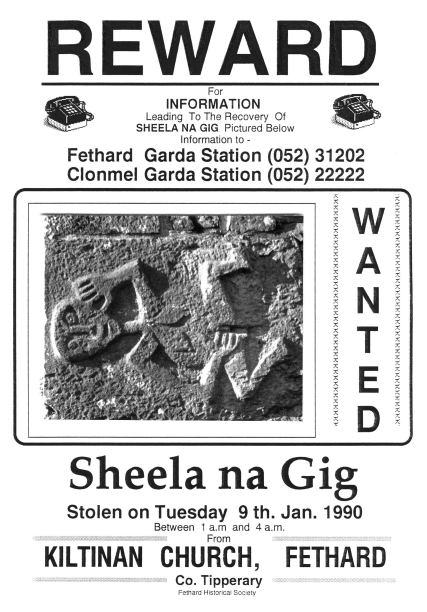
REWARD: Sheela na
Gig, stolen on
Tuesday 9th. Jan
1990
More Sheela na Gigs
« Mokosha, the Ukrainian incarnation of Sheela na Gig, opened its fertile depths for the Russian alkali rapist, sucked it in and munched and munched, until the Russian words became polished like bottle shards by the acid tide to smooth opaqueness. This was how surzhyk came into being. »
Circular letters from hell to hell
In the letters of the Ukrainian Ostarbeiter, my Frosya was speaking to me, in her inimitable idiomatic diction and peasant nitty-gritty mindset. She was now also named Fedir, Nastya, Dunya, Anna, Sofia. Circular letters from hell to hell; from exile and deportation to occupation. I could envision the labored handwriting: unburdened by formal spelling, like their martyr souls.
Those deported Ukrainians’ letters are sandwiched, in the book, between two hard slices of bread: the poet’s own split alter ego. And in this, I recognized… myself — the self I could have been born, but by the whim of destiny wasn’t. Averbuch’s and my geolinguistic patterns are somewhat similar: expats, both actively quadrilingual, Ukrainian-English-Russian, his « quattro » being Hebrew (he spent fifteen formative years in Israel), and mine German. We were both born in Eastern Ukraine, the habitat of surzhyk, his longitude being a little « easternmore », in a village in the Luhansk Region, devoured by Russia in 2014.
But there is a significant difference. When growing up in the Soviet Union, I was acutely aware of my « pure » genetic Jewishness, which afforded me a serene aloofness from the Slavic realm, Ukraine being, for me, a random geographical and linguistic motherland. This is me, that is them. But Averbuch’s DNA is a cacophonous tangle, further cauterized by the joint burden of each lineage’s genocidal tragedy, victimhood and perpetratorhood. So this was why he wrote this book: a duel of his ethnic components and ever-repeating layers of our country’s history.
я пробачив собі
прадіда-українця що ходив погромом на прадіда-єврея
пробачив прабабу-польку яка рвала коси прабабі-єврейці
я пробачив собі прадіда-москаля який забрав
останній шматок у прабаби-українки
я пробачив прабабу-єврейку що написала донос
на прадіда українця
I forgave myself for
my Ukrainian great-grandfather who joined a pogrom
against my Jewish great-grandfather
I forgave my Polish great-grandmother
who tore at the braids of my Jewish great-grandmother
I forgave myself for my moskal great-grandfather
who took the last bit of food from my Ukrainian great-grandmother
I forgave my Jewish great-grandmother
who informed on my Ukrainian great-grandfather […]6
I was glad to learn that Averbuch’s collection is forthcoming in the English language with Lost Horse Press, a US-based publisher that curates a unique series of contemporary Ukrainian poetry (and which previously published my own verse novel, Carbon). It appeared, to my delight, that Oksana Maksymchuk and Max Rosochinsky are the translators of Averbuch’s volume because, on several occasions, I was fortunate to collaborate with Oksana and Max, and witness their wizardry at work.
Maksymchuk and Rosochinsky specialize in amplifying the voices of poets facing enormous historical challenges. Maksymchuk shared with me these reflections on her collaborative, dialogical approach to translation process:
Our translation philosophy focuses on making the poet’s voice comprehensible to readers from a very different linguistic, cultural, and educational background. We try to make the translations work as autonomous self-standing poems in the English language. We treat poems as complete organic units of meaning that need to be transplanted into the new medium. Sometimes we depart from the propositional content of a poem to make its meaning clearer or to emphasize the impulse or insight that it attempts to capture. At other times, we also choose to alter an original’s punctuation, capitalization, line breaks, and stanza breaks in order to convey the intention behind different authorial decisions. In all such cases, we try to discuss our proposed changes with the author and work out a hermeneutically compelling solution that enhances the poem.
In working with Averbuch in particular, one example of such a negotiation, Maksymchuk told me, concerned the title itself:
The literal translation of the Ukrainian-language title Zhydivskyj Korol may be rendered, as mentioned above, « The Jewish King », and this was the version favoured by the author. By contrast, we felt that this rendition was not sufficiently dynamic. To us, the « zhydivskyj korol » of the Ukrainian felt playful, like a name of a game, a quest, perhaps, whereby the player had to prove themselves worthy of the title. Because the term « zhyd » had been frequently used as a racial slur in Ukrainian and Russian, we considered rendering the title as « The Kike King » but sensed that it came off as not only too forceful, but also problematic without sufficient contextualization. Ultimately, we ended up choosing « The Jewish Prince » for rendering the original Ukrainian title. The choice, while still accurate and descriptive, helped bring out the uncertainty and vulnerability of the poetic voice, emphasizing the self-irony and levity involved in negotiating multiple conflicting identities and adopting different cultural perspectives.
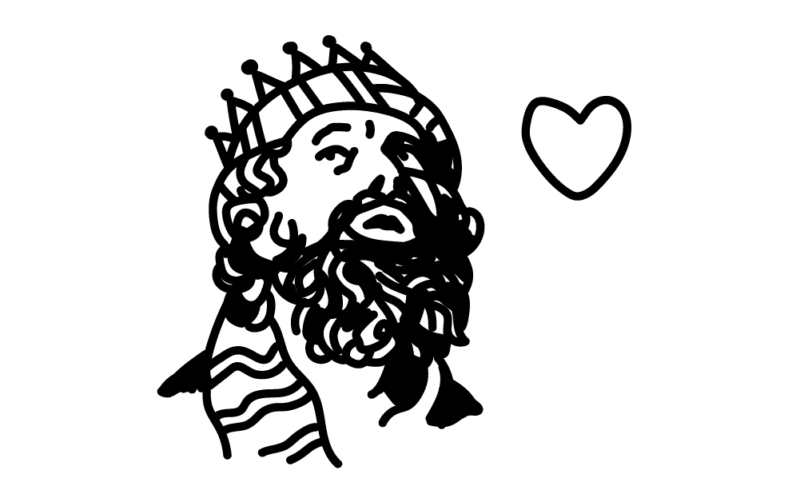
One of the first poems from the cycle that Oksana and Max translated was a coming-of-age story focused on the poet’s grandmothers’ overbearing yet doting treatment of their grandchild:
you’re my puppy, my little chick
my Jewish prince
let thy kingdom come at last.
This rhymed with representations of the American cultural phenomenon of the « Jewish Princess », denoting a beloved child both tormented and spoiled rotten by her family’s passionate and demanding devotion. (I failed to mention before that my family spoiled and overprotected me, too, although not in Frosya’s coarse and unadulterated way, and I would have definitely been called « Jewish Princess », had I grown up in Brooklyn or Queens.) While « Jewish Princes » are a less common phenomenon, the translators felt the direction of the allusion appropriate, as Averbuch often challenges the rigidity of identity, whether national, rational, or sexual. Since the title comes last, the negotiation is frozen for the moment, to be defrosted shortly before the publication deadline.
The English version of « The Jewish Prince » is still in gestation, and the middle section with the Ostarbeiter letters has not been translated yet. But as people of letters are curious cats, failing, at times, to mind their own business, I couldn’t help dallying with the surzhyk sequences of the volume myself (not that Oksana and Max minded much).
I kiss you all hard my dearsweet sisters
I thankyou that you dont forget me
I got your parcels
3 with shortbred kekses and one
with lard and in one parcel a letter
but enother two parcels with lard i gotta not
you are miffed cos u think
i dont write you leters and kards
but i write i write both leters and kards
and diskribe all my life to you
and why you dont get ’em i hav no clu
my dearsweet sisters
дуже я вам дякую ищо ви мене
незабуваете мойі рідненькі сестрички
я ваши посилкі получила
три із коржиками і одну
ізсалом і уодній посильці пісмо
а двох ізсалом неполучила ви
намене обіжаетесь ищо я вам
непишу пісьом і одкриток
і непишу як я живу я вам пишу
і пісьма і откриткі і усьу свою жизь
описую а чого ви не получаете то я
незнаю мойі рідненькі сестрички
« the Ukrainian
mova, the mauve
bride, its heels an
ever receding tip-
tap »
SVETLANA LAVOCHKINA
from Crashattic
Any linguist will tell you that Ukrainian and Russian are as different as Italian and Spanish, or as German and Dutch, with Ukrainian being grammatically even the more complex of the two. A torture despite best textbooks and titled tutors, it won’t yield to you in its wayward beauty, the Ukrainian mova (language), the mauve bride, its heels an ever receding tip-tap: mama, mamy, mami, mamu, mamouyu, na mami — six cases and a vocative — oh mamo, how your gray matter boils. Vertiginous declination of its neck in prefix beads and suffix lace of its petticoat keep you starving awake for many nights until it straddles you for a fleeting moment only to leave you with an aching imperative and broken syntax.
Svetlana Lavochkina, Crashattic (Las Vegas: Witness, 2010)
To recreate all the linguistic chemical reactions between Ukrainian and Russian, an Anglophone cauldron would be neither an option nor necessity, since Slavic languages are synthetical and English is analytical. Their morphology and syntax work on different principles. Synthetical Slavic relies heavily on prefixes, suffixes and inflections to impart the meaning of utterances, while analytical English makes use of prepositions as the glue for parts of the sentence, and the morphology is much simpler. What matters for the reader is the exact visual-emotional impression on a Ukrainophone or Russophone reader, so here I opted for a fusion like « dearsweet sisters » to convey the diminutive affectionate suffix at the end of the « dear » in the original. (Something like « darling », but « darling » wouldn’t work since it is a usual « non-hybrid » way of affectionately addressing your loved ones.) « Kekses » is an attempt at showing a foreign word in an English-language context, coming from the roughly-familial German and recognizable. (The exact translation would be « shortbreads ».) Ellipsis works to render the letters’ informal tone. And showing the flawed Ukrainian spelling in the guise of mistakes you’d typically see in English-language primary school exercise-books is an obvious and easy choice. Oksana and Max might come up with different solutions, and it will be our thrill to compare the results.
Human children and language children are born, equally and indifferently, from love and from rape, and equally loved or neglected, whatever the mode of conception. Acid and alkali react to form salt, harmless and reconciled — the cathartic salt of tears. « The Jewish/Kike King/Prince », whatever the final title and whatever languages the book is destined to inhabit in the future, will be seen by the international reader as an exercise in genetic and historical stoicism, of poetic invincibility — with a crown of alchemic gold as a result. And in me, Alex Averbuch solidified Nanny Frosya, the Jewish Princess and the « little kike », ultimately and irrevocably, into an imperious, foul-tongued, freely-spelled alloy.
- What Nanny Frosya said verbatim was « moya malen’ka zhydovka ». « Zhyd » (« жид ») is an insulting pejorative of « Jew »; « zhydovka » (« жидовка ») is a feminitive. Amusingly, in Polish, « zhyd » is quite a formal word for « Jew » — no mean connotation at all. The formal register for « Jew » in Ukrainian is « yevréy » (« єврей »), « yevreyka » (« єврейка ») for a feminitive. Here, I resorted to an Americanism — « kike » — as an eternal translator’s asymptote. ↩︎
- My first novel, Zap, is a Jewish family saga exploiting many of my relatives’ personalities. ↩︎
- In Kipling’s Just So Stories, a hedgehog and a tortoise want to confuse a little tiger to avoid being eaten. The hedgehog learns to swim, the tortoise learns to curl up, so the tiger can’t tell them apart anymore, and their bodies change, « meeting in the middle », finally to assume full resemblance to each other. This is « how armadillos came to be ». ↩︎
- Examples would look bleak and incomprehensible for a non-speaker ↩︎
- ШО had to close during the war in 2022, due to financial difficulties. ↩︎
- A fragment from the first cycle: full quoting would disqualify the poem from future magazine publications. ↩︎