

Eadweard Muybridge’s moving pictures,
Ambrogio Lorenzetti’s moving sounds
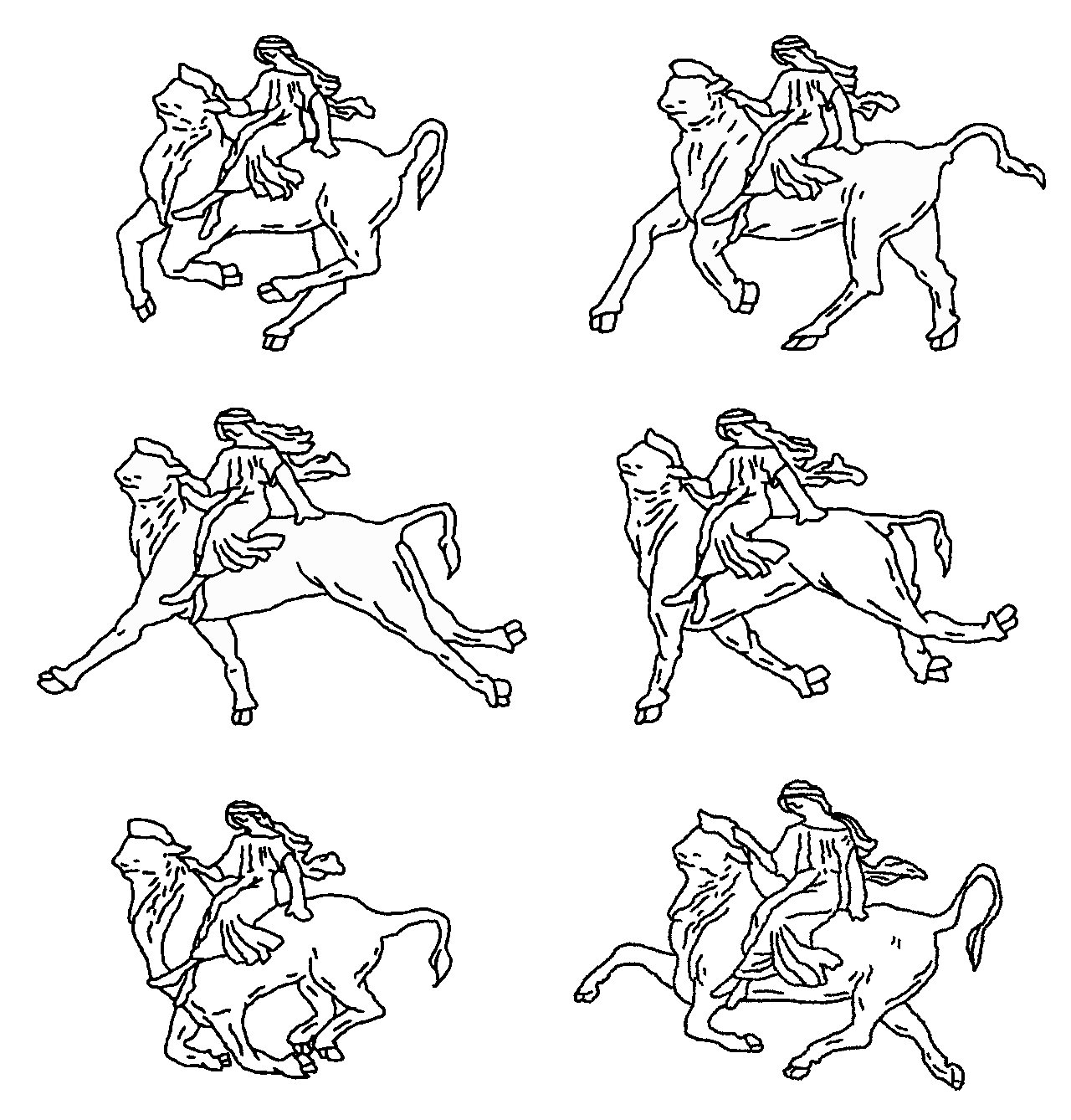
When horses trot, do all four hooves leave the ground at the same time? The question spurred a debate in the 1870s among American railroad magnates — a group preoccupied with motion, distance, horses, iron and otherwise. By the time the pioneering photographer Eadweard Muybridge published his aptly titled photo series Animal Locomotion in 1887, he had borrowed a racehorse from railroader Leland Stanford in Palo Alto, California, to settle the debate. Muybridge arranged a series of cameras at intervals in a row, with each camera connected to a wire stretching across the horse’s path. As the horse trotted, tripping the wires one by one, the corresponding camera took a photograph. Muybridge developed the photos and lined them up: motion at such speed had never before been visible to the human eye. The photographs revealed that a horse in trot did indeed have all four hooves off the ground, but only when directly under the horse’s body. It’s said the French equine painter Jean-Louis-Ernest Meissonier wept with astonishment and disappointment when he saw Muybridge’s miraculous pictures. Like most artists, Meissonier had been painting horses’ four legs stretched out before and behind them mid-trot or gallop, as if in flight. Muybridge’s later invention, the zoopraxiscope, displayed a series of images rapidly enough to animate a horse’s movement, as a form of photographic cinema. He projected these first motion pictures onto walls in San Francisco.

You’re reading this essay for free. With a membership, you can read the full magazine, and you get access to our fabulous Library.
Become a member and get Issue Ten in print as your first magazine, right to your postbox.
Motion at such speed had
never before been visible to
the human eye.
I was reminded recently of Muybridge’s moving pictures while looking at another artist’s serial attempts at rendering the invisible visible. During the last decade of his life, Ambrogio Lorenzetti (d. 1348/49) made at least three different pictures of the Annunciation — the archangel Gabriel’s announcement to the Virgin Mary that she would bear the son of God. The largest of these, two panels constituting a single preparatory drawing in the reddish-brown earthen pigment sinopia, took up an entire wall of the exhibition « Siena: The Rise of Painting, 1300–1350 » at the Metropolitan Museum of Art in New York in late 2024. (The show traveled to London’s National Gallery in 2025.) In 1966, both the preparatory drawing by Ambrogio and the finished fresco painted over it were removed from their chapel wall at the Cistercian monastery of San Galgano at Montesiepi, about thirty kilometers outside of Siena, for restoration. The Annunciation scene was only a small portion of the chapel’s decoration. It was covered with frescos by Ambrogio and his workshop. The sinopia under-drawing was a surprise to the twentieth-century restorers who first encountered it because of how different it was from the finished fresco. The Mary of the painted fresco receives Gabriel’s news standing near a column, with her face turning, and her body leaning, toward the angel. She crosses her hands beatifically over her chest. But the sinopia Mary from the preparatory drawing participates differently, even unwillingly, in the scene: her face is turned toward Gabriel, but her body is turned away. She’s holding tightly to the column, as if — at the shocking news — she supported herself with it, only to crumple alongside the column and collapse on the floor. The human fear, panic and distress that the Mary of Ambrogio’s drawing embodies is at once believable and, among depictions of the Annunciation (including others by Ambrogio), utterly original. In the end, it may have been too original for the chapel’s donor, who is depicted in the painted fresco and who, some art historians speculate, wanted no part of Mary’s all-too-human reaction.

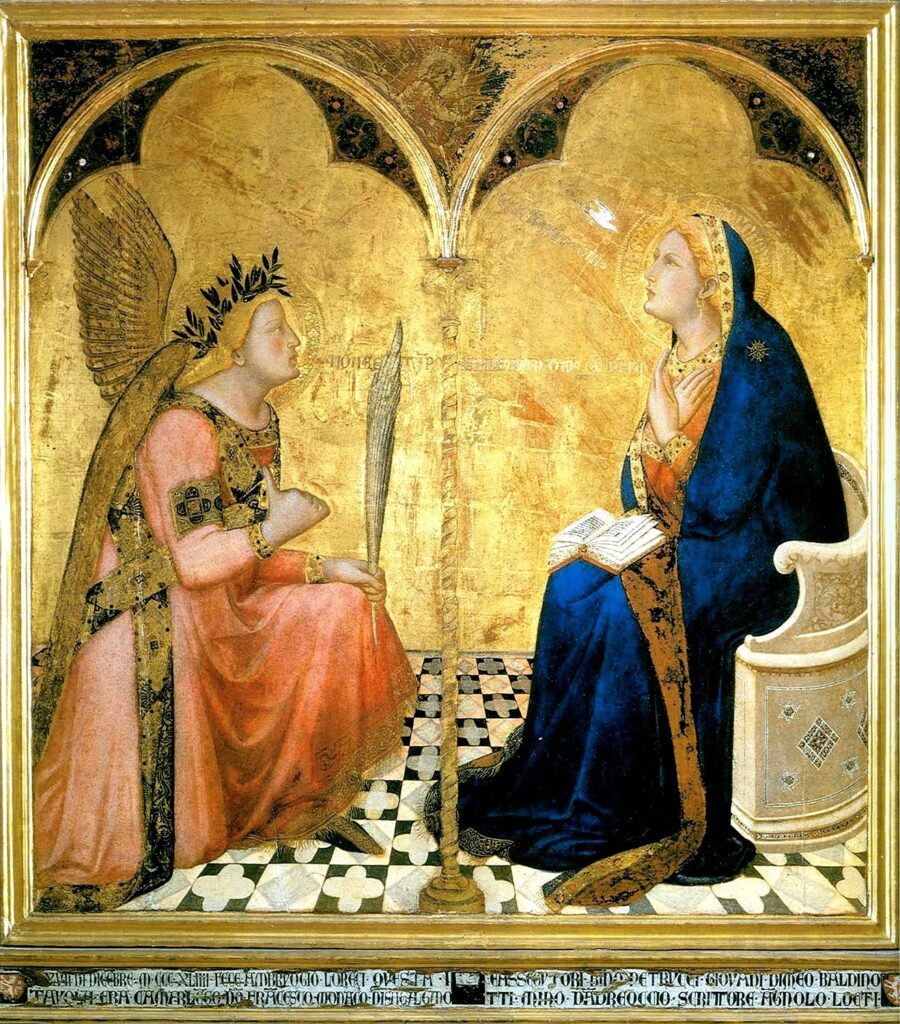
At the exhibition, Ambrogio’s later and more famous Annunciation from the Pinacoteca in Siena was juxtaposed with the sinopia drawing, positioned just to its right on the perpendicular wall. The Pinacoteca Mary is bookish, contemplative and beaming, her body seated facing the archangel kneeling before her. The initial impression of this pairing is of a serial artistic study of the Annunciation, and of Mary, in particular. But Stephan Wolohojian, the Met’s John Pope-Hennessy Curator in Charge of European Paintings and an expert in Sienese art, drew my tour-group’s attention to something else while we paused in front of the sinopia Annunciation. « Look », Wolohojian advised, « at how Mary’s ear is turned outward, against the picture plane. » Only then, with Wolohojian’s prompting, did I notice something else Ambrogio was attempting to capture in both images of the Annunciation: speech. In the Pinacoteca Annunciation, Gabriel’s words, literally golden, travel from his mouth, behind a twisty gold column, and into the heart of Mary. Gabriel’s words aren’t visually depicted in the sinopia Annunciation, but their impact the moment they reach Mary’s ear is. If Muybridge made pictures that capture movement at speed, Ambrogio, it seems, made pictures that capture speech as it moves. Does it fly through the air like Meissonier’s angelic beasts? And when it lands — whether in our ears or in our hearts — what do we feel?

Like the hooves of horses in the nineteenth century, sound’s invisible movement was a topic of debate in fourteenth-century Europe. Chaucer, in his dream-vision House of Fame, expressed one line of current thinking on the matter: « Soun ys nought but eyr ybroken » (Sound is nothing but broken air); thus, « ryght so breketh it when men speketh » (in the same way, men break the air when they speak). Each word, Chaucer theorizes, moves air, and that air propagates successive motion, like ripples on water. House of Fame owes something to Dante, the Florentine poet whose work Ambrogio probably knew. In Purgatorio X, the pilgrim Dante witnesses a scene of the Annunciation carved into white marble with the angel speaking. His speech is described as more lifelike than if made by Nature herself. The pilgrim realizes this is because God « produsse esto visibile parlare, / novello a noi » (Was the creator of this visible speech / novel to us [on earth]). Dante may have imagined the first talking picture, but it was Ambrogio who experimented with how to represent speech in flight. Together his sinopia Annunciation and Pinacoteca Annunciation give us two images of flying speech. Neither is better than the other, but while in the later Pinacoteca Annunciation the angel’s speech is transliterated into Latin and gold, in the sinopia Annunciation, invisible angelic speech is conjured by the viewer’s belief in it. There, Ambrogio’s art makes us believe in the presence of speech through his depiction not of speech itself, but of its visible effect. Gabriel’s speech must be rippling out from the angel’s lips to Mary’s ear because its sound presses her body to the ground with the force of something closer to an ocean wave, the kind Muybridge would have known from living along California’s Pacific Coast.
A loose definition of faith is the belief in things unseen. Artists ask us all the time to approximate faith, to suspend our disbelief. Ambrogio, like Muybridge, experimented with how to make the invisible evident.

You’re reading this essay for free. With a membership, you can read the full magazine, and you get access to our fabulous Library.
Become a member and get Issue Ten in print as your first magazine, right to your postbox.
