
USHA
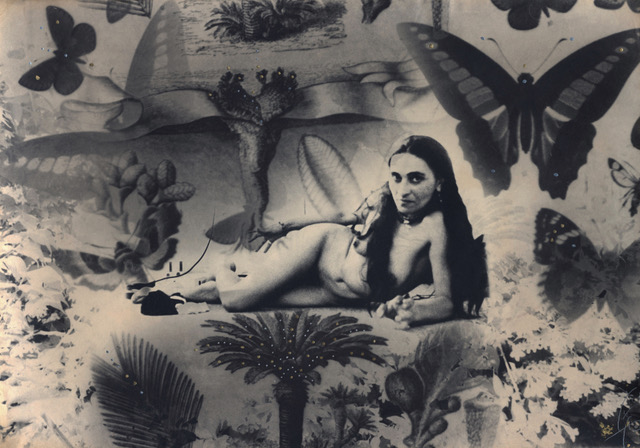
Walk into a gallery in Sofia these days, drop by a cultural talk, or simply scroll online, one name keeps appearing: USHA, « a woman in photography », as she calls herself. The portraits of Stanka Tsonkova, USHA, from the 1970s and 1980s and her experimental photographs from Berlin in the 1990s, once nearly lost, now feel prophetic: self-images made from survival. « For men, » she wrote, « photography is a way to express themselves; for me — to save myself. » Everyone is rediscovering her. At seventy-three, it’s her gaze that young photographers are trying to borrow or perhaps be seen by. Her photographs, haunting, sensual, and defiant, form a dialogue between body and earth, life and death, visibility and disappearance. In one, she lies covered in cracked soil; in another,
she floats in a sea of butterflies and darkness; and in a third, she stages her own wedding — to herself. Together they feel like an alchemical ritual, a result of a process she describes as being in photography, not through it. Working with expired Soviet photo papers whose chemistry can no longer be controlled, she recombines negatives, light, and chance until the image seems to breathe on its own. When I call her a dissident, a feminist, a trailblazer, she laughs. « You disagree? » I ask. « These are not my words, » she says. « They are yours. » And that is her gift: you make of her what you will — which is why a new generation keeps finding her. Her work turns the gaze inward, away from spectacle, toward what survives in us.