

pxl

Queen of the night

Maria Theresa’s « Enlightenment »
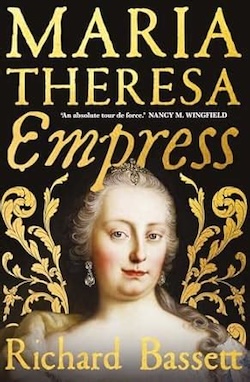
Maria Theresa, Empress: The Making of the Austrian Enlightenment

Richard Bassett

(Yale University Press, 2025)
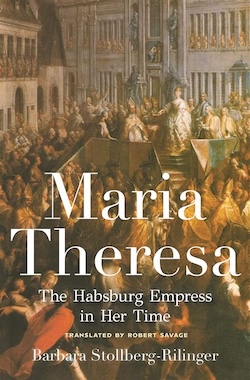
Maria Theresa: The Habsburg Empress in Her Time

Barbara Stollberg-Rilinger

Translated by Robert Savage (Princeton University Press, 2022)

In 1777, Vienna became Europe’s most literally enlightened city by introducing the first all-night street lighting system: 3500 hand-lit lanterns. We’re accustomed to placing « the Enlightenment », whatever that is, in Edinburgh or Paris. Vienna isn’t where we would usually look.

This was the Vienna of Maria Theresa of Austria. Born in 1717, she ruled the Habsburg crown-lands from 1740 until her death in 1780. From 1745, she also presided, de facto, over the Holy Roman Empire. She wielded enormous power over modern-day Austria, Bohemia, Slovenia, northern Italy, Belgium and parts of Germany. (The large Kingdom of Hungary stood slightly apart: it enjoyed significant autonomy while supplying the monarchy with natural resources and military recruits.) To these realms she would add, in 1772, swathes of what is now southern Poland and western Ukraine.
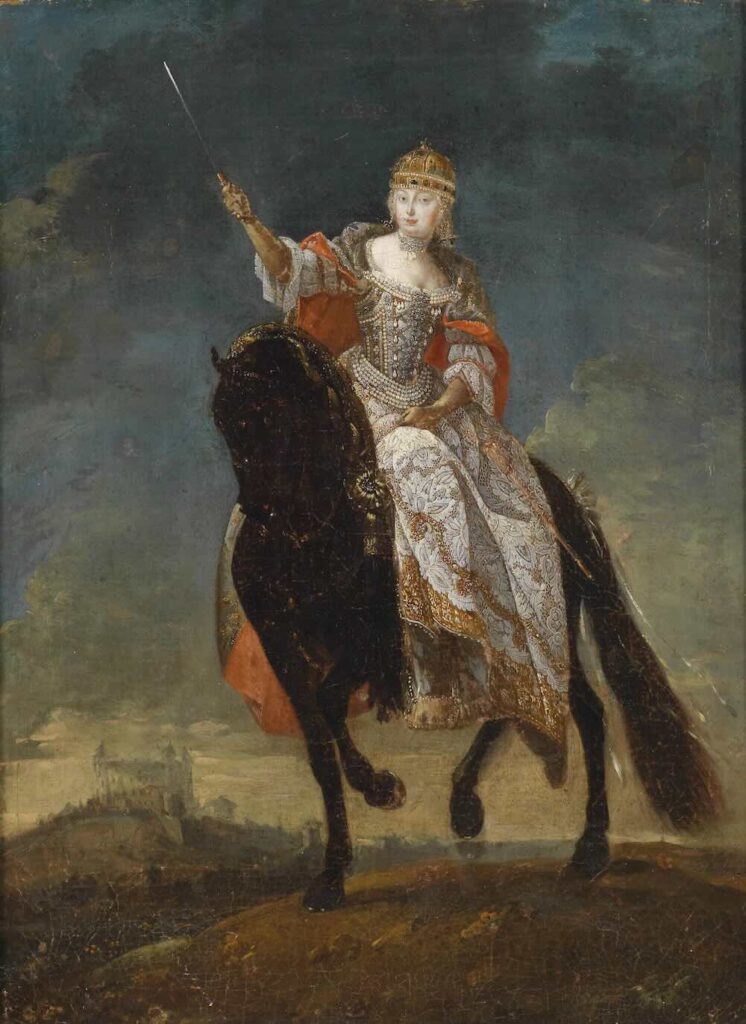
Maria Theresa as Madonna of Pressburg, c.1750
Maria Theresa as Madonna of Pressburg, c.1750 (Wikimedia)

A Habsburg monarch could assume many titles; Maria Theresa’s collection was made complicated by the fact of her gender. By legal fiction she was « King », not Queen, of Hungary and Bohemia, and it was as « King of Hungary » or « King of Bohemia » that she was referred to most frequently in diplomatic correspondence and legal documents. These were the titles she held in her own right. « Holy Roman Empress » was more convoluted: her father, Charles VI, Holy Roman Emperor until 1740, was succeeded by her (Wittelsbach) uncle-by-marriage, Charles VII of Bavaria. When he died in 1745, the title passed not to Maria Theresa (she was disqualified as a woman) but to her husband (and second cousin), Francis Stephen, whom she’d married in 1736. No one believed that he was anything but his wife’s cipher. Heir to the dispossessed ducal house of Lorraine, his family didn’t even have a castle to live in, let alone, say, an army to call on. On their double tomb, the couple are depicted jointly holding a sceptre, but Maria Theresa has the upper hand.
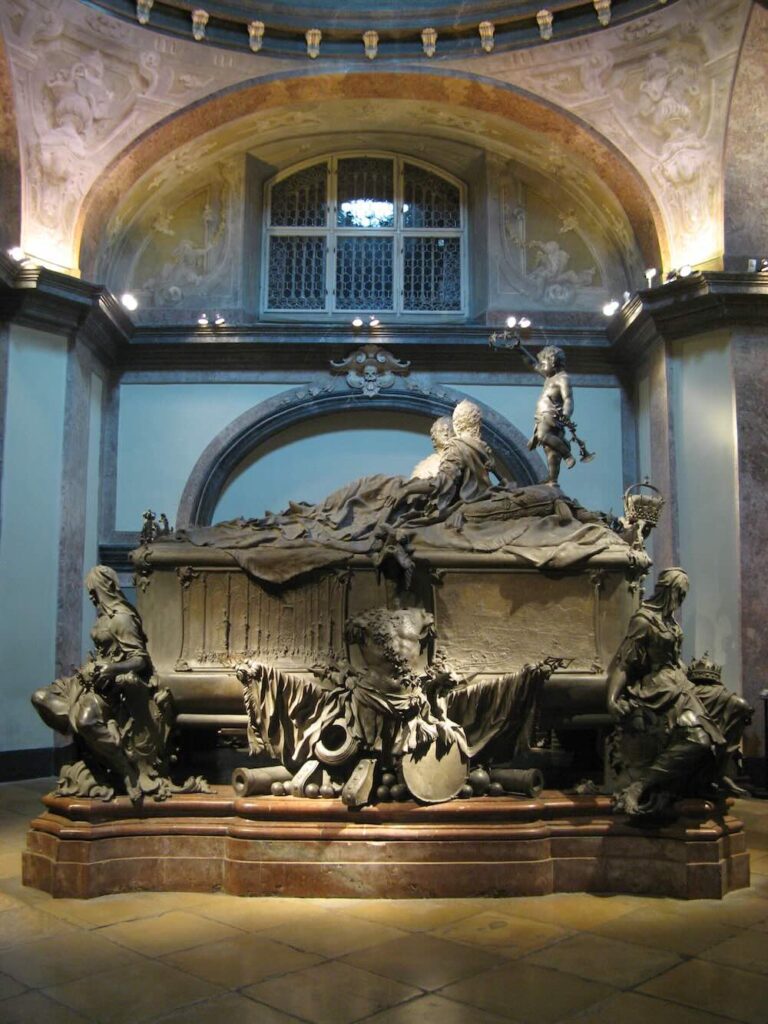
Maria Theresa and Francis Stephen’s tomb in the Crypt of the Capucins, Vienna
Maria Theresa and Francis Stephen’s tomb in the Crypt of the Capucins, Vienna (Olivier Bruchez, 2008, Wikimedia.)

But we are getting ahead of ourselves. Her coronation as queen/king of Hungary is a better place to start. On 25 June 1741, at Pressburg (the city’s German name; Pozsony is the Hungarian name; today it is Bratislava, the Slovak capital) she mounted a horse and galloped up Coronation Hill to slice the air at the points of the compass with a sword as a sign of her willingness to defend the kingdom against all comers. To her advisors’ horror — but to the crowd’s delight — she insisted on performing the ceremony while pregnant and on riding in a man’s saddle. (It was her third pregnancy. She gave birth sixteen times between 1737 and 1756; ten of her children survived to adulthood.) Artists then and now would obscure the scandal by depicting her riding side-saddle.

There followed an eight-year struggle now called the War of Austrian Succession (1740‑48). The unprecedented ascent of a woman to the Habsburg throne inspired Bavaria’s royal family to try and wrest the imperial title away from its centuries-old Habsburg custody and also to claim disputed territories. Maria Theresa would survive, with British help, but at the bitter cost of ceding to the Bavarians’ Prussian allies the realm of Silesia (then Czech, today Polish), which had hitherto been key to the monarchy’s finances. During the war, the Prussians, aided by the French and Saxons, seized large chunks of the Czech lands including, for a few months, Prague itself.

To ponder Maria Theresa’s reign (and her biographies) is to ponder the vast and never-ending question of what enlightenment was, or is. Further, and more particularly: to immerse oneself, from the vantage of today’s Hungary (where I work as a political journalist), in the arcana of Maria Theresa, is a curious experience. On one hand, I find myself tracing things in our own era « back », as it were, to Maria Theresa as paradoxical founder, or foundress. On the other, Habsburgiana lives on here in ways which are by turn charming and slightly sinister. 

You’re reading this essay for free. With a membership, you can read the full magazine, and you get access to our fabulous Library.

Become a member and get Issue Ten in print as your first magazine, right to your postbox.

Maria Theresa’s mark on European history was tectonic. Her reign saw the emergence, in part spurred by the strain of epic conflicts, of a modern administrative state: revolutionising government organisation, the economy, education, and public health. A secure state required an adequately sized and equipped standing army to defend it. Creating one was impossible without a healthy and numerous populace from which to recruit, and a dynamic economy to bear the costs. Having literally lost ground (Silesia) to her adversaries, Maria Theresa embraced the tool that had given those adversaries an advantage: cameralism. This was the new science of government including the sub-fields of public finance, orderly administration and economic planning. She didn’t study the subject herself but appointed advisors who had, and she created institutions dedicated to its teaching (for instance Vienna’s Theresianum boarding school in 1746).

Sovereignty and external defence implied internal consolidation, and Maria Theresa oversaw a radical change in the crown’s relationship with other centres of power (nobility, church and civic corporations). A large standing army in turn necessitated a centralised administration able to raise funds without waiting on the legal consent or administrative co-operation of a patchwork of territorial estates. After the setbacks of war, tax reform was a priority in the late 1740s and early 1750s. Maria Theresa convinced (or strong-armed) those estates to agree to the abolition of their own tax-raising powers (the abolition was tactfully termed a « suspension »). The nobility lost their exemption from personal income taxation, too, as well as their authority to dispense justice via manorial courts. Instead, there would now be universal taxation, with public administration and justice centralised in a professional civil service and judiciary.

If her burning zeal for reform was sparked by the narrowness of her reign’s survival in the War of Austrian Succession, it was enflamed yet further by defeat in the vast bundle of conflicts now known as the Seven Years’ War (1756‑63). Unlike in the War of Succession, Maria Theresa instigated her current of this larger war, in the hope of recovering the Habsburg territories lost to Prussia. This time she was allied with the French and Russians against the Prussians and British, a gambit engineered by her chief minister, Wenzel Anton von Kaunitz, the goal being to recover Silesia while also creating a sustainable balance of powers. The design would prove inadequate to either envisaged task, as the war spilled out via those and other complex alliances to become the first true « world war », claiming a million lives with battles on four continents, from India to North America. Maria Theresa’s Austrian army was defeated at Prague in 1757, a debacle widely blamed on confusion between the different organisations that were meant to ensure the army’s support in the field: on, that is, the duplications or even absurdities of the huge bureaucracy that her reign had inaugurated.

There followed, after 1763, another wave of reform. Postwar inter-imperial stability would be predicated in part on a warm peace with the Ottoman Empire: military rivalry gave way to friendly competition in the 1760s, thus neutralising a traditional threat. Maria Theresa was mastering, that is to say, the « chess game » of diplomacy. The most perfect illustration of this aspiration was displayed in 1769, when royal counsellor and amateur inventor Wolfgang von Kempelen unveiled his « Mechanical Turk »: a purported automaton apparently able to play chess with the empress and her ministers. It caused a sensation at court, though of course it was an illusion: the mechanism concealed a real person who pulled levers to move the « Turk »’s arms and hands.

The Mechanical Turk is a much-interpreted device; for our purposes, it suggests the extent to which diplomacy was thought capable of mechanisation, as indeed was government itself. Mechanistic ideas were applied first to the state’s internal organisation and later to its international relations. Maria Theresa’s reign evinces a post-Cartesian shift: away from an understanding of the state as a « body politic » (with different organs co-operating in shared endeavour), and toward an embrace of the state as a mechanism, a clock, with all activity subordinated to a single motive principle — the monarch guided by her expert advisors. She would achieve mon-archy (sole-rule) in the fullest sense of the term.

In 1766, a new unified civil law code for her non-Hungarian territories, the Codex Theresianus, revolutionised legal certainty. This in turn boosted trade, as did a customs union across most of the monarchy in 1775. In 1774, she introduced universal primary education for children in Austria and Bohemia, preceding France and The Netherlands by over a century. This required the vastly complex organisation of a new school network, a supply of qualified teachers and a system to maintain standards via inspections.

She also sought, in the 1770s, to end serfdom, though this effort was unrealised. It was frustrated by her son and co-regent Joseph (who, after his mother’s death, would reverse course and take credit for serfdom’s abolition). Maria Theresa did at least ameliorate serfdom via legislation for Bohemia in 1775, limiting the number of days of unpaid service that nobles could require of tenants. Later eras would occasionally look back to this as a mark of her liberality, even liberalism. But her employment of the language of rights and human dignity was merely tactical: what prompted her efforts was a fear of widespread popular unrest.

Late nineteenth-century print of Nadelburg (« Needle Fort »), Maria Theresa’s model work colony
Late nineteenth-century print of Nadelburg (« Needle Fort »), Maria Theresa’s model work colony (Wikimedia)

One site that captures these tensions across the decades of Maria-Theresa’s reign is Nadelburg (« Needle-Fort ») a model work-colony founded in the late 1740s at Lichtenwörth, Lower Austria, which Maria Theresa made an experiment in economic planning and social engineering in 1751. It combined hammer mill, workers’ settlement, manufactory and parish: a self-contained community, rigidly separated from the outside world. Half the workers were children, many of them orphans who worked unpaid. Inhabitants eked out a livelihood, competing for individual commissions at piece rates. Like serfs, they were forbidden from leaving without the administrator’s permission. Inmates (as Barbara Stollberg-Rilinger, Maria Theresa’s best biographer, notes) were « doubly disadvantaged: like serfs, they were personally unfree, and like wage earners, they were exposed to ruinous competitive pressures ». One wonders if, had the Nadelburg model been more successful (profits were marginal), the empress would have happily liberated her subjects from serfdom to the nobility, only to make them serfs of the state.

Maria Theresa certainly cast herself as « mother » to her lands, describing herself, on occasion, as « mother of the said dominions », and insisting that for the well-being of those dominions, she would have sacrificed the interests even of her own children, « had I been convinced in my conscience that … their welfare demanded it. » Her own canny navigation of queenly and kingly attributes stood in tension with the dynamics projected onto her. Voltaire was one founder of the inglorious tradition of hyper-feminising Maria Theresa. In 1755, he wrote an account of her successful appeal to the Hungarian nobles at Pressburg in September 1741. It was a low moment in the War of Succession, soon after her coronation. Maria Theresa spoke in urgent, but sober, Latin; Voltaire’s vernacular paraphrase garishly exaggerated the emotional colour of her speech, crafting an aura of feminine vulnerability. Further, he inserted an entirely invented detail: having Maria Theresa hold her newborn son Joseph in her arms as she declaimed, « I have no resource left but in your fidelity, your courage, and my constancy. » Maria Theresa’s search for refuge was made to evoke Mary and Joseph’s search for an inn in Luke’s Gospel. This fabricated motif endured: after 1755, the « Madonna of Pressburg » proliferated in paintings and prints, so much so that some people who had actually been there « recalled » the (entirely absent) prince being brought in by a nurse on a cushion.

Such imaging of Maria Theresa as mother took on the further weight of nationalism in the century after her death. An iconic canvas from 1868, by Alexander von Liezen-Mayer, made famous through mass print reproduction, shows Maria Theresa suckling the child of a beggar woman too malnourished to produce milk, whom she supposedly encountered while walking in the gardens of Schönbrunn Palace just outside Vienna. This too is a fantasy: von Liezen-Mayer depicts her according to the conventions of the Maria Lactans (Mary suckling Jesus), but Maria Theresa never suckled her own children, let alone anyone else’s. The depiction boosted the posthumous myth of the empress’s radical accessibility: providing succour to her people linked her biologically with her nation — or, depending on one’s perspective, her nations, plural.

Maria Theresa suckling the beggar’s infant, after a painting by Alexander von Liezen-Mayer (1868)
Maria Theresa suckling the beggar’s infant, after a painting by Alexander von Liezen-Mayer, 1868 (Public domain)

Maria Theresa’s femininity, moulded and magnified, served various functions. In the nineteenth century, she could represent bourgeois female domesticity in its most fashionable form. Later, and into the twentieth century, her femininity would be a key element in constructions of a grander German national identity: Maria Theresa and Frederick II became the balancing historical icons of German identity, at once distinguishing and connecting Austria (« feminine », the « Catholic south ») and Prussia (« masculine », the « Protestant north »).

Despite her importance to European (and wider) history, however, Maria Theresa has been somewhat neglected by modern biographers. The Austrian historian Alfred Ritter von Arneth’s massive Geschichte Maria Theresia’s was published in ten volumes between 1863 and 1879, a project begun in the Austrian Empire and completed after the creation of Austro-Hungary in 1867. That biography was succeeded in 1917 (the bicentenary of Maria Theresa’s birth) by the Austrian historian Eugen Guglia’s Maria Theresia, ihr Leben und ihre Regierung, published in Munich during World War I — and, as fate would have it, a year before Austro-Hungary’s dissolution. English works worth mentioning include Edward Crankshaw’s biography Maria Theresa as well as the great Central Europe expert C.A. Macartney’s Maria Theresa and the House of Austria, both published in 1969.

The tercentenary of her birth, in 2017, provoked renewed interest: eight biographies appeared (in English, German and French), not to mention a dramatised TV mini-series co-sponsored by the national broadcasters of four Habsburg successor states: Austria, Czechia, Slovakia and Hungary. Participation of the latter three reflects a broader trend in her non-German former territories: recent years have seen a rekindling of sympathetic curiosity, suppressed under communism. Memorials have sprung up in Prague and also Trieste (2022). Leaders of the « Visegrád » states (Czechia, Hungary, Poland and Slovakia) sometimes pose below Maria Theresa’s portrait when they gather for conferences.

Barbara Stollberg-Rilinger’s Maria Theresia: Die Kaiserin in ihrer Zeit, published in German in 2017, towers over recent studies. (Most of what you have read so far in this essay is culled from it.) An English edition, Maria Theresa: The Habsburg Empress in Her Time, appeared in 2021. Over a thousand pages, this massive work of scholarship was greeted with universal acclaim. Maria Theresa emerges as a powerfully paradoxical figure within the Enlightenment: a markedly anti-Enlightenment character — religiously bigoted, suspicious of open inquiry — who nevertheless ushered in major progress due to pressing circumstance and deference to her advisors. Stollberg-Rilinger’s account distilled thirty years of academic work; any other biography of Maria Theresa stands inevitably in its shadow.

Richard Bassett’s new biography, Maria Theresa: Empress (published by Yale in February 2025) is subtitled, provocatively, The Making of the Austrian Enlightenment. Bassett, formerly the Vienna-based Central Europe correspondent of Britain’s The Times newspaper, presents his volume as a complement, not a challenge, to Stollberg-Rilinger’s « indispensable » book, pointing out that the earlier book’s scale and erudition render it « somewhat inaccessible » to general readers. As his subtitle hints, however, Bassett’s interpretation is different, seeking to read Maria Theresa within the Enlightenment, not against it.

One must qualify the word « Enlightenment » the moment it is uttered, and work through historians’ various disaggregations. The Anglo-American Enlightenment and the Central European one, as the historian of the Habsburg monarchy Martyn Rady has suggested, ran on distinct tracks:

In Britain and North America, the Enlightenment tended towards the extension of popular sovereignty, curbs on government and the enlargement of individual liberty. In Central Europe, the Enlightenment tended towards the reverse — towards regulation and the subjugation of the individual to the common good as the ruler understood it.1

Beyond that broad distinction, historians nowadays tend to hedge their bets, by talking about enlightenments plural: German-, British-, French- (or other); radical-, secular- and (even) religious. For Stollberg-Rilinger, judiciously, Enlightenment is considered and gauged primarily through comparison with north-German models like Prussia and Saxony.

Bassett, though locating Maria Theresa within the growing historical literature on Catholic Enlightenment, stakes a more pointed claim:

To the plethora of terms which have emerged in recent years concerning the Enlightenment — « radical Enlightenment », « secular Enlightenment », « Jewish Enlightenment », to name but a few — the reader will, I hope, having absorbed this study, tolerate the validity of a new, additional term: « Theresian Enlightenment ».

Bassett sees in Maria Theresa a « woman who personified not only the special relationship that exists within the Austrian psyche towards the female and the motherly », but also (in an infelicitous metaphor which von Liezen-Mayer would have admired) « the umbilical cord which links Austria to the rest of Europe. » The book amounts to a rescue mission of sorts, often lucid, though a rescue mission risks distortion and overreach.

You’re reading this essay for free. With a membership, you can read the full magazine, and you get access to our fabulous Library.

Become a member and get Issue Ten in print as your first magazine, right to your postbox.

Maria Theresa’s own deployment of the term enlightenment tended toward the sarcastic. In 1775 she complained in a letter to her daughter in Paris (the ill-starred Marie-Antoinette) about the « spirit of rebellion » that was « becoming commonplace ». It was, she wrote, « the consequence of our enlightened century. I have often lamented it. »2

If we think of Enlightenment as freedom of expression, newspapers and coffee houses (a key site of enlightened intellectual adventure elsewhere in Europe), then, well, Maria Theresa was not its champion. Stollberg-Rilinger points out that around 1750, when the rest of the Holy Roman Empire boasted 120 printed newspapers, the Habsburg lands had only two. (The Empire, excluding Habsburg possessions, then had a population of around 24,5 million, whereas Maria Theresa’s domain comprised 11,5 million.) Over her reign she showed little appetite to improve things and several times re-issued a decree forbidding the circulation of written papers in coffee houses. (She did allow Hungary its own newspaper, the Pressburger Zeitung from 1764, albeit in German. It was a marginal concession, mentioned by neither biographer.)

In 1767, she launched a campaign, via a written instruction to her Lord High Chamberlain, Anton Corfiz von Ulfeldt, « to put a stop to the widespread, extremely vexatious sin of freethinking and sacrilege so reprehensibly committed by those audacious enough to hold forth too freely. » Private libraries were to be purged of suspect books and army regiments purged of those inclined to read them.

Yet Maria Theresa’s court hosted learned debate and boasted internationally renowned scholars, even if her relationship with the Enlightenment’s culture of learning was fraught. The tension is well-captured in the brief Viennese sojourn of the day’s leading political economist, Johann Justi (1717-1771): Maria Theresa recruited him in 1751 to teach at the Theresianum, but he left just three years later, frustrated, for Leipzig. (Bassett rosily and characteristically mentions Justi’s celebrated arrival, but not his rapid departure.) She felt deep unease about the age’s avant-garde thinkers — whom she frequently termed « self-styled philosophers » — fearing that their critical approach to inherited hierarchies of knowledge would spill over into challenge to established hierarchies of power.

Still, Maria Theresa’s public actions, if not her private thoughts, often manifested a zest for enlightened improvement. Her social reforms considerably ameliorated conditions for the poor while her professionalisation of the civil service, and reform of the judicial system, nudged the monarchy in the direction of meritocracy and equality before the law.

Consider her approach to medicine. On the advice of her physician, the Dutch Catholic convert Gerard van Swieten (1700-1772), Maria Theresa implemented progressive medical reforms that turned Vienna into a beacon in obstetrics. But she did so while avoiding reading the relevant literature herself. As she explained in a letter to her daughter-in-law Beatrice, « I wanted to remain ignorant so as to be more obedient. »

From 1768, Maria Theresa championed smallpox inoculation, vaccinating her own children and establishing a « inoculation house » in Vienna. Her efforts make her the true pioneer of immunisation in much of Central Europe. But this also had a sinister side. The royal children were inoculated only after experiments on orphans in Vienna’s civic and monastic foundations — described in the records as « illegitimate hospital children ». Only after « six or nine poor children » had been immunised « for each of my own, » as Maria Theresa wrote in a private letter to a friend, did she allow vaccination in the royal family. As Stollberg-Rilinger comments, here « light and dark are not so easily separated. The risks of progress were borne primarily by orphaned children. Nobody asked them for their consent. »

Consider, too, Maria-Theresa’s approach to the abolition of torture. She (reluctantly) agreed to consider it at the urging of the jurist in her court, Joseph von Sonnenfels (1732-1817), in the years following the issuance of a new penal code in 1769. She appreciated discussion but also wanted it boxed within controlled spaces for fear of exciting the public. While formally seeking confidential opinions from a wide cross-section of experts and officials, she also issued a decree prohibiting university professors from publishing on either torture or the death penalty. In 1776, she would outlaw the practice of torture.

Progressive ends and despotic means: the paradoxical dynamics of « enlightened absolutism » were normal among Maria Theresa’s contemporaries. Two male competitors of Maria Theresa’s — her nemesis, Frederick II of Prussia, and her own son and immediate successor, Joseph II of Austria — have attracted greater focus from historians of enlightened absolutism, as has her contemporary Catherine the Great of Russia. Maria Theresa has not been fitted as comfortably into that paradigm: those other monarchs would appear more tidily « progressive », and they embraced the rhetoric of enlightenment that Maria Theresa spurned. Overall, Stollberg-Rilinger’s account prompts us to think of Maria Theresa as a distinct, and perhaps eccentric, sub-type of enlightened absolutist, even if the Empress herself would have rejected the label (as does Stollberg-Rilinger).

In today’s Europe, we might hear some echoes, as populism accuses technocratic elites of something like enlightened absolutism, bypassing democratic institutions and public consultation, pinning too much faith on experts and the wisdom of courts. Once in office, though, an Orbán will tend toward an extreme centralisation of state power that Maria Theresa would have recognised.

Much older Enlightenment historiography posed a struggle between faith and reason — projecting, that is, the binaries of the French Revolution (and later periods) back onto the pre-1789 epoch. But what we would call radical secularism was only one strain of thought within a much wider spectrum of « enlightened » viewpoints. Catholic thinkers devoted much energy towards making religious practices themselves more rational. We may, usefully, think of the « Catholic Enlightenment » as an intra-Catholic struggle between « religion » and « superstition », and of Maria Theresa’s religious reforms as reflecting this dynamic.3 Her campaign in 1755 against belief in vampirism among the peasantry, for instance, prosecuted with Van Swieten, used postmortem examination to refute claims about the « undead ». Claims of supernatural occurrence were to be subjected to exacting official evaluation.

Yet her reforms occasioned frictions, too, between monarchical and church prerogatives. Maria Theresa and her advisors prescribed for the church, rather than in consultation with it. In 1753, for instance, the work of censorship was taken over by the state from the church when Maria Theresa appointed a commission of lay experts to administer vetting functions that had previously been discharged by bishops and the theological faculty of Vienna’s university. That move in turn occasioned further contests: the commissioners rejected blasphemy and obscenity, but embraced sober debate in print, while Maria Theresa frequently insisted on stricter limits than the commissioners wished. She feared that free discussion would excite uncertainty and conflict, writing to her son Maximilian in April 1774 that « All these new books, and especially the discussions [arising from them], incite mischief, undermine all virtue and morality, foster lassitude, license, ease, and indifference towards religion ». Superstition and enlightened discussion were twin enemies of religion.

Economic imperatives inflected these reforms, too. Curbing or banishing superstitious fanaticisms would also address the perceived economic uncompetitiveness of Catholic countries relative to Protestant rivals. Hence, for instance, Maria Theresa’s boosting of productivity by pruning Christian holidays and restricting the number of pilgrimage-worthy holy sites. She wanted her subjects to be good Catholics, but according to models which she and her officials, not the monarchy’s bishops, or even the pope, dictated.

One area that illustrates Maria Theresa’s penchant for state interference in church-governed spheres was her instigation of Vienna’s Chastity Commission (Keuschheitskommission) in 1752, to enforce sexual morality via surveillance and punishment of those engaged in extra-marital sex. Stollberg-Rilinger blames this endeavour on Maria Theresa’s surfeit of moral zeal, Bassett on her resentment of her husband’s own philandering. Other historians (e.g., Sabine Jesner in Military Healthcare and the Early Modern State, 1660-1830 [2025]) posit a genuine concern with the public health consequences of venereal disease.

Whatever the driver, the commission’s work occasioned both resentment and farce. The new approach, from our era’s vantage, was simultaneously progressive (implying equality before the law) and rebarbative: intruding into private life. The project also shocked contemporaries because, like her tax reforms, it targeted aristocrats and commoners alike. (Church courts had always concerned themselves with commoners, but nobles got a pass.) It newly empowered the police, which deployed more formidable investigative resources than the church courts had done, and which could exact harsher punishments. The church courts were merely reactive (responding to complaints brought before them), whereas the proactive police mobilised a dedicated network of informers. The church had relied on the spiritual and social penalties inherent in excommunication and humiliating public penances; the state had fines, flogging and banishment available to it.

The Society of Jesus (Jesuits), a key carrier of Catholic Enlightenment, provides the historian with something like a yardstick by which to appraise Maria Theresa’s own enlightenment. Older histories of the Enlightenment used a cruder measure predicated on the rhetorical antithesis of Jesuits and Freemasons: if a ruler was hostile to the Jesuits but supportive of the Freemasons, then they were progressive; if, on the other hand, they supported Jesuits but persecuted Freemasons they were reactionary. Bassett, reflecting recent scholarship, rightly challenges both the dichotomy and its application to Maria Theresa. Maria Theresa favoured the Society (until its worldwide 1773 dissolution on Papal instruction), appointing Jesuits as confessors to her children and as teachers of diverse disciplines in public institutions. A dusty stereotype has it that the empress « despised » freemasonry while her son and rival, Joseph II, « championed » it, and yet there were freemasons aplenty among Maria Theresa’s advisors, and her gardens at Schönbrunn incorporated Masonic motifs.

One example which Bassett dwells upon is the obelisk fountain designed by Johann Ferdinand Hetzendorf von Hohenberg and erected in 1777. Egyptian-style obelisks were popular garden ornaments in Masonic circles at this time, but this one had a telling detail: a temple scene which on close inspection weds Masonic imagery with the trappings of Catholic monarchy. A crowned goddess endowed with symbols of fertility and creativity looks towards us while wielding a Masonic set square and compass in either hand. At her feet lie the sceptres and cross-topped crowns of Bohemia and Hungary and similarly decorated Austrian archducal cap (a crown by any other name).

Of course cruelty can (at least in its own eyes) be enlightened. The theorists of the Frankfurt School in the 1940s discerned, or diagnosed, a current of the « dialectic of enlightenment », seeing in the Central European Enlightenment’s linkage of progress and state power the intellectual foundations of their own era’s brutalities, including the crimes of the Third Reich. Maria Theresa’s Judeophobia — the forced migrations rationalised in her reign — would provide grist to the mill of that thesis.

It started early. In December 1744, Maria Theresa ordered the immediate expulsion of Prague’s Jews from the city. She had given credence, without investigation, to malicious rumours that the Jewish community had betrayed her by siding with the Franco-Prussian enemy (this was before the city’s brief Franco-Prussian occupation). Her officials delayed implementation until March 1745. 10.000 people were forced from their homes, with many reportedly dying on the road to other towns in Bohemia and Moravia. The empress progressively widened the decree, first to expel all Jews within a two-hour radius of Prague; she then pushed for the complete expulsion of Czech Jews from her domains. She was made to relent, by the territorial estates and by international pressure. Finally the banishment was rescinded in September 1748, and residents were allowed to return to their ransacked ghetto. I for one cannot help but intuit a subterranean linkage between that forced march from Prague and the death-marches from Budapest orchestrated by Adolf Eichmann in 1944.

In 1753 and 1764, she issued statutes codifying, and tightening, restrictions on Jews. Her Judeophobia was deplored even in her own time. Its intensity caused conflict with both her ministers and the territorial estates, and it sparked pleas for moderation from other Christian rulers, including the Kings of England and Denmark, the Estates-General of the Netherlands, the Venetian Senate and the Prince-Archbishop Mainz (Arch-Chancellor of the Holy Roman Empire). As late as 1777 she wrote to the Austro-Bohemian chancellery urging officials to redouble their efforts in curbing the presence of Jews in her domains (quoted in Stollberg-Rilinger):

I do not know of a worse public plague than this nation [Jews]; with their fraud, usury, and money dealing, they reduce people to beggary [and] engage in all sorts of evil transactions that an honest man abhors; therefore, they are to be kept away from here and [their numbers] reduced as far as possible.

On the rare occasions she encountered Jews, she would only converse with them from behind a screen.

Bassett, determined to rescue an « enlightened » empress, urges readers, when contemplating these facts, « to avoid the prism of the twentieth century so dominated by the unique bestiality of the Holocaust ». Further, we’re told that « her well-documented anti-Semitism is […] too easy to characterise out of context ». Bassett points out (correctly) that Maria Theresa’s prejudices lacked the racial element injected by nineteenth- and twentieth-century pseudoscience: after all, she embraced von Sonnenfels (a child convert from Judaism) as a trusted advisor. At times, however, Bassett’s account risks a slide from mitigation to justification. Remarkably, in his bibliography Bassett praises as « superb » the 1930s scholarship of the discredited Austrian Nazi-historian Heinrich Ritter von Srbik — for whom the empress’s antisemitism was one of her chief virtues.

Maria Theresa’s anti-Protestantism, though less severe than her Judeophobia, also fuelled deportations. Beginning in 1752, she approved a series of graduated measures against Protestants, involving surveillance, admonition and incarceration. Conversion houses, guarded by soldiers, were established for Protestant refuseniks to receive compulsory instruction in Catholic dogma. Those who wouldn’t convert became candidates for expulsion at the empress’s personal discretion. Between 1752 and 1756, about 3000 people were deported from Austria to Hungary and Transylvania. Parents were separated from their children: those older than seven were placed in orphanages, younger ones were adopted by Catholic families.

Bassett’s biography pushes back against the academic consensus that Maria Theresa’s treatment of Protestants and Jews was dismal. The grim finale of her anti-Protestantism was a campaign of persecution against Moravia’s crypto-Protestants from 1774 to 1777, which involved bloody suppression and large-scale deportations to Transylvania. Bassett’s argument is that this late campaign is anomalous — symptomatic of Maria Theresa’s failing powers, limited to 1777, and attributable to a handful of ring leaders — and that historians have foregrounded it at the expense of evidence of her greater tolerance. He alleges a broader « encouragement » of confessional diversity across her reign, claiming for instance that « more Protestant Saxons were settled in Hungary under Maria Theresa’s recalibration of her eastern frontier ».

Readers of Stollberg-Rilinger will know this interpretation to be spurious: sectarian persecution wasn’t limited to Moravia, nor to Maria Theresa’s last years. Transylvania’s historic « Saxon » Lutheran population did increase, as Bassett suggests, but not, as he implies, due to the arrival of free settlers from Saxony. Rather, it was produced by the deportation not only of Czech but also of Austrian Protestants. Maria Theresa did permit pockets of exception (embassies in Vienna, Lutheran villages in Transylvania), but these pockets didn’t herald a new paradigm: they merely perpetuated the old practice of « privileging »: granting local toleration for reasons of political or economic necessity. There was an imperial logic of metropole and periphery at work as well: the empress viewed non-Catholics as a « plague », the places on the Ottoman frontier where she « encouraged » their settlement were part of a quarantine zone with strict protocols to prevent infection spreading inwards. Latitude in the borderlands protected the metropole from contamination. Ideas can be quarantined too, she hoped.

Bassett’s biography recounts, in its forty-fourth chapter (« Courage and Honour: The Maria Theresa Order »), his curious encounter at a book launch in Vienna in 1984 with the aged Gottfried von Banfield, the last living recipient, in 1915, of the Military Order of Maria Theresa, an honour established by the empress in 1757. Bassett conjures a vivid scene: Von Banfield « wore a cream shirt and a midnight-blue tie and, but for the splash of red and white in his buttonhole, might have stepped out of a sepia photograph taken decades earlier. » The digression, which slightly tries the reader’s patience for its seeming irrelevance, does however hint at the drivers behind Bassett’s work. There is strong whiff of Habsburg nostalgia about this book, a longing for a lost world — understandable, perhaps, for a writer based in Vienna when that city was on the front line of the Cold War. Yet it may lead him too far, at times, in the quest to rehabilitate Maria Theresa’s reputation.

Bassett is not alone in Habsburg nostalgia. In 1990, Maria Theresa’s name, suppressed under communism, returned officially to the title of Budapest’s inner District VI (Terézváros) and its central boulevard — but there was nearly a more substantial sort of Habsburg restoration as well. During the democratic transition of 1989-90, the left-liberal Alliance of Free Democrats (Szabad Demokraták Szövetsége, SZDSZ) proposed Parliament elect Otto von Habsburg, heir to the defunct throne, as President. Otto had played a positive behind the scenes role in the transition, and was minded, initially, to accept the nomination. He was dissuaded by the future conservative Prime Minister József Antall (Hungarian Democratic Forum [Magyar Demokrata Fórum, MDF]), who feared that an ersatz Habsburg restoration would make Hungary look backward.

For me, Otto’s presidency is one of the great « what-ifs » of modern Hungarian politics. Perhaps his famous personal tact would have softened the vicious factionalism which has proved toxic to Hungarian democracy in the long term. « We could do a lot worse, » observed the eminent Hungarian political historian Domokos Kosáry, while the proposal was still under consideration.

 Today, Hungary’s far-right Prime Minister, Viktor Orbán, is keen to appropriate the Habsburg legacy in order to dignify what the Hungarian sociologist Bálint Magyar has termed Orbán’s « post-Communist mafia state » (in his 2016 book of that name). Orbán, having grown up in the twin villages of Alcsút and Felcsút beside the Habsburgs’ former Hatvanpuszta estate in northern Hungary, has seen to it that the ruined historic mansion has been acquired by his best friend, and the surrounding land by his own father (both are widely deemed proxies for Orbán’s personal wealth). A new mansion for the Orbán family has been built in the former parkland, where the PM habitually spends his weekends. He has likewise appointed Otto’s son George as ambassador to Paris and a cousin, Eduard, as ambassador to the Holy See. 

It’s a clever strategy. Just as Maria Theresa buttressed her legitimacy in Hungary through association with the saintly cults of the country’s medieval Árpád dynasty (especially Stephen I, first king of Hungary), Orbán now does the same with the Habsburgs, thereby adding a touch of sacral legitimacy, or monarchical magic, to a grubby regime.

Alternately, one could say that Maria Theresa is, in a word, messy — or, as Stollberg-Rilinger puts it, a classic case of the paradoxical « simultaneity of the nonsimultaneous ». Here she draws on the German Marxist theorist Ernst Bloch, who reflected on the co-existence in modern societies of advanced forms of technology and economic life, on one hand, with the rankest atavistic ideas on the other. Bloch, writing in 1932, sought to understand such « nonsynchronism ». His essay begins epigrammatically:

Not all people exist in the same Now. They do so only externally. But that does not mean that they are living at the same time with others.

Bloch’s own moment was a particularly « unbearable Now », not least because of « many earlier forces, from quite a different Below ». He was writing in the light of fascism’s ascendance in his own industrially developed yet economically troubled country, when « a ‘renewal’ is under way on the Right », when « the ghost of history » released by economic depression had come « very easily to the desperate peasant, to the bankrupt petty bourgeois ».4

Maria Theresa’s eighteenth-century Austria was not Bloch’s twentieth-century Germany, to be sure. Still, Bloch’s dense vocabularies of time are useful when contemplating her. Old and new overlapped within her, as in her sidelining of the Holy See and her imposition of Catholicism on subjects, her campaigns against both vampires and freethinkers.

People in other ages, including our own, are no different. In Bloch’s own era, we might add, the old and the new did not merely sit in parallel: they blended in ways that would confuse later minds. Techno-fascism combined atavistic revolt against modern culture with ardent enthusiasm for its means of production. Today, those pressing the most reactionary views of, say, gender and migration are also the preeminent users of social media. If we find the mentality, or mentalities, of Maria Theresa a puzzle, we should remember that our own will puzzle others soon enough.

You’re reading this essay for free. With a membership, you can read the full magazine, and you get access to our fabulous Library.

Become a member and get Issue Ten in print as your first magazine, right to your postbox.

  1. Martyn Rady, The Middle Kingdoms: A New History of Central Europe (Basic Books, 2023). ↩︎
  2. Maria Theresa was brought up by her governess and tutors speaking French (not German) as her main language, with Latin a close second. She used French for her private correspondence with relatives and friends. German, conversely, she learnt piecemeal from her nurse-maids, and consequently spoke it with the distinctive accent of working-class Vienna. Although she did later use German, it wasn’t her first choice. ↩︎
  3. See, for instance, Ulrich L. Lehner, The Catholic Enlightenment: The Forgotten History of a Global Movement (Oxford, 2016) and Ritchie Robinson, The Enlightenment: The Pursuit of Happiness, 1680-1790 (Penguin, 2021). ↩︎
  4. Ernst Bloch, « Nonsynchronism and the Obligation to Its Dialectics », translated by Mark Ritter, New German Critique, no.11 (Spring 1977), 22-38. ↩︎