

A new history of a loaded term
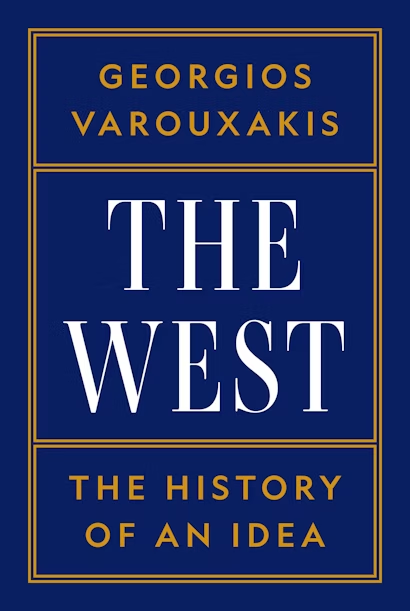
The West: The History of an Idea
Georgios Varouxakisthor
(Princeton University Press, 2025)
The historian Georgios Varouxakis starts his new book with his own first encounters with the idea of the West. His native Crete « lies at the intersection between three continents », he explains, and as a Greek he was to « inhabit a complex mix of heritages »:
Did I have to choose between being Western and being Eastern? Were these self-contained entities with different essences, or were they just words, sweeping generalisations, or at least changeable, flexible narratives? Could one have multiple identities, or did one have to choose?
Varouxakis’s book is primarily about Westerners’ own conception of the West — an approach that allows him to prove that even within the so-called West, the notion was not a coherent container. It is as much a history of terms and discourses as it is about ideas, and it starts the historical clock on those terms pointedly late. Most historians trace the concept of the West back to Herodotus in the fifth century BC, when the « western » Greeks fought the « eastern » Persians. In fact, Varouxakis writes, « ‘The West’ as a potential political entity based on civilisational commonality is a modern idea that arose in the first half of the nineteenth century. »
To be sure, the « ecclesiastical distinction between Eastern and Western Christian churches was centuries old »: long before the nineteenth century, « the Greek Orthodox spoke of ‘Western’ ‘Franks’ », and the division between « the Western Roman Empire, or the Latin (Catholic) Church as opposed to the Greek (‘Eastern’) Orthodox Church, remained significant, too. » But Varouxakis is determined to isolate his inquiry from these longer-standing ecclesiastical or civil divisions.
Various West-like terms were certainly used in the eighteenth century (say, by Voltaire, Adam Smith, or Edward Gibbon). For Francophone philosophes, « l’Occident » was counterposed to « l’Orient », but the Orient could mean many things. It could mean the Ottoman Empire (central to « the Eastern Question » of the day), but also the « deeper ‘Orient’, stretching to India, China and Japan. » By the early nineteenth century, Varouxakis reminds us, the drama of Greek independence from the Ottoman Empire began to sharpen the term for Europeans who took up the Greek cause; thus in 1826, the French clergyman and ambassador Dominique de Pradt saw Greece as « Westerners living on the soil of Turkey, as the Turks were Orientals entrenched on the land of Europe ».
When « the West, » as Varouxakis isolates it, did emerge, its key other was Russia, but in a complicated way. In the eighteenth century, Peter the Great had brought Russia into the « European » power system, but within Europe, Russia was understood to be a « Northern » power, Varouxakis writes. He suggests that only after the end of the Napoleonic Wars and the Congress of Vienna in 1814-1815 did Russia become an « Eastern » menace that threatened to dominate Europe. Russia was the Other within.
The book’s chief conceptual genius is the French philosopher Auguste Comte who, in the 1840s, according to Varouxakis, was « the first political thinker to elaborate an explicit and thorough sociopolitical idea of ‘the West’ — both as a supranational cultural identity and as a proposed political entity, based on civilisational commonality and shared historical antecedents. » For Comte, « West » was an alternative to the term « Europe », which now included the emphatically non-« Western » Russia. His West included the « advanced nations » he saw as « the avant-garde of Humanity »: Germany (not yet a nation but « that great Germanic body, with numerous nations »); Holland; Spain; Portugal; Italy (also not a nation yet, but « the great Italian nationality »). Greece and Poland, too, « countries which, though situated in Eastern Europe, are connected with the West, the one by ancient history, the other by modern ». Instead of Christianity, Comte’s West embraced a scientific « religion of Humanity. »
You’re reading this essay for free. With a membership, you can read the full magazine, and you get access to our fabulous Library.
Here’s our offer: 3 months unlimited digital access + 1 print edition for € 38,00 € 19,00
You’ll get Issue Eleven in print as your first magazine, right to your mailbox.
To make Comte the key inventor of « the West » is, in a way, to rescue the term from any imperialist associations — to associate it, at least for a moment, with the idiosyncratically radical sociology of which Comte was a founder. Comte’s wish was to change the world order; his coinage « aimed at abolishing the European empires and replacing them with an altruistically inclined ‘Western Republic’ » — a project neither imperial nor liberal, but something more majestic. That Western Republic was not an endpoint, but just a necessary stage to an even bigger, global political entity. « The West would eventually disappear and be merged into a greater republic that would encompass the whole of Humanity », Varouxakis writes, at which point, in Comte’s grand vision, « the capital would move from Paris to Constantinople, which would become the permanent seat of the spiritual power and the centre of Humanity. »
Comte’s original West was « a road not taken ». Many other roads were taken, and the book shows how the term « the West » was filled with all kinds of ideas, more or less sane, by different thinkers in Britain, the USA, Germany, France, and Russia, suiting contradictory needs.1 It is cacophonous by design, with a gathering of « Western » witnesses in full-dress, among them Madame de Staël, Henri de Saint-Simon, the Marquis de Custine, Henri Massis, Karl Marx, Friedrich Nietzsche, Arnold Toynbee, Walter Lippmann, Raymond Aron, Richard Wright, and Jürgen Habermas. Many of the names are the usual suspects, and others are quite surprising. Some uphold the West if only to critique their own countries for failing to be true to its supposed values, as when the Harlem Renaissance writer Jessie Fauset in 1917 likened American racial violence to Russian « pogroms », and proclaimed that « We, the American Negroes, are the acid test for occidental civilization. »
If Varouxakis’ aim was to prove how complicated, self-contradictory, and ambiguous the term is, his book succeeds. It also proves, it seems, that no one was « the West » from the beginning (whatever we consider the beginning). To see the West as a process means that France was at one time westernized. Rome was westernized. Greece was westernized (say Plato westernized it), then de-westernized and westernized again. The same with Germany. Nor were the various « Wests » ever geographically consistent: Russia belonged to the European continent but was not « European », Germany is in the heart of it, and still there were reservations. Australia is placed in the West while Brazil is not, cartography be damned.

« I feel you! » was my first thought on reading of Varouxakis’ uncertainties about his own borderline East-West identity. I too had grown up on the « intersection » and in the « mix », and I knew the fascination and the frustration — and the burden — of having to explain yourself to the outside world.
My own idea of « the West and the rest » starts back in my early Soviet childhood in Ukraine. Fairy tales and cartoons rhymed with state propaganda. The difference between « the West » and « the us » was clear, even visual. « The West » was mostly dark and aggressive, oppressed by the Inquisition or by Dickensian capitalists. « The West » always attacked « the us », and « the us » (Slavs, later Russia, later the Soviet Union) never, never attacked anyone, we only defended ourselves. Western knights wore armor; Slavic warriors (Russians, first of all, and Ukrainians as their younger, slightly foolish brothers) all had light and open faces, like children in Victorian postcards, but with beards. Westerners looked a bit better than the Addams family; Western priests looked exactly like the Addams family.
The Soviet narrative was quite clear about what and where the West was: its border coincided with the Iron Curtain. Our socialist friends (Poland, Hungary, Czechoslovakia) as well as the Baltic Soviet Republics (or, to be clear, the working classes of them), had only recently been rescued from centuries-long submission to the evil forces that dominated their societies. We — meaning the territories of the Soviet Union — had also needed to fend off villainous outside forces, and that evil was non-Orthodox (i.e., Catholic and later Protestant). That old ecclesiastical divide, dating back to the Great Schism of 1054 and pre-dating capitalism by centuries, was absorbed into a Soviet teleology and conveniently matched the ideological divide between our happy Union and the sinister West.
It may seem strange that religious differences would be so salient to the aggressively atheist Soviet ideology. In my school years I was already wondering: how come all religions are bad, but the Orthodox is a bit better? If Catholics were so awfully hostile towards science, why had the modern science that we were taught to celebrate flourished in Catholic Europe? I would wonder the same thing in my university years in post-Soviet Ukraine, when the Ukrainian national historical narrative played a similar tune. Catholics who persecuted Galileo? Obscurantist! But the Orthodox Church of the sixteenth century that resisted the Gregorian calendar reform? It was bolstering Ukrainian national identity.
The arcana of sixteenth-century calendar reform had intimate implications for the teenage me. In 1582, Pope Gregory XIII initiated the correction of the so-called Julian calendar, which had been in use since 46 BC but had become, over time, astronomically inaccurate. The Julian calendar year was 365.25 days, while the true solar year is 365.2422 days. For sixteen centuries, each Julian year had drifted from the truth by twelve minutes. The proper timing of Christian holidays was at stake, hence the Gregorian change. At seventeen, I had trouble understanding why we couldn’t have Christmas Eve on December 24, like people in Europe and the US, but had to have it on January 6, like people in Russia.2 That gap in time would come to mean a gap between two worlds. (Considering myself witty, I used to say that Ukraine fell behind Europe not by decades, but by thirteen days.)
In 1994, while still in school, I travelled abroad for the first time — to West Germany, where my dad worked. If you grew up in the Soviet Union, countries like Poland or Czechoslovakia were « abroad »; crossing the Slovak border meant a change of landscape, and even the then-shabbiness of Prague didn’t smooth the contrast. Samuel Huntington hadn’t yet published The Clash of Civilizations, but I bet Huntington would have approved of my intuitive coping strategy after I came back home from the West to the Rest. Something was telling me that Ukraine would not become a part of the West any time soon, so I decided to take matters into my own hands, and join Western civilization on the terms that were then available to me. In my all-secular family, I became the first churchgoer in generations, and the church I chose to join was Roman Catholic, a minority congregation in my native Lviv.

Roman Catholicism was one of my first independent decisions in life, and I must admit that my choice was more intuitive than intellectual, more aesthetic than religious: Lviv’s old cathedrals looked more like the Prague and the Frankfurt-am-Main that I’d just visited. (I’m not a churchgoer anymore, and I have issues galore with Roman Catholic doctrines, but I do not regret the decision, and while my soul may be lost, my aesthetic preferences haven’t changed.)
Meanwhile, in conference halls and cafes, our future intellectual icons discussed the hottest topic: Ukraine between East and West — a topic that had got new breath with the 1996 publication of Ihor Ševčenko’s Ukraine between East and West: Essays on Cultural History to the Early Eighteenth Century.3
But if Ukraine was indeed « between East and West », between could mean various things depending on who uttered it. It could mean that Ukraine was for the moment « between », but would soon reach its final Western destination. Alternately, « between » could mean both, suggesting a Ukrainian dual nature which could be used advantageously, both geostrategically and culturally. Or « between » could mean neither: Ukraine could have its own unique path, its own Sonderweg. That path could itself be narrowly nationalistic or, in effect, pro-Russian, insofar as Ukraine’s « uniqueness » was compatible with a « Russian » opposition to globalization.
Nor was Ukraine the only country in Europe to claim the cliché. Anne Applebaum’s Between East and West (1995) covered her travels through « the borderlands of Europe, » which included Kaliningrad (a Russian enclave in the Baltics, formerly German Königsberg), Lithuania, Poland, Belarus, and Moldova. Ukraine was a member of quite a club.
And then, in 1996, came Samuel Huntington’s The Clash of Civilizations and the Remaking of World Order. For Huntington, Ukraine was less « between » than divided — at the nexus of a religious and civilizational division between « the Uniate nationalist Ukrainian-speaking west and the Orthodox Russian-speaking east. » It is a curious work to look back on today (and we’ll return to it). For now, suffice it to say, you could write a book, and not a boring one, about turn-of-the-century intellectual debates over « the two Ukraines » (pro-Western and pro-Russian), and then another book or two about the instrumentalization — by politicians, both Ukrainian and Russian — of that imagined « clash ».
Varouxakis’s survey is born of an urge to escape geographical determinism, and to instill, accordingly, a suspicion of terms (not only « the West », but also the « Global South ») that might imply such determinism.
Though he is implicitly in favor of what he describes as « so-called ‘Western values’ » — for example, democracy or the rule of law — he argues against such values “being in any way owned by ‘Western’ peoples. » To the non-« Western » listener, he says, such a reference will only imply « that they are losers of history, defeated; that what is good and commendable for everyone was invented by your own (‘Western’) ancestors, and has won; and they must adopt something that is alien to themselves, yet supposedly better in a normative sense. » (This dynamic, Varouxakis notes, has created additional ironies since the nineteenth century, including « an endless search for the non-Western roots of Western civilisation. »)
Better, he maintains, to give those values « universal names »:
It is politically counterproductive, historically problematic and even logically inconsistent to insist that, because certain things (cultural or political or intellectual achievements) were first developed or put together and articulated in a particular part of the world at a particular time (by the ancient Greeks, for instance, in the fifth and fourth centuries BCE), the people inhabiting that part of the world now are owners of the things in question. If that logic were to be followed, the narrow-minded Greek nationalists who claim that the world owes them everything because of what the ancient Greeks achieved — or appropriated and developed — at a particular time in their history, would have a point.
One can only agree. I think good people in the West would support the notion too.
What would make the book more balanced, however, is giving more room to voices who were forced to question their own « westernness », including those from the author’s native Greece. Those on the margins, as you already know from my own example, had given the issue some thought. The chapter on the Cold War devotes a section to « Milan Kundera’s and Czesław Miłosz’s ‘Kidnapped West’ », one of its few detours into « Central European » debates.
Kundera’s much-discussed essay, « The Tragedy of Central Europe », appeared in French in 1983, and in The New York Review of Books in 1984 — that is, when East Germany, Poland, Hungary, Czechoslovakia still lay behind the Iron Curtain, relegated to an inferior Soviet-era status of « Eastern European ». « To a Hungarian, a Czech, a Pole, » Kundera wrote, the « West » was synonymous with « Europe » — a concept, Kundera wrote, that « does not represent a phenomenon of geography but a spiritual notion. » The tragedy his essay described — that of Central Europe’s having been orphaned from its rightful homeland — was a loss for both sides. Before 1945, Kundera reminds us, Central Europe lay at the heart of Western culture — with artists and thinkers including Freud, Mahler, Bartok, Kafka. Even under Soviet oppression, this belief in Europe and the West animated Central Europeans so fiercely that in the 1956 Uprising, he writes, a Hungarian news director about to be killed by Soviet shelling could declare that « We are going to die for Hungary and for Europe. » And yet the « Europe » of the ostensible west had come to see Central Europe as « just a part of the Soviet empire and nothing more, nothing more », all while « losing its own cultural identity. »
Varouxakis’ book tends to avoid the arena of religion, yet the subject is inescapable in these debates.
The common flaw of those historians or political scientists who pose religion as an
essential characteristic of « the West » is their tendency to project it throughout the whole history of a society — as if the impact religion may have had at some moment in the past (combined, of course, with other factors) is a magic pill — or a poison one.
Which brings us back to one of the most important (and often misunderstood) of these theorists: Samuel Huntington, who posed the West as one of one of seven or eight deeply rooted civilizations (« Western, Confucian, Japanese, Islamic, Hindu, Slavic-Orthodox, Latin American and possibly African »).
Huntington’s The Clash of Civilizations began as a lecture in 1992 and an essay in 1993 in Foreign Affairs, with a revealing question mark: « The Clash of Civilizations? ». It was written in the immediate wake of the Cold War, which Huntington saw as a paradoxical victory for Western civilization. The West, in his gloomy account, was unprepared for the future it now faced — a future in which world politics was moving « out of its Western phase », in which « non-Western civilizations » would no longer merely be « objects of history as targets of Western colonialism » but would become, themselves, « movers and shapers of history ».
What was the West to do, if it was to avoid the « clashes » such a world portended? First, recognize that it was a distinct civilization, with pre-modern roots. Second, beware the seeming « Westernization » of the many non-Wests. The West’s very triumph had, according to Huntington, convinced many Westerners that their values were universal. But, as he warned in the 1993 essay, « Western ideas of individualism, liberalism, constitutionalism, human rights, equality, liberty, the rule of law, democracy, free markets, the separation of church and state, often have little resonance in Islamic, Confucian, Japanese, Hindu, Buddhist or Orthodox cultures. » He suggested that « the very notion that there could be a ‘universal civilization’ is… directly at odds with the particularism of most Asian societies. »4
Ukraine, as a border-state, figured in his reflections. He wrote The Clash of Civilizations in the wake of Ukraine’s 1994 presidential election, won by Leonid Kuchma, then vocally pro-Russian. The book pondered « the possibility of the western part of the country seceding from a Ukraine that was drawing closer and closer to Russia », and quoted a Russian general who said, « Ukraine or rather Eastern Ukraine will come back in five, ten or fifteen years. Western Ukraine can go to hell! » The key difference? Religion: « the civilizational fault line that divided Orthodox eastern Ukraine from Uniate western Ukraine, a central historical fact of long standing. » If the Ukrainian east drew close to Russia, what remained would be « a rump Uniate and Western-oriented Ukraine », which « would only be viable if it had strong and effective Western support », a support that would only come « if relations between the West and Russia deteriorated seriously and came to resemble those of the Cold War. »5
In the case of Ukraine, Huntington overestimated the importance of religion as the factor impossible to overcome. If debates on « the idea of the West » teach us anything, it is to avoid betting on one single feature. As Varouxakis puts it, « Huntington’s over-reliance on religion as the main criterion of civilisational identity coloured his whole theory, and invested it with an undue inflexibility. » Huntington was unwilling to accept the possibility that « majorities and their governments » might be open to « a civilisational alliance different from that to which their traditional religious affiliations would predispose him to allocate them. »
To which I would add that religious diversity in a given country matters more than the civilizationally « right » choice. In Ukraine, the seeming monolith of Orthodoxy was constantly undermined both by differences within the Church itself and by contact with other faiths. The Greek Catholic Church is a particular but revealing example: It was persecuted with cruelty in both Ukraine and in Belarus, where the majority was Greek Catholic until the church was dissolved in 1839, and absorbed forcefully into Orthodoxy. In the western part of Ukraine it survived, supported by Habsburg’s rulers, and struggling underground in Soviet times. After the Soviet Union’s fall in 1989, the church was reestablished, and since the 1990s its leaders in Ukraine have encouraged the civic and political activism of their congregations (humble in numbers, never a majority), and in general they openly supported the pro-Western revolutions of 2004 and 2013-2014.
You’re reading this essay for free. With a membership, you can read the full magazine, and you get access to our fabulous Library.
Here’s our offer: 3 months unlimited digital access + 1 print edition for € 38,00 € 19,00
You’ll get Issue Eleven in print as your first magazine, right to your mailbox.
It was February 2020, the pandemic was at our doors, and we didn’t know yet that the event would be one of the last big ones. In the spacious and glossy Parkovy Convention Center in the center of Kyiv, two gatherings were planned for the same evening. On one floor, the Servant of the People party of President Volodymyr Zelensky, elected the previous year, were holding their regular conference. On the other floor was the secular part of a religious celebration: the first anniversary of the enthronement of Metropolitan Epiphanius, the very first primate of the Orthodox Church of Ukraine.
The enthronement was the culmination of dramatic events: in December 2018, the Orthodox Church of Ukraine was granted « autocephaly » (self-governance): the upshot, for those seculars indifferent to the ecclesiastical arcana, was that Constantinople as an Orthodox capital had sided with Ukraine, not Russia.
The event was ostensibly apolitical, but the crowd included former president Petro Poroshenko, who had invested a lot in the decree of autocephaly, but kept his appearance at the gathering low-profile. Zelensky’s Servant of the People party was doing their thing on one floor, and the guests of Metropolitan Epiphanius were occupied with their thing on the other. (That the two events were on different floors may have been more comfortable for everyone: Zelensky was much criticized for mocking the decree in his stand-up show when he still was a comedian.)
After guests took their places in the concert hall — the highest clergy in skufias in the front rows — the choir sang a traditional Ukrainian religious hymn, and Metropolitan Epiphanius, then 41 years old, took the stage. He spoke about the openness of the Church (« openness » was a key word in the speech, also described as « our point of difference »), the role it could play in everyday challenges: family life and civic activism, civil duties and responsibilities, career and migration. He spoke about work ethic, about overcoming trauma, about sustainability and climate change, about leadership, responsibility, and agency. He called on his listeners to consider the realities of the modern world, and said that any church conversations about family (« family values » is one of the buzzwords of those who try « to look Christian » in Ukraine) should address violence and poverty, should foreground emotional health and mutual respect. He spoke of leadership as an antidote to despotism. He cited the Bible but also Winston Churchill. After his speech, the National Academic Folk Instruments Orchestra, in full folk costumes, played a folk arrangement of the Beatles’ « Hey, Jude ».
Then a representative of the laity took the stage, and it was an unexpected choice: Oksana Zabuzhko, the writer who had introduced the term « feminism » to the Ukrainian public in the 1990s and made her name with the novel Fieldwork in Ukrainian Sex.
After the official part of the evening was over, I met my old friend, a Greek Catholic from Western Ukraine who had been involved in organizing the event. We hugged, tears in our eyes. I remember that evening as one of the best drinks parties ever. The table where I landed included a Soviet-era dissident who had been a founding member of the Ukrainian Helsinki Group (a human rights dissident movement), had spent ten years in Soviet labor camps, and gone on to be vice-rector of the Ukrainian Catholic University; two sociologists from Lviv (one had grown up as a Protestant ); a bright young Crimean Tatar activist (a Muslim), and, well, me. We raised our glasses to the church that none of us belonged to, and we were happy. Life had been generous to us: we’d already witnessed a collapse of the empire, and a couple of revolutions. Now we’d seen once again that changes were possible. Even those institutions that were averse to change by definition, could change. They just needed a leap of faith.
After the Russian full-scale invasion in 2022, Ukrainian national flags covered Europe. The map of support for Ukraine seemed to stand as proof that « the West » still exists. War in Ukraine rehabilitated the word, and made it a term one need not be afraid to use. If « anticolonial » had too often in the Cold War-era meant anti-western, « the West » could now once again be anticolonial. Ukrainian symbols became symbols of the West: safe to use, without imperial connotations. Like the 1821 Greek Revolution for Lord Byron (and others), like the 1830 Poland Uprising for Victor Hugo (and others). Like the Prague Spring of 1968 or the Solidarność movement of the 1980s for British intellectuals. Like the EU flag for Ukraine’s Maidan Revolution in 2014. Like Belarusian symbols will be for all of us one day, I hope. As Varouxakis’ messy, cacophonous book serves to show us, if the West is an « idea, » anyone can be part of it. And anyone should.

- In the United States, for instance, a key inventor of « Western civilization » as a concept was the German-American liberal political philosopher Francis Lieber, whose 1833 Encyclopedia Americana deployed that term in its entry on « Woman ». In 1841 Lieber wrote of « the Western World — all Europe, with her many descendant nations », but he wanted a better name, as Varouxakis puts it, for « the civilisational unit that he saw himself and his compatriots (both his current American and his former German ones) as belonging to. » In 1859, he landed on a name that unsurprisingly failed to stick: « Cis‑Caucasian », an endearingly weird riff on nineteenth-century racial vocabularies. ↩︎
- Since 2023, Ukrainians celebrate Christmas on 25 December, like their Orthodox, Catholic, and Protestant fellows in the West. It took full-scale war with Russia for Ukrainian churches, Orthodox and Greek Catholic alike, to fulfill the long-awaited reform. ↩︎
- It appeared first in English and then, in 2001, in Ukrainian. Ševčenko had given the germ of the book as lectures at Harvard in the early 1970s; in 1990, he delivered the title essay as a lecture in Kyiv, at the First Congress of the International Association of Ukrainian Studies. ↩︎
- A follow-up article from 1996, « The West: Unique, Not Universal », claimed the West’s « distinguishing characteristics » in a different way. Huntington listed « the classical legacy, » « Western Christianity », « European languages », « Separation of spiritual and temporal authority », « rule of law », « social pluralism and civil society », « representative bodies », and « individualism ». But he was careful to hedge the point: « Individually, almost none of these factors is unique to the West. But the combination of them is, and has given the West its distinctive quality. These concepts, practices, and institutions have been far more prevalent in the West than in other civilizations. They form the essential continuing core of Western civilization. They are what is Western, but not modern, about the West. » Foreign Affairs (November/December 1996). ↩︎
- Samuel Huntington, The Clash of Civilizations and the Remaking of World Order (Simon & Schuster, 1996), p167-168. ↩︎