

The kulturkanon is a sideshow in Sweden’s culture wars.

En kulturkanon för Sverige
A cultural canon for Sweden
2025
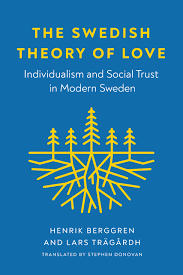
The Swedish Theory of Love: Individualism and Social Trust in Modern Sweden
Henrik Berggren and Lars Trägårdh
Translated by Stephen
Donovan; University of Washington Press
There’s a scene in Karl-Ove Knausgård’s My Struggle where he describes pushing a stroller through a Swedish town, only for Japanese tourists to gaze at him, fascinated by this living example of the Swedish paternal leave policy. « A bunch of Japanese tourists stopped across the street and pointed at me, like I was leading a circus parade or something », he wrote. « They pointed their fingers. There goes the Scandinavian man! Watch and tell your grandchildren about this incredible sight! » For many years, international journalists travelled to Sweden to report on this exotic phenomenon, the Swedish stroller dad, beacon of progressive values and gender equality. This, if anything, is what Sweden used to be known for internationally. It was known, too, for both political pragmatism and a genuine humanitarianism. Today is another story.
As of September 2025, Sweden has an official, government-approved kulturkanon: a « cultural canon ». What is such a thing for, and what should be in it? Great Swedish works of art, sure. What about pieces of legislation? Things like eighteen months of parental leave would seem less obviously canonizable, and yet there they are. Can a canon capture the Swedish soul? The current nationalist government set these questions in motion but has struggled to answer them. What is Sweden supposed to be?

You’re reading this essay for free. With a membership, you can read the full magazine, and you get access to our fabulous Library.
Here’s our offer: 3 months unlimited digital access + 1 print edition for € 38,00 € 19,00
You’ll get Issue Eleven in print as your first magazine, right to your mailbox.

Once the most social democratic country in Europe, and then, in the 1990s, the most neoliberal one, Sweden now aims to become the most nationalist one. In the second half of the twentieth century, Sweden’s generous welfare state made it the gold standard for economic equality. In the book Capital & Ideology, the French economist Thomas Piketty used Sweden in the 1980s as the most successful example of a country that achieved a working model for economic equality without sacrificing social freedoms or economic growth. Over the next three decades, Sweden dramatically embraced deregulation and privatization.1 One of the most equal countries in Europe became one of the most unequal. According to the World Bank, Sweden’s Gini number (a measurement of economic inequality) rose from 23 in 1981 to 31,6 in 2022, similar to the UK and Italy.

Recent Swedish politics, meanwhile, are beset by the same Faustian bargains happening everywhere. In September 2022, the conservative block in Sweden won the national election with a tiny margin. They were only able to form a governing coalition with help from the far-right Sweden Democrats, a nationalist party founded by extremists and Neo-Nazis in the 1980s, now wearing suits and too much hair gel, insisting that they have changed. Before the election, now prime minister Ulf Kristersson, of the center-right Moderate Party, had promised the Holocaust survivor Hédi Fried that he would never, under any circumstances, collaborate with the nationalists. After the election, he broke that promise. Convening in December at the Tidö Castle in Västmanland, the three traditional right-wing parties formed a major policy agreement with the far-right. The Tidö Agreement was meant to tame — and was justified as taming — the Sweden Democrats. But it has more likely passed them the torch: since then, the nationalists have consistently been the biggest right-wing party in opinion polls. Without a formal role in government, they are insulated from blame for all of society’s ills but are still able to play the dominant role in shaping both the policies and the communication strategy of the entire governing coalition. Meanwhile, the center-left Social Democrats, frantically trying to win back the voters they have lost to the far-right, imitate some of their rhetoric and anti-immigration policies. Once proudly proclaiming that Sweden should be a « humanitarian superpower » they are now more likely to brag that their policy platform has « very few woke elements », as a prominent party member recently put it.
The shift started well before. In 2014, the conservative prime minister Fredrik Reinfeldt called for « open hearts » (« öppna hjärtan ») for migrants and refugees fleeing war, violence, persecution and famines. More than a hundred thousand migrants and asylees arrived in Sweden in the following year and were welcomed, initially, by a great wave of humanitarian volunteerism. Sports facilities were converted to help centers, communities of idealists and activists were texting each other in the middle of the night to coordinate support systems, in a surge of Tocquevillean grassroots organizing. But that wave crested. In the decade since, Sweden has toughened asylum laws, increased deportations and aimed to accept the lowest number of refugees in Europe. The large political parties in Sweden no longer want to be associated with the ancien régime of tolerance and diversity. Andreas Bergh, an economist at Lund university, succinctly summarized the last decade of Swedish politics as a shift from Fredrik Reinfeldt’s message of « opening your hearts » to migrants, to a new mantra of « opening your wallets » to pay for the « repatriation » of the same migrants.
Hence an ambient uncertainty about what Sweden is. The country where I grew up may still be known around the world for gender equality, generous parental leave, universal health care and education. Its deep core of progressive beliefs remains the national brand. Yet many Swedes are confused about their own country, and what it is supposed to represent. For progressives, the departure from a humanitarian and pluralist vision feels like a departure from something deeply Swedish. Conservatives and nationalists endeavor to affirm a nativist vision of an old, more homogenous country — while their most obnoxious wings import, with fierce enthusiasm, the most odious tropes of the American culture war.3
There are culture wars, and then there are cultural canons. When the Sweden Democrats signed the Tidö Agreement, one of their explicit goals was the creation of a Swedish cultural canon: a government-sanctioned list of great art, literature, architecture and scientific ideas, which would supposedly define the unique essence of Sweden. The seeds of it were planted fifteen years ago, by the Sweden Democrats’ in-house philosopher, Mattias Karlsson, who poached the idea from an initiative by Denmark’s far-right Danske Folkeparti in 2005. The goal was to create a common cultural identity, that should temper societal division, and « confusion » about national values, in a time of shifting demographics.
With the Tidö Agreement, this long-held wish came true. The historian and author Lars Trägårdh was hand-picked to lead the commission. Trägårdh is a mildly famous, often provocative public intellectual, whose career revealingly tracks the two-decade vibe shift in Sweden. In 2006, Trägårdh co-wrote a widely read book on the ideas that have shaped Swedish society. It had a catchy title: Är svensken människa? (« Is the Swede Human? »). He wrote it with Henrik Berggren, a left-liberal author and historian (also for many years a columnist at Dagens Nyheter, where I am a contributor).
The book articulated, in effect, a historical narrative of, and explanation for, modern Sweden — its relative economic equality, its welfare state — that could please both conservatives and progressives. The Swedish welfare state, in this account, was not a left-wing or right-wing project; nor was Sweden’s remarkable economic equality something that had to be imposed from above « by fanatical social engineers » obsessed with central government power. Both achievements were founded on, and emerged organically out of, long-standing Swedish beliefs in both egalitarian ideals and individual autonomy, and it accommodated those dual needs. The state would guarantee social safety, emancipating the individual from ties of dependency to the traditional family, churches or charities, and what remained and endured was what they called a « statist individualism »: neither consistently left-wing nor right-wing, but a fusion of center-right liberal ideas and center-left communitarian ideas. The support for the welfare state and relatively high taxes, then, was based on a peculiar combination of solidarity and individualism, the idea that everyone should have access to the same kind of safety nets so that we don’t have to worry about helping them out.
Books that attempt to explain the soul of the Swedish people tend to be either insufferable in their self-congratulation or banal in their contrarianism. Is the Swede human? was nuanced, even refreshing. And it remains one of the books shaping Sweden’s public discourse — not as a robust analysis of public policy, or even a historical argument, but as a story that a Swedish political center could tell itself about itself, and a Swedish personality that could be projected to the world.

Yes, the Swede was human, and it longed for solitude. The cover, cleverly designed by Elsa Wohlfahrt Larsson, showed a lone pine tree set against a dramatic sunset. It could be a romantic landscape painting by Caspar David Friedrich, except that the pine tree somehow looks humble rather than Nietzschean. Here stood the little Swedish human, a fragile individual, longing for solitude, but also for the comfort and safety provided by a generous state. That Swede’s deepest wish was a hike along a leafy trail in the woods, picking chanterelles and blueberries, undisturbed by the outside world or any needs from neighbors. To anyone who’d grown up in Sweden, with its relentless imperative of cross-country skiing, and of sleeping in chilly tents in the middle of nowhere, this made intuitive sense.
Is the Swede Human? positioned its Swedish model alongside Germany and the United States. The comparison was expressed in an elegant diagram, a triangle with three points: Individual, Family/Civil Society, and State. The lines posed the possible axes on which a society could manage the burdens of welfare and dependency. Germany’s axis ran between Family/Civil Society and State, hence the German reliance on, or tendency toward, both a strong state and traditional values, together with a suspicion of individualism. The American political model ran between Family/Civil Society and Individual: hence social conservatism and strong family ties, in unharmonious tension with an individualist culture and a weak central government. Sweden sits between State and Individual: a society where the state guarantees individual freedom.
The book’s historical premises were challengeable. The economic historian Erik Bengtsson, most thoroughly, has argued that Berggren and Trägårdh had missed or ignored the harder facts of Swedish economic and political history. Bengtsson notes that the Swedish tendency toward equality was not, in fact, rooted in medieval Swedish values, nor in some essence of Swedish character. Before the twentieth century, Sweden was one of the least equal or democratic countries in Western Europe. Between 1844 and 1906, one hundred percent of cabinet positions were held by the aristocracy. In 1867, only 21 percent of the male population passed the rigorous thresholds for wealth and income required for voting rights, in contrast to the far vaster male suffrage in Germany, France, Denmark and the UK. (Universal suffrage was passed in in Sweden in 1919.) It was precisely this deep inequality and the entrenched power of the upper classes that spurred Swedish workers to organize and create a strong welfare state, with a vast system for redistribution — all of which had to overcome fierce opposition from the aristocracy and wealthy landowners. Equality was created by social democracy, left-wing organizers and labour unions — including those « fanatical social engineers » dismissed by Berggren and Trägårdh.4
Today, in any case, the book reads like an artifact from a different era, in which conservative and progressive thinkers could find some commonality or at least agree on basic facts about Swedish history. This comfortable middle ground has now evaporated, and Trägårdh himself has drifted much further to the right.
After Trump’s first election in 2016, he aligned himself not with the progressives and liberals who were revolted by the new nationalism, but instead with the conservative accommodationists acquiescing to the far-right so they could cling to power. Trägårdh became Swedish media’s go-to guy for explaining the storming of the American Capitol in Washington DC on 6 January 2021 — for which, in his explanation, the left was somehow also responsible. The violence, he argued, was a natural response to « polarization » caused by progressive college students demanding that the removal of Confederate statues. « It’s important to not just blame one side », he said in a radio interview.
You’re reading this essay for free. With a membership, you can read the full magazine, and you get access to our fabulous Library.
Here’s our offer: 3 months unlimited digital access + 1 print edition for € 38,00 € 19,00
You’ll get Issue Eleven in print as your first magazine, right to your mailbox.
All of which makes it rather strange that Is the Swede Human? would finally be published in America, in 2022, with a new title — A Swedish Theory of Love — drawn from a nineteenth-century Swedish pamphlet that argues for women’s independence.
It could have been a good progressive book by American standards. But the English-language version, coming out sixteen years after the original Swedish edition, was updated and repackaged as a story about Sweden’s Covid policy, which was relatively lax, based on the assumption (correct, in the end) that Swedes would mostly comply with the sound advice from scientists and government experts. No need, therefore, for draconian restrictions or curfews imposed elsewhere. What better proof of Sweden’s unique levels of trust in government and public institutions?
Trägårdh himself, in any case, was one of the moderate conservatives who was apparently radicalized by the pandemic: it further entrenched his contempt for progressives on both sides of the Atlantic, his mistrust of government, and eventually his embrace of elements of Trumpist populism.
In 2023, a viral story seemed both to confirm the portrait drawn in Is the Swede Human? and to reveal the underside. The story highlighted a peculiar Swedish social custom: if a kid came over to their friend’s place to play after school, the parents would not feed the visiting kid when dinnertime came around, but instead would let the kid stay all alone in the friend’s room, as the rest of the family dined downstairs. What surprised me (aside from the strange custom itself, which I somehow missed out on in my own Swedish childhood) were the hundreds of Swedes gleefully tweeting their confirmations of this Dickensian absurdity — and militantly defending it, as if expecting families to feed their kid’s friends somehow broke an unspoken compact, in which nobody should depend on others for their wellbeing. There sat the True Swede, a lone pine tree, oblivious to the needs of others.
This viral anecdote might have done more to damage Swedish soft power in recent years than any Russian disinformation campaign. The Swede may be human, but wasn’t quite ready for life among other humans. Michel Foucault spent three years studying in Uppsala in the 1950s, and might have recognized the semi-humanity of the Swede. He later remarked on the country’s culture of cold conformity, where the citizen was reduced to « a moving dot obeying laws, patterns and forms », boding « a brave new world where we discover that the human is no longer necessary. »5
Any cultural canon, nowadays, will be a sideshow in the culture wars, themselves a spectacular sideshow from the brutal realities of politics. Here is how the Swedish one unfolded. Trägårdh, now rebranded as a conservative contrarian, travelled the country, pitching this celebration of Swedish cultural history as a corrective to « modernism, diversity and internationalism », as he put it in an interview with Swedish public radio. The government created a website where all citizens could send in their own suggestions for canonical works. Awkwardly, the deadline for these suggestions was set after the commission made their final decisions for the canon.The key criterion was that only works created before 1975 would be considered. That fifty-year gap, the logic went, would avoid presentism and gather only those truly great works that have withstood the test of time. It also, conveniently, ensures a canon consisting almost entirely of work by white native-born Swedes, excluding the actual diversity that has defined modern Sweden. Since the 1970s, after all, Sweden has gone from being a country where only a few percentage points of the population were born in other countries, to being one of Europe’s most diverse societies, where one in four residents has a foreign background, and one in three has at least one parent born abroad. (The canon’s expert committee lacked any members born after 1975 — there was one, but they left.)

All the while, the government itself escalated its controversial policy of « repatriating » immigrants to their countries of origin. In the face of increasingly Kafkaesque hurdles of the migration bureaucracy, people who spent years learning Swedish and building a new life and deep social ties, getting degrees for vocational schools or professional diplomas to fill jobs where no Swedes were available, are now leaving the country. Unsurprisingly, employers are unhappy about losing qualified workers. And yet Trägårdh, in an interview with the New York Times in May 2025, said that Sweden had in recent years combined a « wonderful openness to immigration with a complete lack of policies that have been able to bring all these people into Swedish society. »
On 1 September, the kulturkanon was finally presented, with a three-hundred-page accompanying report by Trägårdh and his team of mostly conservative scholars. It announces « the need for a cultural canon », lamenting the three « overarching ideologies » that have allegedly afflicted contemporary Swedish society — modernism, internationalism, multiculturalism — creating an urgent « crisis » which the report, sounding like a demagogue from the last century, dubs « the Swedish disease ». Rhetorically and philosophically, that polemical territory is all too familiar to me, as a longtime reporter and researcher on transatlantic nationalist and far-right movements. The report at once deploys the language of deeply reactionary voices like Alain de Benoist, Éric Zemmour and Steve Bannon and domesticates their polemics, by draping them in « inclusion ». « It would be naive to believe that a cultural canon, however sophisticatedly constructed, could in itself cure the Swedish disease », Trägårdh avers, but this humble canon, deployed properly, « will be able to serve as a map and compass for all children and new arrivals. »
Trägårdh’s report reads like a manifesto of a dissident conservative. It taunts his liberal, pro-immigration former friends, mocks Fredrik Reinfeldt’s 2014 « open hearts » speech as an antiquated relic, and dismisses the post-war humanitarian and pluralist consensus that shaped much of modern Sweden. It dismisses these humanitarian concerns « fashionable » ideas that have mostly energized « young people ». Like the Tidö Agreement, it abandons everything that used to be seen as Swedish.
Strangely enough, most of the works of art represented in the canon are both good and actually progressive — certainly in the canonizers’ interpretation of them. The list can hardly be read as a crude catalog of reactionary nationalist revisionism or chauvinist populism.
Most of its choices are refreshingly highbrow. No ABBA songs, no sweetly nostalgic ruminations on clogs or midsummer flower laurels. The oldest thing in it is the eleventh-century Husaby Church, where one can find « the graves of the first Swedish king to be baptized, Olof Skötkonung, and the missionary bishop Unni. » Christianity « came from outside », the canon tells us, « brought by English and German missionaries » of a religion « already a thousand years old at that time and with its roots in the Middle East » — an acknowledgment, of a kind, that this isolated peninsula in a remote corner of northern Europe has often transformed itself by absorbing ideas from elsewhere.
The oldest work of literature in the canon is a baroque poem from 1688 — « Skulle Jag sörja då wore Jag tokot » (« If I would mourn, I would be crazy »), by Lasse Lucidor, lauded as « a proud and headstrong rebel ». The earliest novel is Det går an (1839), by Carl Jonas Love Almqvist, which is praised as a progressive beacon: its heroine wants « a free relationship based on continued affection and mutual respect, not on marriage as an unbreakable legal and religious obligation. » Thus the novel « points forward to later gender equality efforts, but also has deep roots in the biblical ideals of equality that Christian churches have often disregarded. »
Among the most recent works of literature — just making the 1975 cut — is Medea’s Children, by Suzanne Osten and Per Lysander: « A children’s tragedy from the children’s perspective and a milestone in children’s culture that has had a profound impact on the development of children’s theater in Sweden and around the world. » Osten is held aloft as a Swedish pioneer ahead of the international curve, « her persistent work for children’s right to artistic experiences » having a global impact « fifteen years before the UN Convention on the Rights of the Child ».
The canon canonizes plenty of feminist works, for instance the poems of Edith Södergran — a controversial inclusion insofar as she was born in Russia to Finnish parents, but wrote her poetry in Swedish. Here she represents the strands of « Finnish-Swedish modernism ». Her poem, « Triumph to exist… » (1918), is singled out for « uninhibitedly express[ing] female self-esteem, but also a universally touching joy of life and gratitude for the gift of life. » Sonja Åkesson’s « The Marriage Question I-II » (1963) is a heralded as « a double poem that drastically depicts an unequal marriage as colonialist slavery for the woman and a source of dissatisfaction for the man. »
Also canonized is the Romani author and civil rights activist Katarina Taikon, author of « a groundbreaking series of children’s books about a young Roma girl’s struggle against discrimination and social pressure in 1930s and 1940s Sweden. » Taikon’s Katitzi (1969) is celebrated for correcting the « romanticized view of ‘gypsy life’ » spread by writers like Ivar Lo-Johansson (not canonized). Taikon emerges as a great defender of the welfare state: « Katarina Taikon demanded access to all the facilities of modern welfare society. In contrast to what Johansson praised, the picturesque nature of the free, nomadic life in camps and on the roads, she favored running hot and cold water and modern apartments. »
The cultural canon also, curiously, includes policies: the welfare state itself is canonized, in the form of Prime Minster Per Albin Hansson’s 1928 speech about it, celebrated for introducing « the People’s Home as a metaphor »: « Hansson alternated between the words ‘folkhem‘ (people’s home) and ‘medborgarhem‘ (citizen’s home) and wanted to see a society that, like ‘the good home,’ was characterized by compassion, without either ‘favorites’ or ‘stepchildren.’ » (The peculiar custom of excluding a child’s friend from family dinners is not canonized.)
At the root of this vision of tolerance is Sweden’s 1634 Constitution, created by Chancellor Axel Oxenstierna, who, as the canon reminds us, lamented that « All our neighbors are our enemies. » In the spirit of good neighborliness, the Lapp Codicil of 1751 was « an intergovernmental agreement on the Sami people’s right to move freely across the border between Sweden and Norway », which « constitutes a recognition by the Swedish state that the Sami people had certain freedoms that were not shared by other subjects. » The twentieth century brought new canon-worthy innovations: Brunnsvik folkhögskola (1906), the oldest community high school in Sweden, « symbolizes the importance of the voluntary education movement for Sweden’s democratic development. » The national pension reform of 1913 is canonized as « the world’s first universal pension system ». In 1971, « Separate taxation of spouses » was achieved: « a reform that freed up women’s labor and laid the foundation for economic equality in modern Sweden ». But the greatest milestone of public policy is, of course, paternity leave: « In the spring of 1974, the Swedish Parliament made a historic decision. Sweden became the first country in the world to introduce the possibility for fathers to take paid parental leave. » The Swedish stroller-dad is born.
It’s a weird jumble. We get Ingmar Bergman’s The Seventh Seal (1957) and Tomas Tranströmer’s transcendent poetry together with « the spherical ball bearing » invented by Sven Wingquist in 1906. The Viggen fighter jet (1967) is also canonical — « an advanced fighter aircraft that symbolizes both Swedish engineering prowess and the desire for armed defense of Swedish neutrality » — reflecting the reality that Sweden’s advanced weapons technology is one of the country’s major exports, if rarely part of the country’s global image.
Ikea — the entire company — is in the canon, because Ikea « symbolizes Swedish entrepreneurial spirit and shows how innovative business models can change »… global trade as well as homes and everyday life.» (The first Ikea store opened in Älmhult in 1958.) The canon betrays one specific frustration with Ikea, though, for its promotion of « Swedish meatballs ». We learn in the section devoted to Gastronomy that meatballs « began to appear in Sweden in the 18th century », but are « actually the least Swedish of our examples of home cooking ». The implication here is that some imported things, like meatballs (which were inspired by the Turkish kofte) are somehow un-Swedish, whereas other imported things, like Baroque poetry or the Christian faith itself, are deeply Swedish.
The absurd contradiction of the kulturkanon is that it was created by nostalgic conservatives, explicitly to strengthen national cohesion, and yet it ends up being a list of works and ideas that are mostly progressive, often feminist, sometimes anti-nationalist and proudly egalitarian, like so much of Sweden’s actual modern history.
What followed the canon’s publication was a pseudo-debate. The far-right Sweden Democrats immediately celebrated it as a major victory, and launched an ad campaign with the slogan: « Time to talk about Swedish culture again. » Left-wing cultural critics, meanwhile, overwhelmingly condemned the canon in articles that cherrypicked examples like the Viggen fighter jet to prove that it was part of a nationalist conspiracy. « Absolute nonsense », « a joke », « completely irrelevant » were some of the comments from critics in major Swedish news outlets. But the problem was not the institutions or works of art now canonized, but the nationalist context in which the list was created.
Since ideas and abstractions can now be canonized, and thus claimed as particularly Swedish, let us conclude with the allemansrätt: « The right of public access means that everyone has the freedom to move around in nature and enjoy flowers, berries, mushrooms, and more, as long as the landowner’s rights are not disturbed. » Berries are mentioned a total of twelve times in the canon, and perhaps it is here that we glimpse the Swedish soul. The canon reminds us that we have a legal right, a constitutional right, to pick berries wherever we want.
You’re reading this essay for free. With a membership, you can read the full magazine, and you get access to our fabulous Library.
Here’s our offer: 3 months unlimited digital access + 1 print edition for € 38,00 € 19,00
You’ll get Issue Eleven in print as your first magazine, right to your mailbox.

- It developed one of the most radically libertarian school systems in the world, in which private owners get full funding from the government to run schools, in pretty much any way they want to, but can still lift massive profits and place their wealth in foreign holding companies, with no benefit whatsoever to the Swedish citizens who funded the whole enterprise. ↩︎
- It developed one of the most radically libertarian school systems in the world, in which private owners get full funding from the government to run schools, in pretty much any way they want to, but can still lift massive profits and place their wealth in foreign holding companies, with no benefit whatsoever to the Swedish citizens who funded the whole enterprise. ↩︎
- It was telling that it was a Swedish nationalist, Charlie Weimers, who tried to force the entire European Parliament to hold a moment of silence for the death of the American far-right activist Charlie Kirk, in September 2025, despite being told explicitly by the parliament president that this would not be allowed. ↩︎
- Erik Bengtsson, « The Swedish Sonderweg in Question: Democratization and Inequality in Comparative Perspective, c.1750-1920 », Past & Present 244:1 (August 2019), 123-161. ↩︎
- Quoted in Yngve Lindung, « En intervju med Michel Foucault », Bonniers Litterära Magasin (BLM), March 1968. ↩︎