 Skip to content

What do we tell ourselves when all the trees simply vanish?
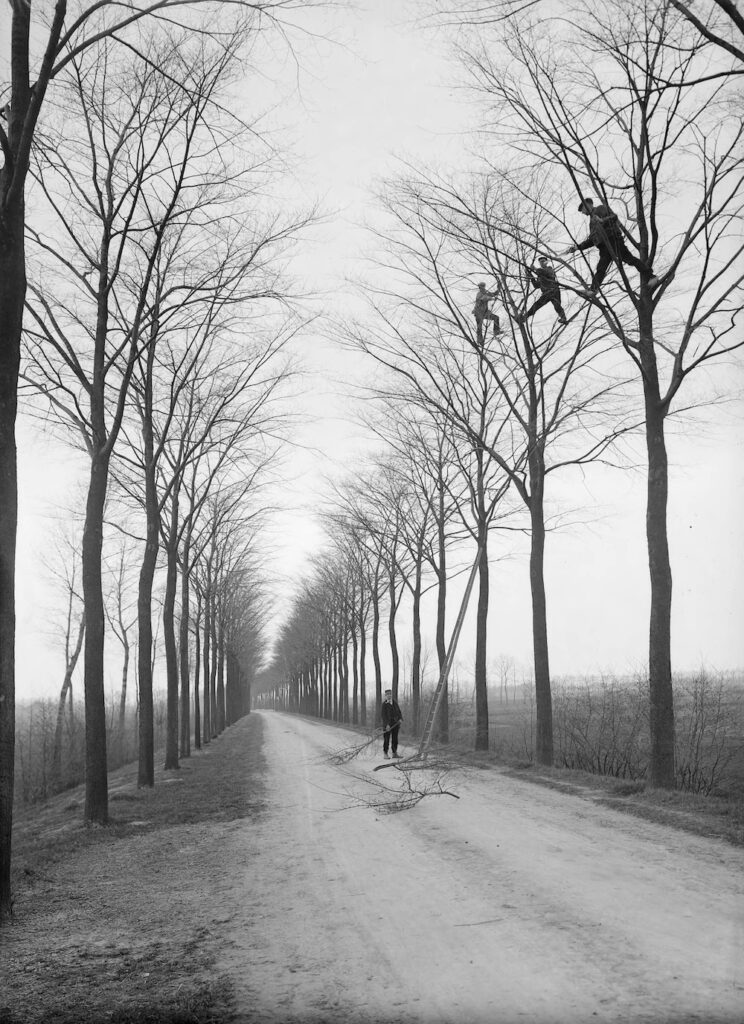
Thousands of The Hague’s oldest poplar trees were culled in 2020 by the municipal government, to protect pedestrians from the danger of falling branches. In my neighborhood, the first trees to be felled lived in a small, unnamed park lining a section of the Haagse Beek, a thin creek flowing from coastal dunes into city center. This was my Covid park, the place where my wife and I inhaled our fresh air during lockdown, where we played around photographing crocuses using the « nice » cameras, and where we spent countless hours observing herons and coots and moorhens — all of whom were indifferent to our artistic experiments and epidemiological worries.
The poplars, once their deconstruction started, did not disappear overnight. For days they lay in heaps of damp sawdust, their decaying branches beckoning armies of beetles, ants, and isopods who no doubt relished their good fortune. As a keepsake, my wife and I dragged a sizeable branch back to our second-story apartment and for the next three years it languished on our balcony — a musty, arboreal relic. The park, meanwhile, shorn of its grandest trees, looked bald and insipid, like it had weathered a course of chemotherapy.
We were not alone in our urge to commemorate local nature. Sometime during those chilly, unsettling weeks straddling March and April 2020, I stumbled across a homemade monument in a back corner of another local park, not far from a clearing where Nazi soldiers had once launched V-2 rockets. It was fashioned from a moldering tree stump that had been cut at a sharp angle at about hip height. Someone had taken a fat marker, the kind used for graffiti tags, and written on its surface, in large, fluorescent, cursive letters: N-A-T-U-R-E! Exclamation point! With a wreath of exuberant curlicues, glowing like a neon sign against dark mossy undergrowth. Thank you for this, it seemed to say. For this I am grateful. But also: What if something were to take this away from me?
This article is behind the paywall. Want to keep reading this article?
Subscribe to the European Review of Books, from as low as €5,00 per month.
Already a subscriber? Sign in