

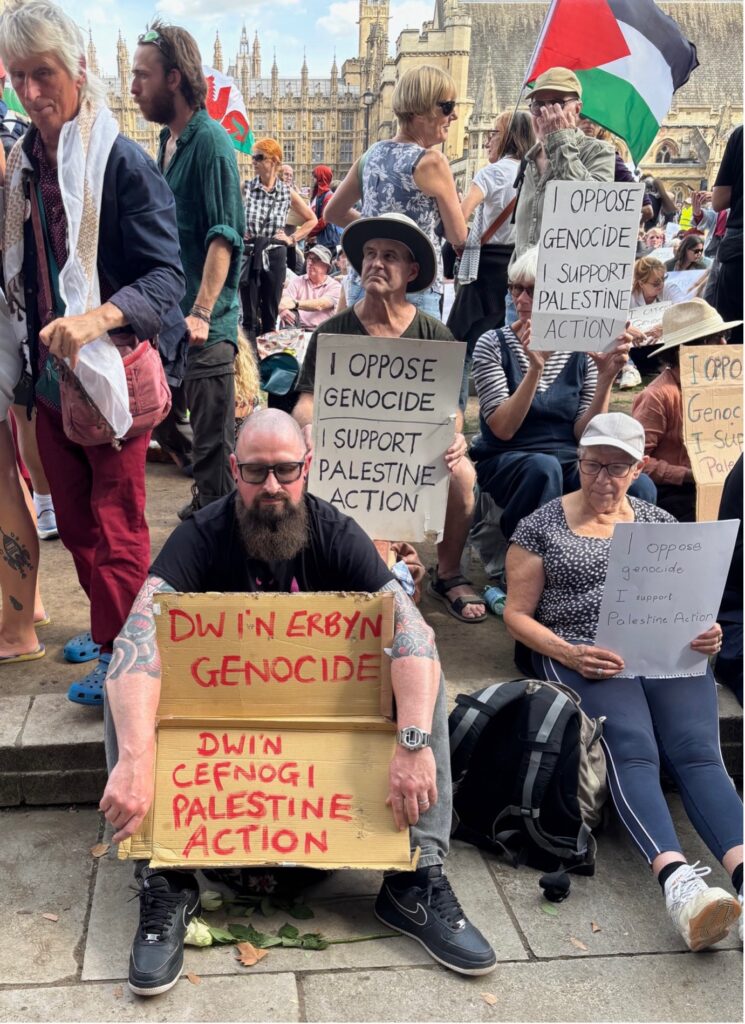
D’win Erbyn
Genocide
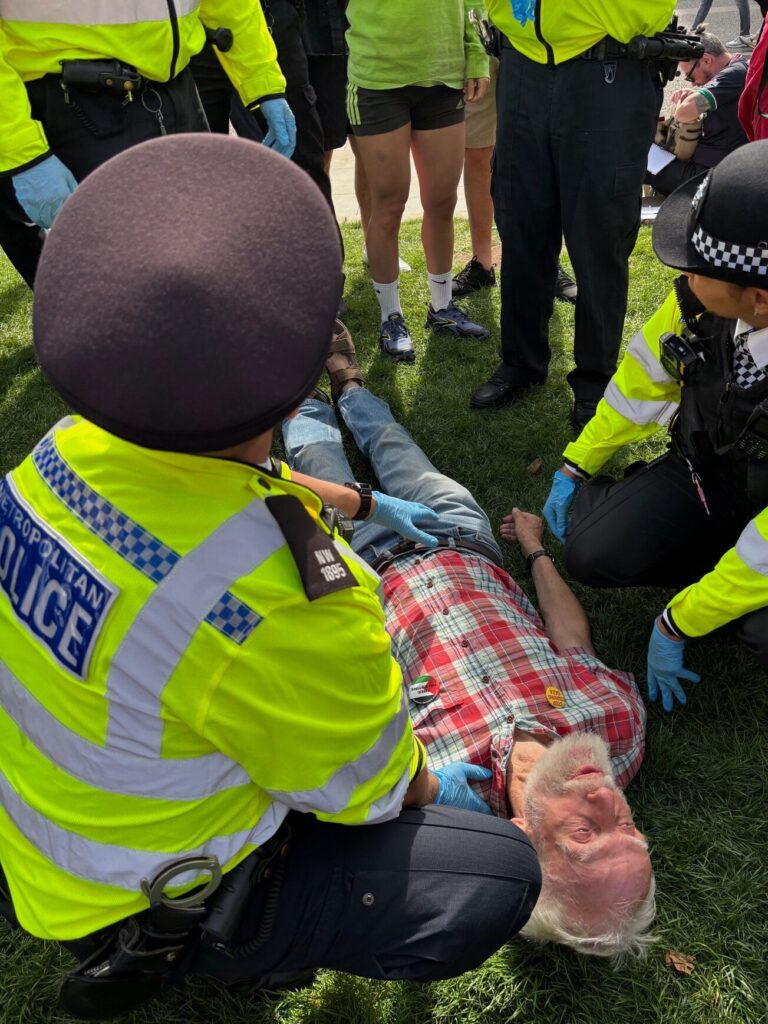
The elderly gentleman seemed at first sight to be having some kind of seizure. He was lying on the ground, his body shaking convulsively. Young men and women in yellow hi-vis jackets, whom I took to be paramedics, were bent over, questioning him. Then they picked him up by his arms and legs and head and carried him off not to an ambulance, but a police van. The man wasn’t ill, I realized: he was an immensely brave seventy-something-year-old whose body was going into shock at the unnatural prospect of being forcibly deprived of its freedom.
The crowd who accompanied him to the van shouted at the police officers, « Shame! Shame! Shame on you! »
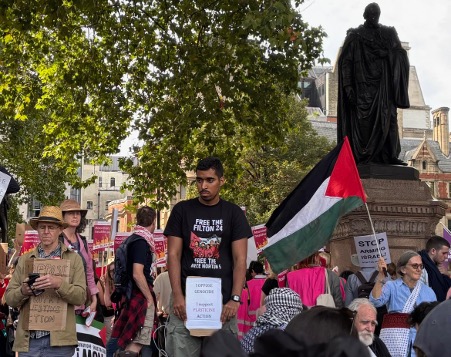
This was last Saturday, and I’d just arrived at the protest in London’s Parliament Square. All across the lawn, people — mostly elderly white middle-class British people, some Quakers, some Buddhists — were sitting in silence, some with eyes closed in prayer or meditation. Most held up signs they’d handwritten, others were still scribbling their message on sheets of cardboard. The signs said, « I Oppose Genocide. I Support Palestine Action. » Others sat on folding chairs, reading a newspaper or a book. On closer inspection, you saw that taped to the cover of their books or the front page of their newspaper was the same message. A younger man, shaved head, tattooed, silently held up a piece of cardboard declaring the same sentiments in Welsh. Dw’in Erbyn Genocide. Dw’in Cefnogi Palestine Action.
Palestine Action is a group that uses direct action to stop Britain from doing business with Israeli weapons manufacturers. Last June, they broke into an Royal Air Force base in Oxfordshire and spraypainted blood-red the kind of military tanker that Britain uses to help refuel Israeli bombers. In July, the Starmer government outlawed Palestine Action as a terrorist organization — a designation never before used for a non-violent group whose actions are limited to property damage. Since then, expressing support for Palestine Action can get you up to fourteen years in prison.
The retired nurses and lawyers and priests and teachers sitting in Parliament Square last Saturday were clearly sickened by the genocide in Gaza, but what was driving them to face charges under the Terrorism Act was disgust at their country’s criminalizing of free speech.
My friend and I spoke to Diane, a cheerful lady who was there with her husband and daughter and grandchild; the daughter couldn’t afford to go to prison, but Diane said she had nothing to lose. She’d packed a sandwich and crisps and was ready for a long day and night in jail. My friend pointed out that her sign was misspelt. « Dyslexics for Palestine, » Diane’s husband joked.
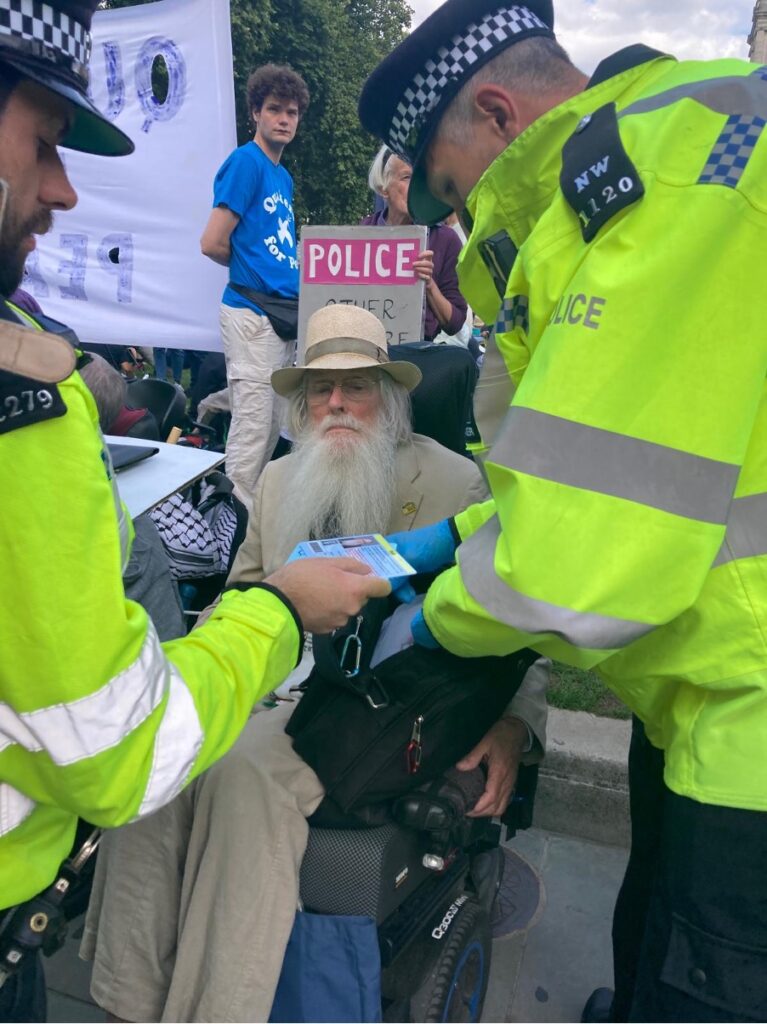
The police nipped at the corners of the sit-down, carrying people away one by one. Everyone I saw being arrested was either old or disabled. One eighty-something-year-old lady getting bundled into the police van was wearing adult diapers under her stretch pants — it can be a long bathroom-less wait in the van —another man who was being carried away horizontally wore an eye patch, and his bald skull was covered in ear-to-ear scars. I spotted Mike Higgins, a blind man in a wheelchair who had already been arrested in last month’s sit-in and was about to get arrested again.
A chorus of « We Shall Overcome » rose across the lawn, the voices high and piping.
Protesters who couldn’t afford a terrorism charge, foreign students who might get deported, or others who possibly didn’t agree with Palestine Action’s methods but opposed its banning, held up banners opposing the genocide, or posters with names and photos of children killed in Gaza. There were people carrying signs which would be outlawed in Germany because they included the words « From the River to the Sea, Palestine Will Be Free, » but which apparently in Britain are okay.
One popular alternative to the proscribed message — a resurgence of 1968-style Situationist playfulness: « I support Plasticine Action. »
When midnight fell over Parliament Square — by which time I was long home — 890 people had been arrested and were facing charges under the Terrorism Act, in what was being described as one of the largest acts of mass civil disobedience in British history. An astonishing number of them were over sixty-five.
There were reports of police feeling ill-at-ease with their day’s work. One anonymous officer complained to a journalist from Novara Media, « Instead of catching real criminals and terrorists, we are arresting pensioners and disabled people calling for the saving of children’s lives. My father was an officer, and the reason I came into the police. I know he would be ashamed and turning in his grave if he saw what I did. »
