


On 21 August, Forensic Architecture, a London-based agency that investigates acts of state violence and lawlessness worldwide, released its latest project — a 161-page report entitled « The Architecture of Genocidal Starvation in Gaza ». The next day, the United Nations declared that Gaza had officially entered a state of famine. Since October 2023, the FA team has been monitoring Israeli actions in Gaza, continually updating FA’s « Cartography of Genocide », and preparing evidence in support of South Africa’s case before the International Court of Justice charging Israel with genocide. We spoke to Nour Abuzaid, senior researcher at FA and herself born in Gaza, whose specialty is creating computational models and tools that can then be taught to activists and researchers on the ground. I asked her about the man-made famine and the Israeli government’s shifting plans for the deportation of Gaza’s surviving residents. The following are my handwritten notes from our communications via video call and email.
Nour Abuzaid: « At Forensic Architecture we have created the infrastructure to monitor Gaza day by day, studying all the changes visible on the ground. It wasn’t easy to find ways to document and analyze thousands of attacks from open-source videos and satellite images. The metadata is removed when a video is posted online, so we go through a process of verification and geolocation for every piece of footage to reconstruct the time and place where an attack took place and cross-reference that with other sources. We mapped every evacuation order, the shifting boundaries of the so-called ‘humanitarian zone’ and Israeli attacks within it. In some cases, we used 3D modelling to reconstruct in detail the space of the attack and use these techniques to cross-check Israeli claims about the trajectory of a missile that hit a hospital or the bullets that killed an aid worker.
We monitored multiple emerging patterns of violence, including the destruction of medical infrastructure, displacement, and attacks on aid. Right now, the weaponizing of aid is becoming more evident, as is the use of starvation to destroy social order and force the displacement of a people. The civil order is clearly collapsing in Gaza; it’s very hard to watch, the levels of desperation to which Palestinians are pushed with this engineered starvation. »
Forensic Architecture is engaged in multiple long-term investigations of worldwide atrocities, both historical and present-day, but Israel/Palestine remains a prime focus. FA’s latest report examines the two models of aid coming (or not coming) into Gaza since March 2025 — the « civilian model », represented by the UN and various long-established charities and that of the new US-backed Gaza Humanitarian Foundation (GHF), an organization run by a former CIA officer in conjunction with the Israeli military.
Since its invasion of Gaza, Israel has been trying to shut down the UN model, discrediting its agencies as Hamas-infiltrated, and assassinating both aid workers and aid seekers. In March 2025, Benjamin Netanyahu blocked all goods and supplies to Gaza, saying that they were being stolen by Hamas — an accusation that was part of Israel’s rationale for breaking the three-month-old ceasefire. Shortly before Nour and I spoke, the New York Times had published a piece in which Israeli military officials acknowledged that there was no evidence that Hamas had systematically stolen UN aid — in fact, they said, « the UN aid delivery system…was largely effective. » (A US report similarly concluded that there was no widespread Hamas control of incoming aid, and that the UN system was « relatively reliable. ») Nonetheless, it’s GHF that remains in place.
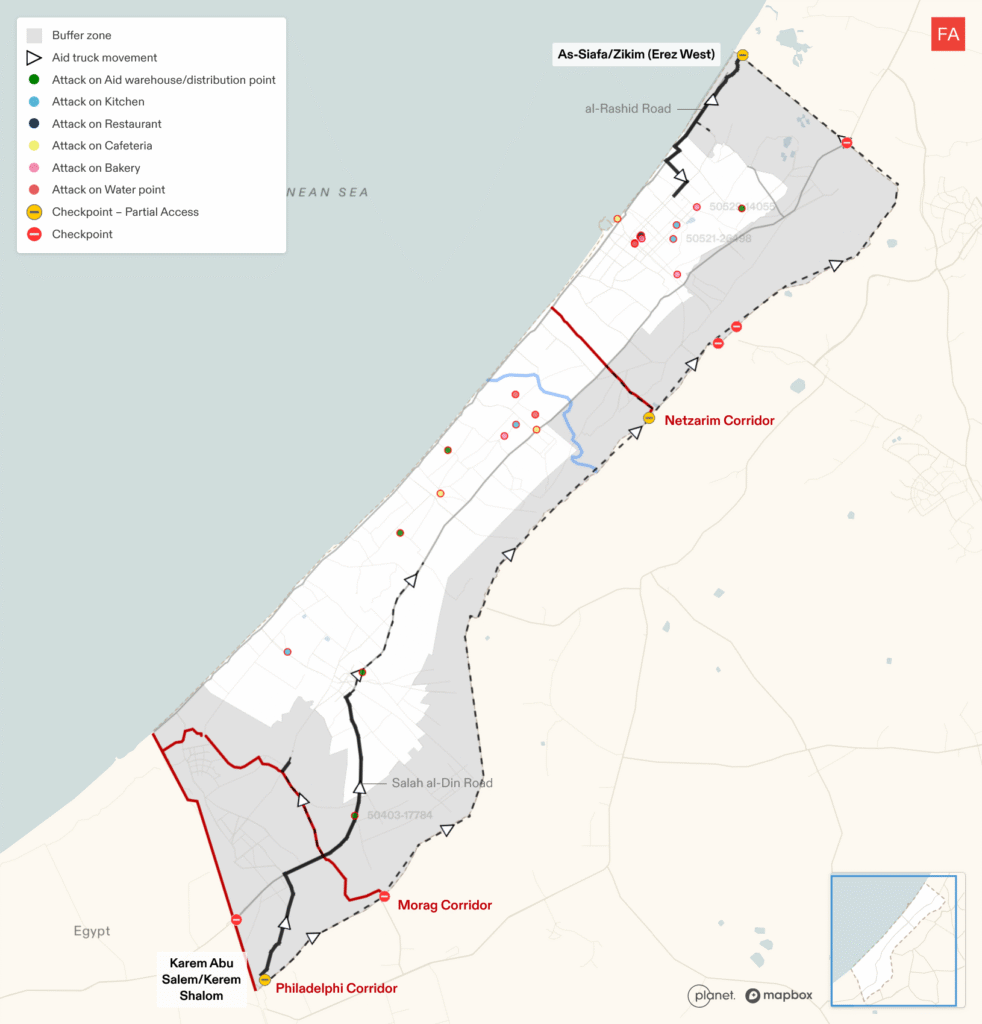
Abuzaid: « The Israeli military has brought about the dismantling of the civilian model of aid distribution, both by restricting the amount of aid entering through it, and by preventing attempts to protect aid convoys. The civilian model, led by the UN, operates well when aid supplies are sufficient. Aid convoys would travel to more than four hundred warehouses and distribution centers across Gaza, and people trust that aid will be delivered to them where they are. When food and supplies are scarce, anxiety over food security increases. Out of desperation, many civilians start waiting along truck routes, they camp out on Salah al-Din and al-Rashid Roads along the routes taken by the trucks and intercept them. The scarcity of commodities makes their prices high in the market, and this also encourages thieves and gangs to intercept aid trucks. The encounter between gangs and desperate civilians means the most vulnerable parts of the society can’t ‘compete’ for aid.
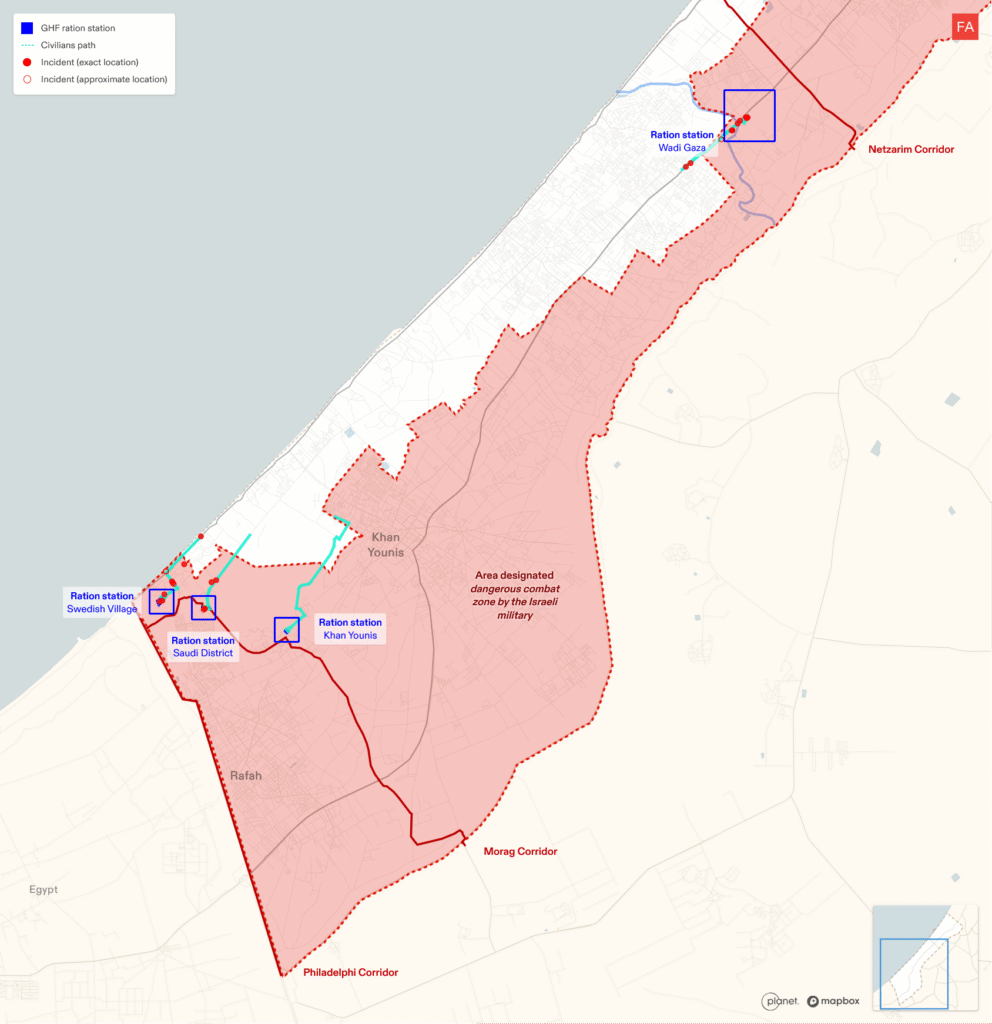
It’s important to say here that the Israeli military attacks the crowds gathered around aid convoys. Many civilians seeking aid are killed there as well as at the GHF stations.
Many cases of aid diversion that we verified have happened within Israeli military zones, in some cases by Israeli-backed militias like the Abu Shabab group. These gangs are not attacked by Israel as other groups are.
Under these conditions, protecting aid convoys becomes essential to ensure equal distribution of limited supplies. However, Israel has consistently targeted the local police and volunteers protecting aid convoys. Local police are also targeted while attempting to chase thieves looting warehouses or markets. In one case in June in the Deir al-Balah market, witnesses reported that members of the police had been distributing bags of flour they’d confiscated from gangs and corrupt merchants who were reselling aid. They were targeted by an Israeli strike that killed several of them, along with civilians who gathered around them to get some flour.
The repetition of these incidents and the sequence of events described by local sources surrounding other cases that we verified suggest a kind of coordination between gangs and the Israeli military, where Israeli attacks target police forces while those forces are chasing thieves. With the police unable to operate, members of civil society in Gaza have tried to coordinate and protect aid convoys. And here it is important to understand the clans as a main component of Gazan society. They are members of extended families that include several hundred and sometimes thousands of people. The clan structure works as an informal network that resolves disputes, they are affiliated with different Palestinian factions, and they can be powerful political actors with access to arms. Since the 1980s, Israel has tried to mobilize clans in the countryside, forming something called Village Leagues to undermine the urban Palestinian leadership — the Palestinian Authority in the West Bank today is a more developed example of the Village League model.
Following multiple cases of the diversion of aid trucks entering from the Zikim crossing in northern Gaza and the killing of dozens of desperate civilians seeking aid there, the clans in Gaza attempted to protect both the aid convoys and people. In late June, the clan leaders issued a video statement instructing civilians not to wait along the truck routes and warning thieves not to attempt to approach the convoy as members of the clan will protect these convoys until they reach the warehouses. FA followed the movements of the trucks that entered from the Zikim crossing on 25 June. We geolocated videos of the convoy the clans protected, all the way until the trucks reached two warehouses in Gaza City, one for the World Food Programme (WFP) and another for American Near East Refugee Aid (Anera). On 26 June, we verified footage of an orderly aid distribution operation from these warehouses, with no casualties, in a successful attempt by society to organize itself. The day after, the Israeli government closed the Zikim crossing, claiming that Hamas had stolen the aid. A senior Israeli politician shared a video of the armed members of the clans protecting aid, claiming these armed individuals are Hamas. We have documented multiple incidents where Israeli officials refer to any armed person in Gaza as Hamas, whether they are members of clans organising aid convoys, or gangs taking control of aid trucks.
Closing Zikim crossing after the successful attempt to deliver aid by the clans is not the first time that civil society in Gaza was punished for attempting to organize and protect aid. Last year, on 17 March 2024, members of the clans worked with the police to protect aid convoys coming from the Netzarim Corridor. Similarly, many civilians waiting for aid then were killed by the Israeli military, including in the incident known as the ‘flour massacre’. The clans and police managed to protect aid convoys on 17 March 2024 until they reached warehouses in Jabalia in northern Gaza, it was the first time aid had reached Jabalia in two months. The next day, on 18 March 2024, Israel raided al Shifa Hospital and assassinated Faiq al Mabhouh, a chief of police who was reported to have coordinated the previous day’s distribution with the clans.
These attacks represent an active attempt by Israel to destroy the civil institutions that govern Gaza, including the police, with the justification that they are Hamas-affiliated, and reaching out to other actors to fill the gap, like the Abu Shabab group. Israel does not follow international humanitarian law in making the distinction between combatants and non-combatants. Police forces should be treated as civilians in this context.
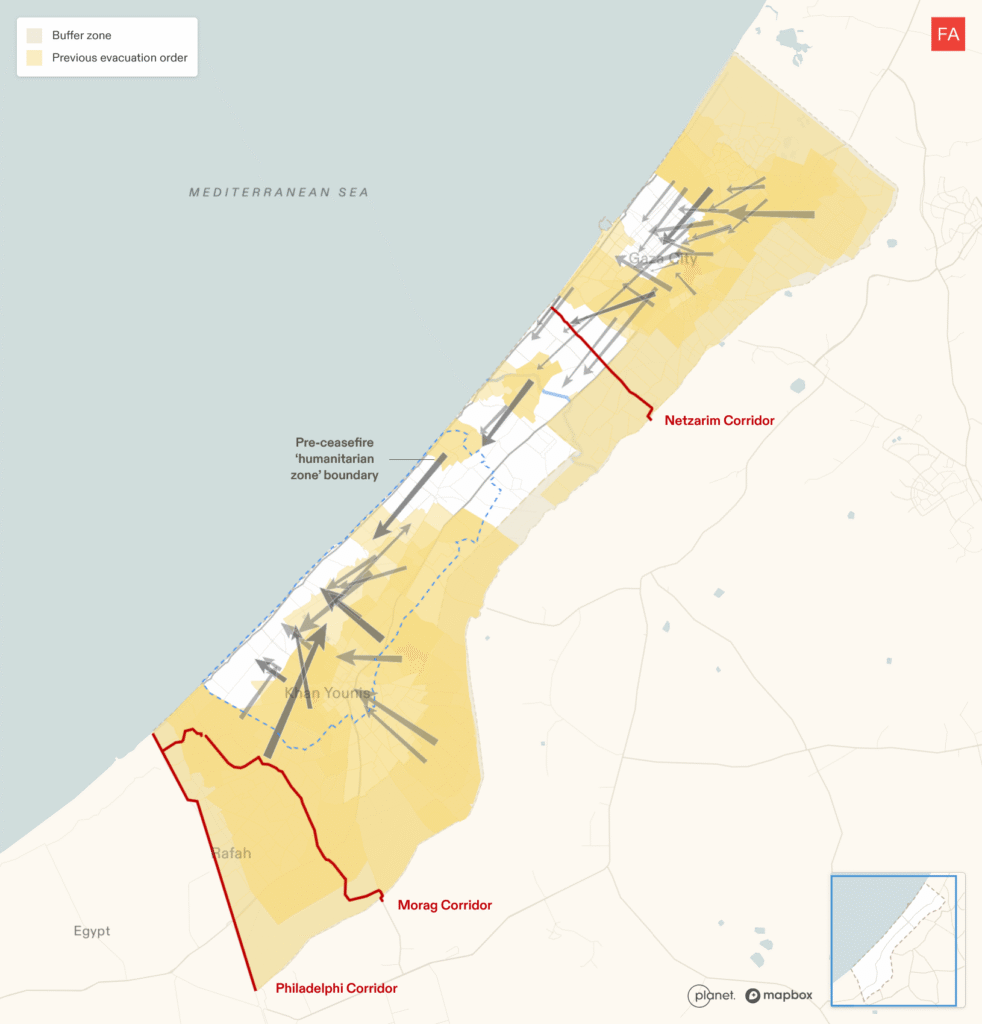
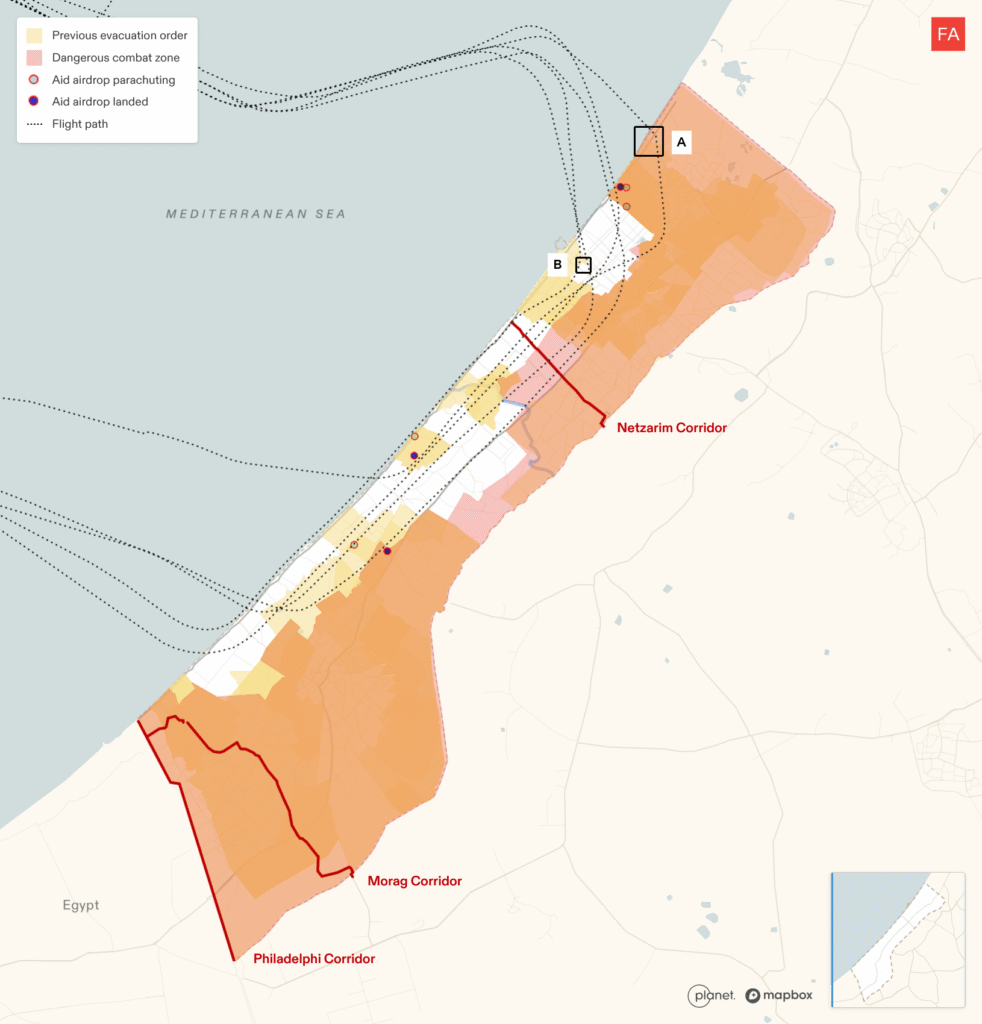
Starvation in Gaza today is used to destroy civil society and also to enforce displacement. From October 2023, there’s been a clear effort to push Palestinians in Gaza from north to south, to the Egyptian border. Israel has been trying to empty Gaza City, making it a no-go zone. And we see how aid is being weaponized as a tool for population transfer, including by now placing the GHF centers only in south Gaza to enforce this southward drive. »
Nour Abuzaid shows us one frame from FA’s investigation: a map of GHF’s ‘ration stations.’
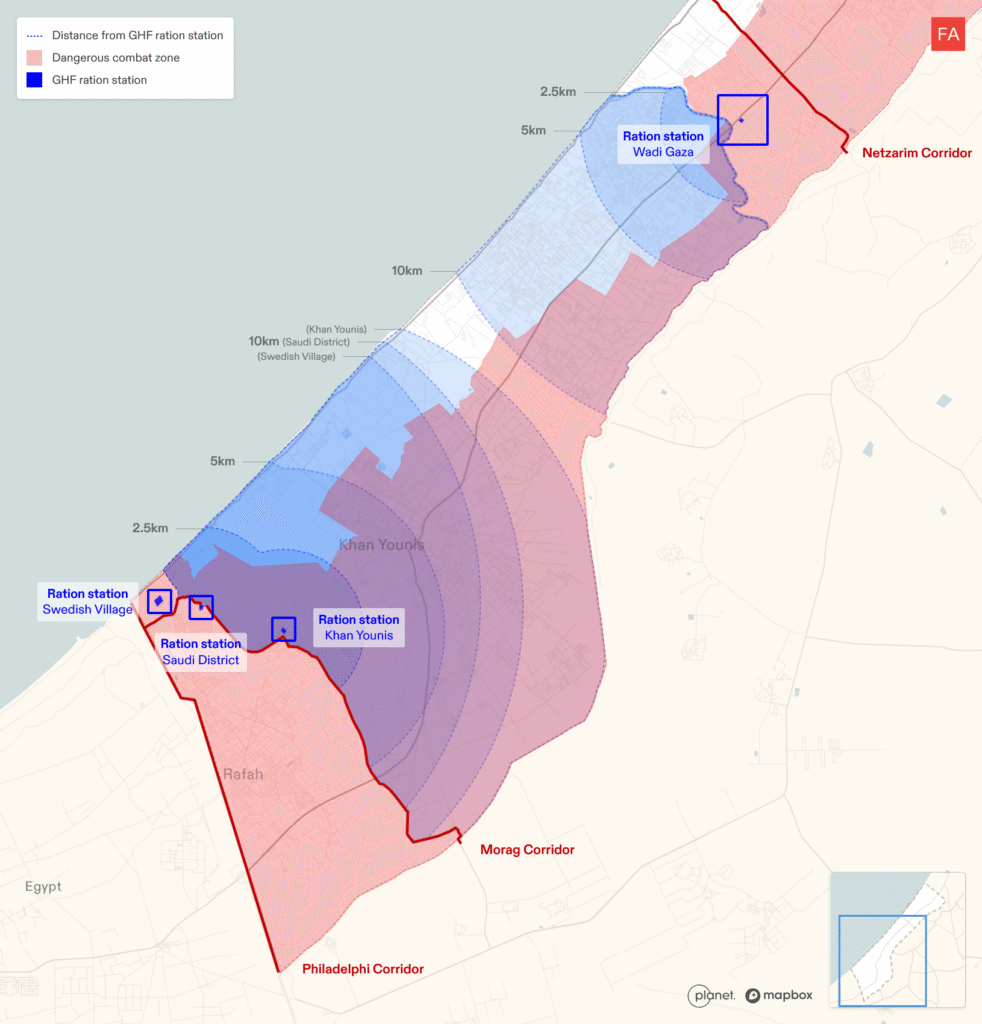
Abuzaid: « Alex de Waal, [director of the World Peace Foundation and an expert on famine] in his work on starvation in Gaza, explains the difference between aid and food ‘rations’, where aid includes shelter, medical supplies, clean water, and fuel, along with foods specially designed for starving children to digest. What Israel allows to enter Gaza today is rations of dry food that can barely sustain life, in an attempt to avoid the declaration of a famine. Look at the placement of the GHF ration stations.
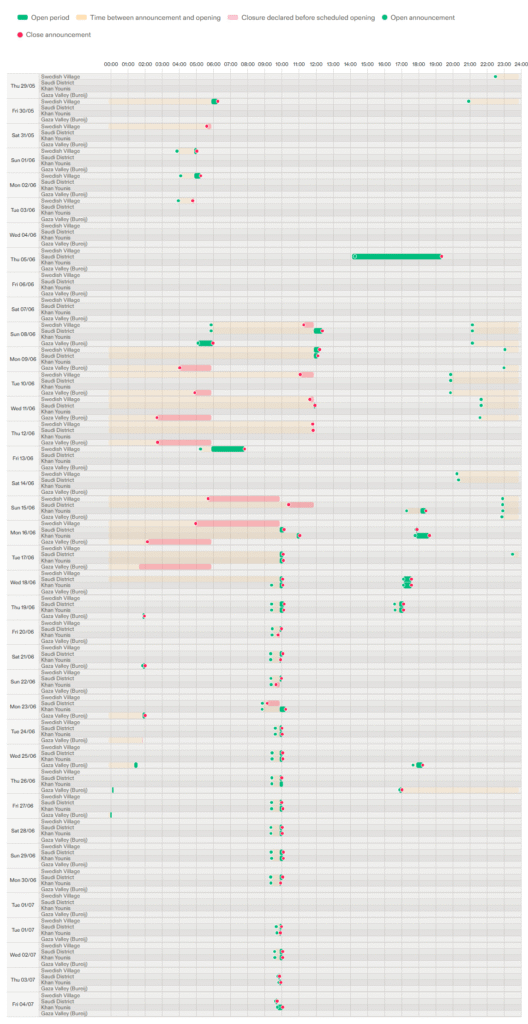
Before, under the civilian model, there were over four hundred locations for aid distribution all over Gaza. Now — when demand is many hundred times greater — there are only four stations to feed over two million people, all of them south of the Netzarim Corridor. One at Wadi Gazi, the other three way south in Rafah. All in Israeli military zones, along military roads. Six hours’ walk on foot. Forensic Architecture went to GHF’s Facebook page, examined its dataset of announced opening hours. We found that some openings were only for ten minutes; the average opening time was for twenty-three minutes; often they were announced to be closed again by the time their opening had actually been posted. »
One particularly chilling chart labelled « GHF stations are lethal spaces » includes videos of Israeli soldiers shooting aid-seekers, including an Associated Press video filmed at El Bureij distribution centre by a US contractor, in which a voice says « I think he hit one. » One what, you wonder? Another video shows an « orderly » example of Israeli-sponsored aid distribution. Here the distributor isn’t GHF, it’s the group known as ‘the Abu Shabab gang’.
Abuzaid: « Israel is always looking for Palestinian collaborators, enforcers. After the invasion, Israel tried to enlist the clan leaders in Gaza, but they refused, only some thieves and gangs agreed to collaborate. The relationship between Israel and local collaborators began early, pre-genocide. The Abu Shabab gang are ex-convicts, drug dealers, who have been hijacking civilian aid along a main road between the Morag and Philadelphi corridors. Now they are an official Israeli proxy, they have been given uniforms and weapons and renamed ‘Popular Forces.’
Abu Shabab issued this video and voice message, telling people from East Rafah to come back to the area, saying, ‘We have built these tents, you will have food and shelter.’ »
Nour Abuzaid screen-shares the video posted by Al Shabab of a lovely, windowed tent that looks more like the outdoor marquee at a wedding than standard refugee gear.
Abuzaid: « The tents were removed from the area soon after, I’m not sure how to understand it, apparently the tents were just set up for the photo-shoot to deliver the message: Israel is rewarding people who are not ‘terrorists.’
The plan has been to create one massive concentration city in Rafah. They talk about creating a ‘transit zone’ of two million people. Nobody is allowed out. [Israeli Minister of Defense Israel] Katz calls it a ‘humanitarian city’ that would start with the transfer of 600.000 Palestinians to a closed-off concentration camp in Rafah, with the long-term objective of incarcerating the whole population of Gaza there.
They didn’t succeed, didn’t finish it in time to receive all the displaced people; it’s a process of trial and error, testing things out, arguments between Netanyahu and the military. If there’s too much international outrage, you shift to something else—establish smaller concentration areas with people cut off from each other, not allowed to leave their camp.
This planned concentration area is something we are keeping an eye on. There are new satellite images every couple of days. Not full coverage, and one- or two-days’ delay, but they give you a good understanding. When a new satellite image comes in, we mine the data and annotate the maps — including red lines that are the expansion of military roads. »
On her screen Abuzaid shows us a recent satellite photo: a little red squiggle that represents the beginnings of…
Abuzaid: « …a new corridor running north to south, separating west of Khan Younis, including al-Mawasi from its eastern part. Already there are similar military corridors separating Khan Younis and Rafah. This new road has been appearing just in the last few days. On 20 July, there was a new evacuation order for people to leave Deir al Balah. We think it might be part of this back-up plan of creating smaller concentration areas. Are they building a military road to separate new ‘humanitarian cities’ they intend to make?
Displacing refugees over and over again is a continuation of the original crime of the Nakba [the mass displacement and dispossession of Palestinians from their lands in 1948]. Israel is now attempting to displace Palestinians from Gaza City, inhabited since at least the fifteenth century BC and today a refuge for hundreds of thousands forced to live in tents pushed steadily towards the sea. In October 2023, Israel first sought to evacuate the city, later imposing a siege on those who remained in order to starve them into leaving. Many returned during the ceasefire. The current tactic is a military siege on a starving population from three directions, flattening every square meter the army invades and turning it into a no-go zone — an endless cycle of killing, displacement, and starvation.
You cannot live with the images we are seeing, with the knowledge of what is unfolding before our eyes. We are watching the same exhausted, starving bodies caught between enduring brutal Israeli fire and facing yet another displacement — knowing that Israel will erase Gaza City as it has erased so many others before. I do not know how much longer this level of oppression can be endured. »
