
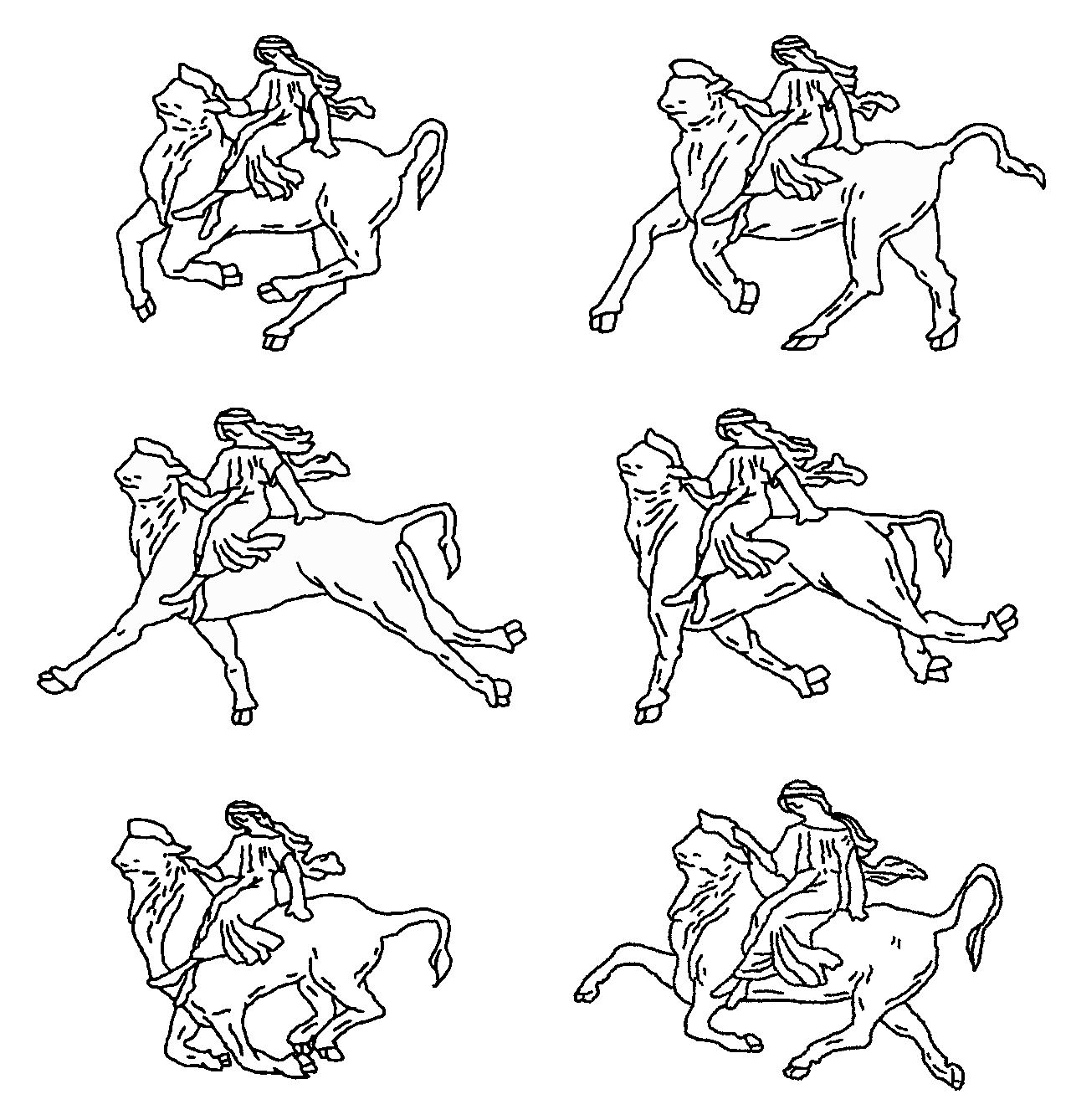

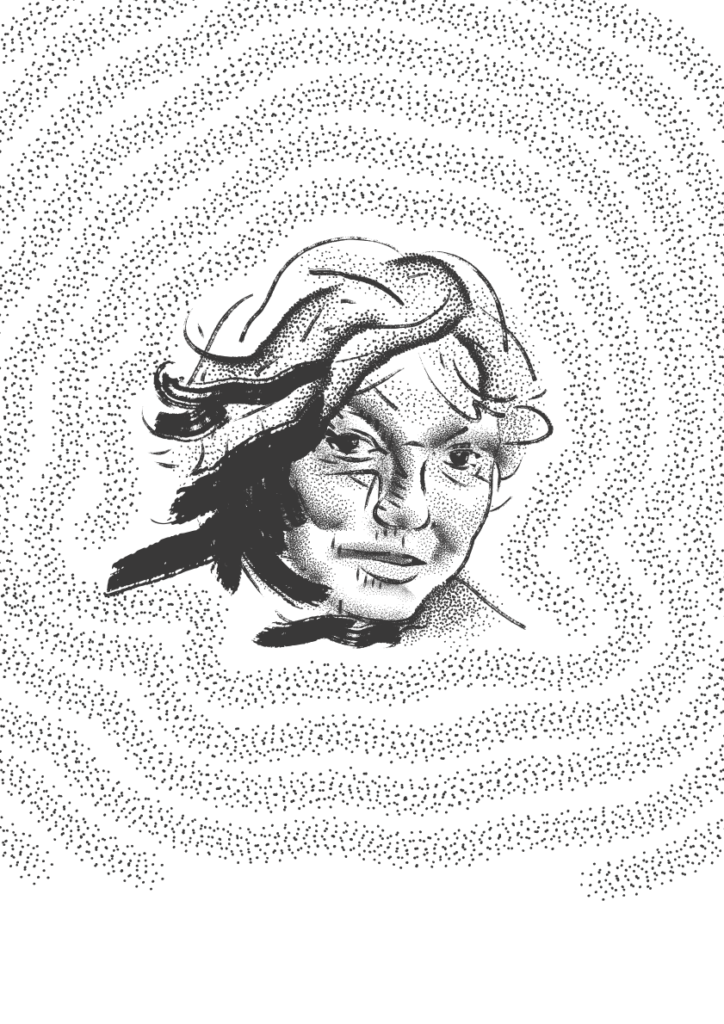
Inger Christensen (1935 – 2009) was a wholly original and experimental writer from Denmark, who wrote prose, poetry and essays. She won major European literary awards and was often named a Nobel Prize candidate. Her novella Natalja’s Stories takes an unusual approach to the theme of migration: a narrator is told a story by her grandmother about her great-grandmother, who was brought to Russia from Copenhagen. When she flees Russia after the revolution, she dies, and her ashes are returned to Denmark. The story is retold over and over — in playfully different, surprisingly rhyming ways. What follows is the first chapter from the English translation by Denise Newman, published by New Directions in May 2025.
— There was once a woman who traveled all the way from Crimea to Denmark so that she could bury her mother. That’s how my grandmother always began the story of her life, for she loved to talk about herself in the third person as if it were something she had read about in a book rather than something she herself had experienced. She was born in 1887 on the outskirts of St. Petersburg in a large wooden house with a veranda painted blue, and a garden leading straight down to the river to a small pier with a white pavilion. The property was only open to the side facing the river; the other three sides were surrounded by a high garden wall, and all you could see were the tops of the fruit trees in the orchard.

But down in the village you could see the house’s fruity towers, which at sunset looked golden and edible. And even though it was said that gold was poisonous, many were hungry enough to feel envious.
My grandmother grew up in that house as the only child of Alexander Firenko and his wife Marie, whom he had abducted from Copenhagen so as not to return to Russia empty-handed.
On his journey home from studying the silk trade in Marseille and Lyon for many years, he had decided to spend what was left of his money on making Marie his wife.
He had gone into a fabric store on the city’s main street because he believed he could best assess a city and its people through something he knew. Here he noticed a young lady assessing the quality of the silk fabrics with a similar discernment. He approached her with a smile and gestures and not many words.
a roll of half silk, schappe, and bourette
After giving a little lift to a roll of half silk, schappe, and bourette, she responded by spreading out the pure silk one so they could really sense the many millions of mulberry leaves eaten and transformed into this more imperishable fabric. It would take years to wear out and the threads to show through, the way in autumn you can see through the veins of leaves.
They both marveled at how the silk shimmered and draped, its mirror reversals from front to back between the matte and shiny side, and they carried it over to the window, in fact, they went outside, all the way out into the street, in order to judge its color in the daylight. Even though it was black, they both knew not all blacks are the same and that it would fade either toward brown or blue. And they preferred blue, because Marie had a wilderness of blue-black hair and skin with the same raw fineness of unglazed, factory-made porcelain.
— Where should we send it? asked the clerk, looking at Alexander Firenko, who pretended not to hear anything because he was lost in his thoughts.
— Thank you, but we’ll take it with us, said Marie, picking up the package by the little wooden handle that the clerk had attached to the cord. Firenko got the bill and paid. And when they were standing out on the street, he took Marie’s arm, pretending to lead her home. The next day they were married and on their way to St. Petersburg.

Marie had in fact led her Russian back home to Villa Elba, which bordered Frederiksberg Garden. It was autumn, and the garden path was covered in a dense carpet of wet leaves. Firenko could smell snow and thought that he would remember the leaves’ colors and use them for a tablecloth made of silk. He would place that tablecloth on the veranda table, and on a high-backed chair he would place Marie, and there she would sit embroidering all winter, and once in a while she would look down at the river that was frozen solid, and in the spring her longing would recede little by little. In the summer and autumn, she would consider herself lucky to have been abducted and destined for such a beautiful and peaceful life in the Russian countryside.
The Russian countryside. That was the expression my grandmother always used when she told her story. — There was once a woman, she said, — who traveled all the way from Crimea to Denmark so that she could bury her mother. And she did it because back then her mother, who was named Marie, had been in great distress and therefore allowed herself to be abducted from Copenhagen by a lovestruck Russian who had taken her with him to the Russian countryside.
The fact that the abduction took place was the result of circumstances that my grandmother always called lucky, happy, and fruitful. For that evening when Marie led Alexander Firenko into Villa Elba, she was actually many weeks pregnant by a gardener from the Frederiksberg Garden.
He was called Long, not because he was especially tall, but because, overall, there was something elongated about him. Including his face and his nose, his arms, hands, and nails. Every inch of his body had the same general elongated quality. But just as a weeping beech propagates in the same way as an ordinary beech, Long had the same effect on women as if he’d been tall and slender or, for that matter, short and compact. In fact, maybe his effect was even stronger because women were so unprepared for it and because his body over theirs felt like a protected space, similar to the cave found under the weeping beech’s branches.
It was after her visits to that cave that Marie discovered she was expecting a child, who’d later become my grandmother, and who, on the very evening that Firenko traveled through Copenhagen, needed another father, in place of Long, who already had a wife and plenty of children.
When Marie bade her Russian guest into the living room of the Villa Elba, she intimated that her parents were not home.
She pointed to the large painting over the fireplace of General Theophil Petersen and his wife on a mountain trek in the Alps. It was her job as the housemaid to dust it off every morning so that the snow on the mountaintop would remain white. She thought it was lucky that she had the same last name as the general. Maybe she didn’t need to ever tell Firenko that the wonderful couple with chins lifted toward the alpine sky were only her masters, whomshe was forced to wait on hand and foot around the clock. Whereas her own parents were long dead and buried. No, she probably never had to tell Firenko, because he let her know with gestures and caresses that she looked exactly like her mother. The same pale skin, the same broad mouth, and the same blue-black silky hair. He ruffled it a bit and kissed her on the nose.
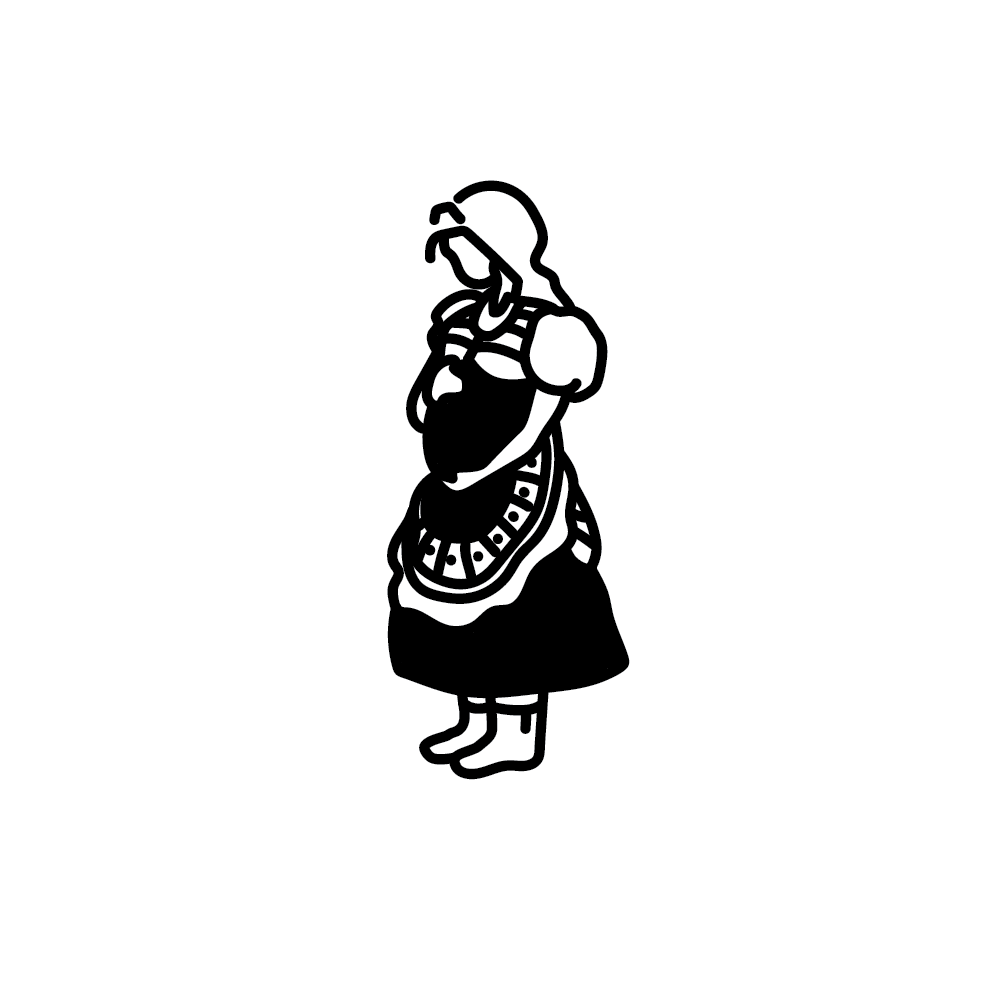
— And the next day they got married, added my grandmother always at this point in the story.
— And soon after, they sailed to St. Petersburg, where Firenko’s family, who belonged to the landed gentry, welcomed them warmly and gave them a large property on the outskirts of town. That’s where their only daughter was born, in May of 1887, and they named her Natalja.
I imagine the past was becoming clearer for her because she was done thinking about the future.
Gradually, as time went on, my grandmother embellished the story, and every time it was told, new details were added. I imagine the past was becoming clearer for her because she was done thinking about the future. I also think that she finally gave up hiding things from me because she’d rather divulge them than take them to the grave.
Basically, it was as if she were trying to make her entire life disappear into the story. As if she thought it would be best to get it all out of her body before she died. But new riddles, new people and incidents, continued to surface, and so she had to keep beginning the story over again.
— There was once a woman named Natalja Alexandrovna who traveled all the way from Crimea to Denmark so that she could bury her mother. She did it because her mother, who grew up in a working-class family near Skive and was named Marie Petersen at her baptism, wished to be buried in the same place where she was born.
That’s how my grandmother always began her story about how her world fell apart during the Russian Revolution and how she had to flee up through Europe to Copenhagen without bringing anything more than an old travel bag, which was made by Schwerin on Pile Street and which her mother had taken with her to St. Petersburg when she let herself be abducted by the young silk trader Alexander Firenko.
This travel bag for many years belonged to the general in whose house Marie had worked as a maid, General Theophil as he was always called, even though Theophil was just his first name. The bag was made to order for a handsome sum because it was an exact copy of a bag belonging to, by all accounts, Napoleon’s deputy.
At least old Schwerin claimed that he had seen the original at a private collector’s in Paris and there was evidence that the bag had been on the Russian campaign.
The copy had now similarly traveled to Russia and back again. Although, without the same contents outbound as homebound.
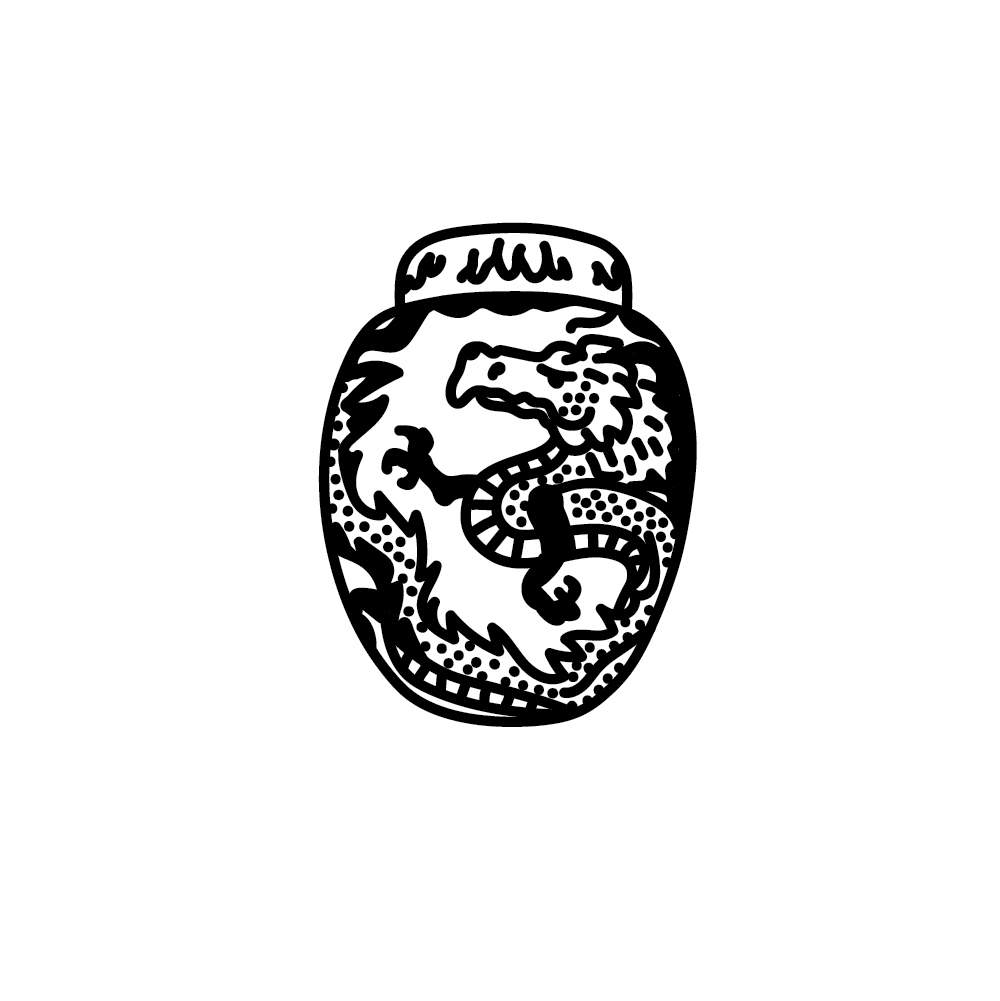
During the last years of her life, my grandmother raved about all the treasures her mother and Firenko had taken with them in their travel bag when they left Villa Elba. First and foremost, the general’s large coin collection, his pistols, and the bag of gold pieces he hid in his tobacco cabinet, along with an array of jewelry and silverware, and a Chinese crock, which Marie had cherished, one of those ordinary kinds with a lid, so useful in the household. A blue dragon twisted like a rootless tree across one side of it. Marie wrapped it in a piece of black silk, once purchased to sew a new blouse to wear while serving General Theophil’s guests.
When my grandmother died, I inherited the rest of the General’s treasures, his travel bag, and the piece of black silk, which my grandmother never had the heart to use.
The last time my grandmother told her life story, she began as she usually did.
— There was once a woman named Natalja who traveled all the way from Crimea to Denmark so that she could bury her mother in the same place she was born.
And then she went on to talk about how Czar Nicholas II was overthrown and there was civil war and famine all over Russia. And how her father Alexander Firenko was one of the first
to be killed because he didn’t grasp what was happening.
— That woman named Natalja, said my grandmother, talking about herself, — was still unmarried when all these events unfolded, although she was over thirty. That was because her father wouldn’t let her marry the forester in charge of the grove. His name was Boris and he came from one of the small brown wooden houses down in the village. Starting when he was a boy, he’d swim underwater to the small pier at the end of the garden to glimpse the large wooden house with many towers and a veranda painted blue. Natalja might’ve spotted him there and invited him up to the white pavilion. That’s how they became secret lovers.
— But when the Firenko family’s buildings and land holdings were confiscated, Natalja’s childhood home was also lost, along with the forest and Boris, who, it was believed, had become deranged from his yearlong affair with Natalja—here my grandmother continued talking about herself in the third person — and he was forced to marry an older cousin.
At this time, it became urgent for Natalja and her mother to flee south with the White Guard. They only managed to pack the old travel bag with a few valuables and the most important family documents.
— And then my mother insisted on bringing her old Chinese crock, said my grandmother angrily. — It was filled with lard and wrapped carefully in a piece of black silk.
By the time the two women managed to reach Crimea, they had eaten all the lard, and most of their valuables had been used to pay for food and drink. All that was left was a pistol, a few pieces of jewelry, and a half dozen gold coins. They worked as nurses at a field hospital to make their supplies stretch a little longer. That’s where her mother got sick and died from dysentery along with hundreds of others. In order to prevent the infection from spreading, the dead were all burned on bare ground. Natalja gathered up some of the ashes into the Chinese crock and started out on the long journey from Crimea to Denmark to bring her mother’s earthly remains back to where she was born, even though these remains were now mixed with the remains of all the others; even though Natalja could not be sure if she managed to get any of her mother’s ashes into the crock at all.
Along the way, she was often asked what was in the crock. Was it pickled ginger, or maybe blackberries with sugar and vodka, or was it sour cream, cheese, lard, or spices perhaps? Each time she laughed and said that it was a mix of everything.
She got in an accident on one of the many train lines. She had been sleeping for a long time and no longer knew where she was. Maybe in the Tatra Mountains, maybe somewhere else altogether. She asked the conductor where they were and if any trains went through the Tatra Mountains. He didn’t answer. Suddenly, it was as if the earth had disappeared under the train. She was flung into the air, where it felt like she was floating for an eternity before falling and striking her head on something hard. But during that eternity, she thought she was on her way down into a tall fern from the past where a black snail was signaling for help with its antennae until the paramedics came.
When she awoke, she was told that someone had found her unconscious, clutching her travel bag like in sleep when you wrap your body around the blanket, protecting it, even though it should be the other way around. She couldn’t remember anything. She couldn’t even remember that her name was Natalja. The only thing she could think of was the burial and the crock with the mixed ashes representing her mother. But she didn’t know where in the world she had landed, only that she now found herself in a room with seven people whom she’d never seen before. She sat upright in her chair, clutching the bag with the Chinese crock.

My grandmother couldn’t grasp what was going on around her. She thought the funeral might be underway. And perhaps soon she would be asked to present the crock. She searched her memory for her mother’s name. The priest was already deep into his sermon, and in a little while he would wave her over. She was afraid she wouldn’t get up at the right moment, and so, to be safe, she took the crock out of her bag and kept it on her lap. She stared fixedly at the blue dragon twisting like a rootless tree on one side of it.
After a while, as her hands warmed the porcelain and she started to calm down, she was able to follow what was being said and understood that the voice speaking did not belong to a priest but an antiques dealer. She put the crock back in the bag. She didn’t want him to think that she wanted to sell it.
Then, she realized that in a moment it would be her turn to speak. She couldn’t possibly remember anything. But, in fact, she knew a great deal by heart. And so, it was probably best that she started from the beginning.
— There was once a woman who traveled all the way from Crimea to Denmark so that she could bury her mother.
Then the rest would surely follow, and before she knew it, she would have arrived at the end.

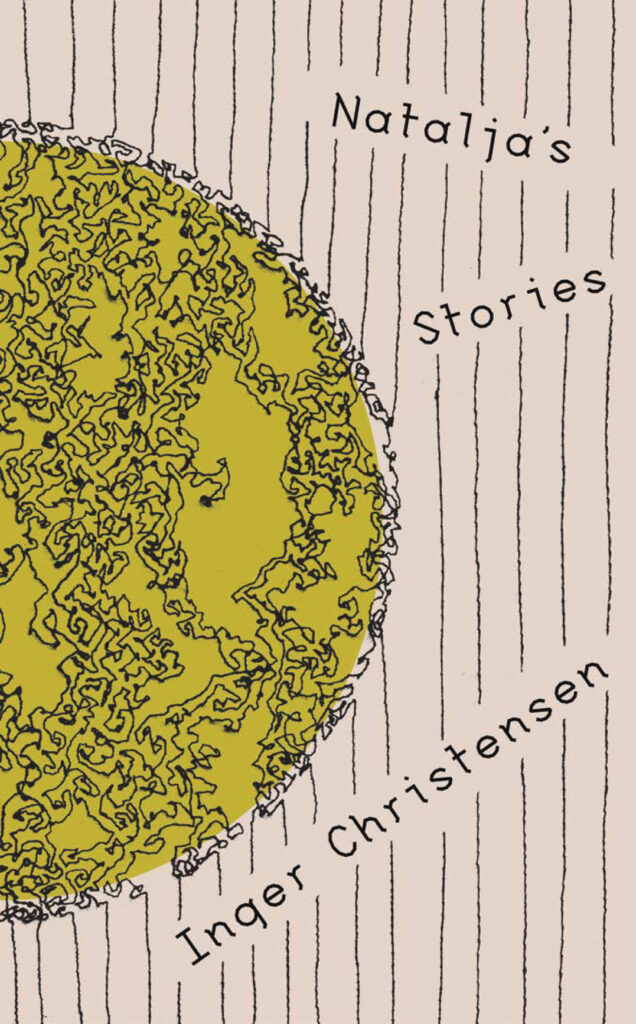
Natalja’s stories by Inger Christensen was translated by Denise Newman and is published in May 2025 by New Directions.