

What do we tell ourselves when all the trees simply vanish?
Thousands of The Hague’s oldest poplar trees were culled in 2020 by the municipal government, to protect pedestrians from the danger of falling branches. In my neighborhood, the first trees to be felled lived in a small, unnamed park lining a section of the Haagse Beek, a thin creek flowing from coastal dunes into city center. This was my Covid park, the place where my wife and I inhaled our fresh air during lockdown, where we played around photographing crocuses using the « nice » cameras, and where we spent countless hours observing herons and coots and moorhens — all of whom were indifferent to our artistic experiments and epidemiological worries.
The poplars, once their deconstruction started, did not disappear overnight. For days they lay in heaps of damp sawdust, their decaying branches beckoning armies of beetles, ants, and isopods who no doubt relished their good fortune. As a keepsake, my wife and I dragged a sizeable branch back to our second-story apartment and for the next three years it languished on our balcony — a musty, arboreal relic. The park, meanwhile, shorn of its grandest trees, looked bald and insipid, like it had weathered a course of chemotherapy.
We were not alone in our urge to commemorate local nature. Sometime during those chilly, unsettling weeks straddling March and April 2020, I stumbled across a homemade monument in a back corner of another local park, not far from a clearing where Nazi soldiers had once launched V-2 rockets. It was fashioned from a moldering tree stump that had been cut at a sharp angle at about hip height. Someone had taken a fat marker, the kind used for graffiti tags, and written on its surface, in large, fluorescent, cursive letters: N-A-T-U-R-E! Exclamation point! With a wreath of exuberant curlicues, glowing like a neon sign against dark mossy undergrowth. Thank you for this, it seemed to say. For this I am grateful. But also: What if something were to take this away from me?
This article is behind the paywall. Want to keep reading this article?
Subscribe to the European Review of Books, from as low as €4,16 per month.
Already a subscriber? Sign in
Thousands of The Hague’s oldest poplar trees were culled in 2020 by the municipal government, to protect pedestrians from the danger of falling branches. In my neighborhood, the first trees to be felled lived in a small, unnamed park lining a section of the Haagse Beek, a thin creek flowing from coastal dunes into city center. This was my Covid park, the place where my wife and I inhaled our fresh air during lockdown, where we played around photographing crocuses using the « nice » cameras, and where we spent countless hours observing herons and coots and moorhens — all of whom were indifferent to our artistic experiments and epidemiological worries.
The poplars, once their deconstruction started, did not disappear overnight. For days they lay in heaps of damp sawdust, their decaying branches beckoning armies of beetles, ants, and isopods who no doubt relished their good fortune. As a keepsake, my wife and I dragged a sizeable branch back to our second-story apartment and for the next three years it languished on our balcony — a musty, arboreal relic. The park, meanwhile, shorn of its grandest trees, looked bald and insipid, like it had weathered a course of chemotherapy.
We were not alone in our urge to commemorate local nature. Sometime during those chilly, unsettling weeks straddling March and April 2020, I stumbled across a homemade monument in a back corner of another local park, not far from a clearing where Nazi soldiers had once launched V-2 rockets. It was fashioned from a moldering tree stump that had been cut at a sharp angle at about hip height. Someone had taken a fat marker, the kind used for graffiti tags, and written on its surface, in large, fluorescent, cursive letters: N-A-T-U-R-E! Exclamation point! With a wreath of exuberant curlicues, glowing like a neon sign against dark mossy undergrowth. Thank you for this, it seemed to say. For this I am grateful. But also: What if something were to take this away from me?
Gratitude and anxiety were common companions. On the return leg of a long-awaited cycling holiday to Germany, I grew obsessed with how dry the landscape had become. Hillsides of brittle conifers turned ashy in the sun. Pastures bleached to straw. And the Rhine dribbled where it should have flowed. When my wife and I returned to The Hague, we found that the city trees were as dry as their country cousins, as though a house sitter had forgotten to water them in our absence. The palmate leaves of the chestnut trees, browned at the edges, dropped to the ground like it was November instead of August. Was it the heat? The drought? An infestation? The poplars’ expiration had been orderly, at least. And they had grown old. The chestnuts, by contrast, seemed destined to expire before their time, their darkening leaves an omen of general devastation to come.
One part of eco-anxiety is the disorienting realization that the tools we use to make sense of the world — calendars, maps, narratives, numbers — no longer make any sense themselves. And how could they? Unprecedented times, we’re told. Or: deep, deep precedent. The last time the atmospheric concentration of CO2 was as high as our current 425 parts per million was sometime during the Pliocene Epoch, roughly three million years ago. But there is a loneliness to comparisons on such a vast scale. How can they be anything other than an abstraction? How can they help us think about how to live? If climate change is a « hyperobject » — to use the philosopher Timothy Morton’s term for entities so vast, spatially and temporally, that they defy human understanding — perhaps it is natural to seek an antidote in the local, the finite, and the commonplace. And what could be more local, finite, and commonplace than an ordinary street tree?

You’re reading this essay for free. With a membership, you can read the full magazine, and you get access to our fabulous Library.
Become a member and get Issue Ten in print as your first magazine, right to your postbox.

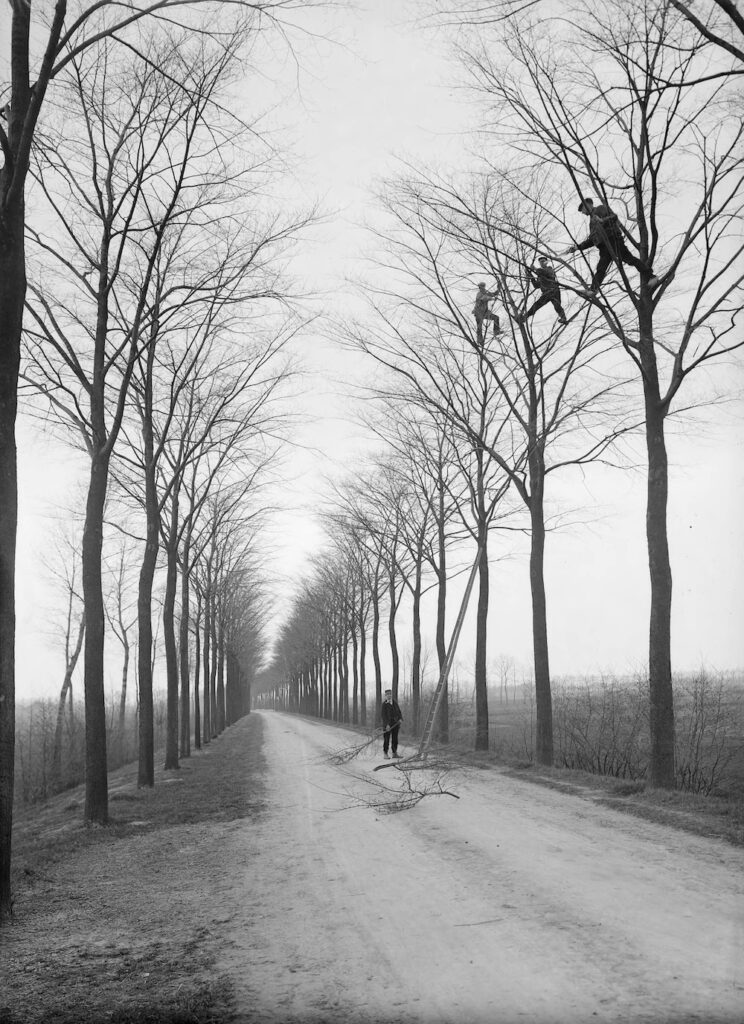
Elm trees grow rapidly and easily in sand, clay, peat and chalk: in short, in all the characteristic soils of the Netherlands. And because they tolerate the bracing squalls of a low-lying, sea-facing country, they were once widely used as windbreaks both for country roads and for the grandiose driveways of landed estates. In the nineteenth century, elms could be found along hundreds of kilometers of raised dikes, their roots used to fortify the embankments. City planners favored them because they could withstand not only smoke and exhaust fumes, but frequent pruning — a must for urban trees. And they were simply beautiful to behold, with towering trunks and vase-like silhouettes. Writing about the universal appeal of Elm Street in North America (where nineteenth-century commentators believed Ulmus Americana to be far more attractive than European varieties), the historian Thomas Campanella has argued that the visual effect of street elms « delivered the elusive ideal of a rus in urbe — the countryside in the town. »1
That felicitous combination had been pioneered in the Netherlands. As early as the sixteenth century, The Hague was known internationally for its many gardens and tree-lined promenades, a development made possible by its comparatively low building density, thanks to the absence of city walls. But it was Amsterdam, growing in size and affluence in the seventeenth century, that is said to have invented the treelined urban thoroughfare in the modern West. In 1615, when the city expanded its borders, newly-dug canals were lined by the homes of wealthy burghers, and in the space between houses and water stood an innovation: rows of planted elms. The historical geographer Henry W. Lawrence locates this as the first recorded use, inside a city rather than beyond it, of « buildings, traffic, and rows of trees together as a unified spatial form, » the way one might encounter at a castle.2 In the centuries to come, the form would be widely applied both across the Netherlands and around the world.


Naturalis Biodiversity Center in Leiden, the Netherlands
Once established, it could be lost — and mourned. In 1919, as diplomats were meeting in Paris to hammer out the political and economic consequences of the Great War, the first diseased elm twigs began to arrive at Dutch plant pathology laboratories, submitted by concerned parks officials. A mysterious iepenziekte was causing leaves in the trees’ crowns suddenly to wilt and brown, a progression that could advance quickly and kill the tree in short order (although depending on the weather, it could also take longer). By 1920, the maladie des ormes was being reported upon in northern France and in Belgium. And by 1924, it had moved eastward into Germany, Switzerland, the Balkans and Poland; southward into Italy and Spain; and northward into Norway. By 1927, it had crossed the English Channel.
Given the importance of Ulmus hollandica to Dutch natural and built environments, considerable public work was necessary when the species began to falter. In 1925, the municipality of The Hague began to uproot hundreds of diseased elms each year, steadily diminishing what had once been a total of 18.000 trees. Utrecht lost over half of its 7000 elms by 1932. Delft, a smaller city with only 3000 elms, saw 1370 perish by 1936. Rotterdam sustained the greatest number of casualties. In 1920, it was home to about 30.000 trees in total, over eighty percent of which were elms — a risky monoculture. By 1933, almost two thirds of those trees were gone. The Dutch Forest Service, meanwhile, did its best to manage diseased trees in rural areas. Of the million or so elms lining Dutch dikes and roadways, some 700.000 either died or had to be destroyed.3

What is it like to live in a place where, in the space of just a few years, all or most of the tree cover simply vanishes? Sick trees spurred adventurous explanations: wrong, but poignant in their wrongness. In 1919, co-incident with the first sickly elms, the Netherlands’ first radio broadcast been aired from a private apartment in The Hague: a two-hour-long tour of the phonograph record collection of the Frisian engineer and inventor, Hanso Idzerda. Five years later, a Dutch newspaper ran the headline: « Death of Trees — Is Radio the Culprit? » It was not so strange, the article suggested, to imagine that the « enormous development of radio-electricity » was somehow related to the « mortality » of the elms. (Swap « radio » for « 5G » and it might have been written yesterday.) After all, radio and « rapid traffic » were both well developed in America, and there you saw dying trees (in this case, chestnuts), too. Other theories blamed the weather: the unusually cold summer of 1920, the drought conditions of the following year, the exceptionally harsh winter of 1923-24. Or was the problem grander? Motorized vehicles and their « incompletely burned gasses »; the shift from horse-drawn to electric trams and their « omnipresent electric cables ». In Rotterdam, it was leaking gasses from the local power plant. In Limburg, subsidence from coal mines. Some people faulted their neighbors. Working-class women who used the street as a place to discard their salted cooking water for potatoes — surely they had something to do with it.
Alongside urbanization was war. In France and Belgium, it was suspected that poison gas from the frontlines had suffocated bystander elms. In the Netherlands, the war years had necessitated the burning of cheap, highly polluting brown coal, and it was feared that this, too, could have led to the trees’ asphyxiation. One particularly eerie article condemned road builders for using sand dredged from the river Maas, because the Maas, flowing through the drainage area of the great battlefields, presumably had taken up blood and poisoned debris.
Alongside war was flu. Not a theory, but a metaphor. « After the people, now the trees », observed an article on Boomgriep (Tree Flu) in 1921. « And why not? They breathe with their leaves, and their roots draw both nutritious and harmful elements from the soil. » The Spanish Flu had killed more people worldwide than the Great War itself. Dutch neutrality aside, some 38.000 died — nearly twice as many as Covid’s toll.
Trees are not people — and yet. As the historian Patricia Faasse has pointed out, all that was modern, new, unfamiliar or undesirable was a source of suspicion when it came to dying Dutch elms. But there’s a deeper human-arboreal affinity that this history summoned. By confronting one form of suffering, one could grapple with another. By attending to the street tree, one could express misgivings about the street itself.

For the past fifteen years or so, professional historians have been trying to figure out what it means to practice their craft « in urgent times ». Following Dipesh Chakrabarty, author of The Climate of History in a Planetary Age (2021), some are rethinking the way we tell stories. The Anthropocene, as a concept, erases the distinction between « natural history » and « human history », and necessitates some experimental narrative-making, at once centering and de-centering human experience, mixing what Chakrabarty calls the « global » (a human construction, related to dynamics of capitalism and colonialism) with the « planetary » (a category emerging from Earth system science). Others are reconsidering why we tell stories. The Australian historian Andrea Gaynor puts it simply: « Environmental histories are needed now to counter dangerous and proliferating historical falsehoods, and to provide the insights and emotional fortitude we need as we face the escalating climate and ecological crises. »4 We need « radical remembering » to help us better understand the ideologies and systems that brought us here, and to recover roads not taken. Historians can also help us see that we — or at least the ancestors of some of the human « we » — have been « here » before.
The climate crisis generates a narrative temptation to go big. The stories can center on missed opportunities (Nathaniel Rich, Losing Earth: The Decade We Could Have Stopped Climate Change), villains you love to hate (Naomi Oreskes and Erik M. Conway, Merchants of Doubt: How a Handful of Scientists Obscured the True on Issues From Tobacco Smoke to Global Warming), or unsung heroines (Alice Bell’s Our Biggest Experiment: An Epic History of the Climate Crisis opens with Eunice Foote, the American feminist and scientist « who in 1856 first warned the world that an atmosphere heavy with carbon dioxide could send temperatures soaring, » though at the time, « no one paid much attention. »). The tone can be admonishing (Jared Diamond, Collapse: How Societies Choose to Fail or Survive), exasperated (Jaap Tielbeke, We waren gewaarschuwd: Over een profetisch milieurapport en wat we er [niet] mee deden — We Were Warned: On a Prophetic Environmental Report and What We [Didn’t] Do with It), or sagacious (Amitav Ghosh, The Nutmeg’s Curse: Parables for a Planet in Crisis).
These works manage to bring the vastness of climate change at least partially into view. But their very epic-ness leaves me curiously unmoored. « Global » and « planetary » notwithstanding, humans (as Andrea Gaynor’s interlocutors Katie Holmes and Ruth Morgan remind us) don’t live out their lives on a global or planetary stage. To « make the planetary personal, » readers need smaller stories, too: stories connecting us to place and community, to the ground beneath our feet. And sometimes those stories deliver no clear lessons, no neat divisions between heroism and villainy, but instead offer sidelong glances into other humans — imperfect, exasperating, enraging, endearing — who have both created and muddled their way through crises large and small.

The reason Dutch Elm Disease is called Dutch Elm Disease (in the English-speaking world, at least) is not because of the Dutchness of the elms or the disease, but because of a cadre of Dutch female scientists in the 1920s who led the way in explaining the disease’s etiology. Thanks to them, we now know that elm disease is caused by ascomycete microfungi, of which there are three recognized species. We also understand its disease cycle: the fungus invades and grows in the xylem, the vascular tissue which transports water and nutrients from the roots of the tree to its branches and leaves. In response, the elm produces defensive plug-like structures called tyloses that, together with the fungus, clog the xylem and halt the transport — which ultimately starves the tree. And finally, we know how the disease spreads. Although the fungus can travel underground via root grafts, a more dangerous transmitter is the elm bark beetle, which carries the spores of the fungus from one tree to another, often across considerable distances.
The scientific work that produced this knowledge was, by all accounts, heroic. Biology may have been more welcoming to women than other fields, but the pioneers still had to fight their way in. The author of the first scientific report on « An Unknown Disease Among the Elms, » published by the Phytopathological Service in Wageningen in 1921, was a forty-one-year-old woman named Dina Spierenburg, who had worked for years as a schoolteacher before enrolling at Utrecht University to study botany at the age of thirty-five. Spierenburg did not succeed in isolating elm disease’s causal pathogen; that was done in 1922 by Bea Schwartz, a twenty-four-year-old PhD student working under the wing of a professor named Johanna Westerdijk. But it would take years for the male scientific establishment to accept the young woman’s discovery. In 1928, another of Westerdijk’s students, Christine Buisman, confirmed Schwartz’s findings and further identified the fungus’s sexual form. A year later she won a fellowship to Harvard’s Radcliffe College, where she continued her work on elm disease and became the first person to confirm its presence in the United States. Other Westerdijk students created effective fungicidal treatments and developed interbreeding programs for disease-resistant elms.
It is easy to celebrate the leadership of a figure like Westerdijk. Known as « Hans » in everyday life, she had grown up in Amsterdam and dreamed of becoming a concert pianist before a bum arm led her to study biology as second best. In 1906, at the age of 23, she was appointed director of the Willie Commelin Scholten Phytopathology Laboratory, selected for her talent for fundamental research, but also for her willingness to accept the modest salary the private institution had to offer. In 1907, she took charge of the Centraalbureau voor Schimmelcultures (Central Bureau of Fungal Cultures), transforming its collection into one of the largest and most important in the world. And by 1917, with a joint appointment at Utrecht University, she became the first female professor in the Netherlands. Over the course of her career, she mentored some 56 PhD students, over half of whom were women.
It is also easy to celebrate the vrouwenhegemonie of Westerdijk’s lab, where men pursued degrees and found employment as assistants, but where female friendships and mentoring defined the intellectual community, and where women could practice science without having to prove or defend or even remark upon their womanhood. Patricia Faasse’s biography of Westerdijk is replete with descriptions of the legendary traditions that took shape under her watch. Each newly minted PhD planted a tree in a « Doctors’ Forest » that gradually expanded its territory behind the lab. (When Bea Schwartz graduated, she planted an elm.) Celebratory dinners were filled with music, song and laughter. International gatherings of botanists featured evening cabaret acts in multiple languages. And when a section of the Baarn facility was renovated in 1930, Westerdijk asked the stoneworkers to chisel her motto above the entrance door: « Werken en feesten vormt schoone feesten. » Loosely translated: work hard, party hard.
All of this makes for a moving story of plucky women in lab coats who, standing up to male ignorance, managed to save their nation’s most beloved tree. I would read and enjoy that book. I have read and enjoyed that book.5 But it also misses something I find important: an empathetic understanding — affection, even — for wild ideas about radio-waves and blood-soaked sand.

In his own foray into the urgent-times discussion, the American historian Paul Kramer proposes three « particular knacks » that his colleagues tend to be good for: « disrupting inevitabilities, digging out lost alternatives, and widening the horizons of empathy. »6 While historical writing about the climate crisis often mobilizes the first two capabilities, Dutch elm disease has me thinking about the third.
On the surface, a fungal infection spread by beetles a century ago seems unrelated to skyrocketing atmospheric carbon or the sixth mass extinction. It was an ecological crisis of a kind, though hardly on a scale comparable to the one we face today. But people of the 1920s were understandably distressed by the loss of their beloved elm trees, and they did not immediately know that humans were not primarily to blame. Many assumed, not unreasonably, that the trees’ fate was bound up with human arrangements.
There is consolation in getting to know — and taking seriously — other people’s not-knowing. The dangers to elms in the first decades of the twentieth century are distinct from the extinction threats looming over so many species in the first decades of the twenty-first — just as Spanish Influenza cannot be equated with Covid-19. But while our current predicaments may indeed be unprecedented (aren’t they always, in the end?), the human responses to them are not. Instead, they are remixed versions of responses that have come before, many times over, containing familiar elements of hope, fear, anger, hubris and loss.

You’re reading this essay for free. With a membership, you can read the full magazine, and you get access to our fabulous Library.
Become a member and get Issue Ten in print as your first magazine, right to your postbox.

What did the trees make of all this? Some of The Hague’s most striking arboreal witnesses can be found at Plein 1813, a stately public square named for the year that the Netherlands became free of French rule. Laid out in the 1850s as part of the first residential area to be built outside the city’s canal ring, the square occupies land that once served as a pleasure park belonging to King William II. At its center stands an enormous monument, the first stone of which was laid in 1863. At 22 meters high, it used to be the largest in the country. At its top is a bronze statue of the Nederlandse Maagd, the Dutch Virgin who, flanked by broken chains and an obligatory lion, symbolizes the restoration of national independence.
Of course the first trees planted there, in the 1850s, were elms, and by the 1920s they were considered monuments themselves. And like the other elms, they succumbed. Such arboreal treasures, the Hague’s municipal authorities knew, would need replacements that were more than mere saplings, and so in 1936 they transplanted chestnut trees, already twenty-five years old, from one of the city’s nurseries. Today, these are the most beautiful chestnut trees in The Hague. They feel substantial, regal, ancient, like they stand for something important. Strolling in their shade, I think of earlier pedestrians who might have engaged in anxious, misguided, or even preposterous theorizing about trees they loved, or even just trees they were used to. Like us, they struggled to understand the overwhelming forces of their own day. And like me, they sometimes projected metaphors onto the fragile green canopy above their heads.
But it would be a mistake to presume that these experiences are equivalent, or that the human-arboreal bond is static, everywhere always one and the same. By 1944, the chestnut trees at Plein 1813 were quite a bit taller than they were when they were first transplanted. Members of a fast-growing species, their crowns would have widened considerably, a progression that might have restored the square’s distinguished air were it not for the fact that the trees’ trunks were now wrapped in barbed wire during the Nazi occupation — a deterrent to any cold, hungry passer-by who, in possession of an axe, might try to make off with enough wood to heat a family home.


Naturalis Biodiversity Center in Leiden, the Netherlands
By this time, Anton Mussert, the leader of the National Socialist Movement, had moved into the neighborhood. Like the residents he displaced, he surely appreciated the stateliness of the square, and during the winter he probably looked forward to strolling under the chestnuts once spring came and the leaves returned. One wonders if he was glad that he got to live in such a beautiful, tree-lined place, even if that beauty was made possible by twisted spikes of steel. Or maybe he had no eye for trees at all. Either way, the chestnuts endured.
Other local trees — and people — were not so lucky. Tens of thousands of the city’s Jewish residents had been deported and murdered. Young Christian men between 18 and 35 were required to travel to Germany to carry out forced labor. And once again, The Hague was losing its tree cover at a rapid clip, though this time there was no mystery about the cause. From 1942, entire sections of the city’s human and arboreal neighborhoods had been plowed under to make way for the Atlantic Wall, a five-thousand-kilometer-long line of coastal fortifications that Hitler ordered to be built from northern Norway to Southern France. The Haagse Bos, the Hague’s largest forest, had been denuded to make way for tank lines. And of the trees left standing by the Nazis, many were chopped down by starving, freezing people, desperate enough for firewood, they risked their lives for it.
Times had changed. Trees once prized for their beauty had become a lifeline for a very different reason. Which metaphors did Hagenaars of the war years use to make sense of their predicament? And which metaphors will appeal to us?

- Thomas J. Campanella, Republic of Shade: New England and the American Elm (Yale University Press, 2003), 3. ↩︎
- Henry W. Lawrence, « Origins of the Tree-Lined Boulevard, » Geographical Review 78: 4 (1988): 359. ↩︎
- P. Bakker Schut, S.G.A. Doorenbos, and A. Schierbeek, Groen en Bloemen in Den Haag (Algemeen Vereeniging voor Natuurbescherming voor’s-Gravenhage en Omstreken, 1936), 45; S. Broekhuizen, Het raadsel der iepenziekte (Bosch & Keuning, 1936), 6-7; Nicholas P. Money, The Triumph of the Fungi: A Rotten History (Oxford University Press, 2007), 30. ↩︎
- Katie Holmes, Andrea Gaynor & Ruth Morgan, « Doing Environmental History in Urgent Times », History Australia 17:2 (2020): 234. ↩︎
- Dutch Elm Disease — The Early Papers: Selected Works of Seven Dutch Women Phytopathologists, translated and prepared by Francis W. Holmes and Hans M. Heybroek (APS Press, 1990). ↩︎
- Paul Kramer, « History in a Time of Crisis, » The Chronicle of Higher Education, 19 February 2017. ↩︎


